
New Report: Build Big
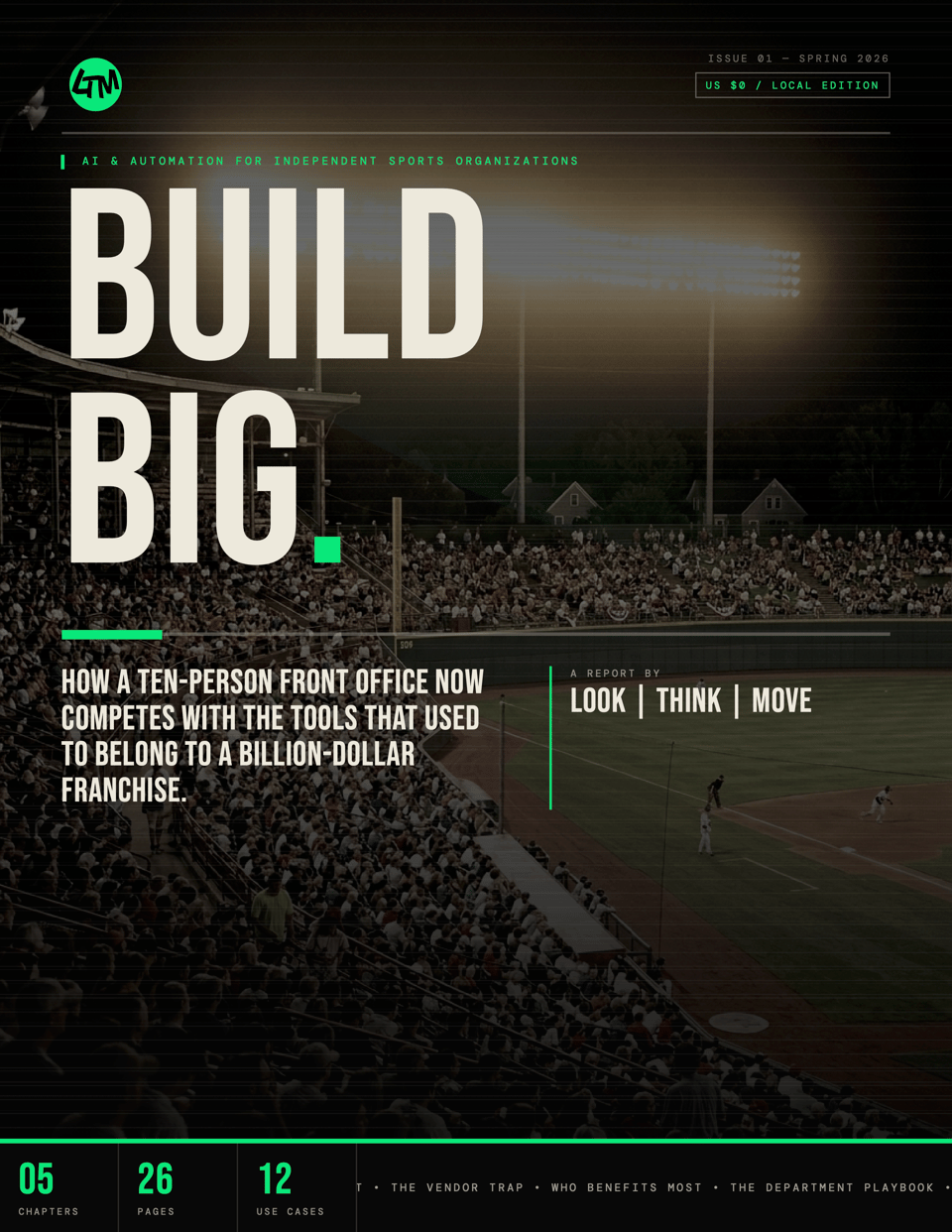
Build Big: The Report
--- I know, I know. It's been quiet around here. No excuses—just one reason: I've been heads down on something that actually matters. Something I've been wanting to build for a while. And it's finally done.
LTM has its first-ever research report. It's called Build Big, and it's about how AI and automation can fundamentally change the game for smaller-market sports organizations. Not tomorrow. Right now. You can download it here. Go ahead. I'll wait.
The Lie We Tell Small Orgs
Here's the thing that's been driving me crazy for a while now. Every time the sports industry talks about AI—the conference panels, the trade pub features, the LinkedIn humblebrag posts—the frame is always the same. The Premier League. The NBA. Formula 1. The organizations with nine-figure tech budgets, dedicated data science teams, and the kind of infrastructure that makes a small-market AHL team or a USL club feel like they're watching through a window at a party they weren't invited to. That framing is a lie. And it's a convenient lie for the vendors who want to sell enterprise-scale solutions to enterprise-scale customers.
But frankly, it's also lazy. Because the actual story—the one nobody's telling loudly enough—is the exact opposite. AI doesn't help the big orgs most. AI helps the small orgs most. Full stop.
Think about it this way. Johann Cruyff's Total Football didn't work because Ajax had more players than everyone else. It worked because it redefined what the players you had could do. AI is the same kind of force multiplier. Smaller market teams and niche leagues benefit most from AI-driven content automation—they can scale up their content output without scaling their budgets. Even organizations without massive media teams can now deliver high-quality content to fans, leveling the playing field in a content-hungry ecosystem. That's not a projection. That's happening right now. The big org with 40 people in their content department and a $3M tech stack? AI makes them marginally more efficient. The four-person front office running a minor league team or a women's soccer club on a shoestring? AI is the difference between punching at flyweight and punching at heavyweight. That's the unlock.
And "Build Big" is the manual for doing it.
What the Report Actually Says
I'm not going to summarize a 40-page report in four paragraphs and call it a newsletter. Go read it. But here's the animating idea: The conventional wisdom says smaller orgs can't afford AI. The cost of adoption is seen as a significant barrier for many sports organizations, limiting their ability to integrate AI technologies effectively. That line gets repeated constantly, and it was true — *past tense* — when AI meant buying a seven-figure enterprise software suite and hiring a team of PhD data scientists to run it. That world doesn't exist anymore. In the past, advanced sports analytics required expensive hardware, dedicated analysts, and large IT teams. But today, cloud-based AI solutions have changed the game. Whether it's a major football franchise or a small regional academy, organizations can now access powerful analytics tools without the burden of heavy infrastructure. This is the core premise of Build Big: the cost curve has collapsed, and almost nobody in smaller-market sports has updated their mental model to reflect that reality.
Smaller market teams or niche leagues benefit most—they can scale up their content output without scaling their budgets. Even organizations without massive media teams can now deliver high-quality content to fans. The report goes deeper: it maps out *specific* workflows—content, ticketing, sponsorship prospecting, fan engagement—where a small org can deploy AI tools today, with what budget, and what to expect. Practical. Opinionated. No sanitized bullshit. Boy, and I mean this: the orgs that read this report and act on it in the next 12 months are going to look very different from the ones who wait for permission from the industry consensus. The gap is opening right now. -
The Real Punk Rock Move
In a 2025 survey of 675 sports media professionals, 81% of executives said they had expanded their use of AI in the past year to improve efficiency and reduce costs. Teams that once dabbled in basic analytics are now investing in full-scale AI platforms for areas like player development, scouting, and fan personalization. Four out of five execs increased their AI use in just one year. Four out of five. So the big orgs are already running. The small orgs are still tying their shoes. You want to know what punk rock sounds like in sports business? It's a 12-person minor league front office deploying an AI content workflow that out-produces a mid-market team three times their size. It's a women's league club using automated highlight generation to build a fanbase in cities they've never even played in. It's a youth academy using AI video analysis tools—the kind that recording and analyzing matches used to make something only top clubs could afford, but now grassroots teams, parents, and schools are using AI-powered tech to improve training and help players get noticed. That's the revolution. Not the big keynote at the big conference. The small org doing the work.
Build Big is my argument that small is the perfect size for this moment — and that the only thing standing between most smaller-market orgs and genuine competitive advantage is the belief that they're too small to try. They're not. Download the report. Let me know what you think.