You're a Journalist, Bless Your Heart
Hello new subscribers! Thank you for signing on, and welcome.
We were putting the finishing touches on The News, Scene on Radio’s latest season, when I stumbled across a striking moment in a relatively obscure online video.
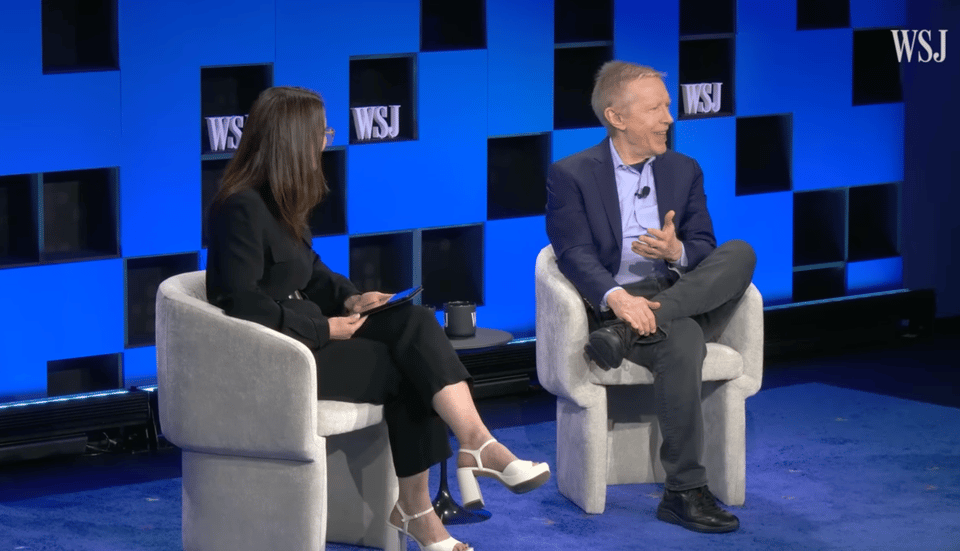
The video, offered up by my YouTube algorithm, was of an onstage conversation between Neil Howe, an author I wasn’t familiar with, and Janet Adamy, an editor in the Washington Bureau of the Wall Street Journal.
They were discussing Howe’s prediction, first made in a 1991 book he co-authored, The Fourth Turning, that the U.S. would go through an acute crisis in the 2020s. He now believes we’re more-or-less on schedule and that the worst of it, still to come, will include some sort of great power war and, in his words, “political collapse” in the U.S.
The latter phrase led Adamy to address the huge gray animal in the room. “We’re in very unusual political times,” she ventured. “A very…” — she hesitated — “um, uh, bold president that we have, with a disruptive agenda….”
“‘Bold’,” Howe said. He turned to the audience and gestured at Adamy as if to say: Are you hearing this? “I like that word,” he said, chuckling. Then came the kicker, as he turned back to Adamy: “You’re definitely a journalist.”
Ohhh, damn.
Adamy laughed gamely as if she were in on the joke, as if she wasn’t in fact being put to shame. This was a rare instance of an establishment journalist being called out, on the spot, for the reflexive normalization and sane-washing that’s been all too common in the mainstream media for a decade now.
To characterize Donald Trump — a chaotic, corrupt, lawless, authoritarian demagogue — as “bold”? That’s like saying the fairy tale Emperor, bare-ass naked in his new clothes, was making a daring fashion statement.
Howe’s line, “You’re definitely a journalist,” should be heard as an indictment by everyone in the news business — certainly those in the Washington press corps. He’s suggesting that only a journalist — or a fool, and Janet Adamy, the Journal’s Deputy Coverage Chief, is not a fool — would go to such lengths to avoid describing the president accurately.
Think of it: The very people whose job it is to tell the public what’s going on in the country have established themselves as a profession peculiarly, even singularly, unwilling to do so.
Oh bless your heart, you’re a journalist, Howe might as well have said.
Howe’s gentle teasing of Adamy was minor stuff, though, compared with the Washington press corp’s self-abasement with the do-over of the White House Correspondents’ Dinner. After the first attempt was cut short by a gunman, the White House Correspondents Association held its annual party last week and, as is the custom, invited the president to speak.
Yes, that president, the one who routinely calls reporters “fake,” “dishonest,” “corrupt,” “human scum.” The one who sues TV networks for reporting he doesn’t like and talks casually of stripping the broadcast licenses from outlets that annoy him.
Needless to say, Trump showed up and trashed the press (and many of his other enemies) in a caustic diatribe. “This is the largest gathering of people with Trump derangement syndrome,” he said, referring to journalists. “Fake news,” the “failing New York Times,” a misogynistic personal attack on CNN’s Kaitlin Collins — Trump played the hits as the Washington press corps sat nicely dressed and mostly stone-faced in front of him.
The WHCA went ahead with the event, despite Trump’s open hostility to an independent press, ostensibly out of respect for the First Amendment, tradition, and “the office” of the presidency.
But Margaret Sullivan, the former Washington Post media columnist and New York Times public editor, wrote that the journalists’ real motives for continuing with the WHCD charade certainly include a desire to maintain access to White House sources. Another reason to do the dinner? To please the media companies’ bosses, who, Sullivan writes, “wanted them to for reasons having to do with profits and commercial interests.”
Our Season 8 series, The News, wrapped up July 8. After spending a couple of years immersed in the history of journalism and its current crises, I’ve been asked what surprised me most. As with previous seasons, I came away with greater clarity about things I understood much more fuzzily before.
Following on Season 7, Capitalism, we knew this one would be about capitalism, too, at least in part. I remember saying as much in early planning conversations with Chenjerai Kumanyika, my co-host. Yet, even more than I expected, this turned out to be a core takeaway of Season 8: That America’s reliance on a corporate, for-profit journalism model is the structural flaw at the heart of our news and information system.
The history of news as big business helps to explain that hyper-cautious, above-the-fray “neutrality” exhibited by the legacy media. The profit motive also, of course, explains the media’s notoriously short attention span — its emphasis on the shiny new thing at the expense of the most important thing.
At the same time, the for-profit news industry is failing on its own terms, creating a different kind of crisis for journalism and for American democracy. Its century-old business model, built on advertising, has all but collapsed, especially at the local level — leading to the decimation of newsrooms and the loss of 75% of the nation’s local reporters since the turn of this century.
Certainly, reporters working at for-profit news organizations do a lot of excellent work. But unlike its rich peers, the U.S. has never supported a strong and sustainable public media system, and during Trump 2 the government cut off its paltry funding of public TV and radio altogether. U.S. policy puts few restraints on the corporate concentration of media ownership. It makes almost no demands on media outlets to serve the public good (and not just their shareholders’ wallets). These characteristics add up to “American media exceptionalism,” as scholar Victor Pickard puts it. And no, he says, we’re “not exceptional in a positive way.”
A news industry overwhelmingly grounded in commerce, one that depends for its success on getting maximum clicks and eyeballs — and keeping its corporate advertisers happy — is not truly independent, is it.
In The News we explore the above themes in much more depth — including how things got this way and how we might make things better.
Which brings me to my other big-picture takeaway from the season: That our national conversation about the news media is mostly quite dumb. Sure, there’s a useful discussion to be had about media organizations themselves and what they can do to better serve the public and regain its trust.
But there’s a whole other conversation we rarely have — about a robust news media as an essential public good that no functioning democracy can live without and which must be handled and supported accordingly.
Leaving ours to the for-profit marketplace isn’t working. So, what will it take to shore up the journalism we have, and to build a better and more durable media system — one that serves people and communities and democracy?
If only that were a topic of media coverage, and one that our politicians felt compelled to debate and to act on.
That’s my humble hope for our 8th season: that it might contribute, in some small way, to an enlivened public discussion about the state of American journalism. And how we can fight to make it stronger, freer, more accessible, and more democratic than it’s ever been.
*
Like this? Share Keeping ScOR with a friend by forwarding this message to them.
If you missed past posts, find the archive here.
-
Thank you for your work to tell the truth. It is refreshing, even though it’s bleak truth. I appreciate you.
-

Thank you, Amy.
-
I don't have anything to add to discussion, simply wanted to jump on to emphasize how much I appreciate discussion like this and not shying away on The News season or posts like these the ridicuclousness of the current political and media climate. Great post to read through
-
Thanks, Lauren!
-
Neil Howe's book is important to read and absorb. His scholarship and wider view of history is insightful and has helped me evaluate what is happening. The full title is "The Fourth Turning Is Here: What the Seasons of History Tell Us About How and When This Crisis Will End." I am facilitating a discussion group on this book starting in late September. We are also facilitating discussions on The News, Seeing White, The Land That Has Never Been Yet, The 1619 Project, plus others. Please contact me if you are interested in joining any of these or knowing more. And I'm glad Neil Howe called out the so-called journalist!
-
Thank you, Jody. Definitely interested to learn more about your discussion groups! Please message us at [email protected] and let me know how to reach you directly?
-
Thanks, John; well said. Just this morning my wife and I were discussing how we could become local journalists and create our own local news source. I appreciate your work.
-
Thanks for reading, Mike, and let me know if y'all launch that news outlet!


Reply: