being human
It’s been a welcome surprise to see people from all walks of life discover the pro-human lifestyle known as “modern Catholicism.”
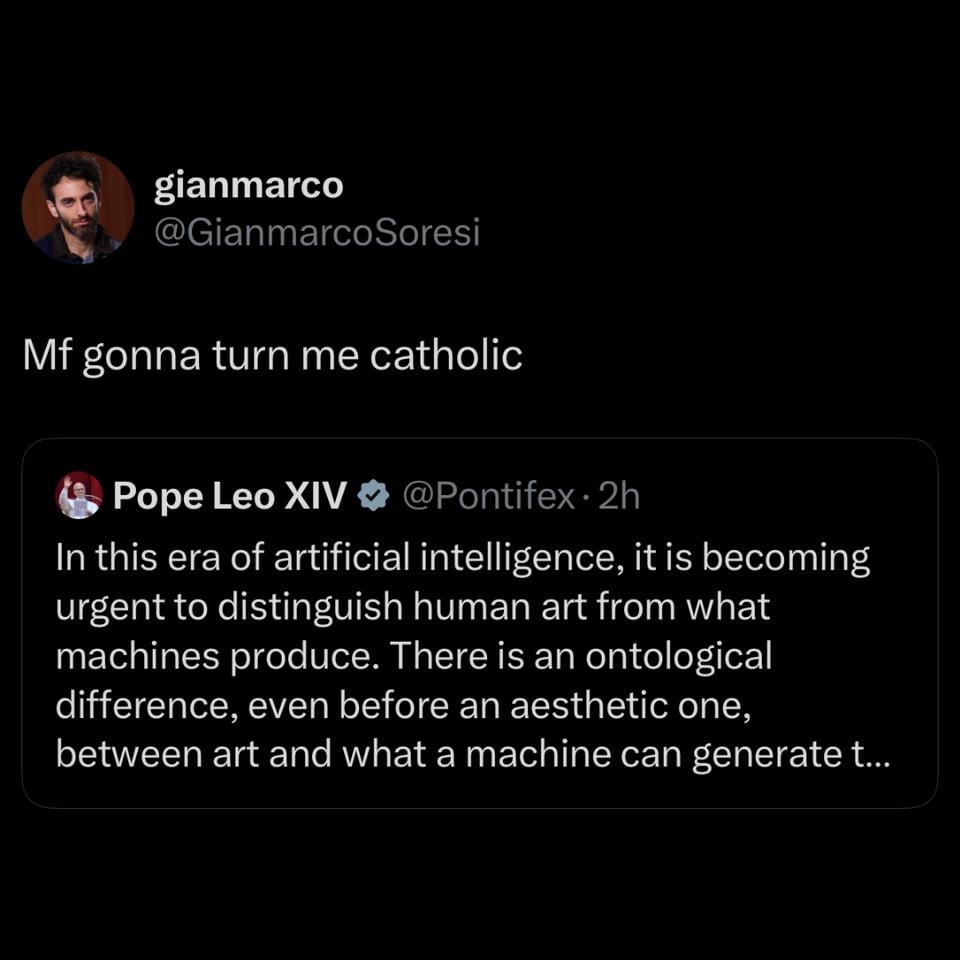
It’s fitting that their introduction is the Pope’s response to the unfolding integration of “AI”. So much of that phenomenon really just boils down to how we treat each other; more precisely, the instruments we use to regiment how we interact with one another.
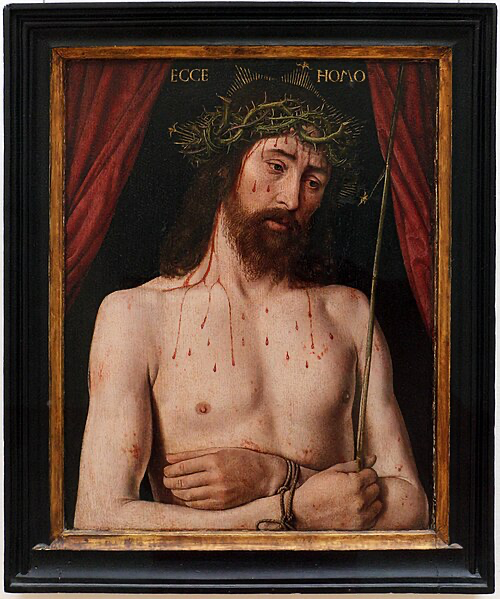
The first mass-market Christian art turned “Ecce Homo” (“Behold the human”) into a bumper sticker.
We’re told the phrase was first used as an epithet: “Your so-called mighty God is but a mortal, weak and wounded.” To which the Christians responded “Yes.”
LOL
Centering humanity is the hallmark of all great civilizations.
Of course, what it means to be human has been a fruitful topic; an unsolved problem as the sci-tech kids like to say, these days.
But we have some fairly clear data.
For example, humans were creating art while they were still struggling to feed themselves. In other words, poor people, hungry people, scared and desperate people, nonetheless created art. As they do, today.
Art is not the playground of the wealthy. Taste is not genteel. Culture is not for the sophisticated.
Rather, art is what makes us human and, I’m fairly certain, every person who has lived and lives today is a human being, whether or not they are afforded the rights that flow from this recognition, once codified by the founding documents of the United States of America – much to the consternation of the monarchists and white nationalists who now run the show; in lockstep with the billionaires.
It’s worth noting that corporations are the obvious precursor of our current “AI’s” or “SI’s” or whatever the fuck made-up marketing term we want to use for golem, monster, daemon, etc.
In other words, a thing we make to do things for us that can also very much do things to us because, as is true of everything we make, it is a reflection of our values and an expression of our political reality.
Of course the AI’s we’re marketed today are serving the very overlords most people reject. It’s unfortunate that the latest iteration of human-machine interfaces is being rejected outright before its full utility can be extracted by the very people who are forever denied their basic rights by their rulers.
Yet, it would be a welcome outcome if this moment of revolt leads more people to discover the not so good news of Christian philosophy (“Ecce homo”): the radical humility that infuriated one of its great detractors, Nietzsche.
As a recent OpenAI “defector” wrote last week in The Atlantic:
The future depends on wisdom that Silicon Valley lacks. Wisdom about how to handle dangerous technology and, more fundamentally, wisdom about what it means to care for people. This moment needs a degree of humility that isn’t natural for people who have succeeded through their extreme confidence. My former colleagues at OpenAI were prescient: They came to understand the scaling laws that meant bigger AI systems would be smarter—and so they went all in on building bigger systems, at great cost. A can-do attitude of achieving the seemingly impossible—coupled with work timelines that amount to perpetual sprints—are common across the industry.
It’s a not very-well-kept secret that modern Catholicism is really just a synthesis of many moral and philosophical traditions. (Like, literally, it’s in the name! Lowercase “c” catholic means wide-ranging, diverse, comprehensive.) Hence, the razor-sharp humility that led Socrates to be sentenced to deportation exile echoes in the Christian embrace of Ecce Homo.
Bonus
Here’s how the Vatican is using AI, fyi.
P.S.
Insofar as modern catholicism is syncretic, all catholics are cafeteria catholics. Only the revanchist fascists who wish to wear the dead skin of the faith would insist otherwise. While the Vatican uses AI to translate mass 60 languages, degenerate liars like JD Vance performatively attends services in Latin. Second Vatican Council be damned along with every other 20th-century achievement.