First principles
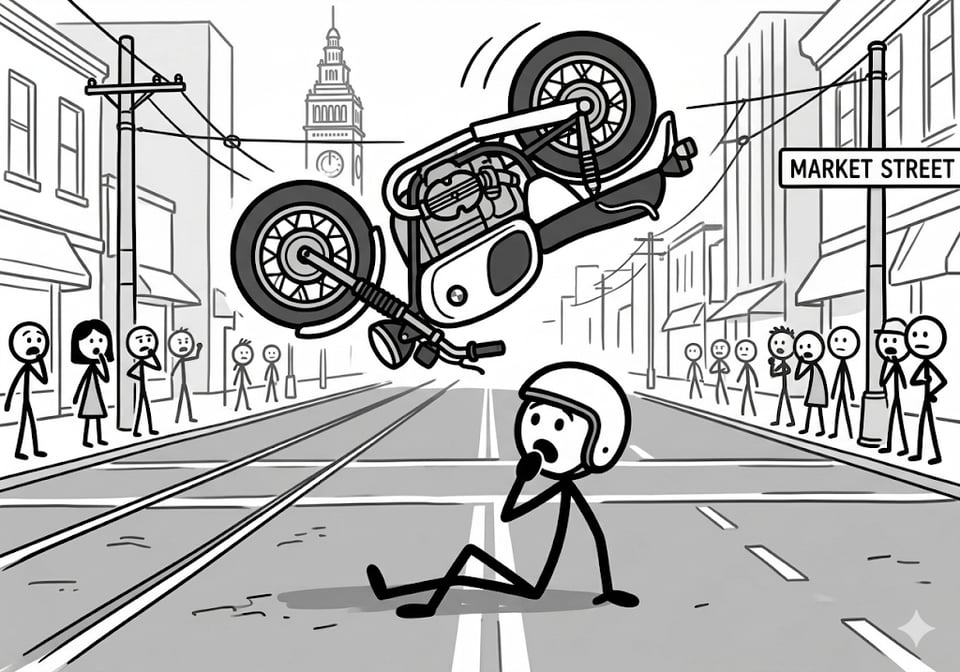
What did I learn when a 500 pound motorcycle landed on top of me on Market Street in San Francisco?
The problem with our speed-centric culture
It’s well established that we live in an age of b.s. YouTube, cable TV, Instagram are all ad driven, and the now brutal competition for attention across a million channels means advertising rewards the opposite of what we humans need to survive.
To survive, we need to plan.
How will we eat during the winter?
How can we catch and kill a giant boar?
How do we keep our baby from being eaten by wild animals?
Planning is not reactive. It’s an act of imagination. It requires the suspension of time, our projection into not one but various possible futures.
Planning cannot be quick. Never is it instantaneous. Rather, planning takes time.
It takes time to think through consequences, based on a careful remembering of events; an understanding of cause and effect.
Baby on the ground got bit by snake and died. Much sadness. Baby hanging from a tree is harder to eat.
Hurry up and die already
We are no longer plagued by snakes. Rather we are plagued by a lack of time. We are forced to “make decisions” more and more quickly, with worse and worse information.
We are asked to suspend judgment precisely when it’s the clock we need to suspend in order to pass better judgment.
This morning, I listened to a few different interviews with the authors of the New Yorker story about OpenAI CEO and possible 🐍 Sam Altman.
And then I listened to an often entertaining “vodcast” talk about AI.
I was shocked by how unmoored from reality this last conversation was. It was a parade of strawmen for quick and spectacular takedowns. Like TV wrestling but with Big Ideas as combatants.
Of course, theirs is the more engaging formula: fast and loose and funny. It’s the one that any ad-driven model will push for engagement.
This is how the aggressively ignorant and incurious Joe Rogan became the Walter Cronkite of today.
Take it in because
Dumber (and darker) days may still be ahead.
Not because the ignorant will dominate our attention but because we’re building an infrastructure of ignorance.
In the USA, the potential windfall of AI is buoying an otherwise broken economy which in turn is bolstering an obviously broken (and broke!) government which in turn is backing a broken organizational model for the rollout of one of the most significant labor tools ever made.1
As with any technology that can reduce labor, the use of AI need not doom us to a world without hard truths. Nor are we trapped to live in our own information poopoo.
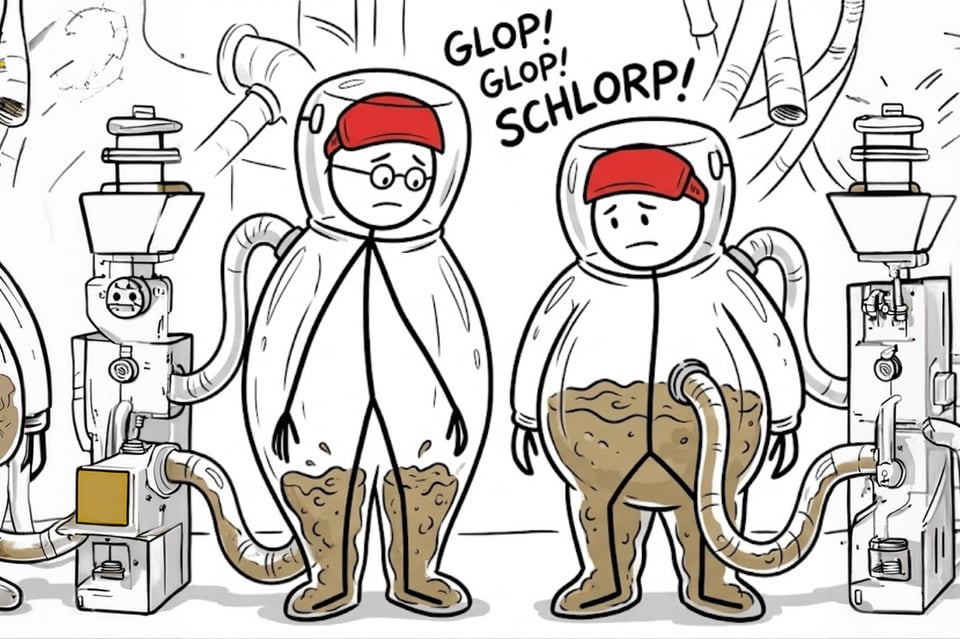
To practice sustainable information hygiene we need to not eat where we poop. Meaning, we can’t mistake our outputs for inputs!
It’s tempting to mistake the speed of a computer for genius.
Look how fast our computer speaks! It can even make decisions! It can plan for us!
Well, not really.
What computers can do, very, very, very well, is remember shit. And they can remember well enough to work their way through a maze.
Today’s computer can remember and test many plans, all at once.
But remembering a plan is not the same as coming up with one. Mistaking the one for the other is how people die when the facts on the ground change; as they do, very quickly, when complexity overcomes our social skills. Our social technē, as it were.
Low rider don't use no gas now
Low rider don't drive too fast
Humans cannot make decisions as quickly as computers. This is our blessing, not a curse.
To deliberate slowly is to have time to uncover more than just the immediate answer to the known question but also to arrive at the question behind the question: the known unknowns and the looming presence, the gravitational pull of the unknown unknowns. (They are many! History makes this abundantly clear!)
Our dogshit economy – run by self-avowed degenerate gamblers – has convinced otherwise sane, sober and smart people that they need to somehow “run with the Tiger” to worship speed as if it was anything but a cheat.
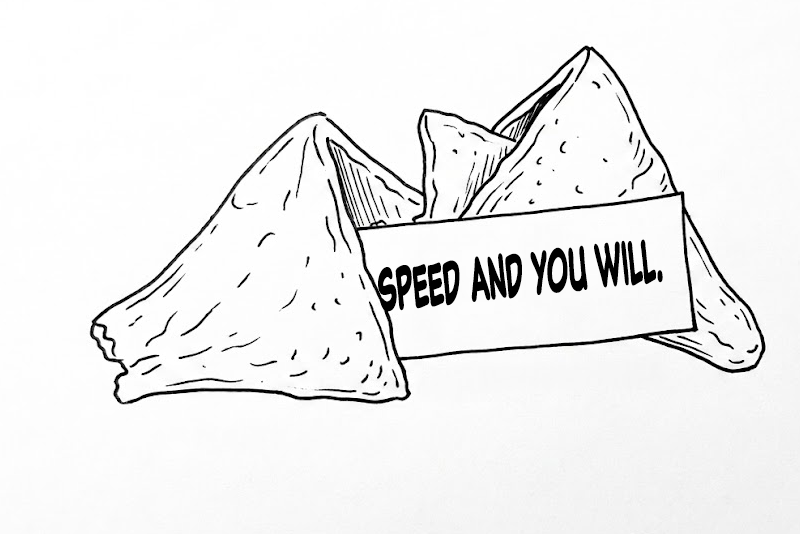
When I was 22, I carried around in my wallet a fortune cookie that read “drive at breakneck speeds and you will.”
I thought myself clever for reading that “will” as: willpower, the desire for greatness. I wanted to believe that if I could only go faster I could achieve more.
I probably had that very fortune cookie in my wallet when I was thrown into the air by a pickup truck that also sent my 500 lb motorcycle into the air before landing on my right leg.
Reader, it slowed me down. And slowing down saved my life. It made me a better thinker and thus a better doer.
Fail fast is maybe only good when you’re not very smart. It’s a brute force attack on your own stupidity or studied ignorance.
If NASA could land humans on the moon with the computing power you now find in holiday greeting cards, then what are we doing with supercomputers?
Working hard or hardly working?
I’d say the latter. Hard work takes more than stamina; it takes the discipline to adjust to your own inevitable discoveries. For if you are not discovering on the job, then you are dumb and bound to fail. Sooner or later is only a question of how much money you started out with.
Of course, in our country the USA in 2026 we are still carrying out mass pogroms against the people who started out with the least and managed to level up to having jobs and feeding their families in the USA. All while we are being led by failsons. Literal failsons. Ah well, nevertheless.
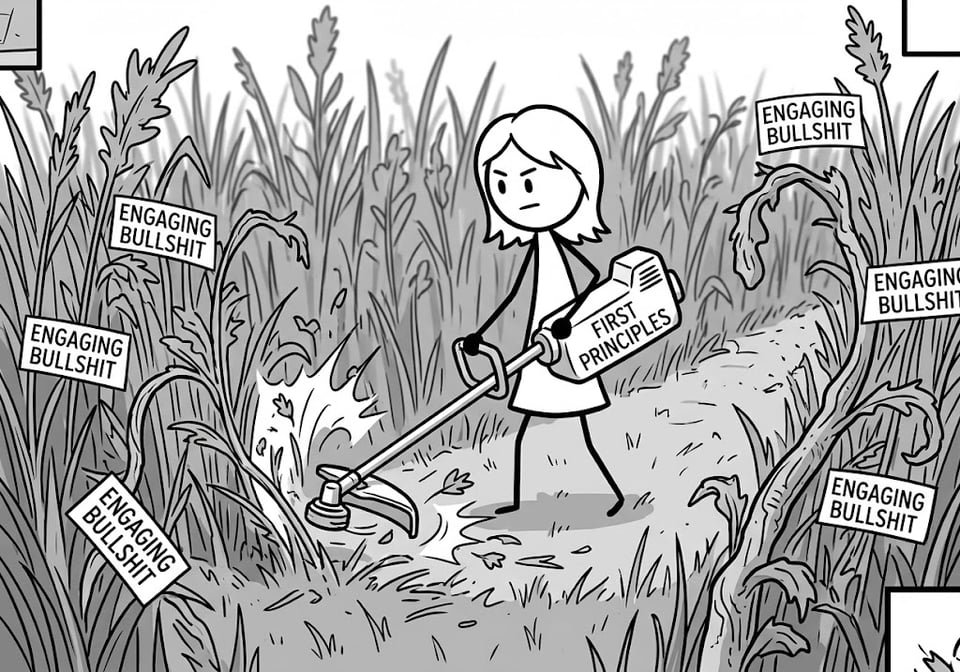
I began this letter citing “First principles” because they are our only way out of this jungle of bullshit, being factory farmed at superhuman scale. (Technically, these are post-postmodern first principles. But who cares.)
A first principle to cut through the noise: arrive at the same truth by following parallel paths. If a thing is true, you will arrive at it from another point of departure.
Your destination is not, then, a matter of chance but rather a matter of destiny – i.e., what goes up, must come down.
A second first principle:

Cui bono?
Who benefits?2
What is the speaker’s motivation in what they are saying? Are they open to following the evidence all the way to a moment of uncomfortable truth? (When is the truth actually comfortable? NEVER! When you learn something you are thrilled. That is not a state of comfort!)
And a third “first principle”
The life unexamined is not only not worth living, it’s the state of affairs for animals.
You may wish to live like an animal – many do! – but it’s make believe; pretend.
The people who want to run as fast as computers are engaged in the same journey as Icarus. It can be done; but not for long.
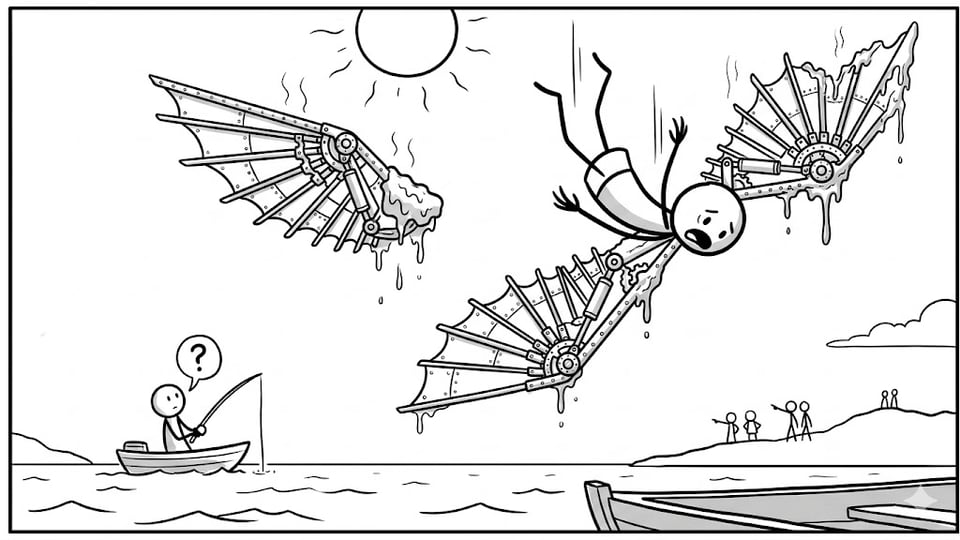
The civilizations that lasted for centuries, if not millennia, without any refrigeration know a thing or two about sustainability.
We need to think more slowly, on purpose, if we are to truly master our machines, rather than becoming trapped in our machinations.
Wondering just how it was we ended up with a giant machine falling on top of us one sunny day.
Why has China embraced AI? It’s a twofer over there as well: the computational gains are real and measurable. Plus hallucinations serve the interests of the state which controls access to the truth fully. ↩
Yeah, this is especially not a first principle but we like things that come in threes! ↩