November: Cold, quiet and beautiful
Frontenac State Park Association newsletter
November 2026 (Vol. 4, No. 11)
Comments, contributions, compliments, complaints? Reach your newsletter editor at [email protected].
November: Cold, quiet and beautiful
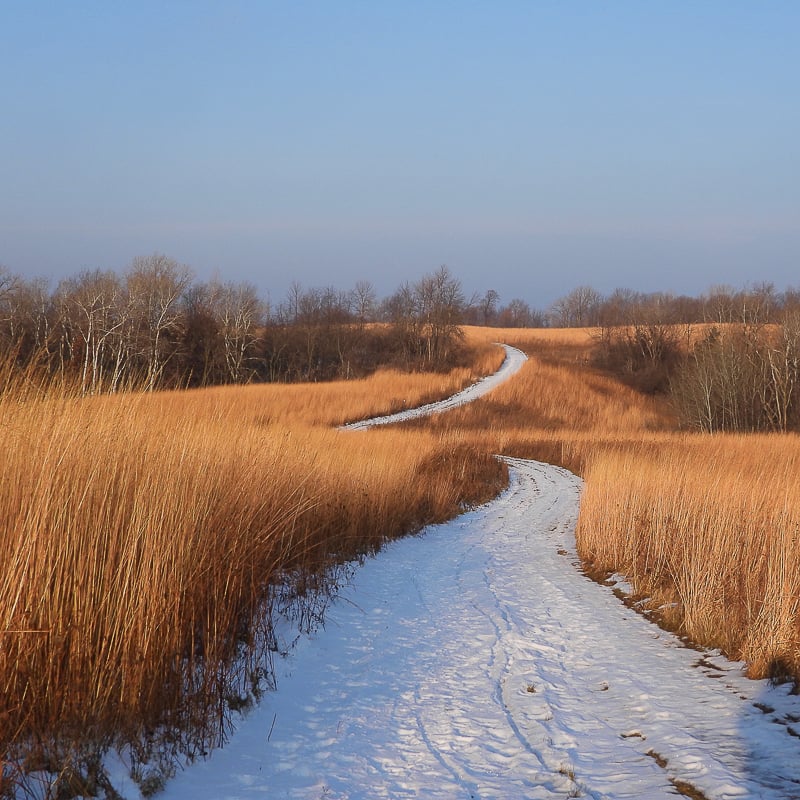
Perhaps no monthly transition in Frontenac State Park is so dramatic as that from October to November. The former is generally the park’s busiest month, bustling with autumn foliage admirers, cool-weather hikers and all of us reveling in the year’s last few warm days. Then the calendar turns, and suddenly it’s colder, darker and quieter … and is that snow in the forecast? The whiplash takes some getting used to, even for seasoned Minnesotans.
But as we’ve argued before, November, despite its reputation for gloominess, can be a treasure of a month. The crowds clear out, the heat and humidity are long gone, and the views from hillside park trails, especially those overlooking Lake Pepin/the Mississippi River, are unmatched now that most leaves have fallen; you can see for miles and miles. Come take a hike before the snow flies and the river freezes over!
November FSPA events
Saturday, Nov. 7, 9 a.m.: Sand Point bird walk, led by Minnesota Master Naturalist volunteer Steve Dietz. Meet in the little parking lot across from the Sand Point trailhead. Hoping to see some migrating waterfowl and perhaps some Tundra Swans overhea(r)d.
Thursday, Nov. 12, 2 p.m.: Frontenac State Park Association quarterly (and annual) meeting: An important one, in which our goals for 2027 are laid out. Interested in joining us? Attend to find out who we are and what we do! Location: 2533 Eagle Ridge Drive, Red Wing.
Saturday and Sunday Nov. 21 and 22: Frontenac State Park closed for annual deer hunt.
Friday, Nov. 27 (the day after Thanksgiving): Free-admission day at all Minnesota state parks.
A few news tidbits from park manager Jake Gaster:
- Overall fall attendance is down relative to previous years. We had a couple busy weekends in October, but weekends were either unseasonably hot or rainy, driving the lower attendance.
- This was an unusual year for colors, too, with some trees (black walnuts, cottonwoods) dropping early and some (maples, aspen) dropping late. It was still certainly beautiful, though!
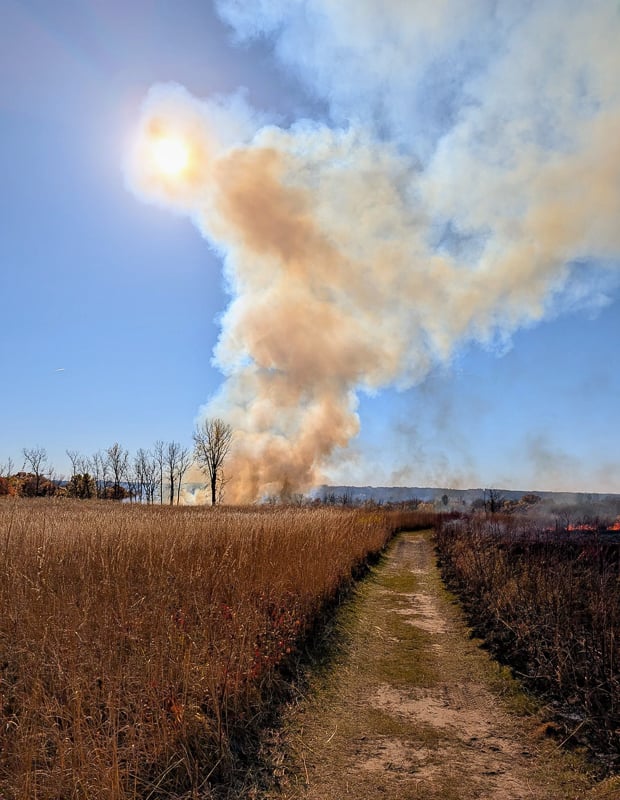
- Our fall prescribed prairie burns are off to a great start! We’ve done six burns so far this season totaling around 200 acres, with more planned for later in the fall. As some years we aren’t able to do our first burns until November, we’re off to an excellent start.
- A reminder that the park will be closed to all visitors on Saturday, Nov. 21, and Sunday, Nov. 22, for the annual park deer hunt, so plan your visits accordingly.
- And delighted congratulations to assistant park manager Amy Jay, who gave birth to a daughter, June Alice Jay, on Oct. 22. Amy will be on parenting leave till March.
Birdnote: Shriek! A shrike! (Warning: Gory description)
By Janet Malotky, Minnesota Master Naturalist volunteer
Halloween just past seems a good time to focus on a local avian ghoul: the shrike, AKA the Butcher Bird. This carnivore methodically stalks prey, pounces on it or chases it through the sky, kills it by biting through its spine or driving it at high speed into the ground, beats it against a branch to soften it up, and then impales it on barbed wire or a thorn to eat or store for later. Talk about terror on wings! The shrike’s got menace in spades.
Two types of shrike visit the park: Northern Shrikes and Loggerhead Shrikes. They’re hard to tell apart, so it helps that they're around at different times of the year. The Northern Shrike breeds in the far north of North America at the edge of the tundra, then escapes that harsh winter by flying south to our relatively balmy winter climate. Though neither shrike is frequently seen in Frontenac State Park, the Northern Shrike is more common.
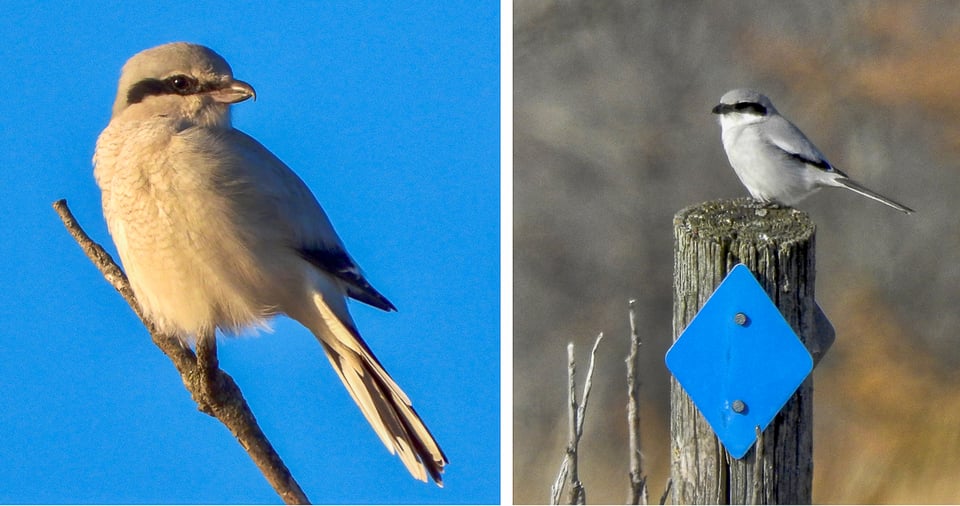
Loggerhead Shrikes winter in the southern United States, then come just a bit farther north to breed in summer. Historically, Loggerheads were common throughout Minnesota during breeding season; however, their breeding range has contracted. Now they are generally only found nesting near the western border of the state and in Dakota County. We do see them now and then passing through the park.
Both birds are just a bit smaller than robins, but they pack a ferocious personality into their small size. They will hunt and eat a robin, along with any other bird they can catch. They also eat small mammals, insects, reptiles, amphibians, and carrion. They perch in the open to scan for prey, but also stalk through grasses and underbrush, waiting in ambush outside of den openings. Why hasn’t someone made a horror movie?
Shrikes need habitat with lots of open space dotted or edged with shrubs or low trees in which they can nest and from which they can hunt. Prairies and grasslands edged with trees and oak savannah are ideal habitats. Giant fields of row crops without hedgerows are not so great, nor are dense forests. Our park has optimal habitat for these birds, which is why we get to see them, even if not very often. Northern Shrikes are listed by the Minnesota Department of Natural Resources as a Species of Least Concern in Minnesota. Yay!
Whether Loggerhead Shrikes will ever return to their former prevalence in our area is an open question. The Loggerhead has been designated an endangered species in Minnesota. The threats are probably multifaceted, including habitat loss due to encroachment on prairies by forests, housing development, and agriculture. Additionally, because shrikes eat a lot of insects like grasshoppers, pesticides used to control crop pests are probably also a significant factor in population decreases.
I suppose some might think that’s just desserts for the havoc they wreak on their prey. Yes, nature can be brutal. But note that shrikes are eating those crop pests in the first place. We should probably be helping them continue to do that, right?
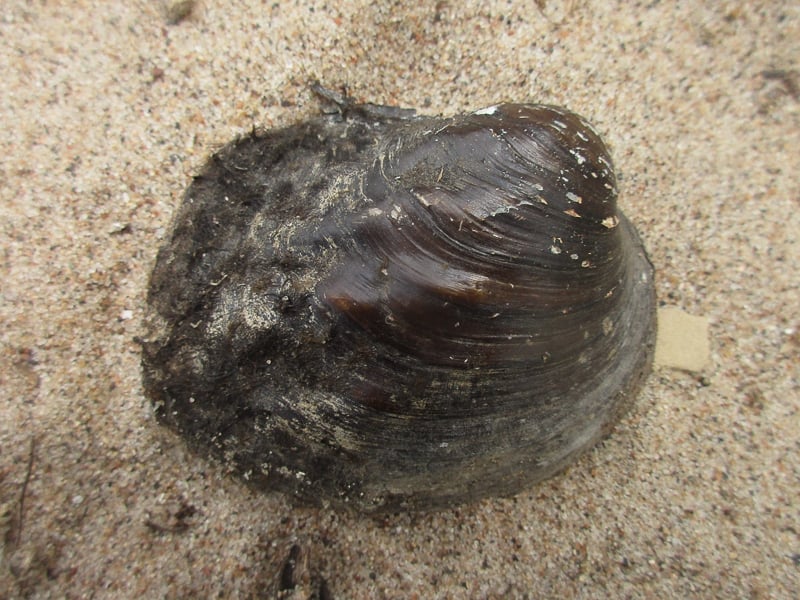
iNaturalist moment: Native mussels, oh my, oh my!
– Steve Dietz, iNaturalist ambassador
The white-tailed deer: Our neighbors, our prey
By Pamela Miller, Minnesota Master Naturalist volunteer
Note: We’re recycling and updating this feature from last November in honor of this being the month of the hunt. A reminder that Frontenac State Park will be closed Nov. 21-22 for the annual deer hunt in the park.
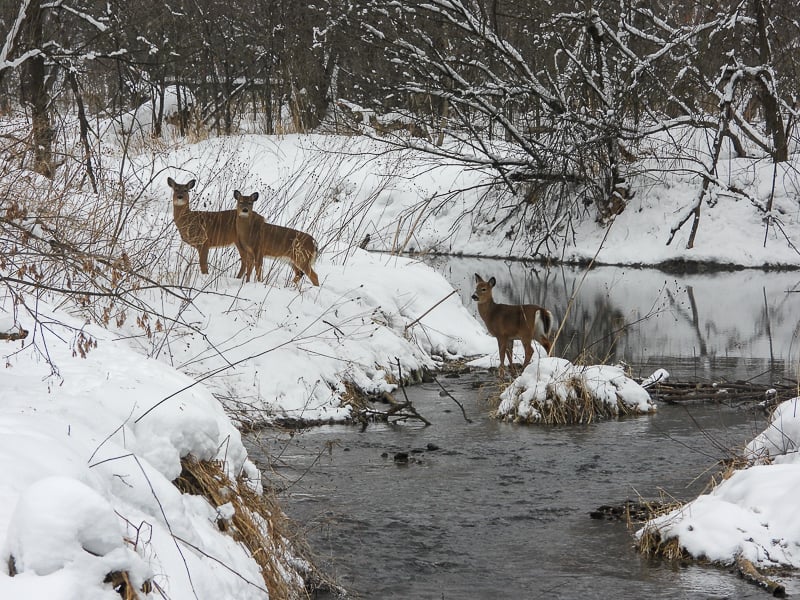
Most Minnesotans, especially those who live in rural and suburban areas, have a love-hate relationship with the white-tailed deer (Odocoileus virginianus). These graceful creatures are a constant reminder that we live among wild things. There’s nothing more heartwarming than finding a newborn fawn, small as a cat, curled in the woods or your yard, soon to wobble away behind its mother. At twilight, deer are beautiful as they graze in summer and winter fields.
Urban Minnesotans may have a hard time fathoming how important the annual deer hunt is in our region. It fills freezers, hones outdoor skills and appreciation of the wild, bonds friends and families in ways both personal and cultural, and most important, helps keep the deer population at a healthy number, preventing starvation and disease.
And then there’s that stupid, doomed deer running smack into your car on Hwy. 61 or County 2, and the havoc deer wreak in our yards and gardens. They mangle apple trees, flowers, hostas, tomato buds, bean plants, grapevine leaves and lots of other good stuff. (Hot tip: They totally leave tomatillos and horseradish alone — surely you can make some kind of hot dish out of those two things.) They head-butt your bird-feeders and leave little souvenirs right where you want to park your lawn chair. They’re often just too much of a good thing.
Thus, the hunt. As mentioned above, Frontenac State Park will be closed Nov. 21-22 for its annual deer hunt, when registered hunters will take out 30 or more deer, thus ensuring enough space and sustenance for those that remain, and slightly safer roads.
November is a good time to revisit a few fun facts about these ubiquitous creatures:
- A typical whitetail will spend most of its life within a square-mile range, which is why you often see the same ones in your yard.
- Deer are color-blind, so can’t spot hunters’ orange garb. But they can detect the slightest movement. “Even the blinking of a human eyelid can be enough to send the alerted deer streaking off,” writes Leonard Lee Rue III in “The World of the White-Tailed Deer.” Their hearing and sense of smell are exceptional, too. They prefer to feed facing into the wind, allowing swifter detection of danger. And you’ll notice deer heads popping up when crows, blue jays or squirrels begin to chatter loudly in response to intruders.
- A deer’s highly evolved hoof gives it traction in woods and on rocks, but it’s useless on sheer ice, which is why a deer chased onto a frozen lake by wolves or coyotes is almost always doomed. That hoof also can serve as a weapon against snakes and predators, and is the reason a hunter should be wary when approaching a wounded deer. During the rutting season, big bucks often drag their feet, leaving distinctive lined tracks in shallow snow, while daintier does leave pretty hoof-dots.
- Yearling bucks are called “button bucks” because their antlers are only nubs at that point. In their second year, the antlers usually become spikes. By the third year, the antlers branch.
- Fawns are generally born in May. As birth approaches, does will shoo away yearlings still tagging after them. As soon as a fawn is born and can stagger to its feet, the mother will lead it away from the place of birth, which is easily detectable to predators by scent. Newborn fawns curl motionless and alone as does leave them to forage, returning several times in a 24-hour period to nurse them. People often worry when they see a newborn fawn wobble off on its own, but no need – the mother can easily track it because of a scent gland in its wee hoof.
- Deer aren’t silent. A fawn will bleat, and older deer emit a ridiculous high-pitched snort when they’re warning others of intruders. They also stamp their feet to warn of danger.
- Does often look downright ratty in late spring, thin after feeding fawns and with their winter coats shedding. By mid-summer, they’ll have new, reddish coats and be a bit more portly.
- What do deer eat? You have to ask? Almost everything! These vegetarian ruminants require 10 to 12 pounds of food a day, most of it from your garden.
- Testosterone-addled bucks famously go bonkers during the rut, and aren’t above challenging a human who’s right in their way. But mostly they thrash each other, sometimes leading to a spooky find in the spring — two buck skeletons locked together by their antlers.
- We could go on with more fun facts — the natural history of deer in Minnesota; their current troubles, including the ravages of chronic wasting disease; hunting info; tips on keeping them out of your garden, and so on. Read on in many places, including Minnesota Department of Natural Resources webpages, Wikipedia, nature and hunting magazines, and lots of books available in your local library, including the aforementioned “The World of White-Tailed Deer.” Our own science essayist, Steve Dietz, also wrote a fascinating one on how deer affect their (and our) environment in our November 2023 issue; check it out.
Autumn magic: Why do deciduous trees drop their leaves?
By Brian Henkel, Minnesota Master Naturalist volunteer
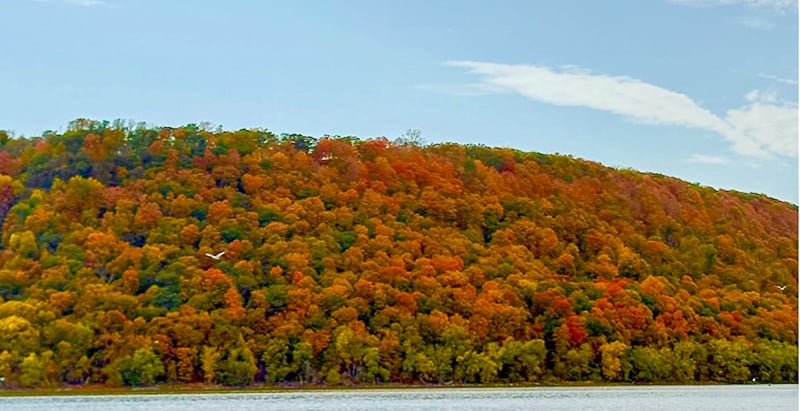
While I love all four seasons in Minnesota, fall is definitely my favorite. Walking Frontenac State Park in the fall is a full sensory experience, with the sound of “raining” leaves; the spicy, musky scent of drying plants, and brilliant leaf colors, all backstopped by Lake Pepin. It fills me with wonder.
How do these fall colors come about?
As the Earth begins its tilt away from the sun, the northern hemisphere sees the days shorten and the temperatures cool. The shorter days reduce the amount of sunlight available to trees, slowing chlorophyll production. The seasonal changes trigger deciduous trees to break down the chlorophyll in the leaves and retrieve and store the nutrients for the warmer, longer days of spring.
As the green chlorophyll breaks down, colorful pigments are revealed. Yellows and oranges were always there. Reds and purples are produced in the fall. The intensity of color depends on a number of factors that occurred throughout the summer and into fall, including sunlight, temperature and moisture.
At the same time, changes occur in the tree that result in a specialized layer forming at the base of the leaf stem, causing it to fall off. The resulting leaf litter plays a vital role, helping to conserve moisture in the ground. Fungi, bacteria, and insects consume the leaves, returning their nutrients and organic material to the ground to be reabsorbed by the trees in the spring. Nothing is wasted.
Of course there are some exceptions in nature. Some conifers (Pinaceae sp.) shed some needles in the fall, while other conifers like tamarack (Larix laricina) are deciduous and drop all their needles annually. Some deciduous trees, like some oaks (Quercus sp.), retain their brown leaves until spring. We could continue to delve deeper, but instead, let’s simply enjoy the fall colors while we have the opportunity. Each fall is different — sometimes striking, sometimes muted, but always beautiful.
During this season of thanksgiving, I encourage you to take a stroll in Frontenac State Park and notice how your senses become involved in the experience. And be thankful for those who came before us and had the foresight to set aside sections of wild land that we are able to enjoy today.
Notes from the field: Taking the new Minnesota Wildlife Action Plan for a test drive
By Steve Dietz, Minnesota Master Naturalist volunteer
At a time when federal stewardship of the environment seems to mean “it will take at least seven generations for you to recover from our actions,” let’s hear it for the science-based planning going on in Minnesota. It may not make daily headlines, but it does make an attempt to think rationally about a future of increasing stressors on our precious environment.
The newly minted Minnesota Wildlife Action Plan is not necessarily rip-roaring reading by the fireside, but it does encourage reflection as you spelunk through vast datasets of “I didn’t know that.” And with a little squinting, you can make it a roadmap to adventures you might like to try out in the spring.
Minnesota’s Wildlife Action Plan 2025-2035: Conserving Habitat and Biodiversity
This plan is the third revision of Minnesota’s State Wildlife Action Plan. At its core is a set of 1,142 “Species in Greatest Conservation Need” (SGCN), which drives conservation efforts, habitat protection and public engagement. Support of these efforts at Frontenac State Park is, of course, also core to the mission of our Frontenac State Park Association.
One significant and welcome change to the plan is that:
For the first time, the list of SGCN has been expanded to include plants and lichens. . . . This reflects a growing recognition of the need for closer integration between plant and animal conservation efforts, as encouraged by national initiatives such as the Restoring America’s Wildlife Act, which also recognized the importance of plants.
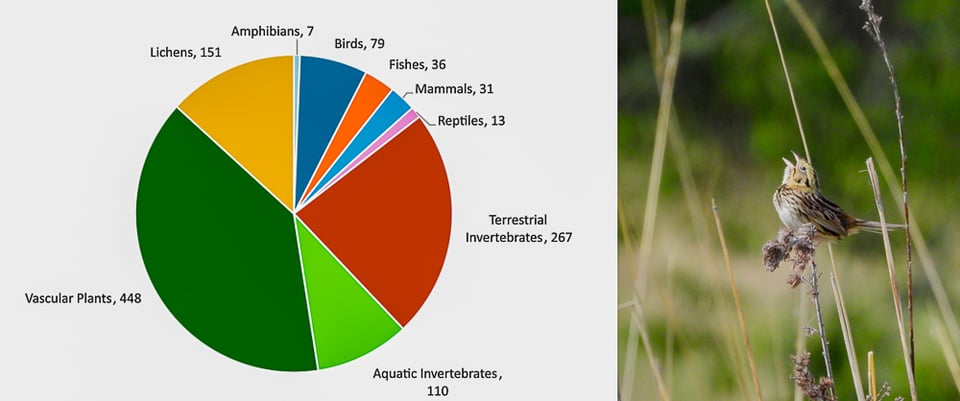
This is interesting because 52% of species of greatest conservation need in Minnesota are plants and lichens. Terrestrial and aquatic invertebrates constitute another 33% of SGCN. This isn’t just government overreach trying to protect life that doesn’t really matter. As the plan states:
Plants are foundational to ecosystems and form the structure of habitats, serve as essential resources for specialist animal species, and provide critical ecosystem services that support life across the landscape.
This is equally true for invertebrates, a critical link in the food chain, which literally support the loons, beavers, deer and walleyes we love so much.
The plan is multifaceted. Perhaps the easiest or at least the most fun way for an amateur like myself to approach it is through species groups or habitats. Pick one of your favorite sights in the park, and follow the path down the rabbit hole, so to speak. For me, one option is the Henslow’s Sparrow, one of the 79 bird species of greatest concern in Minnesota, which I see all spring and summer on Rattlesnake Bluff and less often along the prairie trail. It turns out that their population is likely stable and even increasing, according to some measures. Yay!
Each chapter includes descriptions of stressors affecting threatened species and strategies to mitigate these stressors. It turns out that Henslow’s Sparrows are one of only three grassland species “known to respond negatively to intensive grazing.” This, of course, is not an issue in Frontenac State Park. The account also states: “The most important native plant community for the species is southern mesic prairie. Southern dry prairie can be regionally important, though only one specific type, dry hill prairie, has multiple Henslow’s Sparrow occurrences.” The specific ecosystem types are a bit opaque to me, but still I wondered how the theory tallied with my actual experience of Rattlesnake Bluff.
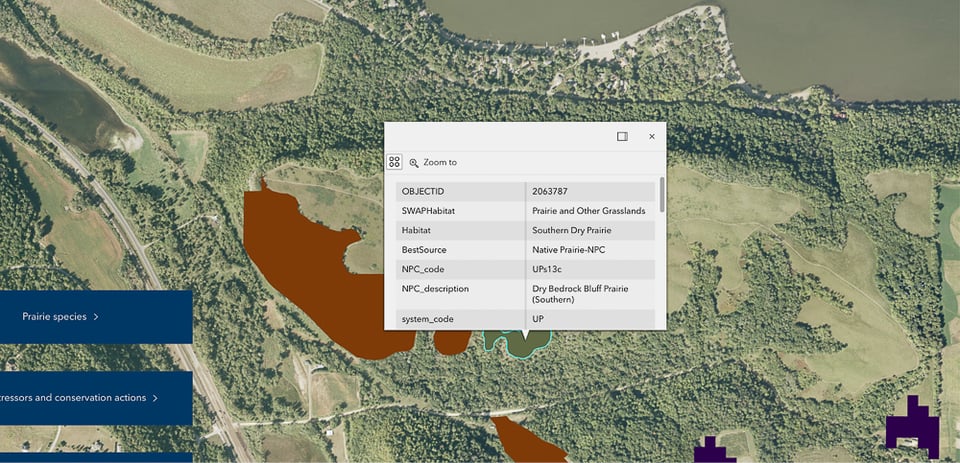
In an important sense, the Wildlife Action Plan is simply a narrative front door to the dynamic database of Species Data and Habitat and Conservation Maps. Knowing that Henslow’s Sparrows are grassland species, I was able to call up the related maps for Minnesota. Zooming in on Frontenac State Park and, in particular, Rattlesnake Bluff, I found that the maps do indeed identify parts of it as being Southern Dry Prairie but of the Dry Bedrock Bluff Prairie variety — not the required dry hill prairie mentioned above. And where I have seen Henslow’s Sparrows regularly over the past four years is generally a bit east of the identified prairies.
Birds don’t read the manual, of course, and other issues such as “their need for tall vegetation and a substantial litter layer,” which will vary year to year as Rattlesnake Bluff is under an active prescribed burn regimen, may be more important than the precise prairie classification. Still, my next walk along the bluff in spring will feel different.
Which brings up the plan’s public engagement goal, “to inspire, motivate, and empower Minnesotans to engage in conservation actions that support Species in Greatest Conservation Need and their habitats,” with seven recommended strategies, including: informational resources, environmental education, wildlife viewing opportunities, empowering communities to improve wildlife habitats, offer participatory science programming and cultivate financial support.
The Frontenac State Park Association’s goals in support of Frontenac State Park significantly parallel these goals. I encourage you to pick your favorite species — fauna or flora — or habitat, explore the stressors and potential mitigation strategies for each, and see how they relate to the specific context of our park. Bon voyage.
Good reads for nature lovers
By Pamela Miller, FSPA newsletter editor
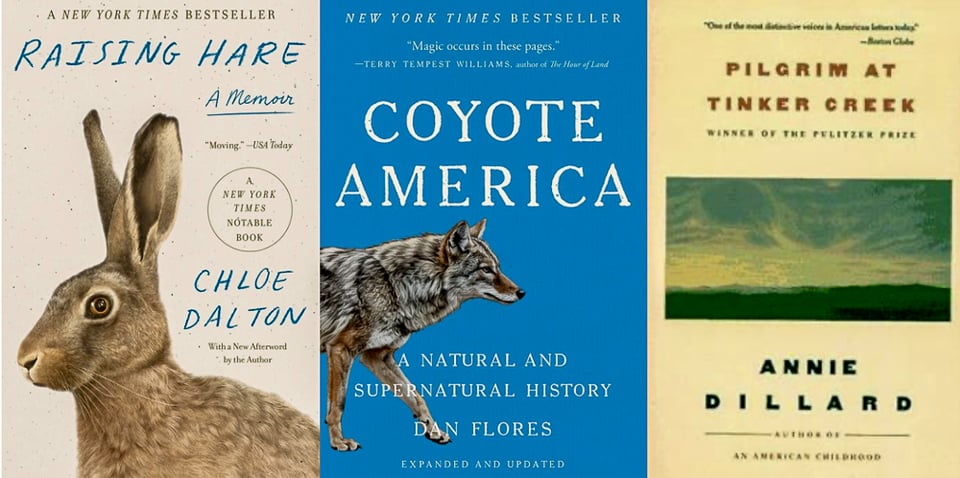
As fall and winter bring darker evenings, our reading time picks up. Here are three primo reads for nature lovers:
- “Raising Hare: A Memoir” by Chloe Dalton: You may think you’re not interested in the story of an almost comically common animal that beguiles and changes the life and outlook of a British woman. But it’s an astonishingly beautiful and universally relevant book. When we look at one thing in nature and get to know it well, a whole world can open up. I didn’t expect to love this one so much; I read it in two sittings. Quote from the book: “I flicked on the switch in the sitting room to find the hare lying on her front, her slim legs stretched out before her as though she had never left, instead of being absent for two weeks. She stared inscrutably into the fire. She was a Dürer painting come to life — her coat a blaze of warm brown and golden tones, her eyes reflecting firelight.”
- “Coyote America: A Natural and Supernatural History” by Dan Flores: Everything you always wanted to know about coyotes, which Flores calls “American avatars,” and more. You’ll come away from this treasure of literary science and history with powerful new knowledge about and respect for coyotes, and listen more carefully for the nighttime howls that reverberate over Frontenac State Park — and even in urban areas. (Also recommended: The new movie “Coyote Vs. Acme.” You won’t learn much from it, but you’ll laugh till your face hurts.) Quote from the book: “Whether those golden eyes, that slender snout, or the insolent swish of a tail charm you or outrage you, the sight of a coyote is never boring.”
- “Pilgrim at Tinker Creek” by Annie Dillard: A shout-out for this 1974 classic by Annie Dillard, who died in September at the age of 81. If you never got around to reading it back in the day, check it out. Thoreau-esque ruminations on nature’s complexities and humanity’s place in it, science and religion. Quote from the book: “We have not yet encountered any god who is as merciful as a man who flicks a beetle over on its feet.”
Poem of the month
“FALL LEAVES FALL”, By Emily Bronte
(1818-1848; English)
Fall leaves fall die flowers away
Lengthen night and shorten day
Every leaf speaks bliss to me
Fluttering from the autumn tree
I shall smile when wreaths of snow
Blossom where the rose should grow
I shall sing when night’s decay
Ushers in a drearier day.
Interested in joining the FSPA?
If you are a member, thank you! You help us pursue our mission of supporting this treasured park in myriad ways.
If you’d like to join us, we’d be honored to have your support. Dues are $25 per year for an individual, $35 for household membership. Here’s a link with signup information.
A reminder that joining us occasionally to help with volunteer efforts is awesome too, even if you’re not a member. The FSPA’s goals are to support Frontenac State Park activities and share our love of this beautiful park with as many people as possible.
To sign up to regularly receive this free, spam-free monthly newsletter, click on “Subscribe” below. Feel free to send questions or comments to your newsletter editor at [email protected]. Questions about the FSPA? You can reach FSPA president Steve Dietz at [email protected].
Handy links for more information and education
Frontenac State Park
Frontenac State Park Association
If you take pictures in the park, tag us on Instagram
Frontenac State Park bird checklist
Frontenac State Park on iNaturalist
Parks & Trails Council of Minnesota
Website for our township, Florence Township
Minnesota Master Naturalist programs
Red Wing Environmental Learning Center
Lake City Environmental Learning Program on FB
Visit Lake City
Zumbro Valley Audubon Society
Bruce Ause’s Wacouta Nature Notes blog
Marge Loch-Wouters’ Hiking the Driftless Trails blog
Frontenac State Park staff
Jake Gaster, park manager; Amy Jay, assistant park manager; Amy Poss, lead field worker.
Parting shots

Thank you, readers and park visitors! Have a wonderful Thanksgiving – we’re thankful for you!
This is Volume 4, No. 11 of the Frontenac State Park Association newsletter, which was launched in April 2023.
Here’s where you can browse the full archives of this newsletter.

