
Reflections on Writing a Novella in 30 Days
Hello my dear newsletter friends. I’ve been neglecting you, for reasons that will be immediately obvious, but I’ve missed you. Already I have a plan for a much more standard newsletter, an examination of modes of engagement available in non-standard prose novels and the sibling bickering of two horrible academics, but not just yet. This is a terribly self-indulgent newsletter, and I hope that you’ll forgive me for that.
I, fool that I am, full of hubris and burnout, discovered a submission call that sparked a cascade of ideas. Unfortunately, the submission call was open from the 1st of May to the 31st (hello! Today!). Exam season, on the other hand, was the latter part of April. A quote from my discord messages, sent on the 27th of March:
oh my god I wish I’d known about this submission call earlierrr I have ideasss but there’s no way I can finish a NOVELLA in time
Anyway. I wrote a novella. Hubris.
This, then, is the internet-friendly numbered list: HOW TO WRITE A NOVELLA IN 30 DAYS
Step 1: Don’t do this
You chose science for you career so that art could remain fun, a safe space devoid of expectations for you to frolic through. You’re remarkably good at setting unattainable expectations for yourself.
You did this last summer, you said you’d write a novel in four months. You finished it before the end of the year, but is that really saying much? By the time you finished that novel you never wanted to write another word. This novella-in-30-days sounds remarkably like one of your classic ‘let’s speedrun burnout’ experiments.
Step 2: Figure out your limits
You subscribe to a lot of newsletters—surprise, the newsletter writer enjoys receiving newsletters. One of them you appreciate for its so-called ‘peek behind the curtain’ of publishing, but oh how the author grates on you sometimes. You understand they’ve earned the right to be a bit pretentious—their first ever story won a prestigious award! You could only dream of success like that (but, see again, this is your hobby. Lay your self worth on your academic writing and leave it be). A common refrain (from this author, among others) is that you can write a short story in a couple hours if you just sit down and do it.
You know this is not true for you. You are a painfully slow writer, picking over every word and stumbling over ideas, not because you’re approaching them with any kind of intentionality, but because the words simply refuse to come, you’re tired, you’re convinced you can not come up with unique ideas. Indeed, for a long time you had told yourself that while you could write well enough, you would never be able to produce enough ideas to sustain yourself.
Step 3: Idea formation is a muscle
Terrible news. Turns out that writing a novel that will never see the light of day is one of the best things you can ever do for your craft. Producing that volume of writing in a relatively short amount of time makes you a better writer. Your plot was incoherent, but the next two you came up with slotted right into place. Your tone and style were all over the place, and now you play with voice like the Victorian dollhouse in your grandmother’s basement. This isn’t to say that writing is suddenly easy, but rather that you suddenly have the tools with which to approach these projects. You thought you’d never come up with a novella idea again after WARftS all those years ago, but suddenly you’re—well, not overflowing, but there is a slow trickle like the mountain spring that forces itself from between the shattered limestone. Doing the hardest thing creatively you can think of makes everything else look easy by comparison. Turns out you can crank out a thousand words a day if you’ve got a clear end-goal in sight.
Subscribe nowStep 4: Drop everything else
Your brain has an amazing habit of sparking ideas only during exam periods. You think this is some extreme version of the joke that circulates about one’s brain being full of words all day until the moment the computer is sitting open and waiting, and then suddenly the mind is a beautifully blank and silent place. Anyway, you only have good writing ideas during exam season.
Writing a thousand words a day is not insurmountable. A newsletter often runs to the tune of 1300, and on a good day you can crank this out in an hour. It’s usually not a good day, and you have two papers due and a quantum exam tomorrow. Something is going to have to drop, but it turns out that allowing yourself a creative outlet during high-stress periods makes the world seem a little more bearable. Maybe it’s alright to skip that last round of LaTex formatting if it keeps you sane.
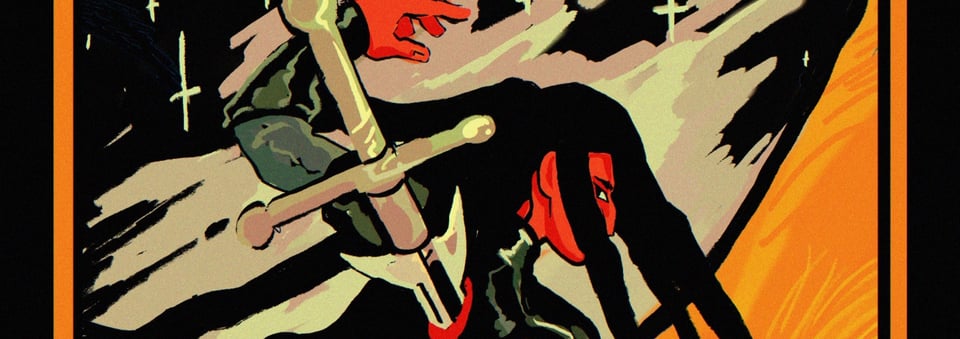
Step 5: You really want to write about this goddamn knight, don’t you?
The issue with exam-season idea generation is not the ideas themselves; indeed, you can tuck them away in your notes app, save them for a rainy day when you have a little more free time. The issue is that you have a brain built for hyperfixation, and suddenly all of your point group calculations are morphing into medieval poetry and historical swords. You’ve written plenty of things without that intense excitement to just start working on the project, but those never coalesce within a time limit; see step 2. If you—writer of max 1000 words a day—are hoping to write a novella of approximately 25k words, that means you will be working non-stop on this for the next month. It’s a good thing you’re so excited about the project, because if you’re not sure that this is what you want to be working on, that next month is going to be an utter slog.
The deadline gives you a clear idea, a clear goal, something to aim towards, and maybe you do work best that way. It’s far easier to write with the light at the end of the tunnel bearing down on you, and with the intense desire to get this thing that is a roiling sea of scraps of prose, themes, landscapes, and a young poet calling down a hawk from the sky into a form that can be shared with the rest of the world.
Step 6: Make a game of it
In the summer you tend to write on your balcony with your dinner, cassettes, and a glass of wine—not so feasible in early May in your city, where this horrible false spring veering threateningly into summer threatens to dump rain and hail on you in equal measures. Your desk feels too much like those exams you just took, the paper you just finished, but there’s a cafe in a beautiful bookstore a half-hour walk away. You play games with yourself, have an iced coffee and write non-stop in a seat tucked away among the stacks until you’re jittering and have to run home to make a proper lunch. You know you’ve written enough in that time, and the rest of the day can be given over to whatever you want. Making a habit of it means your brain has suddenly come to accept—cafe and a caffeine hit? Must be writing time. Rather than forcing it, sitting blankly before your monitor for hours at a time, you climb and write and read and it stays fun. That’s the trick, isn’t it? This is supposed to be fun. Your hobbies shouldn’t be punishments, no matter how much you want to submit to this one submission call. There will be others. The world will not end.
Step 7: Kill your darlings
You’re on a deadline. Chop chop. You wrote two thousand words on chapter three and you’re spiraling, circling, this doesn’t fit your theme, this is tedious, you’re wandering lost in a forest and worst of all: you’re bored. You don’t want to be writing this anymore.
But—you have a deadline. A thousand words a day. Cutting this section will put you behind, and you’re already behind, and you know that drafting isn’t enough, you’re going to have to edit this damn thing into shape and you’re unpracticed in the art of editing. You CAN’T delete this.
See step 6. This is supposed to be fun. If you are bored, if you don’t want to be writing this chapter, something is wrong. You don’t delete it—you chuck it in its own word document, wince at the word count, wince at the word count of your main document, and you start over. You redesign the chapter. Something new and alien blooms beneath your fingers, and you’re excited again, you’re desperate to write. Those two thousand words suddenly seem small and inconsequential. Sometimes you need to take two steps back to let your heel hit the runner’s block.
Step 8: Rewrite the ending
You’re there. You’re at the end. You’re so ready to be done, you can get this finished today. You’re racing and flying alongside you’re knight, you’re going to reach the end. You can be proud of what you’ve achieved, you’ve earned it, you deserve this. The horrible mush of ideas that you tried to explain again and again, being met with blank faces and confused smiles each time will finally be born kicking and screaming into this world. You’re at the end. You wrote it.
It feels unfinished. You know this. You toss and turn and your brain yells that you feel half-formed, incomplete, disappointing after all the work, all the parts of yourself that you poured into this. Is this what it comes to? You don’t want to go back, you celebrated, you were done, you can’t reopen that document.
See step 7. You put your heart and soul into this thing. Open the document. Rewrite the ending—you were so excited to be done, you rushed through it, didn’t grant it the weight it deserved. Just one more day. Just another thousand words. You’re done. You’re done.
Step 9: Celebrate (again)
Congratulations.
Thank you to Nic and K for betaing what I’ve been (lovingly?) calling Evil Novella. You guys are wonderful.
Also, in case anyone is wondering, this newsletter came out to about 1800 words.
What I’m reading right now:
House of Leaves again baybee. By which I mean, I’m still reading it for the first time, but I’ve picked it up for the third time seriously since last summer, and I’m on page 350. Out of. 709. It’s going well.
An album to listen to:
Island, by Owen Pallett (courtesy of Nic) which contains the most Evil Novella song of all time (Paragon of Order). Make of that what you will.
What I’m working on:
Nothing! Nothing! I’m taking a break! So long and goodbye, trusty 2017 laptop!!1
I am NOT killing my laptop she is my beautiful non-gendered woman and I love her. I don’t want windows eleven thank you. ↩


Add a comment: