
Reductio ad Absurdum - Campbell's Monomyth and Atanarjuat
Ok so first of all, yes I know what reductio ad absurdum actually means mathematically, do not come for me. Despite this, I do find the literal idea—reducing something to (the point of) absurdity—rather compelling1. So too, it seems, does half the goddamn internet of Joseph Campbell lovers.
Hello! Welcome back! It’s been a while, I know, but exams are over now and instead of writing my newsletter (which I love) I’ve been speed-writing an insane novella (which makes my brain take on the form of those proposed radioactive waste storage sites).
Abstraction, abstraction, abstraction, my favourite triplet besides Angela Collier’s ‘quantum quantum quantum’, which I quote constantly. At a certain level of abstraction, anything can be made to resemble anything else—at the base level, all material is simply atoms, particles can be classified in our beloved standard model, of course everything is the same. Hydrogen gas and your computer? Sounds like the exact same thing to me.
If you’re not familiar (and oh how I envy you), the ‘Hero’s Journey’ (or the ‘monomyth’) is a story structure proposed by Joseph Campbell in his 1949 book The Hero with a Thousand Faces which he claims describes the majority of myths, folklore, and modern stories, though focusing specifically on those which feature in some way a ‘quest’. The image below is the most common diagram used to present the Hero’s Journey model:

Though I find that Campbell’s own abridged description is somewhat easier to work with:
A hero ventures forth from the world of common day into a region of supernatural wonder: fabulous forces are there encountered and a decisive victory is won: the hero comes back from this mysterious adventure with the power to bestow boons on his fellow man2
Before I dive into my personal dislike of Campbell’s monomyth, I would like to say: it is certainly very applicable, especially to modern adventure stories. Much epic fantasy will happily slot into that lovely circle of adventure and return, though I do not think that this is some nature inherent to stories (or indeed quest stories) themselves. That is the first point that I find to stick: the assertion that the Hero’s Journey is always applicable, or that it describes some truth about the ways that we tell stories.
Campbell has been met many times with criticism from folklorists, specifically for a kind of validation-bias inherent in his work. If you begin with a structure or proposal and then begin to approach works from the perspective of that structure, of course those works will appear to fit your preconceived biases.
I’ve been somewhat irritated by the Monomyth for a while now—I believe I mentioned it in my essay on The Dispossessed, because there are actually only three topics in this world that I enjoy talking about, sorry gang—but the thing that brought it to the forefront was watching Atanarjuat: The Fast Runner and reading southern/western critics’ responses to the film.
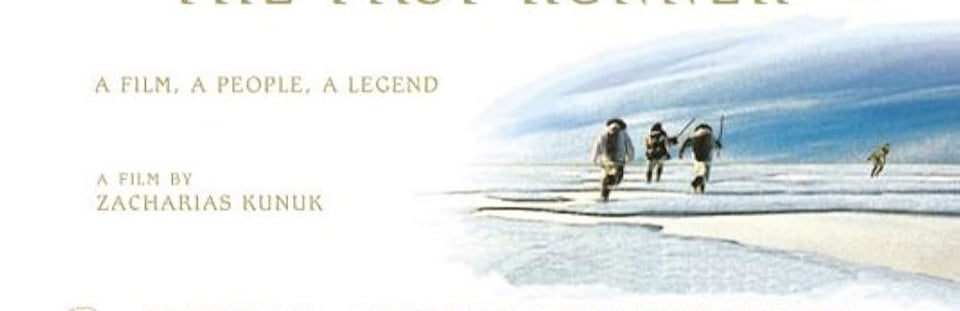
Atanarjuat: The Fast Runner is a 2001 Inuit film by filmmaker Zacharias Kunuk and based on an Inuit oral history. I struggle to describe the film because, as a White westerner, I am likely to fall into the very trap that I am about to critique, and so I encourage you to read about and perhaps watch the film. It is a wonderful experience, and I say this as someone who famously is not a film enjoyer. The key feature of both myths and legend is that following the death of his brother, a man (sometimes named Atanarjuat) runs naked across the ice, recuperates, and then returns to his village to take revenge on/exile/banish the evil from his enemies3.
In his 2007 essay Atanarjuat, the Fast Runner and Its Audiences Arnold Krupat describes the way that western/southern critics seem to approach the film from two standpoints: firstly, as an ethnographic work, that is one which seeks to bring a ‘foreign’ culture and make it accessible to the ‘dominant’ culture, or secondly as a ‘universal’ story, rife with comparison to the ‘greats’ of western literature—Shakespeare, Homer, and yes, the Monomyth.
It is this second group I’d like to focus on. Here are a few of the comments which Krupat has compiled:
“A plot that rivals Shakespeare for intrigue [and] treachery.”
- Robert Denerstein
“A Shakespearean tale of love and vengeance, of magic and bawdy humor.”
- KCRW
“The spirit of Joseph Campbell” and “Campbell’s sense of mythomania”
- Desson Howe, Paul Malcolm
or, my personal favourite:
“Homer with a video camera!”
- Margaret Atwood
Atwood. Worstie. What the fuck does that mean.
From my brief description, it seems that Atanarjuat would fit securely into the Hero’s Journey as Howe and Malcolm suggest, but that is the nature of abstraction. If I describe the plot of any work so vaguely, of course it could be twisted to appear as though it fit within whatever structure I suggested. Indeed, in the case of the movie my brief description completely ignores the complex relationships, dynamics, and culture which define the first few hours of the movie and indeed inform the entire work, before Atanarjuat ever runs out onto the ice. Again, I encourage you to watch the film. This is the problem with this kind of abstraction: you are likely to lose sight of the actual unique and interesting qualities of the work if you’re obsessed with cramming it into these tiny boxes.
While not exactly about the Monomyth, here’s an extract from a podcast episode that is another excellent example of atrocious abstraction completely missing the point of two individual works:
“I don’t know how there wasn’t a court case [for Rowling ripping off Earthsea] because Earthsea and Harry Potter are almost functionally identical to one another…an orphan boy whose parents were killed by the main bad guy doesn’t know he’s a magician, goes to a school when he’s 11 or 12, turns out he’s a really good magician…he’s got another best friend who’s a really smart girl who knows all the magic but she didn’t come from a magic family…and you go ‘HOLD ON A SECOND WHERE HAVE I READ THIS BEFORE?’”
- Media-eval: The Black Cauldron & the Sword in the Stone
Ok first of all: Ged isn’t orphaned, he knows he’s a magician from childhood, Tenar is NOT A FUCKING MAGICIAN AND ALSO SHE’S (maybe) THE REBORN PRIESTESS OF THE TOMBS—
(I’m mostly kidding, I know this is probably just a ‘it’s been a while’ recollection of Earthsea)
What I’m trying to say is that of-fucking-course if you abstract both Earthsea and Harry Potter down to the barest elements of ‘boy goes to wizard school’ they’re going to sound very similar.
The Hero’s Journey should be treated as a tool, not the be-all-end-all of a work of fiction. So much writing advice focuses on crafting your work into Campbell’s surprisingly restrictive structure, and so much media analysis by laymen functions from the standpoint of assuming that all stories must follow Campbell’s monomyth, to the point that the slightest variations become viewed as subversive and unique:
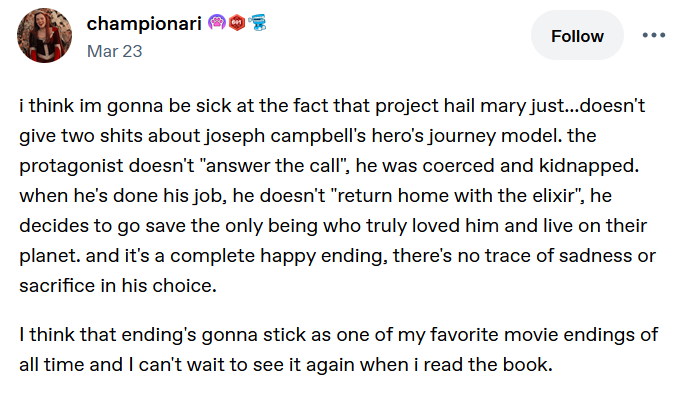
Look, not all stories follow the Hero’s Journey, but I assure you that Project Hail Mary does. It does very much so. Your analysis and understanding of individual works and a diverse literary canon which doesn’t just focus on traditional western stories will be stunted if you are unwilling to meet them on their own terms without enforcing your preconceived notions on them.
What I’m reading right now:
Terrible moment to admit I’m not reading anything. I’ve been too focused on writing and going bouldering. I recently read The Works of Vermin though and oh my god please please read that book. I would love to do a newsletter on it but I truly have no idea what I would say.
An album to listen to:
Wide Open Space by Roosmarijn. I’ve been enjoying it a lot.
What I’m working on:
Evil novella. Trying to get it drafted and through at least one set of edits before the end of the month, partly because I want to submit it to a specific call, and partly to see if I can. It’s actually something of a quest story that I think doesn’t fit the monomyth at all, so take THAT Campbell. Parts of it are also in verse. Because I’m evil.
How the knight leapt at them — the first rider,
a towering creature, face the pitted marble
of a fallen saint’s icon, was dashed down where it stood
to scatter as chips at the dancing feet
of the knight as she ran already to fell the next.
Look at me, feeding already into the abstraction of a thing to make it suit my own goals. Whatever shall we do. ↩
Campbell, Joseph (1949). The Hero with a Thousand Faces (1st ed.). Princeton, NJ: Princeton University Press. ISBN 9780691097435. ↩
The nature of oral histories is that they are changed and adapted with each retelling, and there are hundreds of variations of the Atanarjuat myth. The filmmakers studied a number of recorded versions, as well as talking to Inuit elders to collect numerous versions of the myth. The film then is yet another version, not tied to any one recorded myth. ↩
-
I did not read the whole thing but RRA was a big part of my logic class and my prof loved to say it in a flamboyant way like a magic spell


Add a comment: