
A World Made for You - Riven (2024)
Earlier this summer, to stave off the boredom of long days stuck in a small room with our lone air conditioner, I began to play a puzzle game with my mother. We explored an island falling apart, filled with puzzles, hidden rooms, and tricks of navigation. One of the key mechanics was a lens which revealed secret messages and images scrawled along the walls of a cell—
Oh sorry. I forgot. That was the Forever Lost series, a clear Myst knock-off1.
I don’t usually write traditional reviews. You may have noticed, well over a year into this newsletter. Usually I try to approach a work not in isolation but as a way of exploring a concept, tool, or theme in speculative fiction. However, I did just finish playing the remake of one of my favourite games of all time, and I have some thoughts that I felt would be best expressed in a slightly more traditional format. There are still about five hundred rambling digressions though.
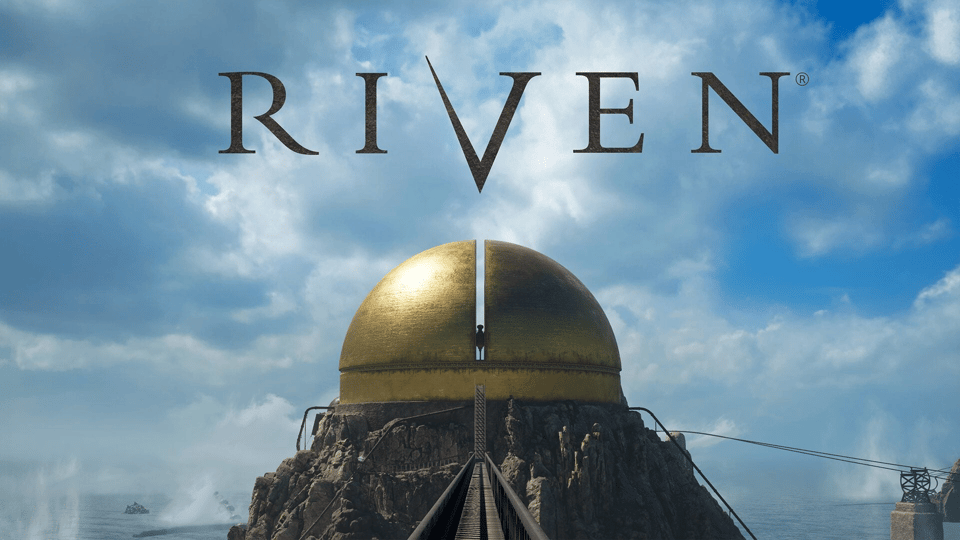
I first heard about the 2024 Riven remake when Claire Hummel (Shoomlah), the art director working on the project, posted about it on her Tumblr. I would consider Myst to be the first video game I ever played seriously, from start to finish, hunched up in our oversized spinning chair in my parents’ darkened office, for some reason having agreed to race my mother to the end of the game. I had never played anything like Myst before, my previous gaming experience having been largely confined to online flash games played on chromebooks between classes, and I was entranced. I sometimes wonder if my previous lack of gaming experience was one of the reasons I was so ready to accept a number of technical limitations that might put off your average gen-Zer when approaching a 90s point and click puzzle game. All that to say, I never really shut up about Myst after that weekend of clicking around the island and associated ages.
And then there was Riven.
From a darkened room, Atrus implored eleven year-old me (in a speech I would have to go back to later following some issues with my screen resolution, which is probably a good thing considering I absolutely had not listened the first time) to journey to a decaying age, trap his father, and perhaps…free the love of his life.
I landed on Riven, was imprisoned, freed, spun rooms, travelled from one island to the next, and the next, investigated workshops and learned number systems and made it to a bridge that—
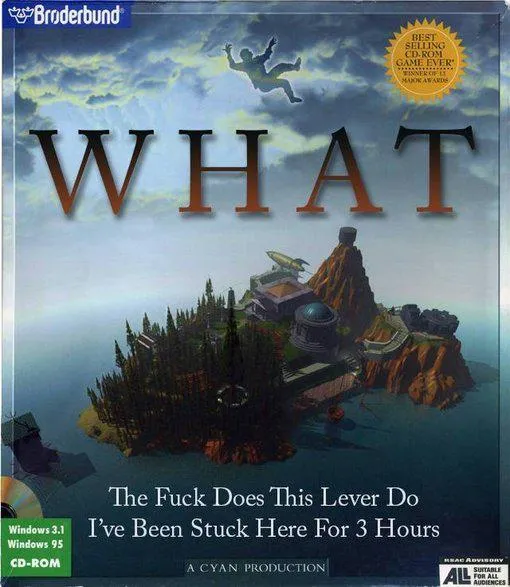
How do I lower this bridge. What? Did I not power something on? Did I need to change another steam tube? I thought I got this one—oh. I just couldn’t see the lever.
This was about when I started using hints.
Even so, it took me many, many hours to finish Riven that first playthrough, and I was utterly entranced by the world, the people within it, the generational drama playing out with the villagers as pawns in the hands of an imperialist man seeking to renew his home to glory and his son attempting to stop him.
While I enjoyed Myst, it was Riven that so entirely absorbed me because, as I said at the time, ‘this feels like a world I’m discovering, not a video game I’m completing’. I could believe that every ‘puzzle’ (except perhaps the marble puzzle, but I can’t begrudge the game its final set-piece) was an organic part of the world, the creation of a paranoid madman or the rebels hiding from him.
While there was no way I could have made it through the game without those hints, it still weighed on me that I would never truly get to discover the world without someone holding my hand. My memory was then, as it is now, too good to replay a puzzle game without recalling all the solutions.
Riven (2024) is about to come out. Fully redone graphics. Rediscover the world you love. It will probably make you cry because you’re an overemotional creature and you know this world inside out.
First things first, Riven (2024) is absolutely gorgeous. This cannot be overstated. The absolute care and devotion that was put into every model, every texture, every tiny animation absolutely shine through. For a game made in 1997, Riven: The sequel to Myst was stunning, and the remake absolutely lives up to that expectation in our modern age. I spent a little time seeing what little spaces I could walk into. At one point, I wandered to the far side of the maglev platform and behind the station to stare out over the cliffs and the horizon. Even the water texture, slightly gelatinous, physics defying, has been captured and rendered into animated 3D.
Two brief notes are required here:
1) I could not play the game on my computer when I first bought it, because I have the worst graphics card known to man, apparently. in other words, the system requirements for the game are unfortunately much higher than I expected2
2) This game made me incredibly nauseous, even from the get go. I don’t know if it’s the walking, the water, or what, but I played this game twice over five months and each time I had to take regular breaks to drink water and calm my stomach.
Despite the nausea, the game controls well and it feels good to walk around and explore (very important for a game that is 99% walking around). I do wish that they had a Myst 3/Myst 4 type ‘even though this is 3D rendered you can still click around like it’s a point-and-click but then look around’ option, for my own sanity.
Certain rooms have been changed or even moved to new locations, and there was always a moment of disorientation and glee as I stepped through a doorway to find myself not at all where I thought I was. Certain moments of progression have been streamlined, and things shifted to clarify certain elements which may have been confusing in the original. Even lore elements have been updated, Catherine’s journal in particular having been substantially reworked with a modern perception of current politics in a way that I found surprisingly enjoyable, though perhaps a little hand-holdy as it assured me of Gehn’s imperialistic goals. I had rather expected a one-to-one remastering, a graphics and engine upgrade, but that is not what Riven (2024) is.
I expect that this review has seemed rather tonally dissonant from the harsh introduction of this newsletter. Perhaps you will notice that I have so far failed to mention an important element of this game, which is that Riven (1997) and Riven (2024) are puzzle games. So, let’s talk about puzzle design.
Riven (2024) was faced with a serious challenge: they intended to fill the world with entirely new puzzles, but, as noted earlier, the original Riven was an absolute masterclass in environmental storytelling and integrated puzzles. Each island, each room, each individual point-and-click frame was carefully designed to further the puzzles. If you remove the final marble puzzle, the entirety of Plateau Island becomes extraneous, but there is no way you could remove Plateau island. I mean, just look at it:
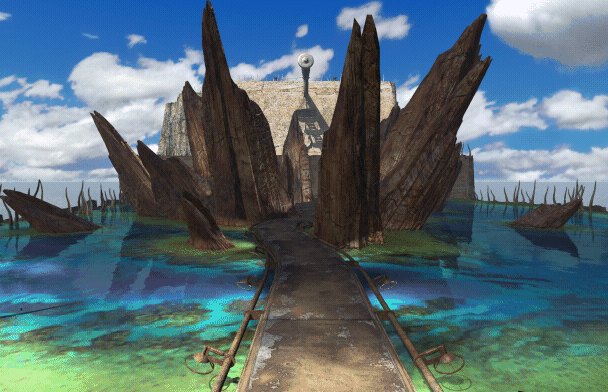
This is what I mean when I say that Riven: the Sequel to Myst (1997) is utterly gorgeous.
There is no easy solution to this problem. The developers were limited to a preexisting world and trying to fit their new puzzles to this world. Even if you replace the particular part of the puzzle at Plateau Island with something else, it will never fit quite as perfectly into that space, because the entire island was designed for a particular purpose, and you’ve simply scraped that purpose out and attempted to replace it with something else, something notably simpler. Put a pin in that.
Another particularly telling element, which bore clear artifacts of this adaptational process, was the inclusion of the Rivenese number system.
One of the most interesting (to me and, I’m sure because of a reddit misstep I made as a teenager, many other people) parts of Riven is the introduction of the D’ni number system. The game presents you with a series of numerals through a children’s game in-world and expects you to be able to figure out how the number system works. This is not a one-to-one substitution cipher type of system, but rather a base five number system. This system forces the player to work within a new numerical framework to solve puzzles, and this system is implemented organically throughout the game.
Now, if you’re remaking Riven, there is no way in hell you can get rid of the number system, but…all your old fans will almost certainly know it by heart, removing the mental game of base conversions. So what do you do?
Just…add another number system I guess??? On its surface this isn’t a terrible solution, but frankly, if you can switch to one new base system, you can switch to another. This is not a challenge for your old players, and it does little more than clutter up the game with a redundant challenge3.
Let’s return to that pin, shall we? I cannot remember a single puzzle that was not made even slightly simpler in the remake. Remember how I mentioned the game was streamlined? The entire game is bafflingly linear. There were always certain tasks in Riven (1997) which had to be completed in a loose order to progress, but now even things like being able to access certain maglevs before others have been removed. You will be playing this game exactly as the creators intended. This also has the strange effect, alongside rooms having been moved about, of creating somewhat nonsensical sequences of rooms. Why is Gehn’s control and surveillance room balanced on the side of a cliff? Why does a maglev lead to an incredibly fancy elevator which then leads to…another maglev? No longer do you need to draw your own map of the submersible lake, fear not! Now it’s just a loop with four stops arranged in a ring on your controller.
I’ve danced around my major problem for a while now. Shall we recall something briefly?
One of the key mechanics was a lens which revealed secret messages and images scrawled along the walls of a cell—
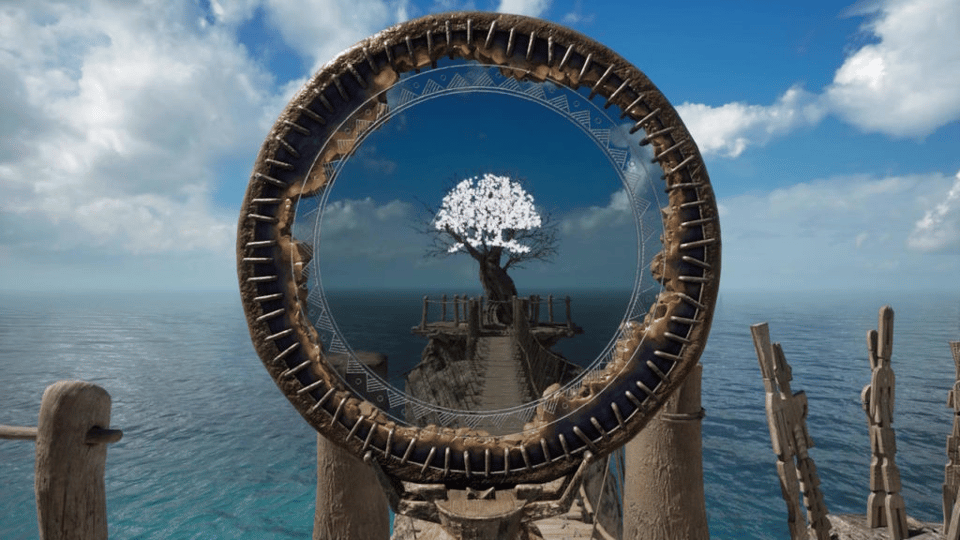
Why. Am I using. A black light. In Riven.
This isn’t even a spoiler. This is one of the first things you are given in the game.
What.
What.
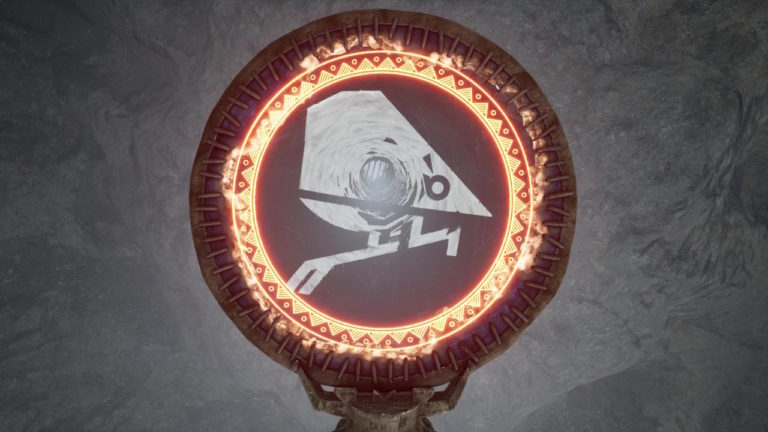
What are we doing here. Why have you given me a lens that glows when you’re near the solution of a puzzle??? Where’s the organic realization of the ways that things on the island are interconnected, where an inconsequential moment early on are recontextualized as the solution to something you didn’t even realize was a puzzle, hidden among the careful elements of this world. Riven (2024) no longer feels like a world, independent of your existence, that you must traverse in order to achieve your goals. Instead, it feels rather like what it is: a game with a beautiful world, full of puzzles that were added after the fact. This world was made for you.
In this way Riven (2024) somehow manages to undermine its own thematic core—Gehn, who believes that he has created the age, created this world to his own specifications, is countered by Catherine, native to the age, strong in her belief of its natural existence. Again, this was made even more literal and explicit in the remake. They want you to be considering these themes. There is an inherent irony in the debate between Atrus and Gehn on whether the ages are created by their hands, considering that the entire game is, well, a game. However, the original Riven does a wonderful job of making you forget, just for a while, that this is all a game.
This makes the entire issue sound far more important than it perhaps is. It is challenging to talk about this game, because it is so clearly a labour of love and on a technical level very well done, and yet…and yet it seems to trip over itself and its own best intentions.
In our emulation of the classic review structure, I must now assure you that…these were not complaints I actively had while playing (well, besides the lens. I did maybe yell out loud at how stupid I thought it was at the time). I was totally engrossed, and that feeling deep at the core of my experience with the original game, that I would never get to discover and play it as it was intended, has finally been put to sleep. There is no way I would have been so engrossed without the new puzzles holding my attention. I played Riven (2024) exactly as intended, linearity and all, and was shocked and joyful by turn by certain changes (there are a few areas which, once inaccessible, are now open to you, and this was another instance of me yelling into the living room, in glee this time). All the same, at the end, I was left with a slight feeling of discomfort, of having seen this game reanimated, in all senses of the word.
Anyway, Riven: the Sequel to Myst (1997) is about £6 on GOG. Just saying.
What I’m reading right now:
Well I’m back in the lab and listening to comfort books (Royal Assassin) and I’ve just acquired the project Gutenberg translation of the Poetic Edda, so great things happening for Lizard
An album to listen to:
Obsessively listening to Grip Your Fist, I’m Heaven Bound by Racing Mount Pleasant currently
Still very very fun despite being a knock-off if you’re the back-seat driver shouting at the player about puzzles she’s missed and ‘no not that way go—no, no, the second house, you still need to develop that film, wait—’ ↩
Though the game was made in unreal engine, so I suppose I can’t entirely blame them. On the other hand, I could play Obduction no problem. ↩
You could argue that this ties into the game’s themes of colonialism and Gehn’s forcing of Riven’s native inhabitants into the D’ni numeral system, but that was already explicit in the original game. You don’t need to handhold me through it, thank you. ↩


Add a comment: