
DG News: September 2026
Hello and welcome to the September issue of the Discourse Graph newsletter. Extend your holiday tan by bringing new ideas to light with discourse graphs.
New in the Obsidian plugin
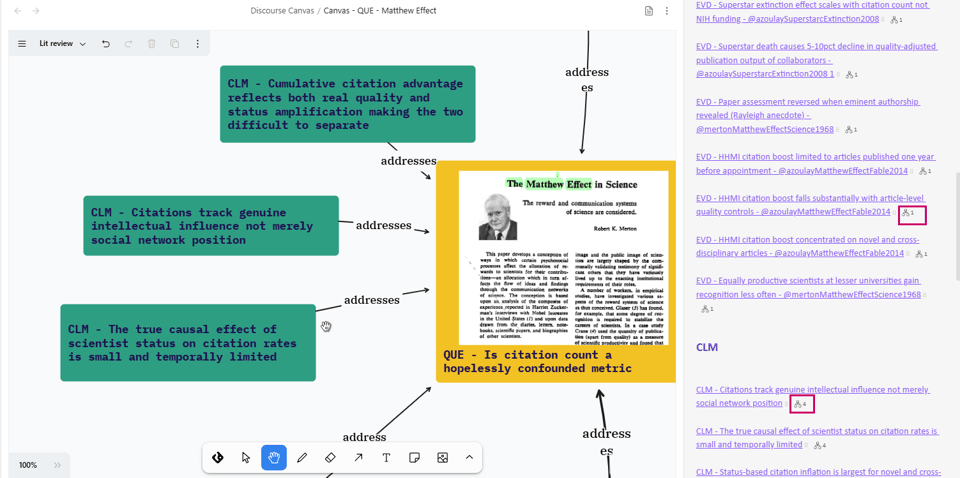
The discourse context overlay
The discourse context overlay provides an at-a-glance summary of the number of discourse relations associated with any discourse node. Click the badge to see a popover listing the node's relations, with an option to add one.
Schema export and import
Get on the same page with your collaborators by sharing your node types, relation types, relation triples and templates between vaults. Select "Export discourse graph schema" from the Command Palette or General Settings to pick items from a checklist and save them as a JSON file. Select "Import discourse graph schema" to open a schema file and choose which terms to add to your vault.
Convert more canvas shapes to nodes
The canvas right-click Convert To menu now works on labelled geometric shapes and sticky notes, as well as text and images.
New in the Roam plugin
Cloud collaborator names
Now you can see who's zoomin' who — the names of your remote collaborators appear under their cursors in cloud canvases.
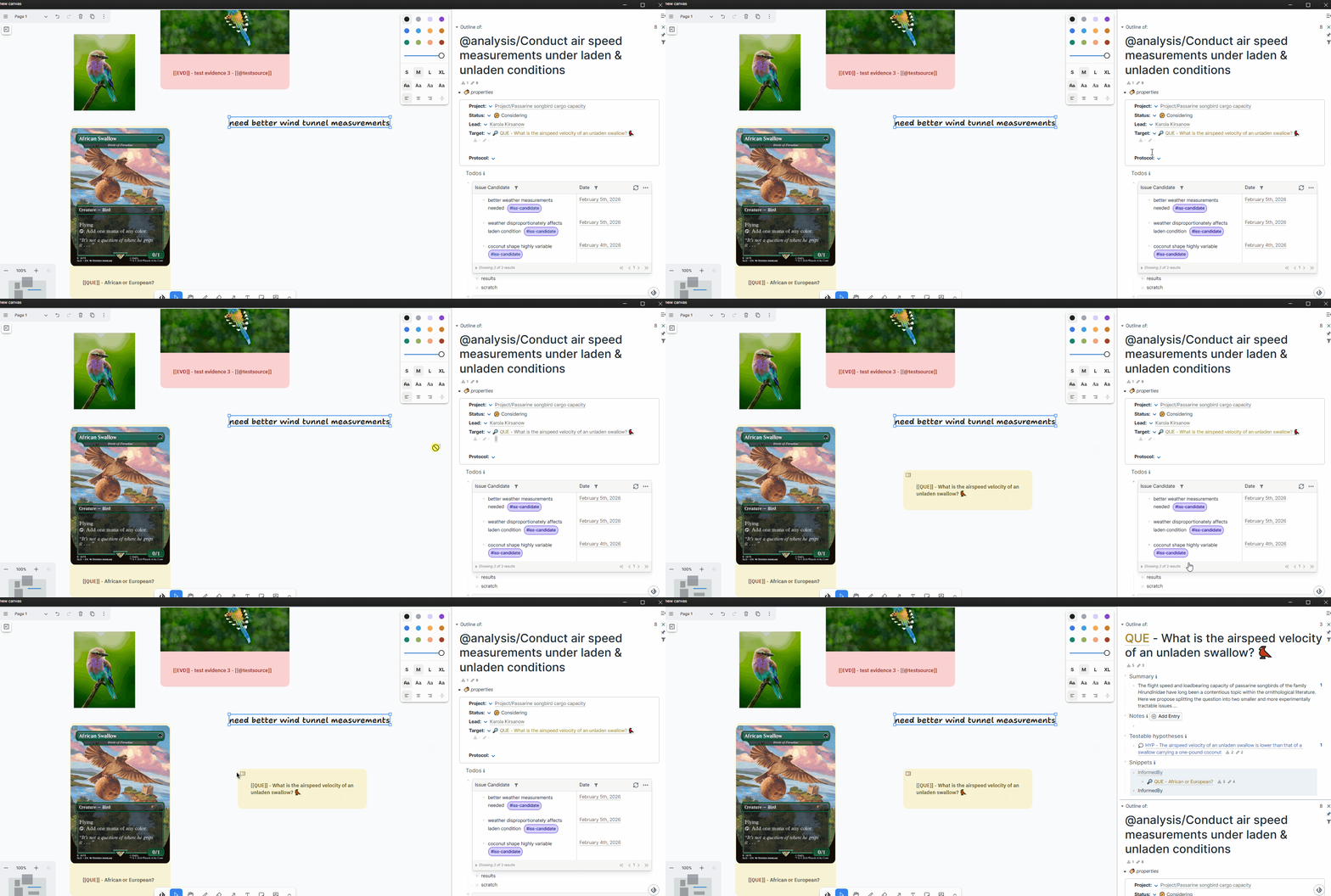
Drag pages to the canvas
Pages can be dragged onto the canvas to create node shapes.
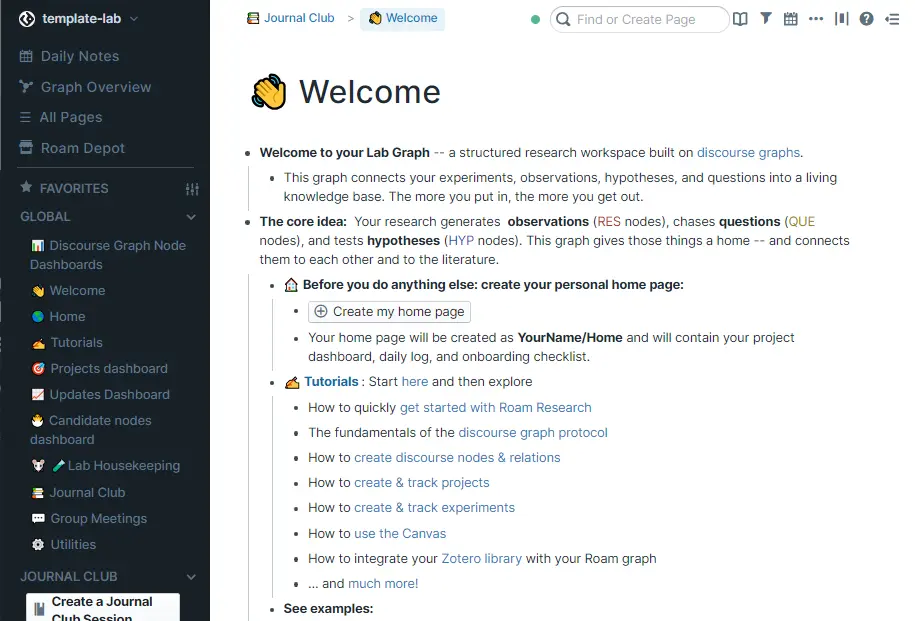
Ask the docs: getting started with the Roam Research template graph
Want to get started with discourse graphs in Roam but don’t know where to start? Follow this guide to download and install our batteries-included starter kit for discourse graphing in Roam.
Dispatches from the frontier: a series on how discourse graphs are improving scientific research
We've deployed discourse graph tools to labs across cell biology, biophysics, and human-computer interaction — over six labs including the OASIS Lab at the University of Maryland, the MATSUlab at the University of Washington, the Holehouse Lab at Washington University School of Medicine, and the Allen Institute for Cell Science — as well as to individual researchers around the world. Our question: how can discourse graphs be used to accelerate research?
In our August issue, we shared how discourse graphs can be used for iterative synthesis of research results.
This month, we'll look at how discourse graphs can be used to bring newcomers to a lab up to speed on cutting-edge research.
Lowered barriers for newcomers to a research project
CLAIM: New lab members face a steep ramp: understanding the lab's questions, methods, and accumulated knowledge. Discourse graphs embedded in hypertext provide navigable context—questions linked to projects, evidence linked to claims, results linked to interpretations.
EVIDENCE: No more staring at a blank page: a first-year cell biology PhD student at the Stowers Institute for Medical Research reported that the discourse graph structure in her notebook lowered the barrier to meaningfully engage in a new project.
EVIDENCE: A new team member at the Allen Institute for Cell Science reported having a "much clearer" understanding of the context of a project after seeing issues and relevant hypotheses for the project.
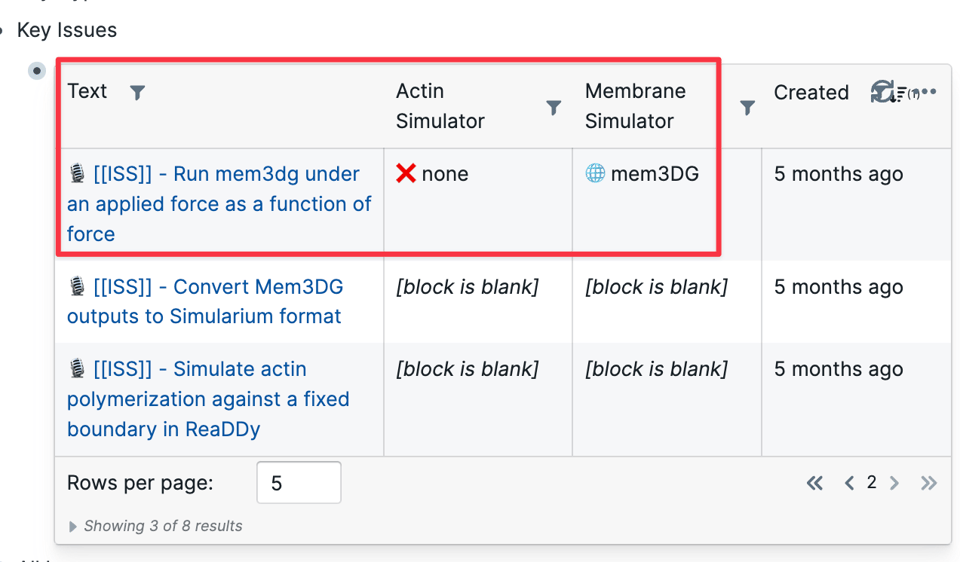
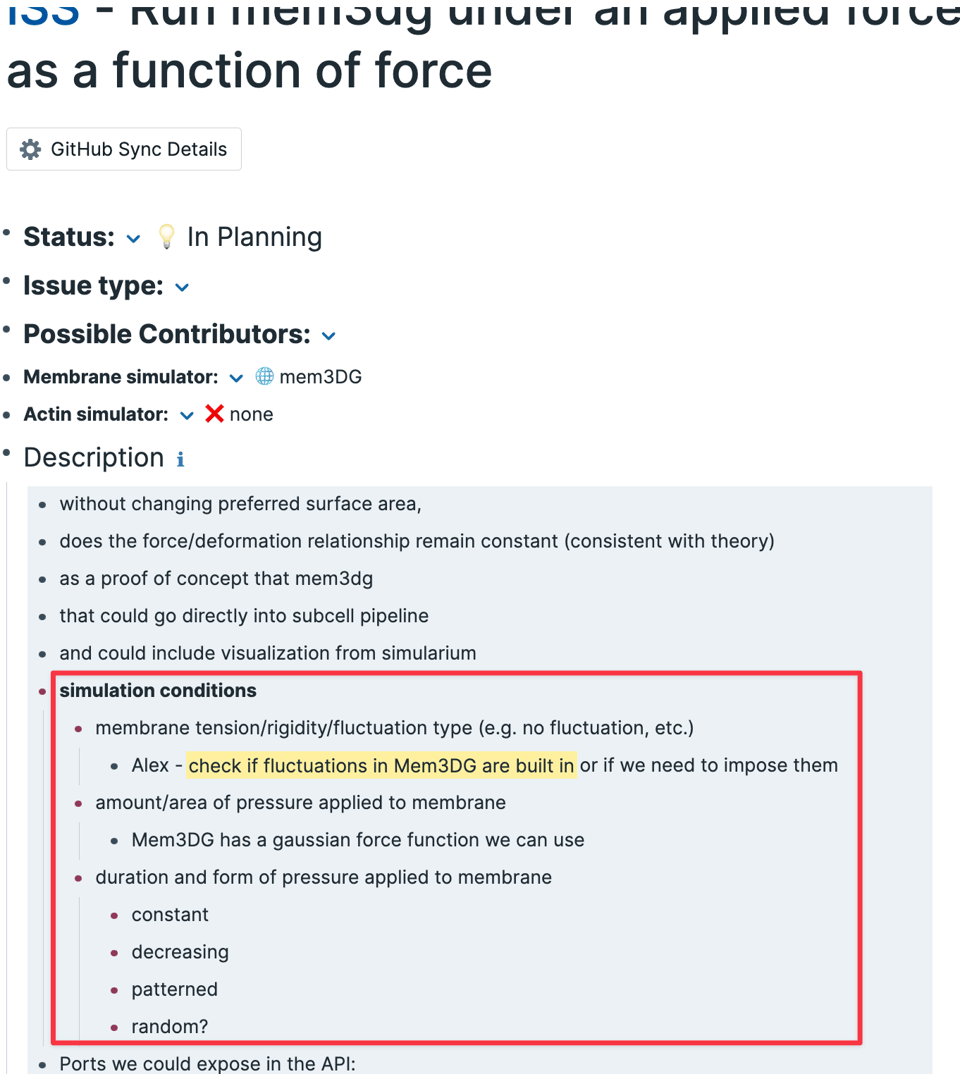
EVIDENCE: An undergraduate biology student at the University of Washington used the lab discourse graph to kickstart his time in the lab by claiming and completing open issue without the PI's involvement.
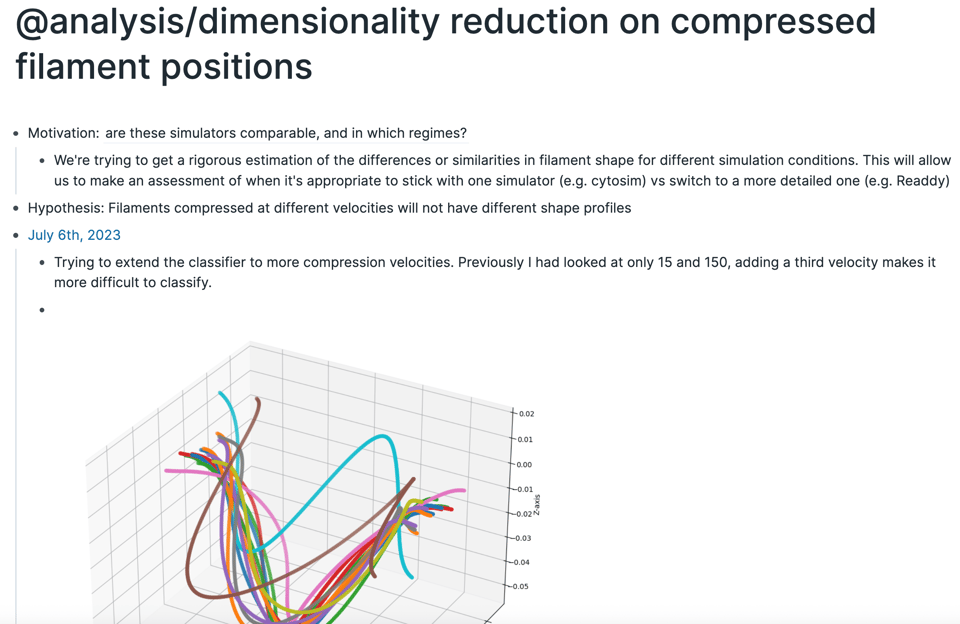
CLAIM: Convenient access to granular discourse nodes (hypotheses, evidence, sources) accelerates and improves experiment planning by enabling direct conversation with prior work.
Tune in next month when we explore how our pilot users are using discourse graphs to run better meetings and form stronger research collaborations!
We'd love to hear from you about how you've been using discourse graphs to accelerate your research. Please contact us via email to share your experiences!
Contributions
We’re always delighted to receive community contributions in the form of issues and pull requests in our GitHub repo. This month we’d like to highlight DiscourseGraphs/discourse-graph/pull/1258, which makes the Obsidian plugin fall back to Obsidian's own metadata while Datacore is still indexing, so discourse nodes don't go missing in the meantime. Many thanks to Nathan Skene of the UK Dementia Research Institute for the fix!
If you're interested in contributing to the project, please read our guide on GitHub for how to do so.
We are also open to sponsors, collaborators, and grant opportunities. Please contact us via email if you are interested in supporting us.
Join our Slack for quick updates, tips, and troubleshooting. And don’t forget to follow us on Bluesky for all the news that’s fit to skeet.
Thanks for reading and joining us on this journey to make science and research easier and more accessible for everyone. Until next time!


