
Palestine 1936 by Oren Kessler
Oren Kessler examines the Great Arab Revolt of 1936–1939 and the origins of the modern Middle East conflict.
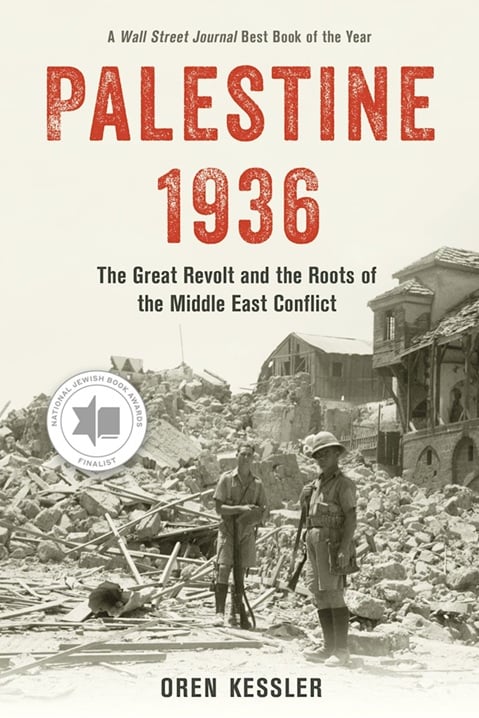
First published by Rowman & Littlefield in 2023, Oren Kessler’s Palestine 1936: The Great Revolt and the Roots of the Middle East Conflict is an essential book on the early years of the conflict.
Upgrade nowPalestine 1936 reconstructs the 1936–1939 Arab uprising against both British Mandatory rule and the growing Zionist presence in the Holy Land as a foundational moment in the modern Middle East. What began as a widespread revolt quickly escalated into a prolonged, violent struggle that drew in Palestinian Arabs, Jewish communities, and British forces, leaving thousands dead and reshaping political realities on the ground. Rather than treating the revolt as a standalone episode, the book frames it as the first major, sustained collision between two national movements whose competing ambitions would define the region for decades to come.
At the same time, the narrative emphasizes how the uprising transformed each side internally. For Palestinian Arabs, the revolt briefly forged a stronger collective identity across class and regional divides, even as internal fractures, rivalries, and escalating repression undermined the movement and contributed to displacement and long-term political weakness. For the Zionist community, the conflict marked a turning point toward militarization and strategic self-reliance, as cooperation with British authorities helped build the foundations of a more organized defense infrastructure. The period also brought key international concepts—such as partition and the idea of a Jewish state—into serious diplomatic discussion, setting precedents that would echo through later generations.
When Palestine 1936 was first published, October 7 had not yet happened, and a ceasefire was still in place. By the time the paperback edition arrived, it was nearly a year and three months after the attack. In a post–October 7 world, the book proved to be timelier and more relevant than ever.
It took me a few months longer to read than I would have liked, but that was because there were many Shabbos afternoons when all I wanted to do was catch up on sleep. Once I started reading, however, I found myself absorbing every bit of the history. The book provided an added perspective that many people fail to consider when tearing one another down on social media. Telling the story of this conflict means introducing readers to the key players on all sides: British, Jewish, and Arab. The earlier Balfour Declaration would eventually give way to the Peel Partition Plan in 1937 and, ultimately, the White Paper of 1939. The Peel Plan was rejected, and while Zionists repudiated the White Paper, Parliament approved it before the Arab Higher Committee formally rejected it a week later. The main text comes to an end in 1939.
Plenty of books have explored what happened during the decades that followed, including The Missing Peace: The Inside Story of the Fight for Middle East Peace by Amb. Dennis Ross. Ross’s book is an in-depth account of the peace talks that took place between 1988 and 2001. By comparison, Kessler does his best to condense nearly a century of history into a 20-page epilogue. Whether readers ultimately choose to learn something from it, I do not know.
This is one of those books where pulling a few quotes or discussing select passages would not do it justice. Because of the nature of what Kessler is doing here, there are simply too many important moments and insights to single out.
Palestine 1936 is a book that I believe ought to be mandatory reading for anyone wishing to discuss the Middle East conflict. Kessler does not choose one side over the other but instead takes an even-handed approach to exploring the history, introducing readers to the major figures, movements, and decisions that continue to shape the region today.
