PHOTO ESSAY: The Remains of KK Park
Before it got torn down, it had grown to the size of a small country. Here's a rare look inside the ruins of what was once the world's largest scam compound.

There’s a Russian proverb you often hear in journalism: Trust, but verify. When it comes to covering the scam industry, though, there’s very little trust to go around. So when I saw the headlines late last year about the Myanmar military’s sudden demolition of the KK Park scam compound and the government’s new “zero tolerance” policy toward online fraud, I knew I needed to take a closer look to see what it all added up to.
I finally got a chance to do that last month when I made my most detailed assessment yet of the cyber-scamming hotspots along the Thai-Myanmar border. I’ve done these trips before while reporting The Big Trace, but this time I focused more on mapping and photography to get a clear sense of what’s changed since my last visit before Burmese troops started detonating buildings inside KK Park last October.
The short answer is that there are now some real eyesores along the Thai-Myanmar border where large-scale scam compounds used to operate. Some look abandoned, others torn apart—none more so than KK Park—while others appear intact but quieter, as if everyone inside got told not go out except for some stray motorcycle idling by. But when you peek further inside Myanmar, you can see tons of new construction happening along a much-longer stretch of the narrow river that separates Thailand and Myanmar. It’s still happening—it’s just harder to see because the newer compounds are more difficult to spot. That is, of course, by design. And it’s a fitting illustration of what’s going along the Moei River these days: The criminality is moving further inland to make it harder to see, witness, document and corroborate.
But yes, it is, still there.
In this two-part series, I’ll take you on a guided tour of what I saw along the border. We’ll start with KK Park and some never-before-seen images of the destruction inside. Then, in part two, I’ll show you what’s replacing these eye-catching eyesores further inland on the Myanmar side of the Moei and share some take-aways on how the scam industry is pivoting in response to pressure from law enforcement.
But first, a big thanks to the team that made this expedition a success. I’m especially grateful to my fixer for helping me and my driver navigate the muddy and uneven roads along a 100 kilometer stretch of the Moei and to Erin West from anti-scam nonprofit Operation Shamrock for helping us document the beauty and tragedy of the bucolic landscapes we visited. Keep an eye out for her mini-documentary about our trip, and all the great work she’s doing to raise awareness about what’s happening in these remote corners of the globe that steal so much from so many.
And if you find this reporting valuable and wish to get more of it, please sign up for this newsletter; I have lots more planned as I finish The Big Trace and I’d love to keep you posted. But for now, let’s start our journey in an online scam compound that grew so large that it was the size of a small country before it got blown to pieces by Myanmar’s military.
Subscribe nowSacrificial Lamb
If you’ve never heard of KK Park, here’s a quick primer on the images you’re about to see.
In December 2019, construction started on a smattering of buildings along a sharp bend in the Moei River. The site was just a few miles south of Myawaddy, a trade hub on the Thai-Myanmar border located in an area controlled by a militia under the command of Myanmar’s military. Construction sped-up once the military staged a coup on February 1, 2021, overthrowing Myanmar’s civilian-led government. Besides dashing hopes for peace and democracy in the Southeast Asian nation of 55 million, the coup also enabled Chinese cybercriminal gangs to scale-up the business model that prompted mysterious projects like KK Park to sprout up along the Moei River: They could buy large tracts of land, pay for protection to crooked militias who would enable them to ply their craft with impunity, and enjoy high-speed internet, fuel and electricity from Thailand, not to mention smuggling routes that made it easy to get thousands of people across the border to work in supposed telemarketing jobs that were really online scamming jobs in disguise. Once recruits arrived, the cybercriminal bosses confiscated their passports and forced them to target people around the world with elaborate forms of cyber fraud, including the infamous “pig-butchering scam” that went global during the COVID-19 pandemic.
I’ve mapped dozens of these walled-off facilities along the Moei; none grew bigger than the industrialized cyber fraud super-site known as KK Park. By October 2025, it was slightly bigger (520 acres) than Monaco, a small country on the French Riviera, and it functioned like its own city, with casinos, a hospital, stores, restaurants, villas for bosses, guard posts, barbed wire fencing and other infrastructure necessary to enable human trafficking-fueled online fraud to flourish on a vast scale. There was no official count of how many people toiled inside, but one population estimate published by Mizzima, a Burmese news outlet, put it at 40,000, which aligns with my reporting. It was a cybercriminal citadel, and Myanmar’s rulers had little reason to shut it down; KK Park and similar compounds further north (along with Shwe Kokko, a city hosting such operations) were protected by a border militia under the command of the junta, which made the scam industry a good source of much-needed revenue amid the civil war sparked by the February 2021 coup.
But by October 2025, diplomatic pressure to crack down had ramped up to the point that Myanmar’s generals had to do something to show they were taking action. They needed to legitimize themselves in the eyes of the international community, especially ahead of an upcoming December 2025 election that Myanmar’s military junta would point to as a validation of its power grab. In that context, demolishing KK Park made a lot of sense. Within weeks of the military’s October 19 entry into KK Park, videos of the damage were aired on Myanmar’s state-run TV, and by early December, government-run news sites published daily updates showing which buildings had been demolished, when and where. We got our final update on January 10, 2026, when the government published the last of these Bingo-like graphics and declared, with much fanfare, that “all illegal structures” inside KK Park had been “systematically demolished.” By the government’s count, there were 635 buildings inside KK Park, and the junta claimed that all had been incapacitated either by controlled detonations or heavy machinery.
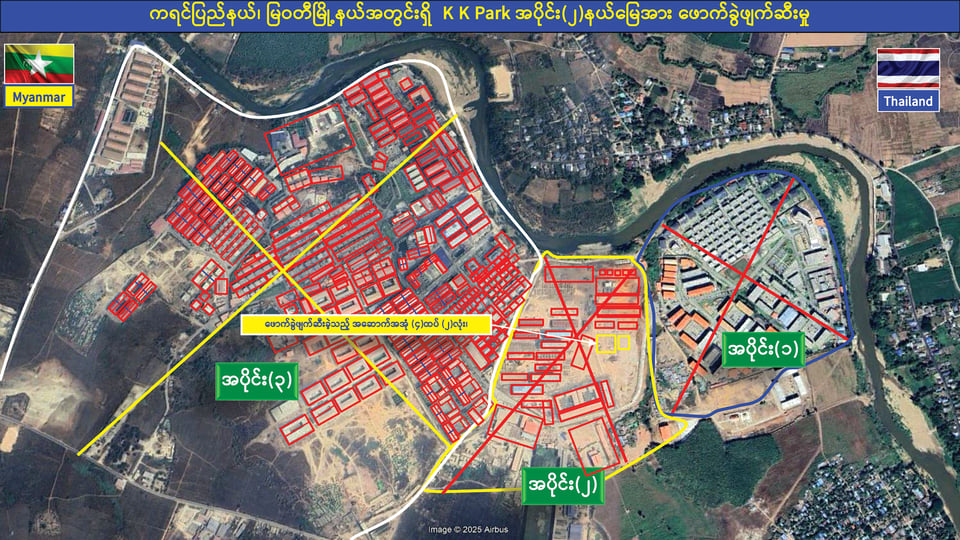
Below is the last of the junta’s demolition progress maps. The red outlines show buildings the military claimed to have demolished between October 2025 and January 2026. In part two of this series, I’ll get to what happened with the people who worked inside. But for now, let’s take a look at what remains of the physical infrastructure that used to house them.
Old KK
The oldest section of KK Park, labeled in some Chinese maps as “Old KK,” contained many of the most instantly-recognizable structures within the fraud complex. Old KK featured rows of low-rise dorms and office buildings alongside a golden casino on the banks of the Moei River. For context, here’s what the casino looked like before the demolition.

And here is what remained of it in August 2026.
Below is what the area looks like from above. The piles of metal that you see are clearly getting sorted for recycling. In fact, much of KK Park resembles a large recycling project as workers sift through the remains of dilapidated dorms and office buildings to peel off scrap metal for transport.

Next door to the former casino, the rows of dormitory buildings that used to house workers inside Old KK are still standing, but they’re uninhabitable.

Here’s what the dorms used to look like before the demolition.

Further down the river, Old KK’s former commercial district—shops, restaurants and the like—and several of the office buildings adjoining it have been wiped out.

Here’s a bird’s eye view of the whole area. Note the massive recycling project under way.
Another section of Old KK used to house villas for higher-ups. That’s now just a flattened wasteland, too.

Jinzhou
Next to the vanquished villas, another section of KK Park known as Jinzhou Park resembles much of Old KK: Piles of rubble and partially-collapsed buildings that look ready to topple over. One already has.

Here’s a wider view of Jinzhou. Remnants of structures that have already been demolished are getting sifted and sorted for scrap metal.
Baoli
Up the river from Old KK, a long, narrow, neighboring compound commonly known as Baoli or Poly Park is mostly still standing. Only a few structures inside look like they’ve been flattened and there are few signs of damage on the remaining buildings.

There is a practical reason for why most of Baoli might have been left untouched: Baoli sits directly across from a large Moei River trade gate with Thailand, making it an important logistical gateway for the entire KK Park complex. As of mid-August, the ferry crossing looked like it was still functional; a truck and several excavators sat parked inside.

KK Park itself had a smaller trade gate across from the golden casino in the Old KK Park section. The doors to that trade facility were shut and it looked empty inside.

Contrast that with last year, when the same trade gate was ferrying supplies from Thailand to aid the construction flourishing on the Myanmar side of the Moei.

Dongfeng
Now let’s switch to the other end of KK Park. About a mile down the river, another large section of KK Park known as Dongfeng sprung up in 2022. Dongfeng featured a similar smattering of villas, dorm and office buildings and what looked like its own casino and entertainment district. It was where the first controlled blasts could be heard in October 2025 after the Myanmar military’s incursion into KK Park, and where much of the destruction first showed up on satellite imagery once watchdog groups like Myanmar Witness dug in to assess the damage. Below is what the Dongfeng section looked like during my visit in August.

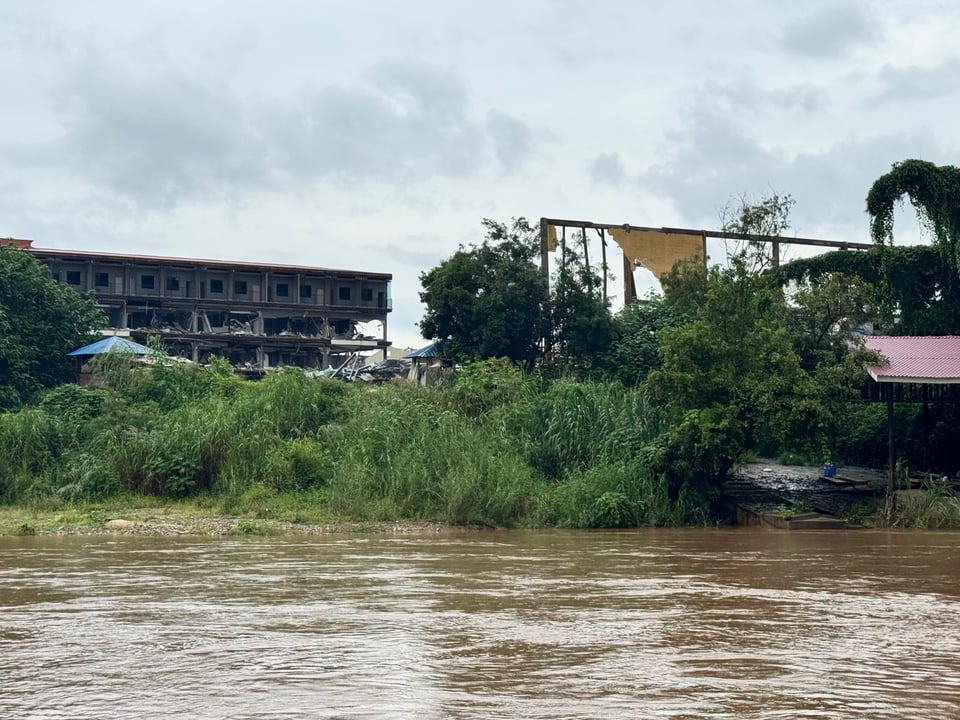
Back on the ground, as you drive along the Moei, you can’t miss this tilted building on Dongfeng’s riverfront. I’ve often heard it described as a hotel. It looks completely gutted and dilapidated. Below are before-and-after images of it in August 2026 and March 2025, respectively.


The hotel sat next to a garish casino-like building that formed Dongfeng’s entertainment district. It too has been wrecked but left standing.

Further inside Dongfeng, the large red building that dominated its skyline is also partially collapsed. Behind it, you can see one of two golden pagodas that sit untouched amid KK Park’s wreckage.

Next, let’s look at Dongfeng’s villa neighborhood. Half of the villas have been flattened. The other half are still standing, stripped of their walls. The remains are being sifted for scrap metal.

The larger mansions with blue roofs closer to the Moei River had their walls bashed-in with heavy machinery, but they’re still standing. So is the wall around the perimeter of Dongfeng.
Century Park
The area in between Old KK and Dongfeng was first filled-in between 2022 and 2023 with a new subdivision often identified as Century Park. This vast area underwent significant construction until 2024, when Century Park appeared to have been completed. Century Park has the most buildings left standing, though none look inhabitable. Advertisements are still visible on some of the partially-collapsed structures that were abandoned in a hurry.


Unfinished Construction
Another section in between Century and Dongfeng was cleared for development in 2024. By March 2025, construction had started and I could clearly see cranes and half-finished buildings on the Myanmar side of the Moei. The AFP later published a helpful infographic showing the fast pace of development in this unnamed area, which saw significant expansion throughout 2025.

Below is what the area looked like during my visit last month (foreground of image below). The rows of buildings that I photographed mid-construction in March 2025 were completed sometime later that year and then bashed-in with heavy machinery after the demolition started.

Zooming out, this is still the emptiest section of KK Park, thanks to the fact that it wasn’t complete by the time the demolition started last October.

To grasp just how big KK Park was before it got wrecked, here’s a bird’s eye view of the whole complex, from Old KK to Dongfeng.
KK Park’s massive footprint could easily eclipse many college campuses in the U.S. But don’t expect to see it get repurposed into a university anytime soon. The powers-that-be seem content with just letting it sit there and rot as its scrap metal gets recycled for new building projects elsewhere.
What building projects are there nearby? More on that in part two.