defaming film theory
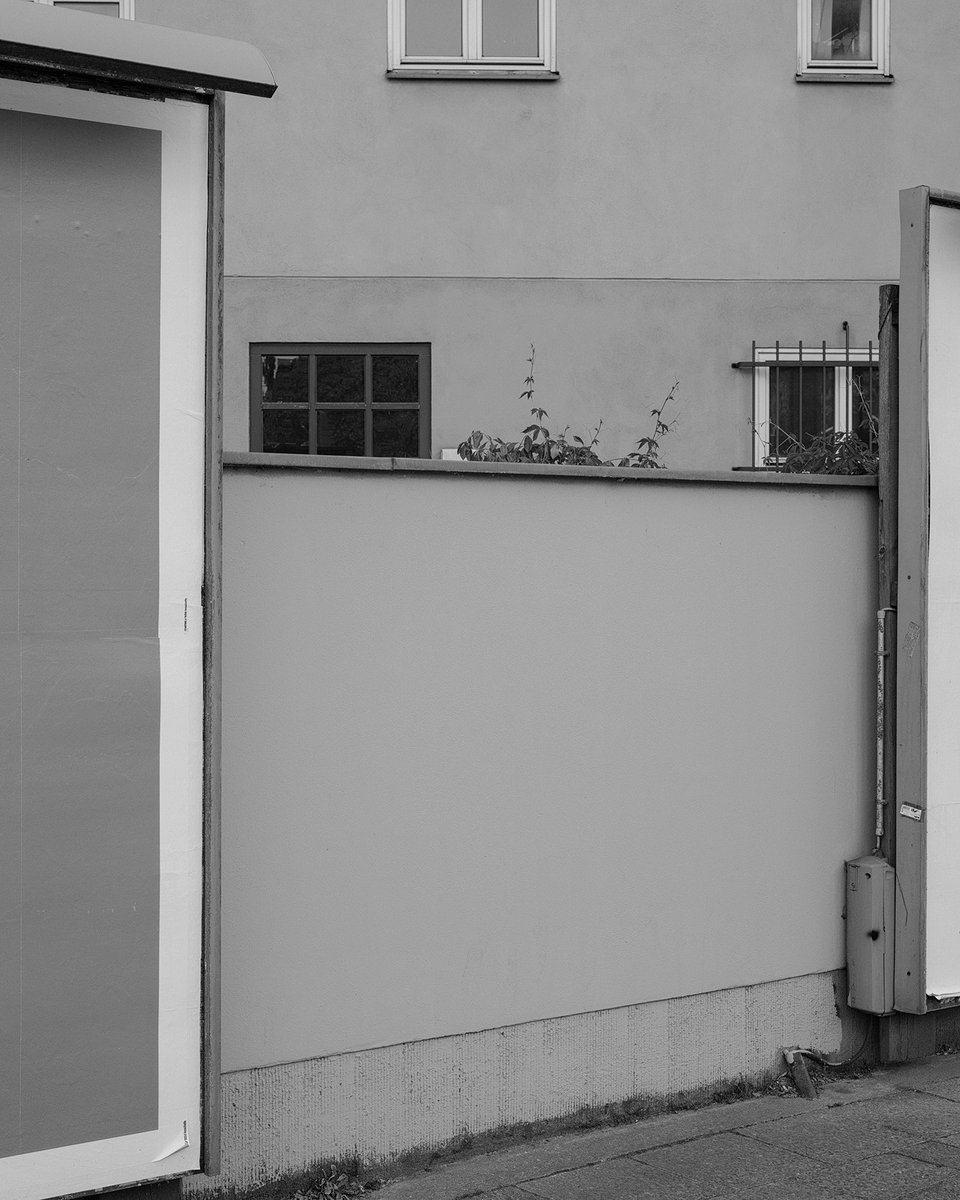
I like thinking about my photographs (mind you, after the fact) because it might teach me something. I remember when I took this picture in Berlin somewhat early one morning some day, it deeply resonated with me even before I saw it processed on my computer. This was a lucky find, too: every time I came back to that location, someone had written some graffiti in that blank spot. I would not have taken the photograph with graffiti in what now is a blank space, because that’s what the picture is all about, the blank space.
Or rather, of course, it is not about the blank space. It’s about anything but that blank space. I don’t necessarily want to explain the photograph — what I see in it, how it functions for me — because I find it incredibly tedious when photographers do that. After all, you have your own eyes to see, and you might see and/or feel something very different.
But there’s a bit of a strand going through my work, which I’ve always felt was something that you don’t ordinarily do in photography. Photography tends to be very pointy: hey, look at this! And then this (whatever it might be) is in the center of the frame. In many of my pictures, I enjoy pushing this out towards the edges of the frame — or beyond. I’ve always thought that I want to frustrate a viewer’s desire to see — by making them look at, well, nothing, while making it clear that there is something — it’s just that it’s barely at the edges of the frames.
I never was under any illusion that this idea was particularly original, even as I came across it by chance: in that Berlin moment, I saw the picture the way it would be. I don’t know why or how. I typically don’t tend to pre-visualize photographs. When I do, the pictures usually aren’t very good.
Regardless, for the past few days, I have been reading (or rather attempting to read) Amphibious Realities:The Documentary Poetics of Allan Sekula by Gail Day and Steve Edwards. I had been interested in Sekula, and a book about him sounded like a good idea. Alas… To begin with, the book is poorly produced (the photo insert section was bound grain wrong so the book is difficult to open). It’s also filled with enormously tedious academic jargon. On top of that, I’m not even convinced that the authors understand photography well. So I’m slowly making my way through the book — there is just enough insight for me not to just drop it.
Somewhere in the book, I came across what sounded like a description of the kinds of pictures I spoke of above: “In general, Sekula’s photographs avoid the device of de-framing, a compositional form discussed in film theory and usually achieved by pushing the subject to the image’s edge while hollowing out its centre.” (p. 85) The book has millions of footnotes to all kinds of Marxist “literature”, but there’s nothing here.
I tried using Google to find out more about “de-framing” but this has not been particularly successful. “Do you mean defaming?” Google asked me at some stage. Well no, but this is a good pointer for how degraded the internet has become: you can’t find a lot of things any longer, and instead you are offered nonsensical alternatives (yeah, Google, tell me more about “defaming film theory”).
Anyway, on the off chance that one of you — meaning the people who read this email — know more about de-framing in the context of film theory, please send me a note. I’ll be very grateful.
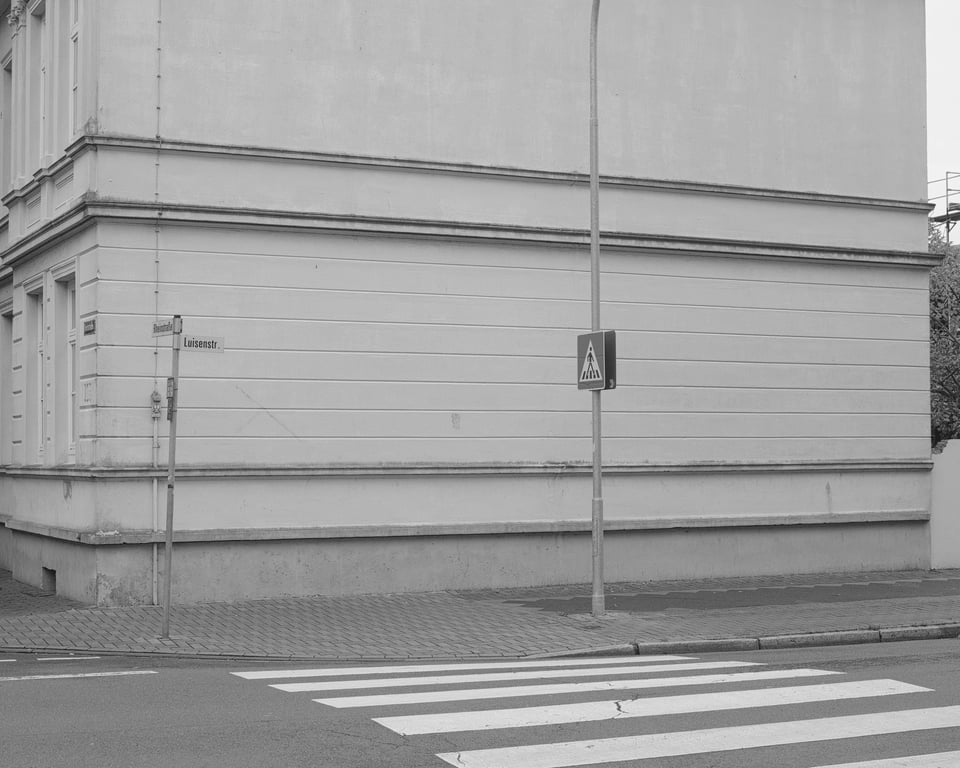
It’s not even that I want to put some large theory around my work. It’s just that finding parts of my work in some company that much smarter people than me have thought about might give me some insight.
Mieko Kawakami has a new novel out in English translation (which I haven’t read, yet). There have been some interviews, and there were two that stood out for me. This author has an uncanny ability to switch around even the most poorly phrased (or ill-informed) questions to deliver some real insight. For example:
“I think the role of literature is to disturb those who go about their lives without a care, completely sure and never doubting anything, and at the same time to ease, even if only a little, the burdens of those who go through life in a state of anxiety and fear. That’s my job as a writer.” (source)
Or:
“There seems to be an implicit suggestion that feminist literature is a separate form of expression, distinct from Literature with a capital-L. And that makes people feel less threatened, because it’s contained in a special category. […] If we can engage in a substantive discussion and my work is interpreted as a “feminist novel” as a result, then I would be happy with that. I’m not fed up with feminism, not at all. I just don’t want the label to be used as an excuse for intellectual laziness.” (source)
What does it feel like to live life under constant bombardment? Rahaa (not her real name), an Iranian educator who runs an art center in Tehran, tells us.
Naghmeh Sohrabi, the person who collected the above, is being interviewed here.
You really want to read all of this.
You also want to read this, a number of writers writing about, well, writing when writing does not make any money. I mean many of us are in that situation that they’re doing one thing (that pays the bills, however well or poorly) in order to support their creative practice. It’s a really long read, but it’s rewarding.
Kind of. I mean it’s rewarding, but I also found a lot of it really depressing.
These days, it’s depressing to be aware of how the world works, isn’t it?
If you have been reading along for a while you’ll know that I have the stupidest ideas. Somehow last night, before falling asleep, I thought that today, I needed to take a number of pictures of myself with my kids camera (the one with the built-in thermal printer), scan the prints, print them enlarged on letter-sized sheets, cut them up, and then re-assemble my face as a montage. I’m not afraid to admit that I did just that today:

There is some room for improvement, but this is not bad.
Just don’t ask me tomorrow what I think of it.
Well, anyway, that’s enough from me. I don’t even know what world I will be sending this email into because the news keeps changing on really small time scales.
We’ll just have to hope, however desperately, that all will be well eventually. When those four astronauts went around the moon, there were some brief moments where many people realized just that: all will be well, even though we’re not there, yet.
Thank you for reading! Be well!
— Jörg