Can I interest you in some scented candles?
After I sent out my last email, a number of you (thank you!) emailed me to help out with my quest to find something about “deframing”. In particular, there was one article pointed out (found here).
The article certainly is interesting, but I’m not sure whether it really helps me. Mind you, I’m not complaining — and certainly not about the kindness of all those who went looking for me. Instead, it might just be that the original reference (from that book about Allan Sekula) was simply a misdirection: the authors appeared to be talking about something that the term in question (“deframing”) was not really intended to describe.
This had me think that in the world of photography, we don’t really have a lot (or any?) in-detail writing about the photographic frame that goes beyond generalities, do we? I suppose discussions around this fall under “composition”. This never came up in my ten years of grad-school teaching, even though it’s a very important topic, in particular if you want to put a book together.
Obviously, I could simply not be aware of any discussions or texts. In which case the reasons for all of this confusion would all be mine. But I’d like to sort at least some of this out, even if it’s just for my own benefit (trying to understand how I can use the photographic frame to throw curve balls into how viewers see my pictures).
Speaking of confusion, for quite some time now I have been having problems making good photographs where I live. I can make ones that are good enough; but good enough is not good enough for me (if you know what I mean).
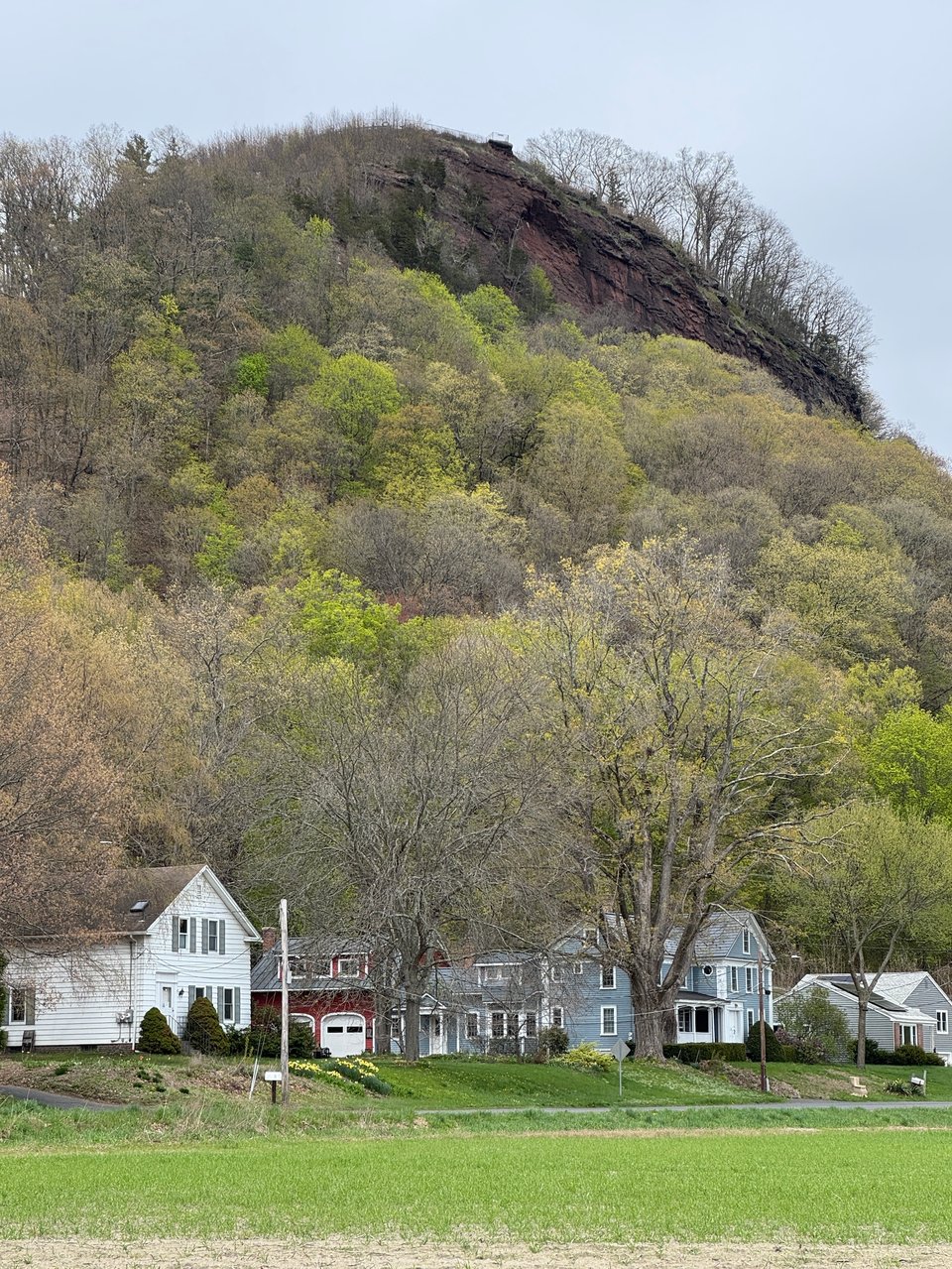
This is all very strange because I live in an area that people will travel to when they’re on vacation. A few miles up the road, for example, there is “colonial Deerfield”, a mix between a historical theme park and a quaint New England village. I could just go there and take some pictures, right? Believe me, I’ve tried. I got some good-enough pictures.
I think there used to be more vacation people in this area about fifty years ago when Bostonians would take a ride up what was and still is called “The Mohawk Trail”. But that has mostly disappeared. Now, people from Connecticut drive up I-91 for sightseeing and shopping (mostly in the town that I luckily don’t live in any longer).
In fact, right where I live there is a huge “Yankee Candle” store (there’s also a factory here). I honestly don’t understand the scented-candle business, but from the numbers of cars there I can tell that it’s better business than photography.
Anyway, it is very scenic in this area. You’ll have to take my word for it. It’s just that my pictures aren’t good enough for me. It would be good for me to figure out this problem, given that I cannot possibly rely on flying all the way to Central Europe (or Japan) to make pictures. I mean I like doing that. But at this point, I just don’t have enough free time to do so.
A while ago, I went to some outdoor market at “colonial Deerfield”. I don’t actually recall what it was for or about, only that it was in late fall. Part of the programming entailed being able to see the interiors of some of the old houses (without having to pay for that). That was moderately interesting if you’re into that kind of thing. (I’m not.)
I remember that in one of the houses, one of the guides proceeded to tell my partner and me all about the house and the village. That was moderately interesting if you’re into that kind of thing. (I’m not.)
But I do remember one detail, namely that the guide talked about “the English” and “we” while talking about some history more than 200 years ago. I don’t remember why or how this struck me as so absurd. To begin with, the people who settled in that village were colonialists from, you guessed it, England. Somehow, “the English” were now (I mean then, but the guide pulled it into the present) different than “we” (no idea how I possibly fit in there, what with me being German).
I suppose the impetus behind volunteering to tell visitors all about “the English” at some historical village might be very similar to what drives people to engage in historical re-enactments.
Photographers loving complaining about having to write. I will tell you a little secret: writing isn’t actually easier for people who do it professionally or often. It’s just that we writers have some basic tools (tricks) at our disposal that help us. One of those tricks is explained in this short video (starting at around 47 seconds in):
So there it is, the trick, namely what Tina Brown calls “the vomit draft”. Whatever you want to call simply writing things down to edit them later. As Philip Roth explains, the key to writing is not the writing, it is the re-writing.
(One more trick: write for your own benefit, edit or re-write for your readers’.)
In other words, if your expectation is that your first draft will be the end result, you’re delusional. Photographers typically make the task of writing hard/difficult by embracing pointless and counterproductive assumptions around how you get to the finished piece.
Instead of expecting to write the finished piece right away, simply sit down and write bits, then re-write (edit), continue writing and/or circle back. And you do that until you’re done.
If you think about it, the process is not any different than what you do when you create an edit and/or a sequence of pictures: you add, and you then remove what’s not working, adding other bits etc.
Onto other things…
“In the 2010s, amid the displacements and disappointments of the Arab Spring, the influx of Middle Eastern exiles — Syrians, Egyptians, and Palestinians, among others — made Berlin feel like the ‘Arab capital of Europe.’ It was this population that bore the brunt of the cancellations in Germany, where prominent politicians and media outlets deployed hoarily racist tropes in the name of anti-anti-Semitism.”
This round-table discussion dives into what it feels like for people caught up in these recent developments. It’s a long and sobering read that is worth your time if you want understand better what’s going on in Germany right now.
Speaking of Germany, Wolfgang Koeppen might be a writer you might have never heard about. There was just a lengthy profile about him in New Yorker magazine.
In the early 1950s, he quickly wrote three novels which… did not go over so well in the country: “Critics in the newly formed nation of West Germany were baffled by his polyphonic rapacity and enraged by his scorn for the country’s élite, many of whom were scarcely reformed Nazis—a fact that was considered tactless to mention. […] Seemingly wounded by the trilogy’s reception, he never wrote fiction again.”
The books are now available in English translation.
“My wife insists we once took a yoga class together, early in our relationship,” writes Tim Requarth, “she remembers the teacher vividly (a French acrobat, rainbow dreads, apparently quite a character), where we sat (to the left of the door), and the color of the yoga mats (teal). I insist she is misremembering: I have never been to a yoga class, even to this day.”
Fake memories are fascinating. And there’s a reason for them:
“The beauty of memory, not as a static storage bank but as a dynamic process of on-demand re-creation, is that it’s efficient. You can access a tremendous amount of information about your past without having to dedicate special storage space to your personal archive. But that efficiency comes with risks. Each time you replay and reconsolidate a memory, it can subtly change. Other things you’re thinking about during recall, how you feel while recalling it, other, similar memories that activate similar patterns of neurons, these can mix and mingle and, ultimately, change the reconsolidation of the original memory itself. And once changed, it doesn’t revert because there is no gold-standard stored version. There is only the latest replay. And because memories are, essentially, reactivations of specific patterns of sensory and other neural activity, that means that sensory patterns alone can get consolidated as memories. This is a false memory.”
And now AI is making all of this even more problematic.
People talk of photographs as stand-ins of memories or as memories. But if memories are on-demand re-creations, the whole idea does not make the same sense any longer.
The rain has stopped, and I should go out to try to make some decent pictures again. Today, I will cross the bridge across the Connecticut River and see what I can find in Sunderland. If you’re ever in the area, you definitely should visit the little village for this one reason alone:
“The Buttonball Tree is an exceptionally large American sycamore […] As of November 2019, the tree was over 113 ft (34 m) high, with a girth of 25 ft 8 in (8 m) (at 4.5 ft or 1.4 m high) and a spread of 140 ft (43 m). […] Though the age of the tree is unknown, it is estimated to be well over 350 years old, with many estimates saying that the tree is closer to 400.”
I’ll say hi to the tree for you.
As always thank you for reading!
— Jörg