
Hey there,
Welcome to a new issue of Ninja Sparks. My son went back to school today and I am in the middle of a game jam project that has become a bit of a rabbit hole.
As is normal for me, we’ve spent a lot of time over the holidays doing Pokémon related things. We watched a lot of the World Championships coverage on YouTube, and I also played at one of the local Worlds events. It was the first time I’ve done anything vaguely competitive in Pokémon. I didn’t win, and made lots of stupid mistakes, but it was fun to try. I don’t think it’s something I’ll be doing very often, but I will keep practising and maybe try again in the future.
To get us eased back into the school year, this issue is all about some of my favourite free Pico-8 games. I’ve been playing quite a few while working on my own game, and they’ve reminded me how much I enjoy those little “ah-ha” moments when you suddenly understand how something works.
Unfortunately, each time I post a gaming roundup I end up spending a lot of time playing the games instead of writing about them. Hopefully I don’t get too distracted this time, especially since I have a deadline with the game jam coming up.
Sebastian’s Quest
Adam Atomic has made lots of little games over the years, and Sebastian’s Quest is one of my favourites. It’s a very simple game where you play as a pug, named Sebastian, who wants to eat the cheese. To do this he has to find his way through a maze.

A pixelly pug in a world of plants and gems.
This was the first of Adam’s games I really got into, and it had lots of lovely “ah-ha” moments where I slowly understood what was happening with new discoveries changing how I saw the game. I love games that let you work things out for yourself, rather than explaining everything to you. It’s something I want to try to add to my own projects, but it’s hard to get right.
I don’t want to say too much about any of these games because discovering things is part of the fun. I really enjoyed this one and have played it through a few times.
Other Adam Atomic games I have enjoyed include Rat Dreams (2D Soulslike where you dodge roll everywhere), and Vampire Vs Pope Army (you’re a vampire drinking popes to escape prison - not as dark as it sounds).
Moss Moss
Moss Moss is a platform game where you play a little green blob that has to rewild the entire world. Each time you rewild a screen you unlock a new leaf, which eventually creates a path to somewhere else.
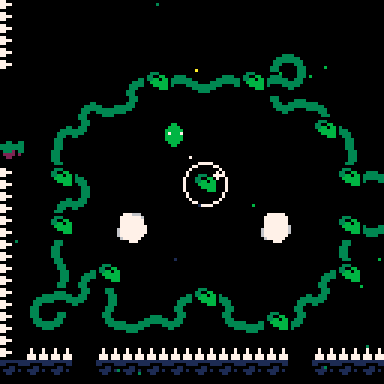
A little green blob trying to rewild the world.
I particularly like how you see places you want to get to, and then later find a way to reach them, often without realising how everything connects. It has a map that shows where you have been and what you have completed, which makes exploring and finding the remaining secrets really satisfying.
It’s the sort of game where you think you’ve seen most of what it has to offer, then discover there’s still more to find. I also like how the world gradually opens up as you learn what you can do. It makes the exploration feel like a reward in itself.
Don’t forget the dash button. It’s not essential, but it is helpful for a couple of the trickier bits.
Carrot Kingdom
I would have said that Sebastian’s Quest was my favourite Pico-8 game, but then I played Carrot Kingdom.

A white rabbit hunting for carrots.
I mentioned above how I enjoy the “ah-ha” moments in games, and Carrot Kingdom is full of them. The first time round might take you 20 to 30 minutes to finish, but once you’ve finished the game you realise you can do it a bit quicker. My best was about one minute. Quite a change, and I’m not going to tell you how!
There’s a lot of really satisfying discoveries in Carrot Kingdom, and very few times where I got stuck or felt frustrated. The way the game loops round and the way the mechanics are naturally introduced is so well done. There’s a couple of bits that are genuinely exciting, and it makes you feel really clever.
That’s the thing I find so impressive. The game gives you enough information to work things out, but it lets you make the discoveries yourself. When you finally understand something, it feels like your idea, even though it was carefully designed so that you would understand what to do at the right time.
Mouse Required
Mouse Required is a simple little puzzle game where you have to move a mouse cursor around a maze to unlock your other cursor friends.

A cursor inside a computer trying to crack the code.
It only took me five to ten minutes to finish, but I really liked it and actually felt it was the perfect length. I particularly enjoyed the pencil mechanic and the way the other cursors interacted with the environment, even solving one or two of the puzzles for you!
It’s a nice reminder that a game doesn’t need to be long to feel complete. It introduces an idea, has some fun with it, and then finishes before it outstays its welcome. There’s something quite satisfying about that, especially when I’m currently trying to squeeze a metroidvania into 13kb.
Golf Sunday
Golf Sunday is a simple golf game where you have to play golf. However, you can also get in your golf buggy and drive around the course going from hole to hole, which makes a lot more difference than you might think.

A pico-8 golf game with a drivable buggy.
I think I enjoyed driving the buggy around as much as the actual golf. There’s something about being given a little world and a few simple things to interact with (e.g. crashing into the flags or sinking the buggies in the lakes) that makes you want to see what happens. It doesn’t all have to be about completing the next objective.
It’s a simple game but really nicely done, and it spawned a “full size” (if you can call a Pico-8 game full size) version called Golf Monday, which has even more to offer.
It was also the first time I understood the power of sprite stacking in games for a pseudo-3D effect, and I keep looking for games I can use it in myself!
Johan Peitz, the developer of Golf Sunday, has made quite a few Pico-8 games, and is also responsible for PicoCad, a simple 3D editor for Pico-8 that I have covered before.
Resist the algorithm!
Social media wants everyone to discover the same things. I am trying to change that. If you know someone who feels the same then please forward this to them, or send them the archive link. It all helps!
Project Updates
The JS13k game jam game is coming along nicely. My game, now called Unicorn Escape, is playable from start to finish, and it’s just about in size budget. It’s a complete, albeit very short, metroidvania with some dodgy vector graphics and iffy music, but it works. I have about a week to polish it up before submitting.
I’ve put some more screenshots on Bluesky and will publish a link to the finished game in the next Ninja Sparks newsletter.
One thing I have really enjoyed is working on the level design with my son. I made a level editor that lets me print out an image of the world, and we’ve been drawing on top of it to work out how the caves should connect, change the environment and add new areas.

A photo of our behind-the-scenes work on Unicorn Escape showing our collaborative level design process.
When I started making the game, I was mostly building caves and hoping I could work out how to link everything together later. My son approached it differently. He would look at the map and suggest new routes, areas and things that could happen, without worrying about what I had originally intended.
That has led to a few “ah-ha” moments of my own. Sometimes one of his ideas has made me realise how two parts of the map could connect, or how an area could become more interesting with a small change. I’ve then been able to tweak and refine things, and gradually the world has started to feel like a proper place rather than a collection of shapes.
I think the different approaches have worked really well together and he’s ended up making quite a big difference to the game. What started as something fun (printing the levels and asking him to edit them) has become a proper collaborative effort to make a game.
In the past he has helped me make levels for Splatter Balls, and I think this is something we’ll be able to do more of together in the future.
Finding these moments of realisation and wonder is something I want to try to add to my own games. I’m not sure I can squeeze any more features into Unicorn Escape before the deadline, but working on the map with my son has been a lot of fun and has changed the game for the better. It’s been great having those “ah-ha” moments ourselves, and seeing how a different approach can make something click into place.
Perhaps the trick is to stop thinking quite so much about what the player needs to do next, and start thinking about what they might be curious enough to try. I’m not sure if it’s the sort of thing you can plan for, or if it unfolds naturally, but if I keep it in mind then hopefully I can make it happen.
Now I just need to resist the temptation to play Carrot Kingdom again and actually finish making my game!
What's the most interesting thing you've discovered online lately? Send it my way!
See you next time,
Ben
You just read issue #83 of Ninja Sparks. You can also browse the full archives of this newsletter.


