Writing prompts can make you less lonely
Advice that can help you write more and live less lonely
Note from Tucker
It’s rare a work of writing advice makes me feel less lonely, but that’s what 2026 Guggenheim Fellow Lucy Ives’s latest work THREE SIX FIVE: PROMPTS, ACTS, DIVINATIONS made me feel as I read through these exercises.
Each exercise exists in a squashed block of a book that’s hued with blue and orange and a cloth bookmark — gorgeous for a shelf or coffee table. The pages are thick with simple instructions that are often leaving lots of blank space. It’s simple and straightforward. Occasionally, Nick Mauss’s illustrations shows up drawn in simple lines.
The book felt like a cookbook of ideas from another era, meaning it’s not swarmed in the barbwire of busyness, or infused with the promise of solving your busyness.
Despite a fuel-tanker of tools and information at the current laptop worker’s disposal, it can feel like we can’t get ahead. But when it comes to creating anything new — art, relationships (e.g. networking), jobs, novels, tools — there are no magic buttons. Plain and simple. It’s a simple, yet messy process. The promise of a magic wand, in my view is a false one.
Ives’s book makes no promises to help you finish a novel; generate a pile of work. But rather, the exercises are something deeper than productivity: you’re pushed to play and use your intuition.
Exercises will ask you to remember things that are forgotten; collaborate with animals; pick up recycled materials; research myths; create family webs of fictional (or real) characters — and so much more.
“Something that we hear about all the time,” Ives told me on the last episode of Book Stuff “people feeling isolated, people feeling as if they don’t have agency, people feeling trapped, etc.“Like they can’t change, they can’t move.”
A feeling I’ve come across in my creative practice at times. Ives continued:
“The goal of the book is not to say you need to do something really complicated and hard to change or be in dialogue with the world. The book is saying, “No, I’m going to set a very low bar, and we’re going to use things that have no value and that are just like extremely plentiful in order to give you this feeling that you have agency and you can make change. And you are creative, basically. Like to restore…or to give that feeling to people.”
The exercises are cheap: a simple writing utensil, and a bit of time. They are there to spark new thoughts, and bring you someplace new. If you’re stuck creatively, or just in general, I would recommend this book.
Bookmarked (Links to more reading recommendations)
Lynda Barry’s WHAT IT IS Is is also a highly recommended book if you’re feeling in a creative rut. I’d also check out her talk on creativity and images.
Writing Legend Annie Dillard died, sadly. PILGRIM AT TINKER CREEK was one of those books that ignited my love for reading and desire to write.
THE BEST SCIENCE STORIES AND HOW THEY WORK is out. I went to an event with Siri Carpenter this week and heard her talking about the book. It was so great to hear the love and enthusiasm for science writing.
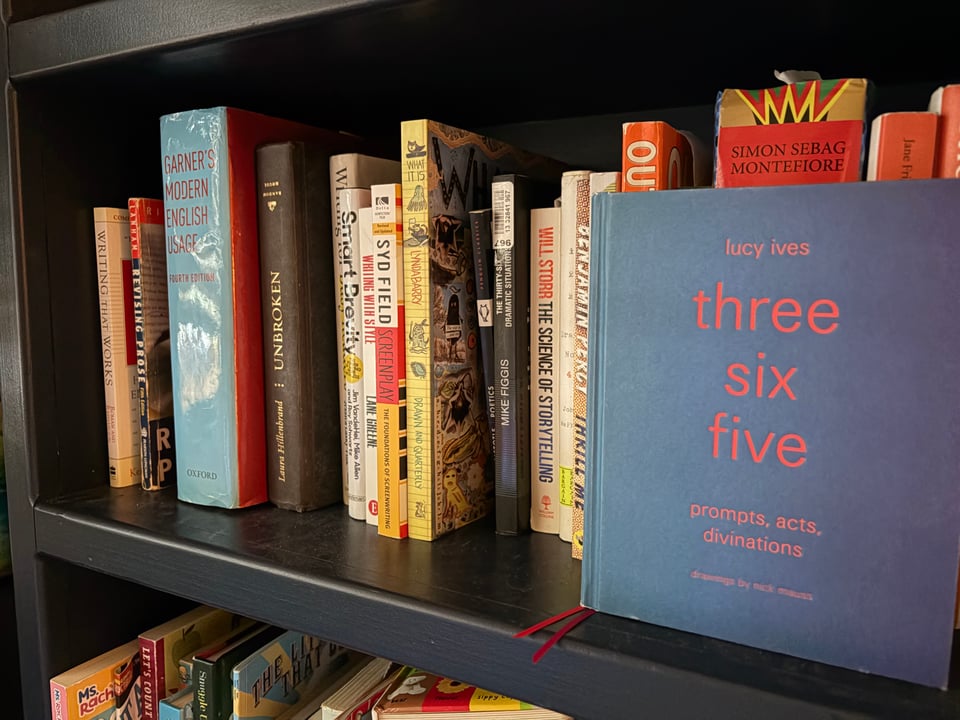
Shelf photos


Add a comment: