
Expedition 25
The Bathysphere
Welcome back! Do close the hatch behind you! Today Chris is thinking about learning, and enjoying the work of the Lubells. Elsewhere, we get great recommendations from Failbetter’s Séamus Ó Buadhacháin, Keith shuns Silksong in favour of Ghosts ‘n Goblins and Florence looks forward to competitive map-making.
As ever, please consider taking out a paid subscription – it’s £25 for the year and you get access to the full newsletter as well as all previous content!
The Bathysphere crew
Christian Donlan
Florence Smith Nicholls
Keith Stuart
Contact us at [email protected]
Delightful games
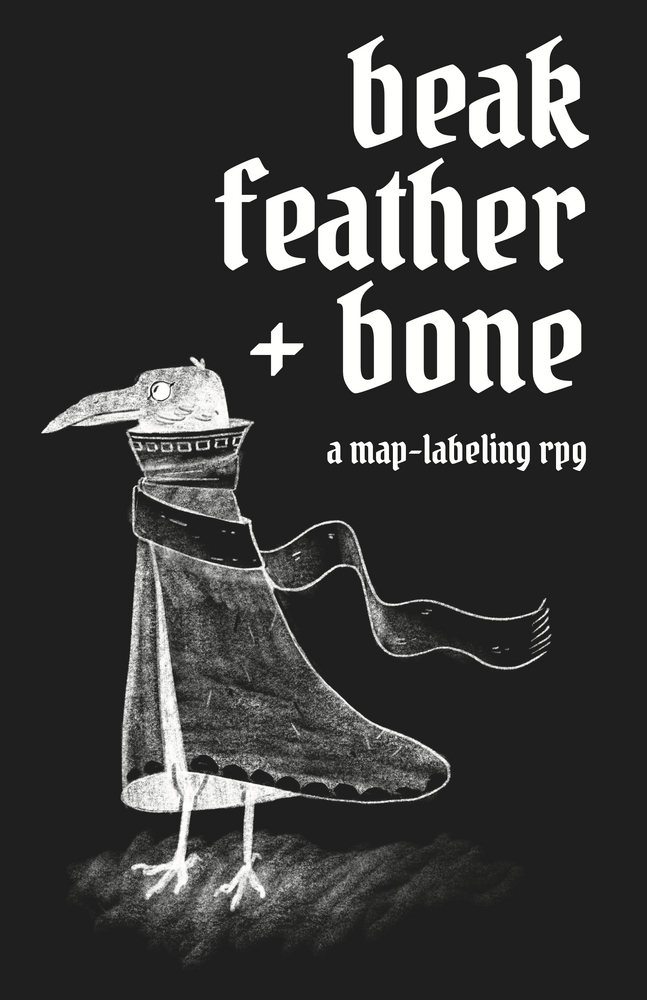
This week I’m in York for a conference. As the last dregs of summer spilled over the city I popped into Travelling Man and found a hard copy of Beak, Feather & Bone, a competitive map-labelling RPG. I love maps, and the game’s implications of competitive worldbuilding certainly are intriguing. I’m hoping to give it a try with a pen, paper and a warm drink once Autumn finally unfurls. FSN
Interesting things
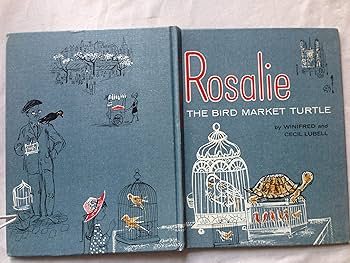
Tiktok introduced me to the work of Winifred and Cecil Lubell, a couple who created beautiful children’s books in the mid-twentieth century. Nothing profound to say here, other than I want a game in this style, preferably from Simogo. CD
We are big fans of zines in the Bathysphere (they take up less space than books), and have thoroughly enjoyed the Forgotten Worlds series dedicated to retro game magazines and their place in gaming history. Issue six is out now and it’s a homage to Sega’s ‘blue skies’ era of the late-80s and early 1990s, a time when every arcade or Mega Drive game featured gorgeous cobalt vistas, unblemished save by the odd fluffy white cloud. The zine contains images of magazine covers of the era as well as interviews with editors. There’s even a chat with Al Nilsen, Sega of America’s legendary marketing chief. Lovely stuff. KS
Once again, I’m recommending an academic paper (this one you can read for free through JSTOR, I promise!) Chris’ piece on difficulty and learning this week reminded me of Patrick Jagoda’s On Difficulty in Video Games, in which he distinguishes between three different types of difficulty: mechanical, interpretive and affective. I really like this reframing of difficulty beyond game mechanics, after all, Elden Ring’s lore is probably more difficult to unpick than the attack patterns of its most deadly bosses. FSN
A developer recommends: Séamus Ó Buadhacháin, Failbetter

Occasionally we ask a game creator for five of their own recommendations for books, places, events or films that may be interesting to video game folk. This week is the turn of Séamus Ó Buadhacháin, senior programmer at Failbetter Games, currently working on the hugely promising folkloric adventure, Mandrake.
A non-fiction book: The Flavour Thesaurus (Nikki Segnit, 2010)
The one book I'll rescue when I finally set the kitchen on fire; less a conventional collection of recipes, more a third-eye-opening guide to how to (or not to) combine flavours themselves. A kind of cross between a medieval pharmacopoeia and Nixon's enemies list, it contains the most savagely accurate assessment of chicken cacciatore ever put to paper.
A novel: Cold Comfort Farm (Stella Gibbons, 1932)
Plucky orphan Flora Poste discovers an extended family stuck in the wrong sort of lusty rural melodrama, and sets out to fix matters using the powers of common sense and good tailoring. Being sorely in need of both, I find this deeply inspiring.
A film: Best in Show (dir. Christopher Guest, 2000)
My favourite of the Christopher Guest mockumentaries follows a bunch of classically Guestian weirdos (complimentary) and their animals on their way to compete at the Mayflower Dog Show. Impossible to pick a best bit, but Parker Posey's excellently toxic Weimaraner-owner gets quoted a lot round mine, for some reason.
A TV series: Soupy Norman (RTÉ, 2007)
A troupe of Irish comedians, by overdubbing episodes of the Polish soap opera First Love, weave an increasingly fractured and loopy tale of the Irish urban-rural divide (well, sort of). Imagine a Beckett play with just the good bits left in: that is, very dark, very funny, and under eighty minutes long.
A contemporary video game: Untitled Goose Game (House House, 2019)
A stealth game and power fantasy for those among us who see a plump and comfortable country village and dream of violence. If you've ever had to get off the road to dodge an oncoming Range Rover, this is the game for you. Rise up, comrades! For it is a lovely morning in the village, and we are horrible geese.
*
Essay: Finding the words
It’s since having a kid, I guess, that I’ve become fascinated with the act of learning things. This is probably because, for children, it seems like the act of learning things is entirely automatic. They just vacuum up ideas and turn them into abilities. They can reframe their entire universe in a few seconds. I was not expecting this, but it’s completely thrilling to watch in action.
And also: I am deeply, openly envious of this. I’m 47 now, and my ability to learn new things has very much slowed down. Learning is now a decision - and it comes with the acknowledgement that I will have to stick around for a while. I did the Couch to 5K a few years back, and there was a surprising amount of learning in that. I’m not remotely ashamed to say that it took me 613 days. But I did it! I learned things I still think about. I’m not just talking about the bright and sudden awareness that I have knees and I should look after them.
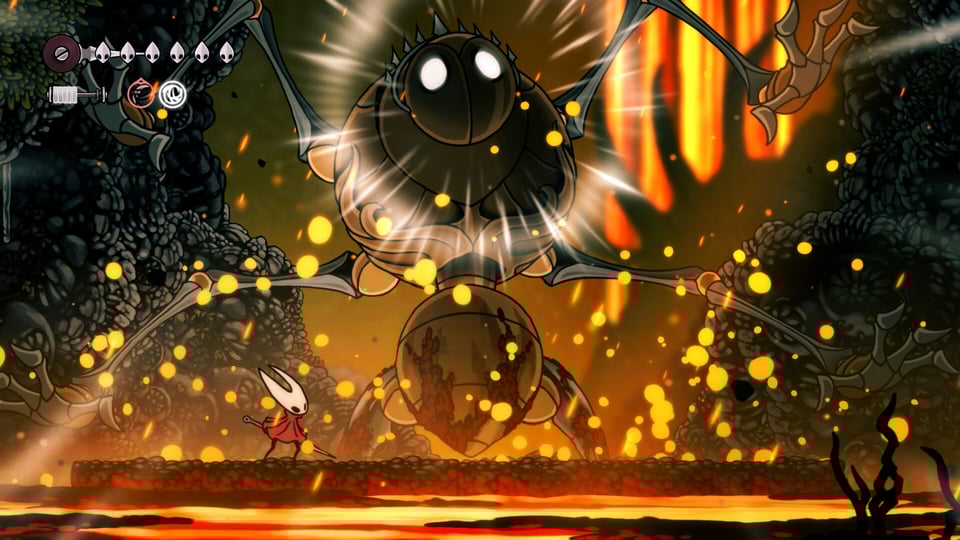
Anyway, games are filled with learning, and that’s never been clearer than this week. This is a rare topical moment on the Bathysphere: I’ve been playing Silksong, and it turns out that Silksong is all about learning.
Really! Bosses you can’t find a way in with. A map that leaves you completely muddled half the time. Minor enemies that can properly do you in if you give them a moment’s notice. All that is learning. But then there’s the learning about what you might term the game’s handwriting. This is how the developers think: where they are likely to double-down on cruelty and trap a resting spot, where they like to hide upgrades, what they like to put you through in order to earn those upgrades.
What’s been surprising is how much, in some of these cases, approaches I’ve taken to learning in other areas have worked quite well with Silksong. Learning, I’m tempted to say, is as much a set of useful skills and approaches as it is a process.
Just one example here, because there is a bee in the room. I’m learning to swim at the moment. I am terrible at it. But what I’ve learned in my journey to be less terrible at it is that I can break movements that initially seem wordless to me down into individual bits that aren’t wordless. I know this is obvious. But it wasn’t obvious to me. So while I swim - I’m learning front crawl - I’m often going through words in my head: grab, push, twist, not the face! Count. One. Two. Turn.
This translates surprisingly well to a boss in Silksong, say. I’ll go in, and on my nth attempt, I’ll be talking to myself in my head, reminding myself of everything I need to do. Jump. Dash. Low jump. Don’t get too high. Wait.
This is useful to me. I am a wordy person, I think, but I’m constantly encountering beautiful parts of the world that don’t seem to yield to words, or don’t seem to yield immediately. That symptom that cannot be accurately described. That taste of something that is wonderful but doesn’t fall into neat sentences. I spent a while, a few years back, obsessed with description, wandering around and interviewing people who I felt described things really well. Like Nikki Segnit, author of the wonderful Flavour Thesaurus and Lateral Cooking, and Jimi Famurewa, whose every restaurant review leaves me gasping at the deep knowledge on display but also the precision with which it lands on the page.
They both offered me variations on the same thought: to describe something, there’s a bit of repetition to it. You live with it. You turn it over in your hands. You break it into pieces in the search for any kind of way in. This sounds like learning. And it sounds, I think, like playing a game like Silksong. CD
Retrospective adventures

All the current interest in Silksong got me thinking about super tough platformers from the olden days – a thought process that inevitably led to Capcom’s excruciatingly tough 1985 arcade classic, Ghosts ‘n Goblins. Here’s a cover illustration from the June 1986 copy of Your Sinclair which featured a two-page preview of the ZX Spectrum conversion by Elite Systems. I love how 1980s video game magazines were so freely interpretive with their cover illustrations – this image bears little resemblance to anything in the game; it has a more classical Tolkien-esque appearance, but it certainly works as an arresting image.
The article inside is interesting in that it’s a relatively early example of a studio visit, where the writer goes to see the development team and plays a game while it’s still a work in progress. The programmer claims to be using a process named ‘Dixel Scroll’, which scrolls the screen two pixels at a time rather than one, thereby allowing faster eight-way directional movement on the limited Speccy hardware. I’m not sure this sounds right – it has a hint of Sega’s famous ‘blast processing’ boast. But if you’re interested in a more detailed look at how the game was coded for the Spectrum, there’s one here.
Add a comment: