The Pull, no. 4
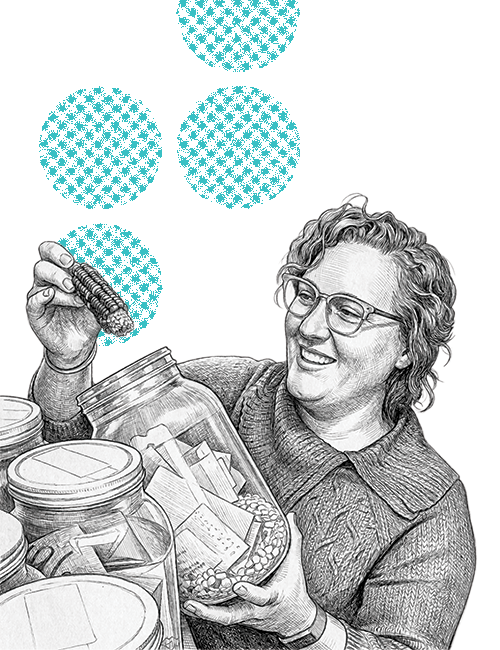
April is National Poetry Month, and I can think of nothing more poetic than the first seeds and sprouts of another spring, so we’re talking plants with:
Vivian Bernau, preservation director
Seed Savers Exchange
Archival Magic: Gloves or no gloves in your work?
VB: Generally, it’s no gloves, unless we are harvesting seeds from wet fruits like tomatoes, peppers, squash, cucumbers, things like that. When we’re saving seeds from those types of plants, we want to give the seeds extra time to mature, which often means that we’re actually harvesting seeds from rotting fruits, and no one wants to have the smell of rotting cucumbers embedded in their hands for days. Gloves are certainly needed for safety when we’re working on processing hot peppers. I actually did my Ph.D. working with chili peppers, and folks would walk into our lab and then just kind of back out because the capsaicin had volatilized.
AM: What was the most recent archival object you showed to someone else?
VB: In our collection, our archival objects are the seeds, the plants, but also the documents associated with them. Right now, we are preparing to digitize another set of documents that have been reviewed. And this next set of materials that we’re working with are several boxes of seed packets from the 1980s, 1990s, and some a little bit older. And that includes many seed packets from other countries as well. It’s really interesting to thumb through those and look at the pictures and different tables and documentation that was included on those seed packets.
AM: When did you first realize that you enjoyed working with archival materials?
VB: My interest in this work started as an interest in horticulture. Growing up, my family had a truck garden where we would grow 300 different tomato plants each year. That’s an opportunity to grow lots of different varieties, and I’ve always loved seeing the variation between them, starting when they’re seedlings, but also in the fruits and in the flavors. When I went to college, I wanted to be a plant breeder, but I wasn’t actually that interested in doing the breeding. I just wanted to explore the varied shapes and colors and tastes and the histories associated with those. And so I found that conserving the seeds and their stories was where I wanted to be instead of on the genetic side. My interest in exploring the archives really deepened when I started learning about databases and how to organize this type of data and what you can learn by combining different types of data.
AM: What’s the most memorable item you’ve found or seen in any archive?
VB: I worked at a gene bank near Mexico City, at the International Maize and Wheat Improvement Center, during my Ph.D. studies. They had an awesome informal display, something that they would always pull out for tour groups, that showed the domestication of corn. They had a sample of the wild progenitor of corn, which is called teosinte, and then a sample of a traditional variety of corn that’s still cultivated in that region. And corn is cross-fertile, so the cultivated corn can still cross with its wild progenitor, and that leads to these intermediate types of semi-domesticated corn. There’s gene flow that continues to happen between the wild populations and the cultivated populations. And I still use a picture of that in presentations to show an example of domestication but also how these populations are continuing to change and interact with each other.
AM: What is one aspect of the archives that you wish the general public understood better?
VB: So living collections—seeds and plants—require an immense amount of resources to maintain. And in addition to that, we’re also maintaining the documentation that comes with them. In many cases, the seeds or the plants themselves aren’t as valuable unless you have documentation explaining why they’re valuable. The plant can’t tell you its story. So we’re really maintaining two separate collections. Most of us have more of a plant background than an archival background, but we’re trying to talk to each other more and more. I would also say that sometimes folks send us seeds that are very old and have been stored in very poor conditions thinking that we can work magic, that we can resurrect them. And we can’t. We try to do a lot of upfront conversations with our donors and potential donors to understand if they have seeds that can actually grow because we can’t conserve everything, especially if it doesn’t start out alive.
AM: Archives are often portrayed as sterile or silent, but can you describe a specific sight, sound, smell, touch, or taste in your workspace?
VB: One of the crops that we conserve in our collection is corn. And in order to conserve a variety of corn, we have to grow it every 30 to 50 years to get new seeds that will last for a few more decades. When we grow the corn, we have to hand-pollinate it to prevent it from crossing with other varieties of corn that are nearby or in the same field. When I am hand-pollinating corn, that’s a lot of time with my hands over my head putting bags on top of the tassel to capture the pollen. Especially with a lot of older corn varieties, there’s hundreds of millions of pollen grains, and you’re shaking that into your face. At the end of the day, I go home, and I’m just covered in yellow pollen and sometimes kind of have a gritty texture embedded into the sunscreen on my face. That’s how I know that I’m getting a lot of work done.
AM: What is an example of a representation of archives or archival work in TV / film that you thought got it right or got it completely wrong?
VB: The pop culture reference that I use sometimes is Mad Max: Fury Road. There’s an elder in the community who’s the Keeper of the Seeds. She has a satchel of seeds that she’s protected for many decades, waiting for the right time and the right place to actually grow. I really like that seeds are used as the symbol of hope and renewal, and I think they definitely get the ethos right. But, of course, you can’t just leave them in a satchel for decades and decades. As with other archives, there are specialized conditions that are needed to extend the time of viability. At our organization, at Seed Savers Exchange, we hope that we’re not just carrying the seeds, that we’re also carrying the story that comes with those seeds, because the story is what connects the seeds to a community.
AM: What archives-related question should I ask the next person?
VB: I enjoy working with the data as well as the plants, and right now, we’re preparing to move from our current database to an open-source platform that’s been developed by other gene bank folks. I’d like to know about a unique component of a database that the next person uses or a feature that they wish their database had.
—
This newsletter was written on the traditional lands of the Piscataway and Nacotchtank.