The Pull, no. 3
Some people recently walked away with 13.5-inch gold-plated figurines of a fellow named Oscar, not quite 100 years old this March, so we’re talking film with:
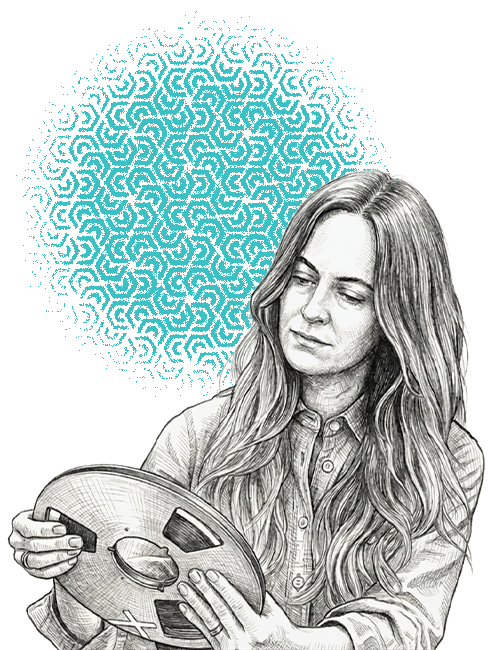
Yasmin Dessem, head of audiovisual preservation
University of California, Los Angeles (UCLA) Library
Archival Magic: Gloves or no gloves in your work?
YD: [laughs] You know I’m going to say “it depends.” It really depends on the materials we’re working with and if we’re going to be in any way touching the recording surface. Certain formats, especially ones that are cartridge-like, audio cassettes and VHS tapes, the tape is protected inside of a shell, and unless we’re opening that up and doing repairs, we’re not going to wear gloves. But things like lacquer discs have a plastic coating that’s very sensitive to pH changes. The acids and things that live on our fingertip oils, when they interact with those plastics, they can hasten the degradation in those areas. That degradation is called exudation, and I’ve seen ghosts of handprints from discs in the past that had been handled without gloves. It’s kind of amazing. So basically we’re trying not to leave anything behind so the recordings are as uncontaminated as possible.
AM: What was the most recent archival object you showed to someone else?
YD: I was helping a colleague teach an undergraduate music industry class. We wheeled in library carts of archival materials from the punk collections that are here at UCLA, and we made sure that there was an array of materials to sort of open people’s perceptions of what could live in a library or archive. We included photos and zines, but also objects like signs from Al’s Bar and their cash can that was living at the bar. We had all kinds of materials, including an outfit that was designed and worn by John Denney of The Weirdos. I think the students were really excited to interact with these objects and see this subculture get taken seriously in an academic library setting.
AM: When did you first realize that you enjoyed working with archival materials?
YD: I would say that it’s not one moment. I really gravitated, even as a young person, to old objects, old photos, and figuring out how things worked. While I was in graduate school, I worked for UCLA Library Special Collections processing archival collections. It’s actually an amazing program that Special Collections has called the Center for Primary Research and Training. And that’s when I really got my hands in there and was able to sort of get another perspective on what are archives. I had come into it really thinking about feature films and, you know, classic films. But to be able to see materials that belong to everyday people that might not be widely recognized but who still left a lasting impact on their community or their profession, that to me was really powerful. You really feel the weight of responsibility of processing someone’s materials. There’s a weight that comes with that and a sense of honor, like you’re trusted with their legacy.
AM: What’s the most memorable item you’ve found or seen in any archive?
YD: This is the hardest question. I think it’s why I feel so lucky to be doing what I do because every project I work on reveals something completely surprising that I didn’t know existed or just is lovely. But the thing that I always come back to again and again is something that really deeply touched me, these beautiful Kodachrome home movies. There’s two of them in the Golden State Mutual Life Insurance Company records. GSM was the largest Black-owned insurance company in the U.S., and they were founded in 1925, and every year they would have an annual picnic in the summer, celebrating that anniversary. And these two films—first of all, they’re just beautiful. The color’s beautiful, the imagery’s beautiful. But what’s really important about them is that they’re from the ‘50s, and they show recreation sites like Lake Elsinore and Val Verde that were frequented by Black families at a time when there was discrimination which barred them from enjoying a lot of public spaces. And I think what I love about them is that they’re this personal artifact on one level. They’re filmed by an unknown staffer—we tried to figure it out at one point—and they’re showing you this joyful experience. But it’s also this bigger impact that Golden State Mutual had on its communities, the lives it touched. So it’s a microcosm—it’s this really small glance into someone’s personal life but also something much bigger. They’re just stunning—they’re very dreamy. I mean, you hear “life insurance,” right? What? But then you realize what an amazing story it is.
AM: What is one aspect of the archives that you wish the general public understood better?
YD: I think usually the general public isn’t immediately connecting libraries and archives with media-based formats. The Film & Television Archive, which sits under the library—the collections there hold so much rare material that doesn’t exist anywhere else. Home movies, oral histories, live musical performances, radio programs, newsreels—primary source materials that offer researchers a chance to connect with a historical moment in a much more profound and personal way that isn’t really as possible with textual primary sources alone. The AV in the archives definitely provides like a fuller context, so it also helps situate the paper-based documentation that we see in our collections. And I would say I think the other thing, if I can piggyback on that, is that people aren’t always aware of all the labor that’s behind making things accessible. These are analog formats that need to be digitized before they can be accessed. These analog formats are fragile. They’re made of unstable materials, and it takes so much hands-on work to make something viewable or listenable by someone who’s requesting it now, but also into the future. We’re cleaning it, we’re treating it, we’re digitizing it, but we’re also having to maintain the playback machines. Then there’s all the ancillary work that happens around it, like media metadata description, digital preservation, all these circles that sort of build out from that activity. So it’s really that level of human intervention and activity that happen before and after digitization, it’s something that people don’t often think about when they’re clicking on a video file—so many hands were involved.
AM: Archives are often portrayed as sterile or silent, but can you describe a specific sight, sound, smell, touch, or taste in your workspace?
YD: I love this question. [laughs] Smells! The vinegar smell from deteriorating acetate films. As acetate motion picture film ages, it gives off acetic acid, and it smells like vinegar. They call it vinegar syndrome. It’s funny, but it’s also that the smells are a reminder to me of how physically vulnerable these collections can be. And, I don’t know, I think that’s another sense that tells me that these are in peril. Most of the films we’re working on are older. They weren’t maybe housed in the best conditions in a previous life, and so that smell is something we’re just very used to being around. And most of those items tend to be 16mm, 8mm, small-gauge film, which was I think almost always acetate-based. That’s why there’s so much vinegar happening. And then sound. This week I came in, and I got to hear a lot of this sound: a HEPA vacuum and the fume hood. So when we’re working on, you know, vacuuming mold or we’re working with solvents and those fumes are getting sucked into the fume hood, those all make these really loud noises. It’s definitely not a quiet space, that’s for sure.
AM: Can you tell me about a project that was really challenging, especially a project that was equal parts challenging and rewarding?
YD: What I find incredibly satisfying, but also crazy-making in the best way, is troubleshooting and repairing equipment issues. Basically it’s not really part of our training as conservators or library professionals to do this kind of maintenance. But it’s sort of a very niche skill, so we try to do a lot of maintenance ourselves. But doing that in addition to all of our other work, right? That can really be a challenge. Sometimes it’s super mundane stuff like, I'm trying to find this one replacement part or this adapter. Recently we had to ship a 75-pound U-matic videotape cleaner to Illinois to this vendor that I found who could still service them. But they said it had to be on a pallet. So I was like, okay, I’ve never done this. We had to find the right box that could withstand it. And then a colleague of mine in conservation found a pallet in another library and brought it over. And then we had to find a freight shipper. And so something so small, where it was like, “This is behaving inconsistently,” can take up way more of your day than you think it would. But at the end, when you finally get everything working, it’s so, so much more satisfying. U-matic is the earliest form of videotape in a cartridge. It came out in the early ‘70s, before VHS, before Betamax, before all that. So the U-matic tape cleaner, we use that to clean a tape. Often we have to bake the tapes to stabilize them so you can play them back, and then you also clean them so that you try and get the best possible transfer. We’re lucky—we have a lab oven, but I know a lot of amazing audio engineers doing remastering work who are using food dehydrators. You’re baking it at a steady temperature for a set amount of time, and then that temporarily—everything’s temporary—temporarily stabilizes it, and then you can play it back.
AM: What archives-related question should I ask the next person?
YD: I’ve noticed that archives and archival work are portrayed in movies and television sometimes with varying degrees of success. It’s like any job that you see reflected in film, right? Sometimes you’re like, “What?” I would ask, “What is an example of a representation that you thought got it right, or got it completely wrong?”
—
This newsletter was written on the traditional lands of the Piscataway and Nacotchtank.