Wednesday, June 10,2026. Annette's Roundup for Democracy.
We're onto him.
Many headlines say something like this.👇
Trump Previews Fall Strategy With Baseless Claims of California Vote Fraud.
The president is using the slow count of mail ballots in California to renew his effort to cast doubt on election outcomes he doesn’t like, despite a lack of evidence of any widespread fraud.
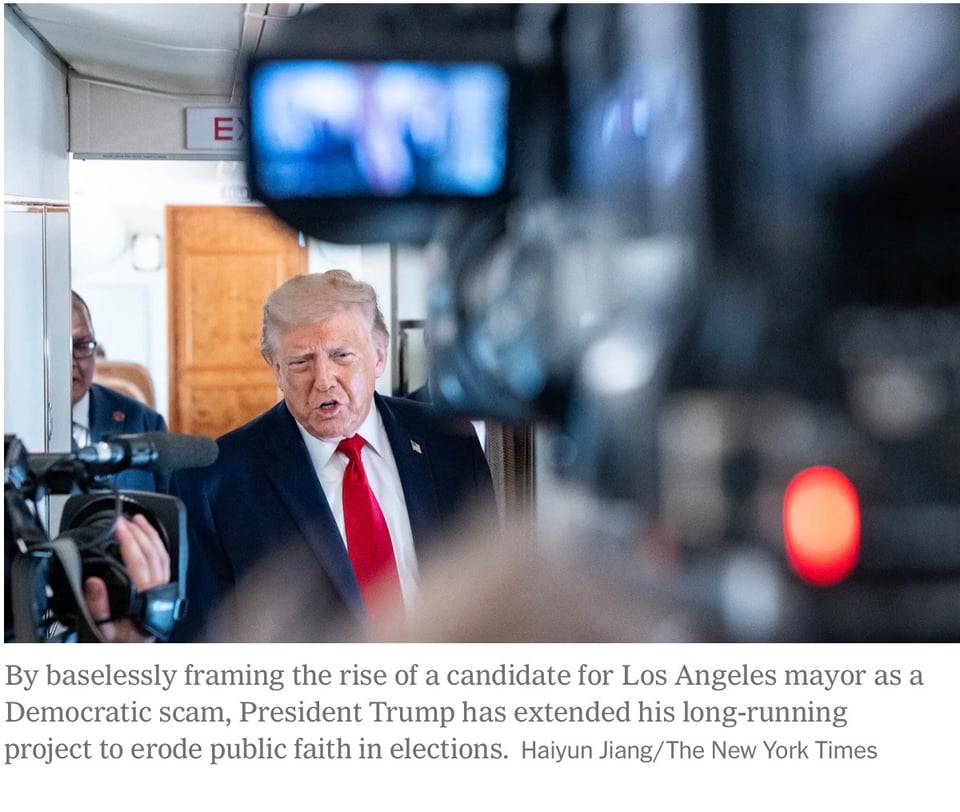
For President Trump, any Democratic election victory is suspicious on its face. Even, apparently, in one of the most liberal cities in America.
“Not possible for Spencer Pratt to have lost the L.A. runoffs after the big lead he had,” Mr. Trump wrote on social media on Monday. “3rd World Nation.”
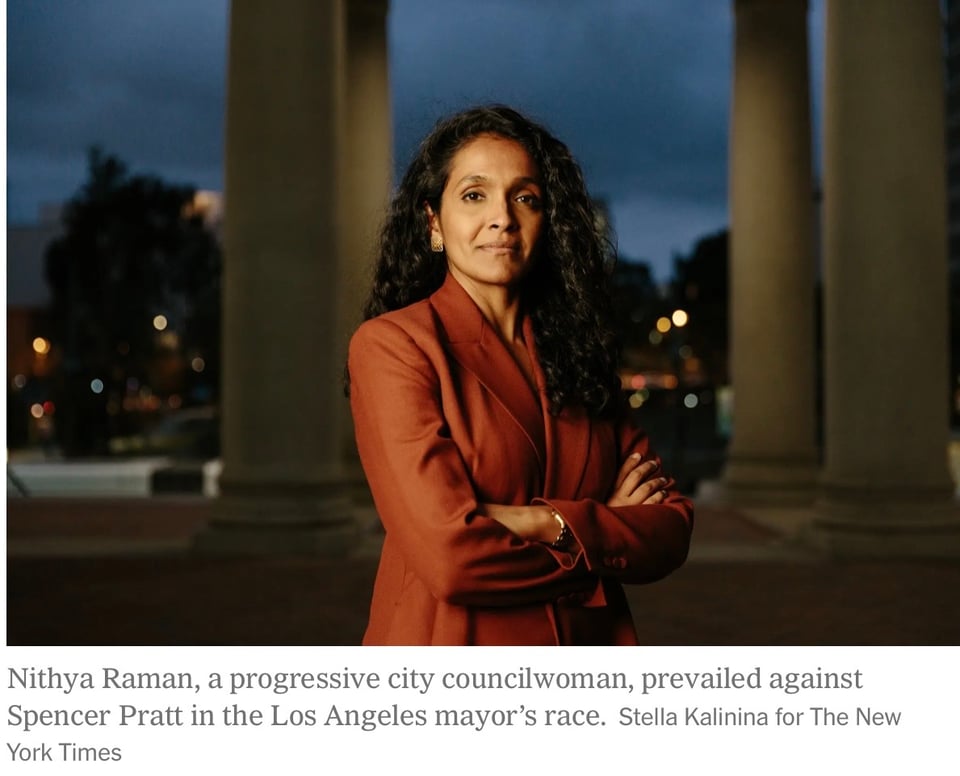
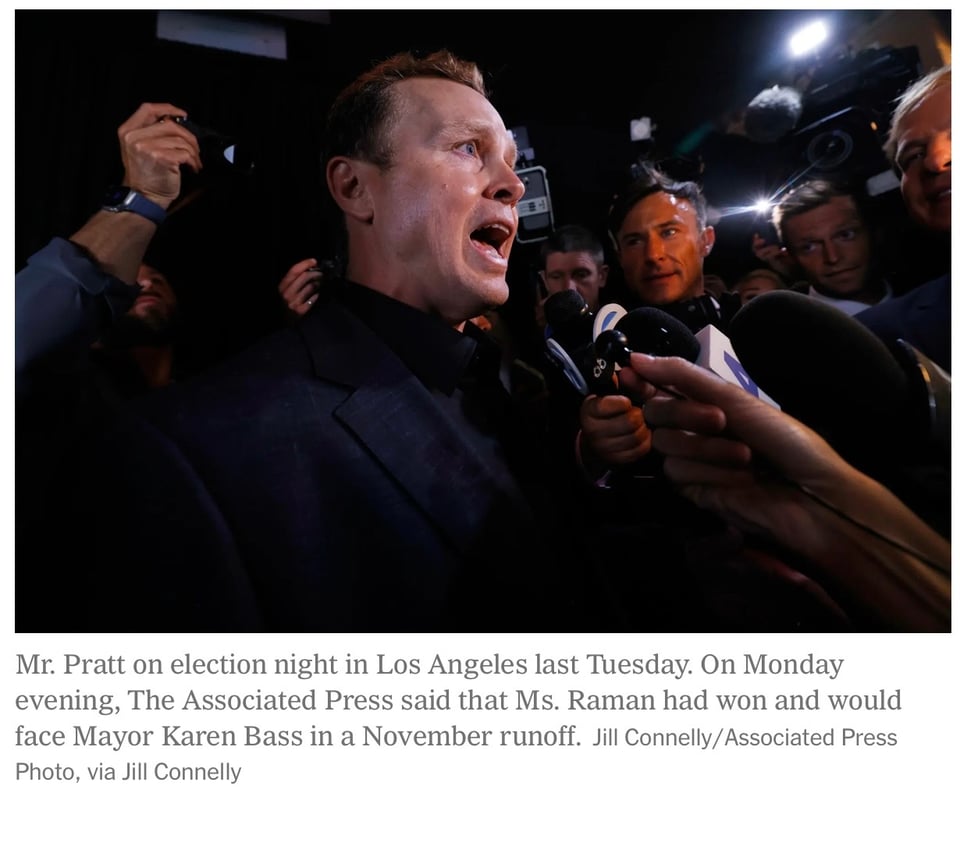
On election night last Tuesday, Mr. Pratt — the reality-television personality and Trump-endorsed Republican — led the progressive city councilwoman Nithya Raman for second place to advance to November’s mayoral runoff, behind the incumbent, Mayor Karen Bass, who is also a Democrat.
But as election officials spent the following week counting late-arriving mail ballots, which were disproportionately from Democrats, Ms. Raman edged ahead of Mr. Pratt. On Monday evening, The Associated Press said that she had indeed prevailed.
Such fleeting Republican leads are common enough to have a name — the “red mirage” — yet Mr. Trump, as he did in his own 2020 loss, cast the slow count as proof of theft. By baselessly framing Ms. Raman’s rise as a Democratic scam, Mr. Trump extended his long-running project to erode public faith in elections — and gave an unusually clear preview of how he could greet any disappointing results for his party in November, when control of Congress is at stake.
He has been anything but subtle about his desire to limit the ability of Democrats to vote by mail, implying, with no evidence, that simply choosing that widely used means of casting a ballot is inherently suspect. Addressing a gathering of Republican lawmakers in March, he said the way to hold their majority was to pass a strict voter identification law cracking down on mail ballots.
“It’ll guarantee the midterms,” he told them, warning that failure would bring “big trouble.”
Privately, according to one senior adviser, he has pressed aides to find ways to “stop them stealing it from us.”
What is striking so far is how little of this has survived contact with reality. Voting legislation he has championed, the SAVE Act, cleared the House but stalled in the Senate, where Republicans lack the votes to break a Democratic filibuster. Among other things, the bill would require proof of U.S. citizenship to register to vote and would compel states to share voter rolls with the federal government.
An executive order he signed in March directing the Department of Homeland Security to assemble a federal list of eligible voters and barring the Postal Service from delivering mail ballots to anyone left off it was condemned by election experts as illegal and drew multiple lawsuits.
Still, even if Mr. Trump fails to change election laws or processes, he can sow substantial chaos simply by trying to convince voters that the results were fraudulent.
More than five years after his supporters, fueled by lies about a stolen election, stormed the Capitol to stop the transfer of power, Mr. Trump has tried to recast Jan. 6, 2021, as a day of “peace,” claiming his supporters were led astray by F.B.I. officers in a false-flag operation. He has produced no credible evidence, yet he has pardoned rioters who breached the Capitol and has entertained paying restitution to some of them, over the objections of even some in his own party.
His fraud claims about California could matter especially in November. The House majority rests on a thin margin, with Republicans holding 218 seats to Democrats’ 213. After California voters approved Proposition 50 in November — a constitutional amendment pushed by Gov. Gavin Newsom to permit a redrawing of the state’s congressional map — Democrats have a chance to flip as many as five Republican-held seats, potentially enough to take the chamber.
Many of those seats lie in the same Central Valley and Orange County districts whose ballots take days or weeks to tally. In other words, the races that may decide control of Congress could be counted in precisely the slow way Mr. Trump reflexively calls fraud. Elon Musk has amplified the message, arguing that the combination of no voter ID and mail-in ballots amounts to legalized fraud.
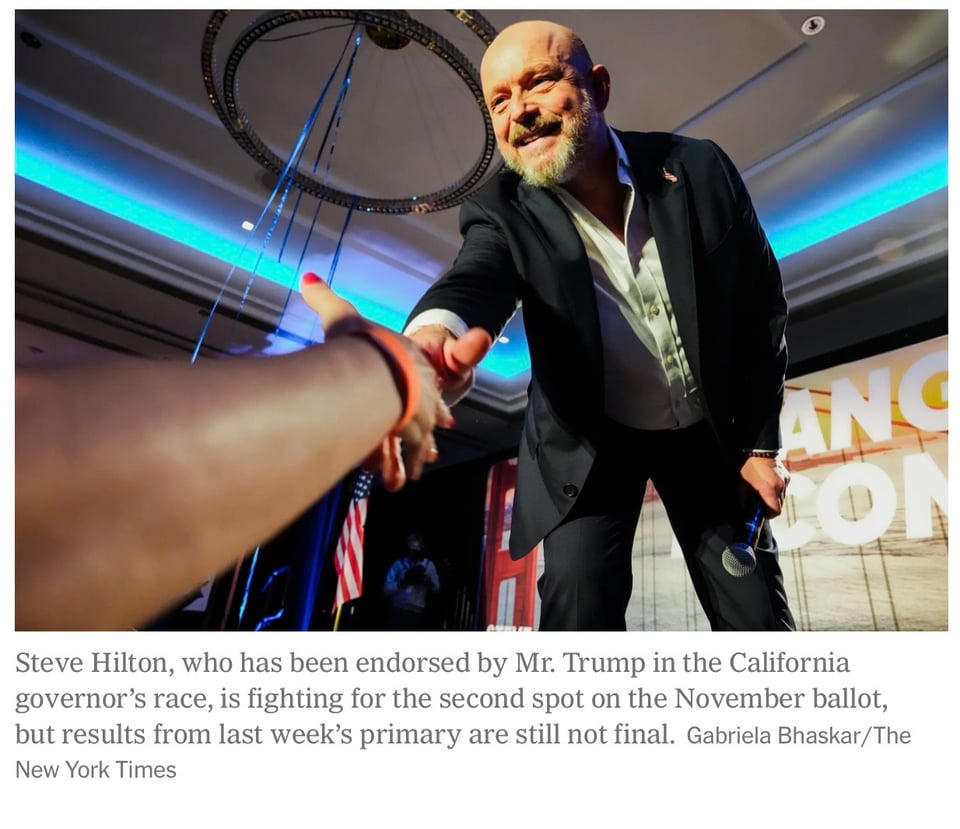
Mr. Trump has leveled the same accusation at California’s governor’s race, in which the Republican Steve Hilton is fighting for the second spot that would set up a November runoff against the Democrat Xavier Becerra.
After complaining about “rigged elections” in his Monday social media post, the president added: “Now they’ll be working on great guy Steve Hilton. Won’t have results for, possibly, TWO WEEKS, according to officials.”
An executive order he signed in March directing the Department of Homeland Security to assemble a federal list of eligible voters and barring the Postal Service from delivering mail ballots to anyone left off it was condemned by election experts as illegal and drew multiple lawsuits.
Still, even if Mr. Trump fails to change election laws or processes, he can sow substantial chaos simply by trying to convince voters that the results were fraudulent.
More than five years after his supporters, fueled by lies about a stolen election, stormed the Capitol to stop the transfer of power, Mr. Trump has tried to recast Jan. 6, 2021, as a day of “peace,” claiming his supporters were led astray by F.B.I. officers in a false-flag operation. He has produced no credible evidence, yet he has pardoned rioters who breached the Capitol and has entertained paying restitution to some of them, over the objections of even some in his own party.
His fraud claims about California could matter especially in November. The House majority rests on a thin margin, with Republicans holding 218 seats to Democrats’ 213. After California voters approved Proposition 50 in November — a constitutional amendment pushed by Gov. Gavin Newsom to permit a redrawing of the state’s congressional map — Democrats have a chance to flip as many as five Republican-held seats, potentially enough to take the chamber.
Many of those seats lie in the same Central Valley and Orange County districts whose ballots take days or weeks to tally. In other words, the races that may decide control of Congress could be counted in precisely the slow way Mr. Trump reflexively calls fraud. Elon Musk has amplified the message, arguing that the combination of no voter ID and mail-in ballots amounts to legalized fraud.
This year, California had an unusually competitive primary election for governor, driving up turnout and raising the stakes of the statewide count. To add to the issue, many Democrats waited to return their mail ballots as the field shifted and as some were concerned that Democrats could get locked out of the top two spots.
Asked whether Mr. Trump had any evidence to support his claims that the California elections were being rigged, Abigail Jackson, a White House spokeswoman, said he was “committed to ensuring that Americans have full confidence in the administration of our elections.” That pledge, she added, is “why millions of Americans sent him back to the White House,” adding that Mr. Trump would implement measures to “secure our elections for generations to come.”
During his losing 2020 campaign, Mr. Trump repeatedly made baseless claims that mail-in voting was rife with fraud. In that election, Democrats, many of whom were strictly adhering to pandemic protocols, were much more likely to vote by mail than Republicans, who tended to prefer to vote in person on Election Day — a partisan divide that persists today. Yet Mr. Trump’s crusade against mail-in votes that year alarmed Republican legislative leaders, who privately tried explaining to him that many of the party’s own voters were older and cast ballots that way.
Several states took days to finish counting mail-in ballots in 2020. In Pennsylvania, Joseph R. Biden Jr.’s share of the vote grew each day, eventually allowing him to overtake Mr. Trump in the state and win the election.
Since 2020, many states have made significant investments to speed up their abilities to count mail-in votes quickly. In California, however, it is still common for it to take days or even weeks before enough votes have been counted for news organizations to declare a winner.
This year’s election in California was primed to create even more of a red mirage effect than normal. Facing late upheaval in the governor’s contest after the departure from the race of Eric Swalwell, a congressman at the time, many Democrats waited until the last minute to return their ballots. That meant that the first ballots to be counted and reported were more Republican than normal, and the ballots reported after Election Day have been even more Democratic than is typical.
Paul Mitchell, vice president of Political Data Inc. in Sacramento and an expert in California voter turnout, said that his firm’s data showed that the share of Democratic voters’ ballots being processed has far outpaced the share of Republican ballots in recent days, and that the distance had widened.
California sends every regular voter a mail ballot that can be returned at their convenience. It gives a weeklong grace period for ballots to arrive as long as they are postmarked by Election Day. The state allows voters registered at old addresses or those not registered at all to fill out provisional ballots that become valid if election officials verify their information and deem them eligible. And it allows voters with mismatched signatures on file to resolve discrepancies once they are detected.
All of those provisions make voting easier for residents in California than in many other states, but they add various checkpoints in the system to ensure security, each of which costs time.
“In California and Los Angeles, we have our election laws written in a way that maximizes participation,” said Mike Sanchez, a spokesman for the Los Angeles County registrar of voters.
Mr. Mitchell, who is a Democratic consultant, said that, paradoxically, the most effective way to speed up California’s count would be to eliminate security protocols, like cutting ballot signature verification or checks on voter registration for provisional voters.
“I don’t think Republicans would want that,” he said.
Other election experts said that California suffered from logistical problems. Each of California’s 58 counties is responsible for running its own election, and many lack sufficient resources to verify mail ballots and count votes quickly. They may not have enough workers, space or machines to process ballots in quick order.
State lawmakers passed at least three bills last year designed to speed up the count, but the changes seemed to have marginal effect, given where things stood on Monday, with only about three-quarters of the ballots counted six days after the election.
The bills shortened the deadline to finish counting most ballots, to 13 days from 30 days. They also allowed election officials to begin processing ballots earlier than before and required slightly more frequent updates of results.
But elections are largely county-funded, and most of California’s counties lack the resources to keep staff on constant rotation, said Kim Alexander, who runs the nonpartisan California Voter Foundation.
“We expect our counties to provide all these services to facilitate elections, and the state and federal governments aren’t paying their fair share of the cost,” she said. (New York Times)
One more thing.
The California Governor's race has its candidates.
MAGA, Trump, the votes are now counted.
Listen to Tom Steyer.
In case I didn't make enough fuss over this. 👇
Trump and Knicks game 3.
Trump tried to make the evening all about himself.
Many blame him for the Knicks' loss.
Donald Trump booed by the crowd during the anthem prior to Game 3 of the NBA Finals.
Trump was booed loudly by fans inside MSG when he was shown on video screens during the national anthem as he became the first sitting president to attend an NBA Finals game.
Chants of “U-S-A! U-S-A!” echoed through the arena as Avery Wilson sang “The Star-Spangled Banner,” but they gave way to boos moments later as Trump was displayed on the jumbo screens giving a military salute. The jeers ended when the U.S. flag followed him on the screens, and fans cheered when New York Knicks players were shown. Mentions of the San Antonio Spurs also elicited vociferous boos.
The president was unfazed. “It was, I think, mostly cheers,” he told reporters after the game before boarding Air Force One to return to Washington. “It was loud, and it was very enthusiastic.”
Trump watched Game 3 from Knicks owner James Dolan’s suite, along with granddaughter Kai, personal adviser Boris Epshteyn and Cabinet secretaries Lee Zeldin, Sean Duffy and Doug Burgum. He sat next to Dolan for the first quarter and spent part of the second talking to NBA Commissioner Adam Silver and Republican gubernatorial hopeful Bruce Blakeman.
Trump’s Marine One helicopter flew from his home in New Jersey and landed near Wall Street before his motorcade made its way up through Manhattan and to the arena roughly an hour before tipoff. He encountered a handful of people making rude gestures, and outside the area, one group held signs saying “Trump must go.”
He settled into Dolan’s suite shortly afterward.
During the afternoon before Trump’s arrival, the New York Police Department and the U.S. Secret Service set up a large perimeter surrounding Madison Square Garden. Fans lined up to get inside the arena more than four hours before tipoff, in a scene more closely resembling New Year’s Eve in Times Square than the usual leadup to a basketball game.
They were required to provide a ticket or pass to get past various checkpoints, along with going through a Transportation Security Administration-style magnetometer. Secret Service personnel and police were positioned at every corner and in large numbers. Daily commuters, tourists visiting Manhattan and fans were all confounded at various times as they tried to maneuver the security.
New Yorkers forced to adjust
After traveling from his home in Florida for the game, Knicks fan Greg Weldon said the main inconvenience faced so far has been the lack of information.
“We’ve asked so many cops, secret service, guys with machine guns, what to do, where should we go,” he said. “Nobody knows.”
Knicks coach Mike Brown and Spurs counterpart Mitch Johnson downplayed any concept of being inconvenienced by the closures and enhanced security because of Trump.
“There’s a lot going on, and I’d much rather be a part of it than not,” Johnson said.
With security stepped up, a watch party outside was canceled, and ticket-holders were not allowed to bring bags inside the Garden. Fans had gathered near the arena to watch games during this playoff run, during which the Knicks have won 13 games in a row to reach the final for the first time since 1999 and move two victories from their first NBA title since 1973.
“We are looking forward to bringing back watch parties for Game 4,” Police Commissioner Jessica Tisch said at a news conference Monday. “But I think New Yorkers are used to presidents coming to town, and they understand that that generally means lockdowns of areas and that’s what you’re going to see tonight at the Garden.”
The Knicks’ streak was broken Monday night, with the Spurs winning 115-111. Game 4 will be played Wednesday night at the Garden.
Incidents heighten attention to Trump’s security
This is the latest major sporting event Trump has attended during his time as president, and the security measures have created major hassles for fans.
Thousands of fans missed the start of last year’s U.S. Open men’s singles final between Carlos Alcaraz and Jannik Sinner because of lengthy security lines. Even though the U.S. Tennis Association pushed back the start of the match by a half-hour, many fans still couldn’t get in because added measures meant that they had to go through screening not only when they arrived at the Billie Jean King National Tennis Center but again in front of the steps into Arthur Ashe Stadium, where Trump watched from a suite.
Federal law enforcement officials have been reexamining Trump’s security in light of three incidents in the past two years: a shooting at a 2024 rally in Butler, Pennsylvania; the discovery of a man armed with a rifle as Trump played golf in West Palm Beach, Florida, later that year; and the recent shooting at the White House Correspondents’ Association dinner.
Asked Sunday his thoughts on Trump attending, Knicks center Mitchell Robinson said: “Cool, I guess. We can still get out there and play (no matter) who’s here and who’s not.”
Mayor Zohran Mamdani and other dignitaries were also at the game, as were Yankees Hall of Famer Derek Jeter and two-time Super Bowl-winning quarterback Eli Manning of the Giants.
It was already hard enough for Knicks fans to get inside Madison Square Garden because of astronomical ticket prices. The get-in price for a ticket is higher than the average cost of monthly rent in New York, surging over $5,000.
The best seats were listed for tens of thousands of dollars. Mamdani said he bought his ticket, which he said was standing-room-only, for about $1,000 directly from Madison Square Garden.
The difficulty of seeing the game in-person has prompted fans to crowd bars, streets and watch parties all over the city. The watch party near the Garden has become a major event all through the playoffs, but with Trump attending, that event was moved a few blocks away outside the security perimeter, at Bryant Park.
“We improvise,” said Knicks guard Jose Alvarado, who is a New York native. “We’re New Yorkers. We’re going to find a way to watch a game, and that’s what we’re doing.” (Associated Press)

One more thing.
Complaining about little things.
$10 mil. Not much.
Complaining about important things.
human life.
Heels dug in. What will his party do?
Queen of a news world controlled by Trump.
Scary and scarier. Think of what she has done to CBS.
Election and other political news yesterday.
Maine Senatorial Race. The one you are waiting for.
We have to beat Collins.
Iowa.
California Congressional District 6.
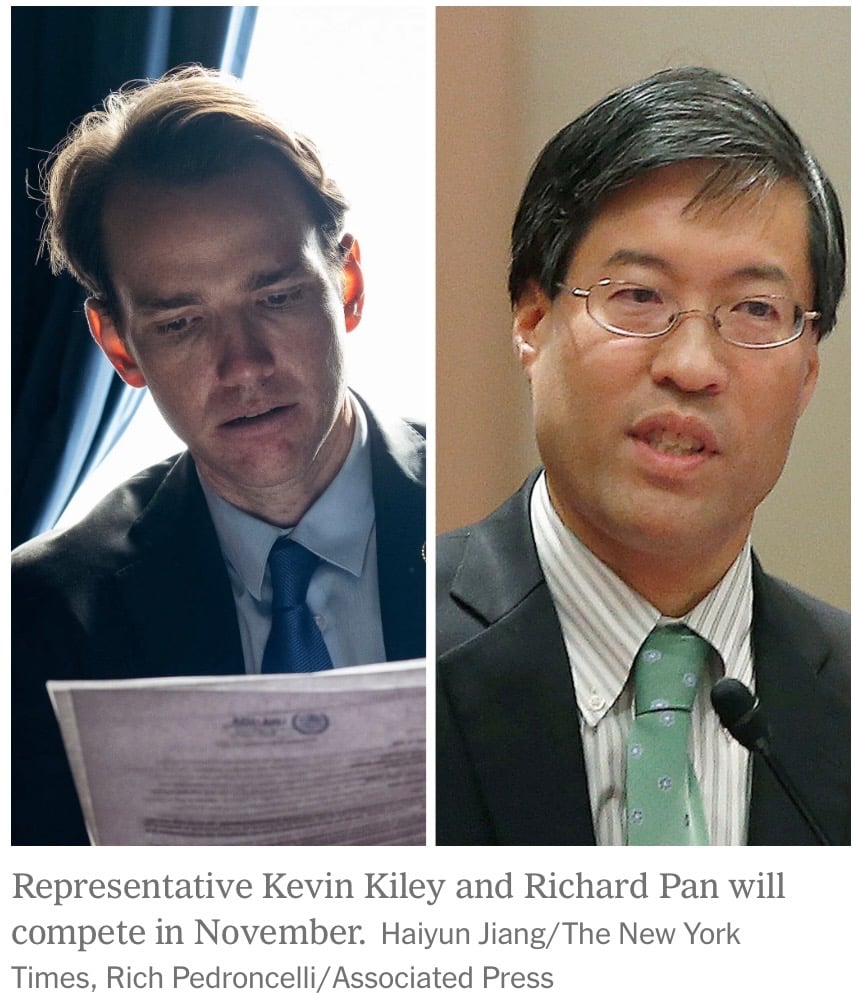
Representative Kevin Kiley, a former Republican who changed his registration and became an independent earlier this year, will face Richard Pan, a former Democratic state senator, in California’s newly redrawn Sixth Congressional District this fall.
Mr. Kiley and Mr. Pan were the top vote-getters in a seven-way open primary, according to The Associated Press.
The new district includes the City of Sacramento and is widely considered to be favorable for Democrats.
Mr. Kiley was first elected to the House in 2022 to represent a more rural stretch of Northern California.
California Congressional District 22.
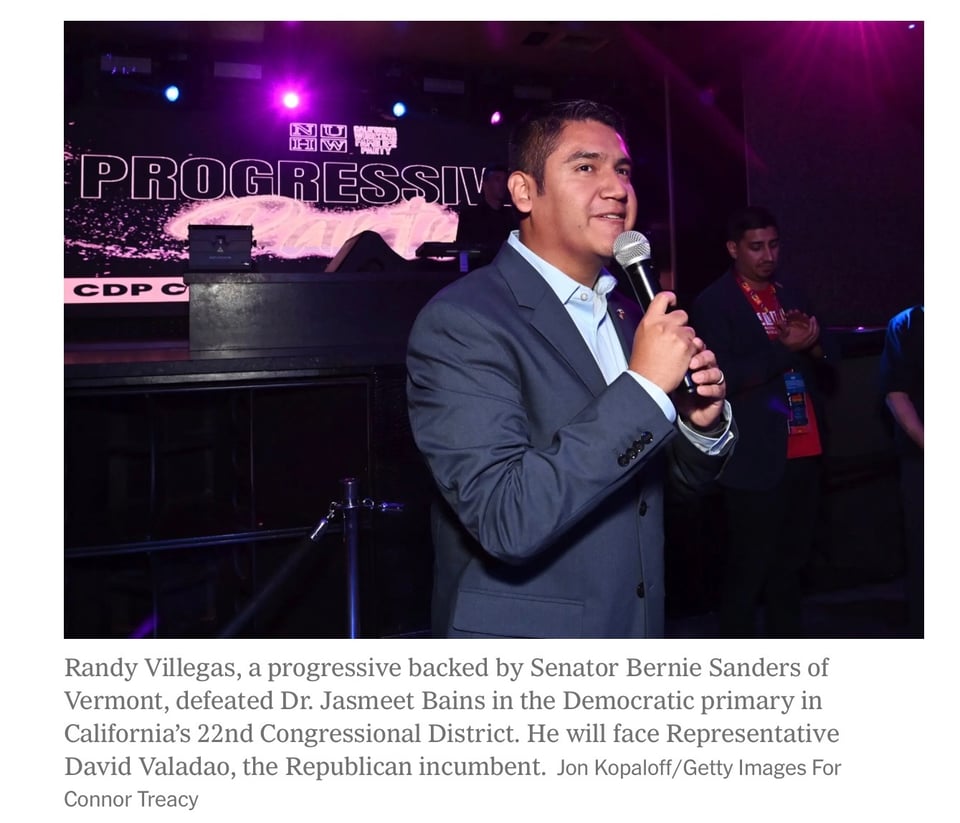
Randy Villegas, a political scientist and school board trustee backed by progressives including Senator Bernie Sanders of Vermont, advanced in a high-profile primary in a battleground Central Valley House district, according to The Associated Press. Democrats view the district as crucial to their efforts to regain control of Congress this fall.
In the general election, Mr. Villegas will face Representative David Valadao, a vulnerable but battle-tested Republican who has survived many past attempts to oust him. Democrats are eager to test the new lines they drew in Mr. Valadao’s Bakersfield-area district last year to make it even more competitive; they are also bullish about their ability to win back Latino voters.
California Congressional District 7.
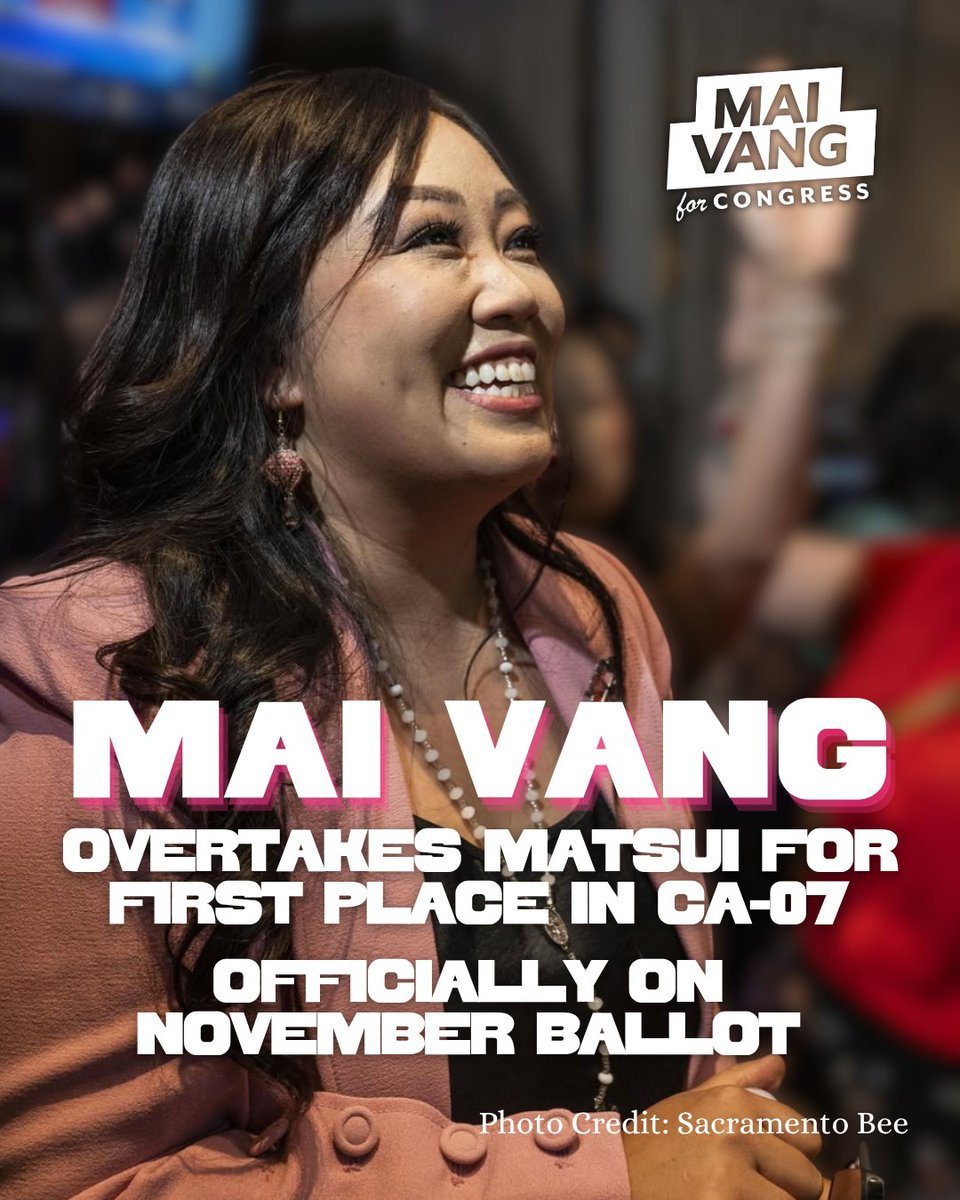
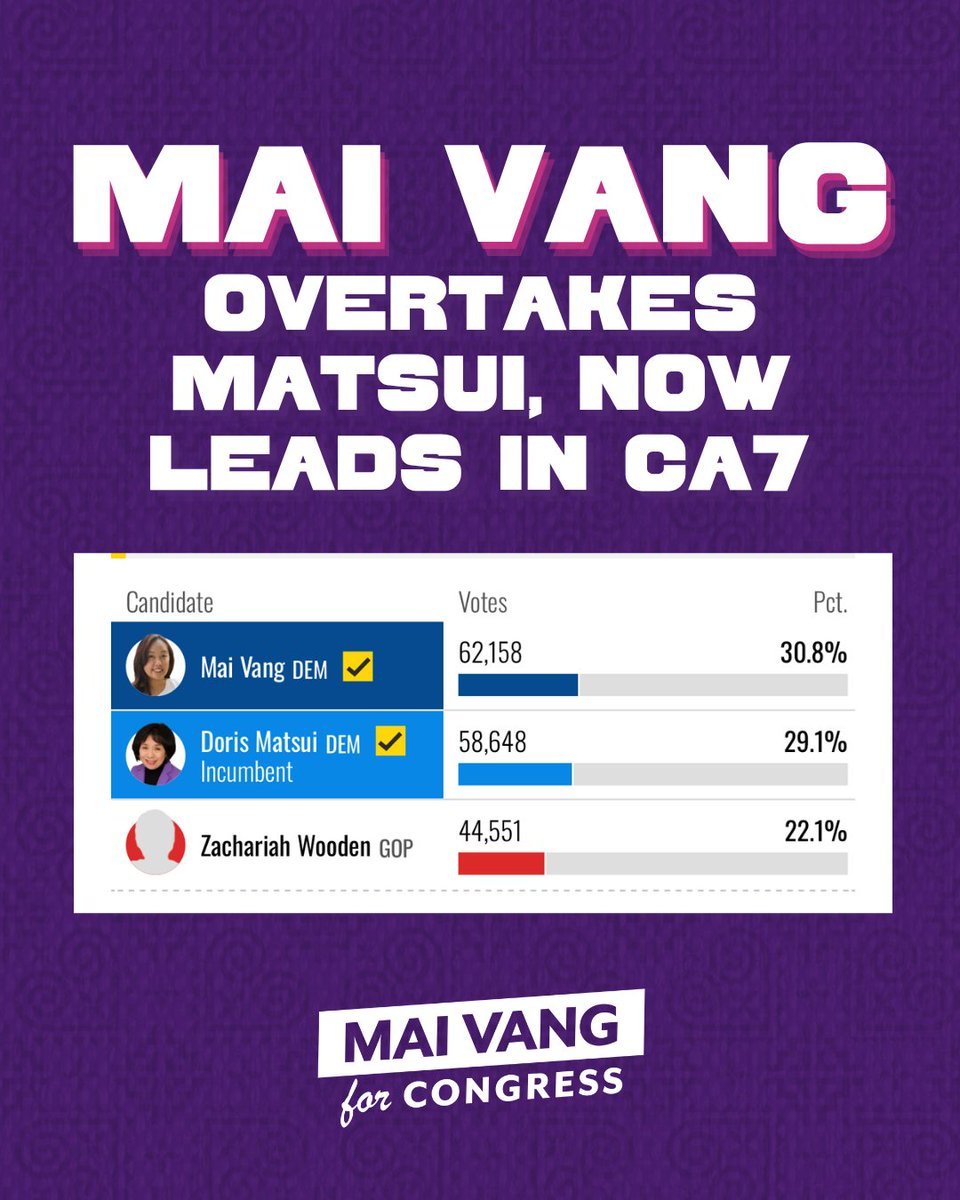
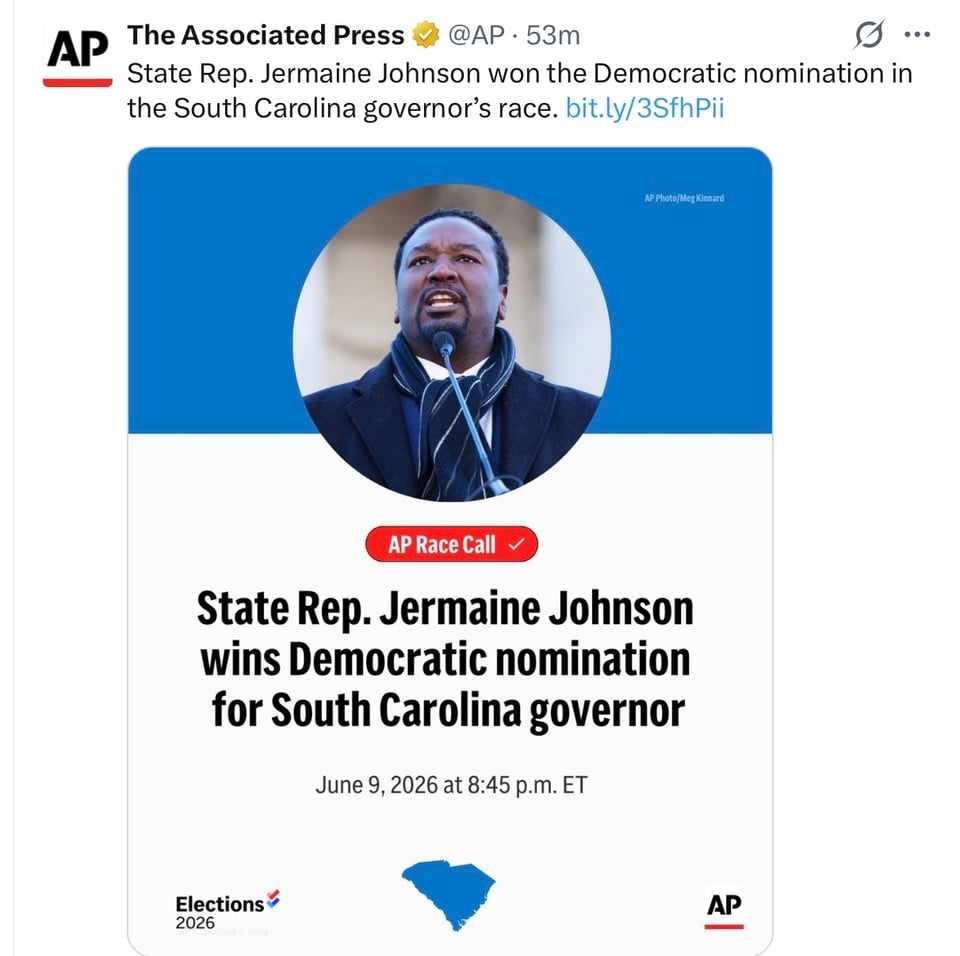
South Carolina Democratic Primary.
Back, as if she never left.
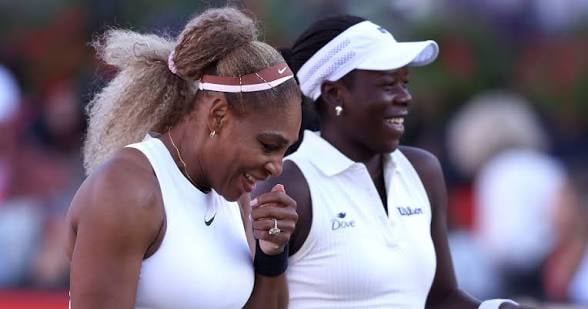
But this was doubles. Is Wimbledon singles next?

