Wednesday, July 1, 2026. Annette's Roundup for Democracy.
The Supreme Court spoke Monday and Tuesday.
Birthright was the BIG, BIG one. 👇
6–3 was the judgment, but only 5 justices - Roberts, Sotomayor, Kagan, Barrett, Jackson - joined Roberts’s opinion. Kavanaugh — concurred in the judgment and dissented in part.
Thomas, Alito, Gorsuch dissented.
Supreme Court Rejects Trump’s Effort to End Birthright Citizenship.
The justices blocked an executive order that banned birthright citizenship for the children of undocumented immigrants and some temporary foreign visitors.
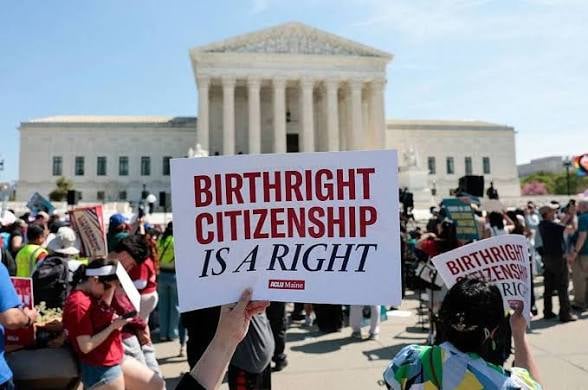
The Supreme Court on Tuesday struck down President Trump’s executive order limiting birthright citizenship, reaffirming the long-held principle that the Constitution guarantees that nearly all children born on U.S. soil are citizens.
The ruling was a significant blow to a policy long pursued by Mr. Trump to prevent babies born to undocumented immigrants and temporary foreign residents from automatically becoming Americans.
Chief Justice John G. Roberts Jr., writing for the majority, explained that Mr. Trump’s executive order violated the 14th Amendment of the Constitution. Children born in the United States to undocumented parents or to parents temporarily in the country, he wrote, are citizens at birth.
“Citizenship, then and now, was the right to have rights — to freely participate in our political community,” Chief Justice Roberts wrote. “The framers of the 14th Amendment extended that promise to ‘every free-born person in this land.’”
He added: “We keep that promise today.”
Justice Amy Coney Barrett was already under fire from the right for her majority opinion on Monday in a 5-to-4 ruling allowing some mailed ballots to be counted after Election Day. In the birthright citizenship case, she again joined the court’s three Democratic appointees and Chief Justice John Roberts to form a majority on the constitutional question before the court, guaranteeing that the opprobrium will continue.
The descendants of Wong Kim Ark, the Chinatown cook whose 1898 victory at the Supreme Court secured birthright citizenship for all Americans and set the precedent for today’s ruling, said in interviews that they were elated — and relieved. “You’re born here, you belong here,” said Sandra Wong. “We have had that for 150 years.” Reflecting on her ancestor Wong Kim Ark, she added: “My great grandfather never set out to become a symbol,” she said. “But he stood up for what was right and that made a difference.”
Sandra’s brother, Norman Wong, said there was a broader lesson to be taken from Wong Kim Ark’s legacy and today’s ruling. “All Americans need to stand up for their rights,” Wong said. “Our rights are not privileges, and we can’t let the government or anyone in it take them away.”
The legal battle over birthright citizenship began on the first day of Mr. Trump’s second term, when he announced an executive order titled “Protecting the Meaning and Value of American Citizenship.”
In the order, he declared that citizenship would no longer be automatically granted to babies born on U.S. soil. In particular, children born to immigrants who entered the country illegally would no longer be citizens, nor would those born to parents here on a lawful but temporary basis, such as those on student, work or tourist visas.
The president’s order faced immediate legal challenges, as civil rights organizations, immigrant advocacy groups and expectant parents sued, successfully winning in court to block the order while lawsuits unfolded.
It never went into effect, and there were few signs the administration had been preparing the dramatic overhaul of the citizenship system that would have been necessary were it allowed.
The N.A.A.C.P., noting birthright citizenship was rooted in granting full rights of citizenship to formerly enslaved people, cheered the decision. “Trump’s attempted assault on the 14th Amendment was dealt a major blow today,” Derrick Johnson, the organization’s president and chief executive, said in a statement. “This decision is a powerful affirmation of the Constitution and the enduring promise of equality it represents.”
Kevin Roberts, the president of the Heritage Foundation, a conservative think tank, described the Supreme Court ruling as “a tremendous betrayal of the republic,” which he argued lessened the value of American citizenship. He also previewed the next possible move for Republican opponents: He called for a constitutional amendment to correct it.
Speaker Mike Johnson, who was in the middle of a news conference when the court announced its decision, said he was “very disappointed” in the outcome. Calling the ruling a “textualist, originalist view,” Johnson said that it would result in “serious challenges going forward” that the United States would need to find a way to address.
In a virtual news conference, groups representing the babies who would have been subjected to President Trump’s executive order stressed the ruling reaffirmed the nation’s commitment to equal citizenship and national belonging. Cody Wofsy, the deputy director of the A.C.L.U. Immigrants’ Rights Project, quoted from mothers in the case. One woman said this Fourth of July would “feel even more special,” he added. (New York Times).
Click this link to read the Supreme Court opinion on Birthright Citizenship.
One more thing.
In the hours since the Supreme Court’s ruling, some Senate Republicans have already urged Congress to pass legislation or a constitutional amendment to end birthright citizenship. But voting on such a measure, even just to placate President Trump, would carry severe political risks for Republican lawmakers, who are already worried about losing their narrow majority in both the House and Senate.
Polls show that most Americans support the right to birthright citizenship, including about 40 percent of Republicans. Such a vote could also risk the inroads that Republicans have made with Hispanic voters, as Latino Republicans have historically been more supportive of birthright citizenship.
With just over four months until November’s midterm elections, many Republicans will be loath to take a vote that might anger broad swaths of the electorate that could be crucial to the control of Congress.
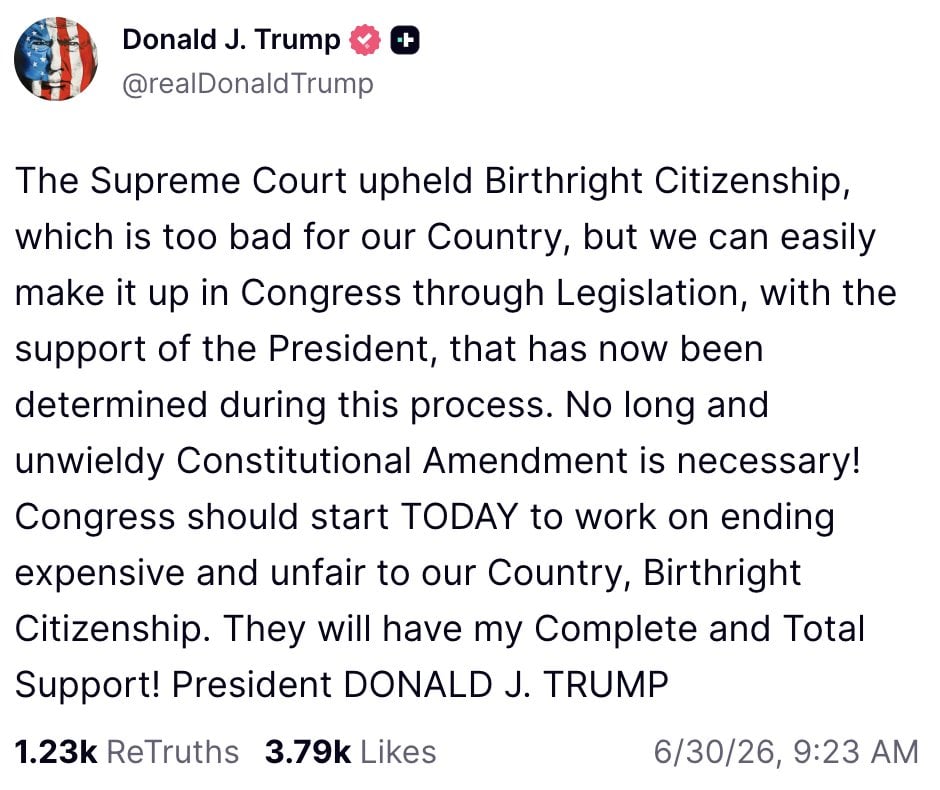
Other SCOTUS verdicts this week.
SUPREME COURT HANDS REPUBLICANS A CASH ADVANTAGE FOR THE MIDTERMS
The Supreme Court struck down restrictions that limited how much national party committees can coordinate spending directly with candidates, a ruling that supercharges the GOP’s already massive financial lead heading into the midterms.
Republicans are sitting on a brutal cash advantage. The RNC, NRCC, and NRSC ended March with $238 million in the bank and zero debt. Their Democratic counterparts, the DNC, DCCC, and DSCC, ended the same month with $120 million on hand and $18 million in debt, much of it sitting on the DNC’s books alone.
Now that gap is about to get worse. Campaigns get a legally protected discount rate on television and radio ads that outside groups and party committees do not get, sometimes paying a tenth of what outside spenders pay in expensive markets. With coordination limits gone, national committees can funnel their massive war chests directly into that cheaper ad space through the candidates themselves. “If the court overturns the coordination rules, you essentially turn the national committees into additional bank accounts for the campaigns,” Democratic operative Jesse Ferguson told the Washington Post.
Republicans are not hiding their excitement. Ryan Dollar, general counsel for the NRCC, compared the ruling to Citizens United for its significance. Democrats say they have been bracing for this outcome for over a year, with the DCCC holding off on setting up separate fundraising operations because it expected to eventually be allowed to coordinate straight from its main committee.
This is not an abstract legal fight. It is the difference between Republican candidates having a trust fund and Democratic candidates having to scrap for every dollar, right as the GOP tries to hang onto a House majority with an unpopular war and high prices working against them. (Real American Media)
SUPREME COURT UPHOLDS BANS ON TRANS ATHLETES IN WOMEN’S SPORTS
The Supreme Court upheld Idaho’s and West Virginia’s bans on transgender athletes competing on girls’ and women’s sports teams, extending a losing streak for the LGBTQ+ community at the nation’s highest court.
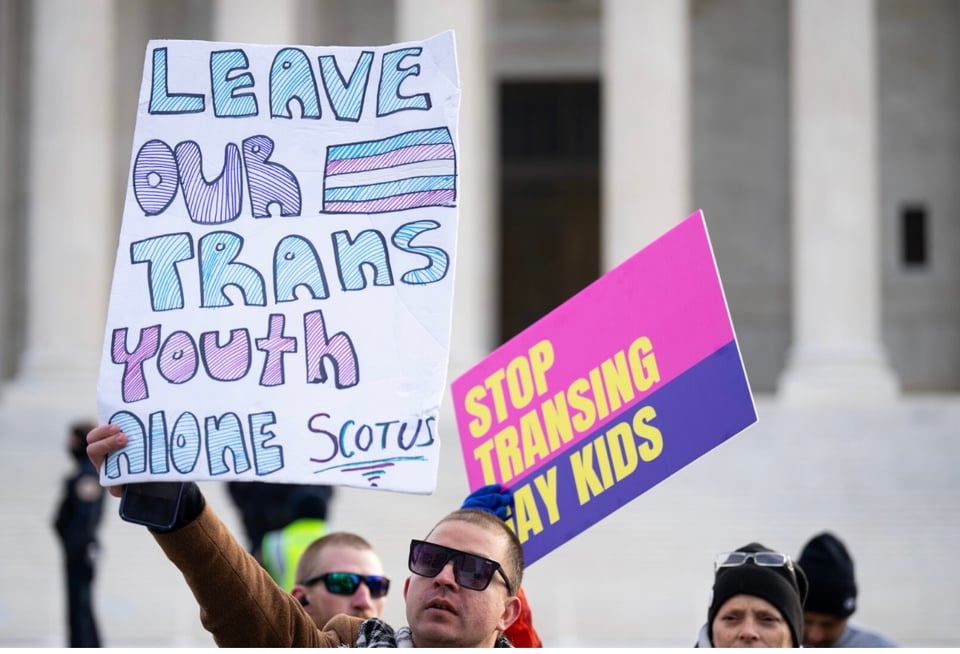
The case combined challenges from Becky Pepper-Jackson, a teenager from West Virginia, and Lindsay Hecox, a college student in Idaho, who argued the bans violated the Constitution’s equal protection clause. The justices were not persuaded. It is the latest in a string of defeats this term alone, following rulings that sided with a religious counselor’s right to perform conversion therapy and with parents seeking to block schools from withholding information about a student’s gender identity.
Trump signed an executive order last year pushing to keep transgender women out of women’s sports, and twenty-seven states have now passed their own bans, according to reporting from the Washington Post. The NCAA and the U.S. Olympic and Paralympic Committee both fell in line shortly after Trump’s order, updating their policies to exclude trans women from women’s competition.
Public opinion on the broader question of transgender rights is more divided than this ruling suggests. A Pew Research Center survey found 56 percent of Americans support anti-discrimination protections for transgender people in jobs and housing. But on athletics specifically, opinion has shifted hard toward restriction, with 66 percent now favoring rules requiring athletes to compete based on sex assigned at birth.
This ruling will be used as a template. Conservative states are watching every one of these decisions as a green light to push further, and this is the third loss for transgender rights at the Supreme Court in a single term. (Real American Media)
Wins and losses
The Supreme Court significantly expanded presidential power yesterday, holding that Trump can fire most independent government regulators. That’s a big deal. Critics say a president who can fire regulators at will is a president less constrained by constitutional checks and balances. He or she can issue loyalty tests. The court framed only one exception: governors of the Federal Reserve.
The decisions came in two separate, but related, cases.
The first concerned Trump’s efforts to fire Rebecca Kelly Slaughter, a Democratic member of the Federal Trade Commission, because her policy views are, in his mind, inconsistent with the priorities of his administration. (As in, she’s a Democrat.) The 6-to-3 decision in that case determined that the president could indeed fire her at will.
That’s a substantial shift in political power, one that gives the president more direct control over independent government agencies. The ruling has implications for more than two dozen of those agencies — including, but not limited to, the Securities and Exchange Commission, the National Labor Relations Board, the Nuclear Regulatory Commission and the Postal Service. As my colleagues note, the president has already changed the leadership of at least 13 agencies.
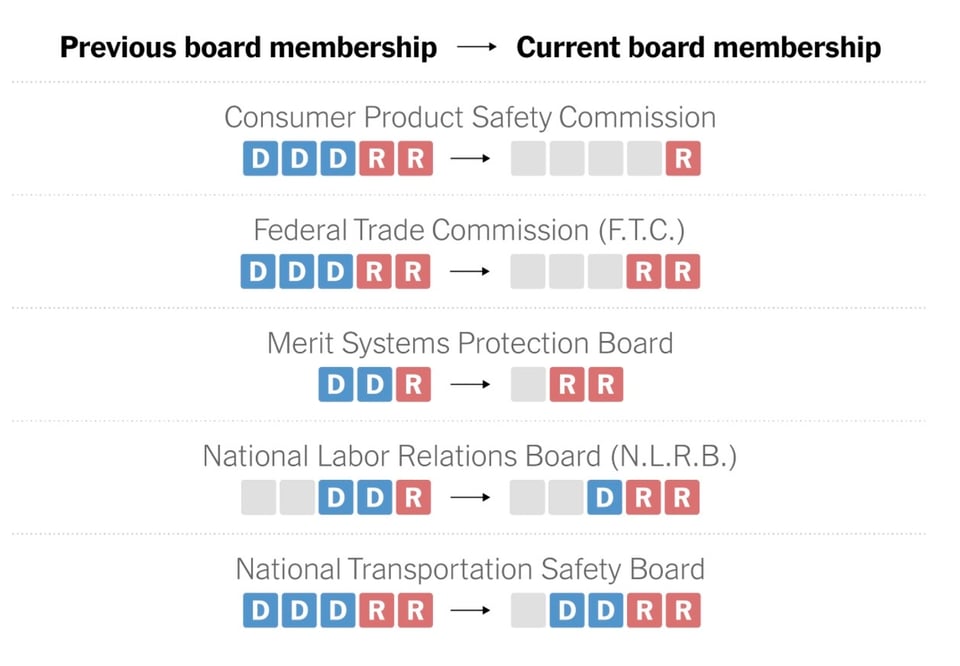
In a dissent, Justice Sonia Sotomayor wrote that the ruling “promises to unleash only chaos.”
At the same time, the Slaughter decision carved out the “unique role” of the Federal Reserve, with justices ruling that officials at the long-independent central bank could be fired only for cause.
The second case, involving Trump’s efforts to do just that to Lisa Cook, a governor of the Fed, underscored the carve-out. In a 5-to-4 ruling — with two conservative justices, John Roberts and Brett Kavanaugh, joining the three liberals — the court said that Cook could not be fired without the chance to rebut unproven allegations of mortgage fraud leveled by the Trump administration against her. Only a president can remove a governor from the Fed for cause, the justices wrote. “But that does not mean that he may make that decision for any reason, or no reason,” they added. (Trump immediately renewed his vow to fire her anyway.)
Request denied
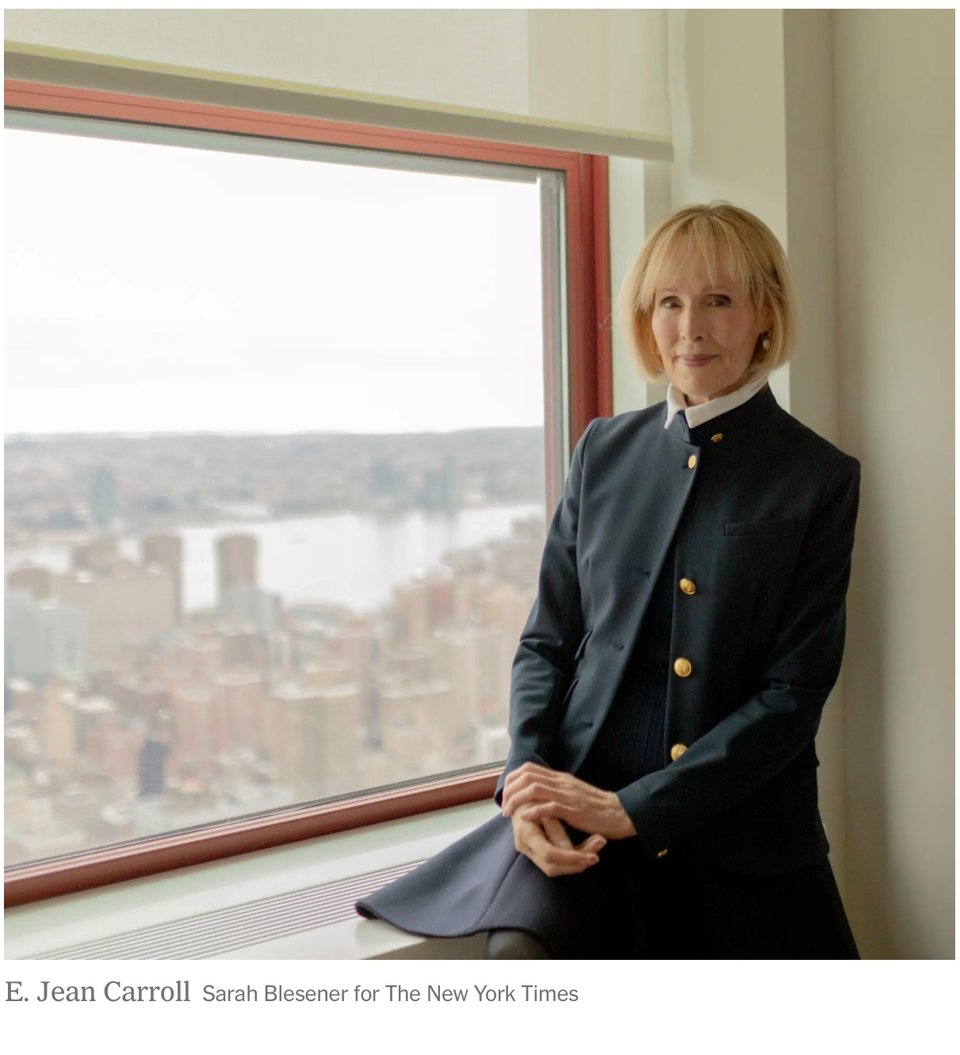
The Supreme Court also ruled yesterday on a request by Trump to re-examine a $5 million civil judgment against him after a jury found in 2023 that he had sexually abused and defamed the writer E. Jean Carroll. The justices declined to take up the case. That could end his legal efforts to fight back against the jury verdict finding that he assaulted Carroll in the mid-1990s in a department store dressing room.
Trump condemned the decision on social media. “I will continue the fight against this Weaponization and Lawfare Case against me, including the ridiculous claim of Defamation, with all of my power and strength,” he wrote.
From the mailbag
Trump was no less pugnacious in responding to another Supreme Court ruling yesterday. (We’re coming to the end of the court’s term, and the decisions are coming in hot.) This one upheld the grace period that Mississippi has for late-arriving mail-in ballots. The ruling means that Mississippi can count ballots that come in up to five business days after Election Day, so long as they’re postmarked by that day. And it leaves in place laws similar to Mississippi’s in 18 other states and territories, including Nevada and California.
On social media, Trump excoriated the decision and called for passage of his voter identification law:
“In light of the tremendous loss in the Supreme Court today concerning Voter’s Rights, and the fact that ‘people’s’ votes are allowed to be counted LONG AFTER an Election is over, it is more important than ever to pass THE SAVE AMERICA ACT.” (New York Times)
I despise Netanyahu and Israel’s attacks on Gaza and Lebanon. I also despise some internal policies in Israel.
But I despise this too, because it is a slippery slope.👇
Yes, the Mayor is relatively inexperienced, and in his zeal, he will sometimes misspeak. That's what he did this week.
Mayor Mamdani, people who disagree with you, aren't "monsters." Don't de-humanize them! Apologize.
Open Letter From Rabbis. https://jewishmajority.org/open-letter-from-rabbis
We are rabbis and cantors from across the United States. We serve different communities, hold different political views, and do not speak with one voice on every question concerning Israel, American politics or the war in Gaza. But we are united in our belief that Mayor Zohran Mamdani’s recent speech about pro-Israel civic participation is dangerous, unacceptable and beneath the office he holds.
On June 18, Mr. Mamdani described AIPAC as “monsters,” accusing it of moving “millions in dark money” to “preserve their power” and “turn us against one another.” Using the language of “monsters” against political opponents is an act of dehumanization, and when the targets of that dehumanization are overwhelmingly associated with the Jewish community the consequences become especially dangerous.
History demonstrates that campaigns against Jews often begin with rhetoric portraying them as uniquely sinister, uniquely powerful and somehow less deserving of equal treatment. Mr. Mamdani’s words invoke a familiar story about Jewish power, Jewish money and Jewish manipulation of public life. After criticism, Mr. Mamdani doubled down on the remarks.
Mr. Mamdani’s words matter because they were spoken by the leader of the city with the largest Jewish population outside Israel. They matter because antisemitism in America is rising. They matter because from Boulder, Colorado to Washington, D.C., we have seen how anti-Israel demonization can lead to political violence. These comments came mere days after five individuals were charged for plotting to kill AIPAC supported government officials according to a FBI criminal complaint, and the same day that a man in Florida was indicted for planning to target an AIPAC office in a mass shooting. By casting pro-Israel civic participation as monstrous, conspiratorial and anti-democratic, Mr. Mamdani has put a target on the backs of American Jews and their allies.
Some Jewish allies of Mr. Mamdani denounced his language, while leaders of the largest Jewish membership organizations expressed alarm. Jonathan Greenblatt, CEO of the Anti-Defamation League, posted that “This is the kind of bigoted conspiracy mongering that you expect from unhinged streamers or white supremacists. It’s not the language that we should expect from the mayor whose jurisdiction suffers from the highest levels of antisemitism of any city in America.” Ted Deutch, CEO of the American Jewish Committee, commented that “when you call people monsters, you’re not debating ideas, you’re dehumanizing the people you disagree with. And when that comes from a mayor, it creates an environment where people…wonder whether they can safely live and speak as themselves.” We agree.
The concern raised by these remarks is not confined to a single speech. Many Jewish Americans have watched a pattern emerge in which Israel, Zionists and pro-Israel Jews are repeatedly singled out for uniquely hostile treatment. Criticism of Israeli policy is legitimate, but obsession, demonization and dehumanization are not. The line between criticism and prejudice is crossed when Jews are treated as uniquely malevolent, powerful or undeserving of the civic respect afforded to every other community.
These remarks are part of a broader trend. Mr. Mamdani is the country’s most prominent Democratic Socialist of America (DSA)-affiliated officeholder. He made the remarks at a rally for congressional candidates, including two endorsed by NYC-DSA. In the same week a DSA-endorsed candidate won the Democratic primary for mayor of Washington, D.C., virtually ensuring that she will win the general election. Democratic-socialist and DSA-backed candidates are now competing for and winning offices in major cities throughout the country. When Mayor Mamdani speaks, he is not speaking only for himself. He serves as a model for a growing political movement whose rhetoric and priorities are increasingly being emulated nationwide.
The fixation on AIPAC reveals a glaring double standard. American politics is awash in outside spending from unions, corporations, ideological super PACs, environmental groups, business associations, trial lawyers, crypto interests and countless other organized constituencies. AIPAC is not the largest spender in American politics, nor is it unique in seeking to influence public policy. Anyone may argue for campaign-finance reform. But when the outrage is reserved for pro-Israel advocacy, and when that advocacy is described with language of hidden money, secret control and sinister power, it gives the appearance of antisemitism. Worse, it places Jews in danger. Many Jews reasonably hear echoes of longstanding antisemitic tropes.
Our communities include Jews with a wide range of views on Israel, Prime Minister Netanyahu, the conduct of the war in Gaza, Palestinian statehood and American foreign policy. Vigorous debate is part of Jewish life. But anti-Zionism is not mere criticism of Israeli policy. In its plain meaning, anti-Zionism denies the right of Israel to exist as the Jewish state. It calls for the elimination of the one sovereign refuge of the Jewish people. Conflating policy criticism with anti-Zionism is a slight of hand meant to make the destruction of that refuge seem enlightened.
Surveys show that the overwhelming majority of American Jews believe Israel has a right to exist as a Jewish homeland. Jews may disagree about Israeli governments, military actions, settlements, borders or peace negotiations. But when public figures treat “Zionists” as a uniquely suspect category of people, they are speaking about the overwhelming majority of the Jewish community. Demonizing Zionists is not perceived by most Jews as criticism of a foreign government; it is experienced as an attack on a core component of Jewish identity and peoplehood.
A recent Jewish Majority poll found that 82% of New York Jewish voters are concerned about rising antisemitism, and that most connect it to the normalization of anti-Zionism. Whether one agrees with that assessment or not, responsible leaders have an obligation to listen when an overwhelming majority of a minority community says it feels threatened. This is the lived reality of Jewish communities who are watching old hatreds return in new language.
Mayor Mamdani should apologize. He should retract his remarks and affirm clearly that Jews and pro-Israel Americans are full participants in our democracy.
We can debate policy. We can argue about money in politics. We can disagree passionately about Israel and the Middle East. But no elected leader should demonize Jews or those who stand with the Jewish state. Criticizing Israeli policy is not antisemitic. Treating millions of Zionist Jews as morally suspect, politically illegitimate or less deserving of equal participation in public life is.
When a Heat Dome hits you, think about this.
Weather tsouris seems to be everywhere these days.
Be safe, please.
Ho, Ho, Ho! Rare June Snow Closes Beartooth Highway, Parts Of Yellowstone
Winter is back in Wyoming as a late June snowstorm closed the Beartooth Highway and Yellowstone's Dunraven Pass. At 9,400 feet, the Top of the World store recorded three inches of snow. “We got our boots out and just kept working," said Libby Lane.
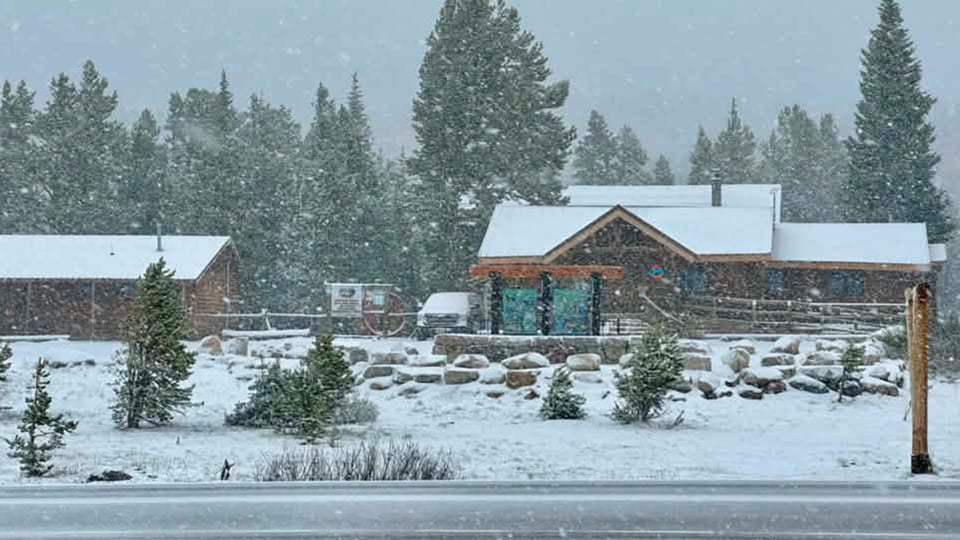
Libby Lane of Red Lodge, Montana, was going about her usual business Monday at the Top of the World Resort on the Beartooth Highway. As of 1:30 p.m., it was still snowing up there.
“We’ve got about three inches of snow, and it's still snowing,” Lane told Cowboy State Daily. “It's blowing and melting off the road, but the road looks slick, icy, and slushy.”
The only vehicle Lane had seen was a snowplow that drove past in its effort to clear the highway, heading for Cooke City.
I was hoping they’d open it today,” she said. “I haven't heard anything from anybody. Sometimes we're the last to know. Unfortunately, we have to look for the cars coming over the pass to know when it’s open.”
The Beartooth Highway was temporarily closed at 4:53 p.m. Sunday in anticipation of incoming snow. Monday’s snow vindicated the precautionary closure.
This is Lane's fourth season living and working at the Top of the World on the Wyoming side of the pass. When the Beartooth Highway closes, she and her coworkers are stranded at the summit until the road is deemed safe enough to traffic to resume.
However, this wasn’t unusual from Lane’s perspective. Snow-related closures, even in late June, are “not a surprise at all.”
“It’s very common,” she said. “We got our boots out this morning and just kept working.”
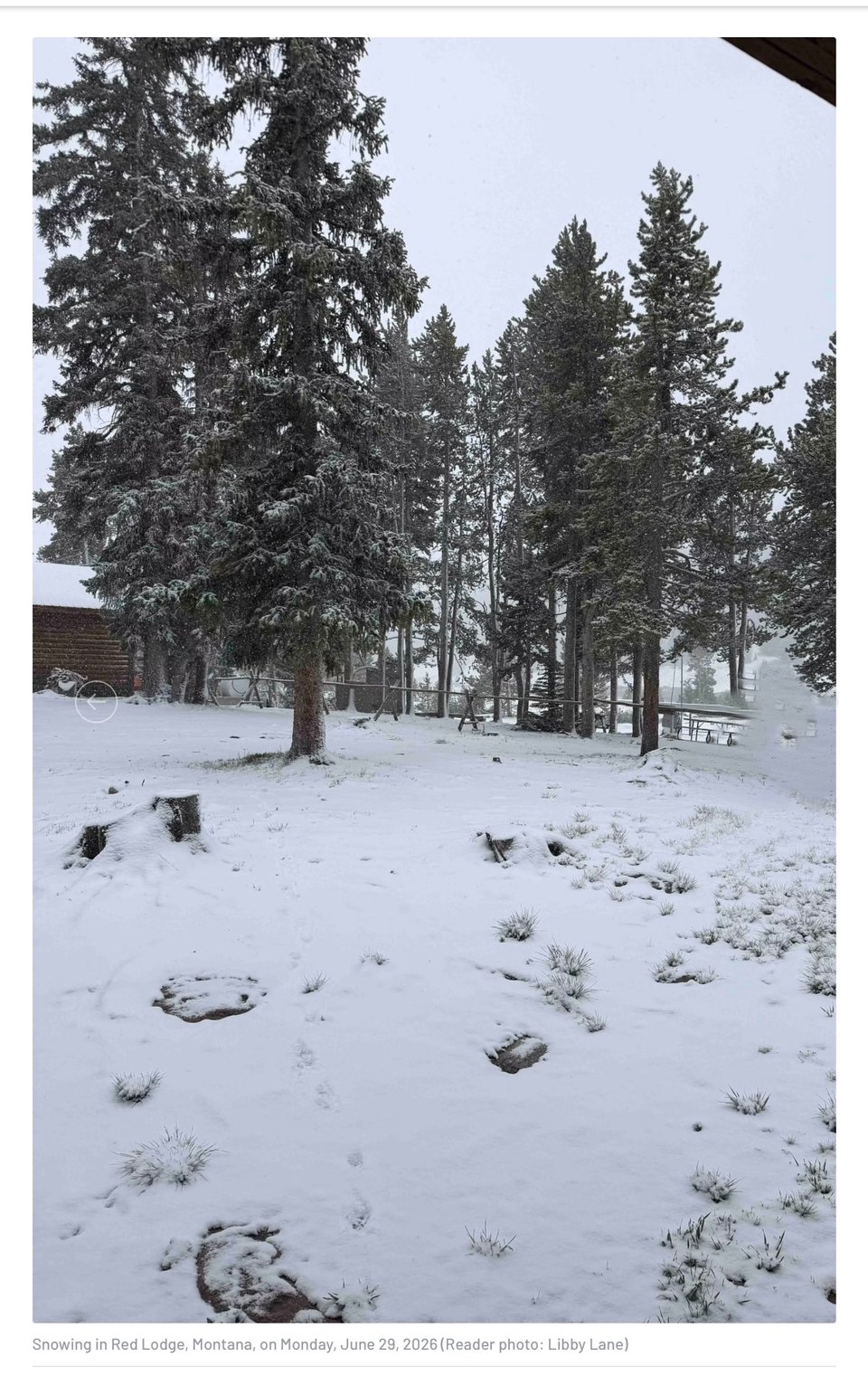
Yellowstone’s Dunraven Pass Closes
Dunraven Pass in Yellowstone National Park also closed Monday morning due to “winter weather conditions.”
“We’re looking at an inch of snow in Cooke City, Montana,” said Tessa Stetzr, with the National Weather Service office in Billings. “We were forecasting around 1 to 2 inches along the Beartooth Pass and 6 inches in the higher elevations.”
Snow also fell farther south in Wyoming.
Stuart Pierson of Centennial was heading over the Snowy Range toward Saratoga when he encountered “a pleasant surprise.”
“I left my house around 10:30 a.m., and there was light snow as I went over the top near Barbara Lake Road,” he said. “Nothing was sticking yet, but there was a lot of snow in the air.”
None of this winter weather was expected to escape the mountains, and a cooler-than-average Monday will give way to temperatures in the 80s and low 90s by July 4.
Where’s That Coming From?
The snow in northwest Wyoming came from a cold front moving across Montana, originating in the Pacific Northwest.
“There’s an upper-level low over Montana,” Stetzr said. “That's allowing cooler temperatures to make their way into the state and lowering the snow levels to around 7,000 feet.”
Lance VandenBoogart with the National Weather Service office in Riverton said that’s not unusual for northwest Wyoming or Yellowstone, even in the last days of June.
“Yellowstone and any high-elevation spot in northwest Wyoming can see snow any time of the year,” he said. “The high at Old Faithful was 44 degrees, and that’s not even record-breaking cold for this time of year.”
Still, there were cooler-than-average temperatures across Wyoming on Monday. Daytime highs were in the low 70s in central Wyoming and only in the mid-50s to mid-60s in the Bighorn Basin.
Many spots in Wyoming would welcome an inch or two of moisture. VandenBoogart said they’ll be going without.
“It’ll fizzle out by this evening,” he said. “This weather system will be weakening as it pushes through the mountains. The Bighorn Basin might see a couple of rain showers, but we’re not looking for much notable precipitation from this.”
Heat Of The Moment
If it’s cool and wet on June 29, what does that mean for the upcoming celebrations of the United States 250th anniversary on July 4?
VandenBoogart and Stetzr agreed that Monday’s high-elevation snow was an anomaly. By Friday, it’ll look and feel like summer again.
“We'll continue to have daily chances for afternoon showers and thunderstorms, but we're expecting temperatures to return to the upper 70s and low 80s for the second half of the week,” Stetzr said.
Central and southern Wyoming could get even warmer.
“We’re looking at the low to mid 80s through the middle of the week,” VandenBoogart said. “By the time we get to Friday, through the Independence Day holiday, we're going to be probably upper 80s to around 90, closer to mid-summer normals.”
As for the Beartooth Highway, the National Park Service said the road would be opened “when conditions improve.” Based on the amount of snow seen on webcams in Cooke City, that probably won’t be until Tuesday.
Don’t Read Into It
After a record-breaking dry winter and spring, some might be inclined to see June snow on the Beartooth Highway as a promising sign. After all, El Niño’s on the way and promises to disrupt global weather patterns in a way that could, possibly, benefit Wyoming.
The latest outlook from the NWS’s Climate Prediction Center still favors above-average moisture for Wyoming this summer. VandenBoogart doesn’t think anyone should read into it too much.
“Climatology isn’t going to be your best forecast,” he said. “The latest update is a slight lean toward above-normal precipitation for the western half of Wyoming in July, August, and September. It's not a sure thing, just that the odds are a little better than normal.”
Meanwhile, the snow on the Beartooth Highway isn’t indicative of anything other than the fact that anything can happen at a 10,000-foot elevation.
“If Casper got snow right now, that would be impressive,” VandenBoogart said. “When you're getting it up in the mountains and Yellowstone, snow happens when these cold systems ride through.” (CowboyStateDaily.com)

