Thursday, July 2, 2026. Annette's Roundup for Democracy.
MAGA Melts Down, if SCOTUS ever follows current law.
As Matt Cohen, Senior Reporter at Democracy Docket wrote about the SCOTUS ruling that states can count ballots arriving after Election Day-
It’s rare these days that the U.S. Supreme Court hands down a win for voting rights, which it did Monday when it ruled 5-4 that states can count mail ballots that arrive after Election Day. President Donald Trump and MAGA took it as well as you’d expect — and used the ruling to continue their push for voter suppression legislation. Also in this week’s Eye On The Right: Liberty Vote drops its billion-dollar lawsuit against election denier Mike Lindell, and as always, our weekly dispatches from the Twilight Zone.
Supreme Court mail ballot ruling spurs Trump and MAGA meltdown: ‘This is how our country dies.'
Republican officials including President Donald Trump and anti-voting activists are melting down after the U.S. Supreme Court upheld state laws Monday that allow grace periods for ballots mailed by Election Day.
The right responded to the ruling by stoking more fears about voter fraud and lamenting that the court had allowed “endless mail-in ballots.” Trump and far-right figures also used the decision to bolster an ongoing push for the SAVE America Act — though the measure does not address the issue at stake in the case.
“In light of the tremendous loss in the Supreme Court today concerning Voter’s Rights, and the fact that ‘people’s’ votes are allowed to be counted LONG AFTER an Election is over, it is more important than ever to pass THE SAVE AMERICA ACT,” Trump wrote an hour after the ruling came down.
Florida Gov. Ron DeSantis (R) called the decision a “loss for election integrity” and said his state will continue to only count mail ballots that arrive by Election Day.
“SCOTUS validates election practices in places like California that count votes received after the election,” DeSantis said.
In a 5-4 decision in Watson v. Republican National Committee, the nation’s highest court upheld Mississippi’s 2020 law that guarantees all mail ballots postmarked by Election Day are counted, so long as they arrive up to five days later. Currently, 14 states have laws allowing mail ballots postmarked by Election Day to be counted if they arrive after.
“Democrats are inviting chaos at the ballot box by allowing elections to drag on for days and weeks after voters cast their ballots,” RNC Chairman Joe Gruters said in a statement. “Republicans are not going to be deterred by this decision, and the RNC will keep fighting to have elections end on Election Day as Americans want.”
Gruters also used the ruling to pressure Congrss to pass the SAVE America Act.
“If we want fair and secure elections, Election Day should mean exactly what it says, which is why this decision makes it even more imperative that Congress pass the SAVE America Act,” Gruters said.
“The Supreme Court just handed the Left a weapon they will use in every close race between now and November,” Cleta Mitchell, a conservative lawyer and activist who founded the anti-voting organization Election Integrity Network, wrote in an email to supporters. “Mail-in ballots postmarked by Election Day can now arrive days later and still be counted. In 14 states. With no way to verify where they’ve been or what happened to them.”
Mitchell, who played a pivotal role in President Donald Trump’s effort to overturn the 2020 vote in Georgia, also noted the role mail ballots played in the recent California elections, where GOP candidates’ election night leads withered as mail ballots arrived days later.
“Similar issues have created prolonged uncertainty and changed results in other states,” she said. “That is wrong as a matter of principle — and it erodes trust in our elections.”
“Remember Election Day?” Rep. Abe Hamadeh (R-Ariz.) asked on X. “This disastrous SCOTUS decision, authored by Justice Barrett, guarantees we’ll keep drifting away from it — as our sacred elections get bogged down by endless mail-in ballots and never-ending counts.”
Justice Amy Coney Barrett, writing for the majority, rejected the GOP’s argument that federal laws setting a date for elections preempted states from accepting ballots after that day.
“[E]lection-day statutes do not set a deadline for ballot receipt, so they do not prevent Mississippi from counting ballots postmarked after election day yet received afterward,” Barrett wrote.
Far-right lawmakers and figures slammed Barrett for authoring the majority’s opinion and, along with Chief Justice John Roberts, siding with the three liberal justices in upholding Mississippi’s law.
“Amy Coney Barrett is the worst choice ever among all GOP justices. And that includes Roberts,” anti-voting activist Seth Keshel wrote. “What a disappointment she is.”
Sen. Eric Schmitt (R-Mo.) called the Supreme Court ruling a “shockingly wrong opinion.”
“Justice Barrett joins with the liberal justices to hold that federal election law does not preempt states who allow late mail-in ballots to be counted,” Schmitt said. “This is terrible for election integrity.”
Schmitt added that the Watson ruling was another reason for Congress to pass the SAVE America Act — the sweeping anti-voting bill that’s currently stalled in the Senate.
Trump took to social media to pressure the five GOP senators who don’t support the measure to flip their votes. The senators — Lisa Murkowski, Susan Collins, Thom Tillis, Bill Cassidy, and Mitch McConnell — “must vote to SAVE OUR COUNTRY,” Trump said.
Other right-wing figures joined the call to pressure the Senate to pass the bill in the wake of the Watson ruling.
“Yet ANOTHER reason the SAVE America Act must be passed NOW!” right-wing commentator Nick Sortor wrote. “This means states like California can CONTINUE taking WEEKS to count ballots after Election Day. BEYOND insane.”
The anti-voting activist Scott Presler was even more anguished.
“So, basically, we just learned that if a state passes a law to accept mail-in ballots weeks after Election Day, SCOTUS will uphold the law,” Presler wrote. “This is how our country dies.”
Far-right podcaster Tim Pool shared Presler’s distress.
“If there is no election day we have no democracy,” Pool wrote.
David J. Freeman, a far-right minister and political activist who posts online under the moniker “Gunther Eagleman,” called the ruling a “big loss for Republicans.”
Freeman praised Justice Samuel Alito’s dissent, which warned that the ruling “creates a serious risk of further undermining public confidence in our elections and our system of self-government.”
“Translation: Places like California can keep taking their sweet time ‘finding’ ballots days (or weeks) later and it’s all good,” Freeman wrote. “We need REAL election integrity, same-day voting, strict deadlines, voter ID, and no more games where the count drags on until the “right” number appears. PASS THE SAVE AMERICA ACT!” (Democracy Docket)
As to SCOTUS birthright ruling, the Constitution won, but barely.
July 1, 2026, Letters from an American, by historian Heather Cox Richardson-
Today the Supreme Court under Chief Justice John Roberts upheld birthright citizenship. But, as Jonathan V. Last of The Bulwark notes, the Supreme Court should never have taken this case. The lower court judges who heard the case were appalled that the administration was attacking the clear terms of the Constitution. Judge John Coughenour, who was appointed by President Ronald Reagan, called Trump’s executive order “blatantly unconstitutional” and said: “I’ve been on the bench for over four decades. I can’t remember another case where the question presented was as clear as this one is. This is a blatantly unconstitutional order.”
And yet the vote to uphold the Fourteenth Amendment was not unanimous; it was 6 to 3. And one of those six justices upholding birthright citizenship, Brett Kavanaugh, wrote that his objection to Trump’s attack on birthright citizenship was based not in the Constitution, but rather in his belief that Trump’s executive order violates a law. If Congress rewrote that law, he wrote, he would be willing to overturn birthright citizenship.
Four of nine Supreme Court justices are willing to rewrite the Constitution by fiat.
Although the court’s decision simply upheld the conditions that have been in place for more than a century, MAGA is treating it as a dramatic and dangerous change. “Now that [the Supreme Court] has opened the floodgates for foreign invaders to flock across our borders and spawn, the only choice we have is to triple down on immigration enforcement,” wrote right-wing podcast host Matt Walsh. “Militarize the border. Mass deportations. Round every illegal up. Don’t pull back when the lesbian activists start screeching about it. Use whatever force is necessary. There is no other option.”
Katie Phang is investigating rape charges against Trump.
Journalist Katie Phang filed a federal lawsuit against the Department of Justice for violating the Epstein Files Transparency Act, leading a judge to order the release of unredacted records by July 2, 2026.
These documents include FBI interview notes regarding a woman's allegations of sexual abuse and assault by Donald Trump while she was 13.
Today is the day!
Want to know how big the grift? The New York Times wrote an expose.
Trump Pulled In at Least $2 Billion After Returning to the White House.
The release of a mandatory financial disclosure for 2025 shows that the Trump family’s holdings, particularly the president’s crypto businesses, were stunningly lucrative.
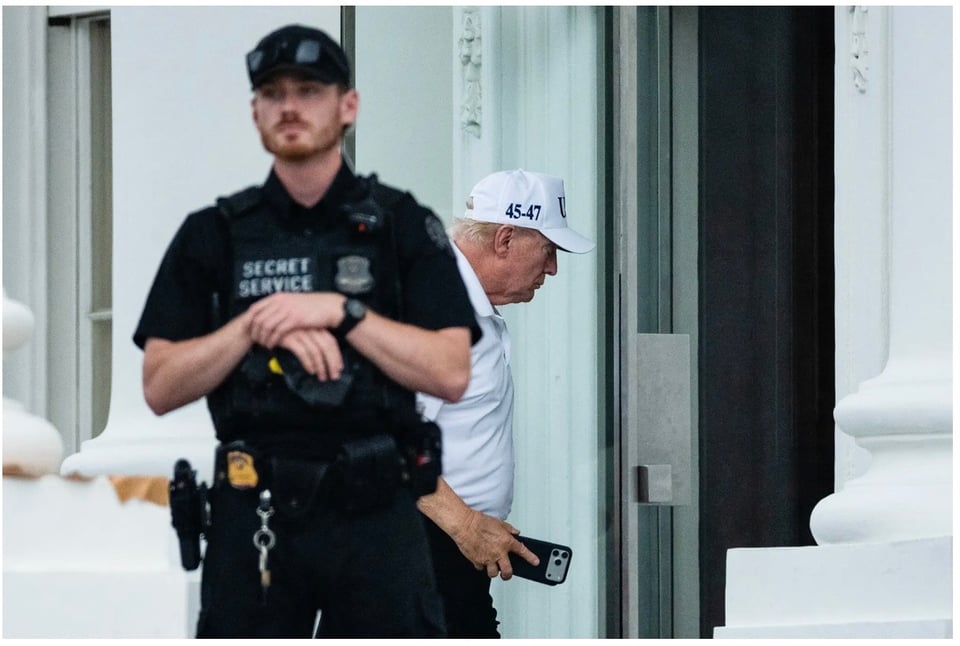
President Trump entering the White House on Sunday.
His mandatory financial disclosure report for 2025 pulled back the curtain on his secretive business operations.Credit...Eric Lee for The New York Times
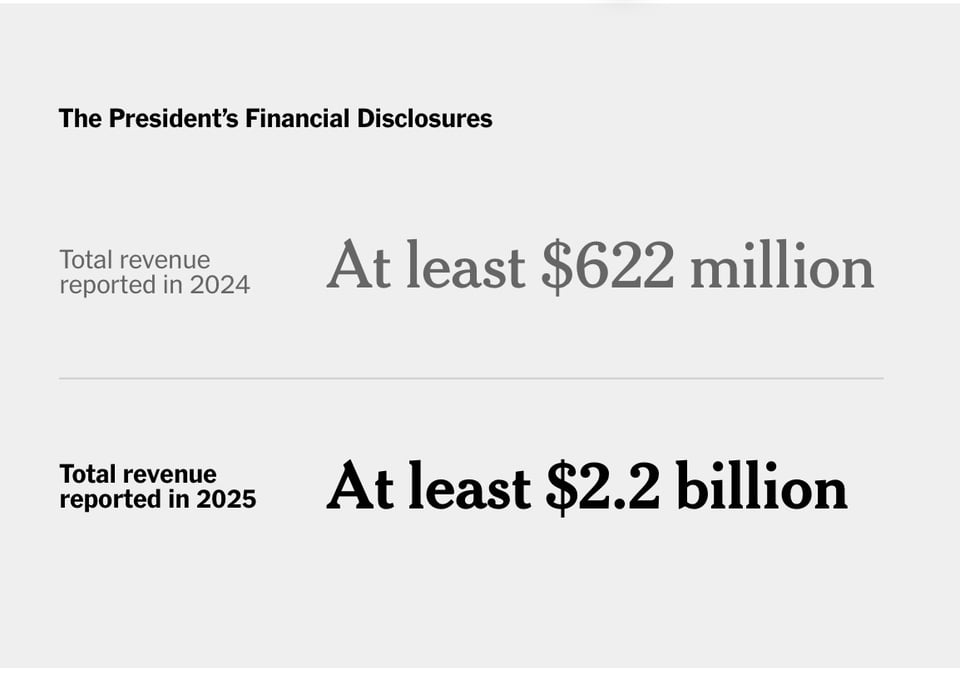
President Trump reaped a stunning windfall in his first year back in the White House, including about $1.4 billion from his family’s cryptocurrency businesses, a new filing shows.
All told, the president pulled in at least $2.2 billion, a figure that includes other parts of his vast holdings, such as his real estate assets. That compares to a minimum of $622 million his enterprises pulled in for all of 2024, before he returned to the presidency.
One of his biggest hauls in 2025 came when an investment firm tied to the United Arab Emirates bought nearly half of the Trump family’s main crypto company, World Liberty Financial, a transaction that blurred the line between foreign policy and private enterprise.
Mr. Trump also collected hundreds of millions of dollars from sales of his $TRUMP memecoin and World Liberty’s sale of its own digital tokens.
The results, detailed in Mr. Trump’s mandatory financial disclosure report for 2025 and released on Tuesday, pulled back the curtain on the president’s business operations. His crypto ventures, the report shows, are now some of his most lucrative enterprises, a remarkable turnabout for a man who once slammed crypto as a haven for drug dealers and scammers.
The president’s finances, which had been something of a mystery, highlight a conflict in his crypto business: Mr. Trump is a major crypto industry operator and its top policymaker.
It is hardly the only issue to arise from having a businessman serve as president. The president’s family business, the Trump Organization, has also capitalized on Mr. Trump’s popularity in certain parts of the world, licensing the Trump name to properties in countries that are crucial to U.S. foreign policy interests, including Saudi Arabia and Qatar.
Those two deals alone generated more than $14 million for Mr. Trump last year, the filing shows.
Mr. Trump brushed aside a question over concerns about a conflict of interest while speaking to reporters on Wednesday morning after the disclosure was released.
“I purposely, I never speak to any of the people that run the money,” Mr. Trump said.
“You know why I’m profiting? Because the stock market is going up,” he added.
However, The New York Times recently reported that he meets with his financial advisers once a year for an update on this accounts. Regardless, the stock market’s movements do not explain the bulk of his financial haul in 2025, including the U.A.E. investment in World Liberty Financial or the licensing deals.
Although the report released on Tuesday offered revenue figures for Mr. Trump’s crypto and real estate ventures, it did not reveal whether all of the businesses turned a profit or a loss, which is consistent with his previous filings.
The report also offers little clarity on the president’s net worth, much of which is tied to estimated property values and the fluctuating paper worth of crypto assets and his stock portfolio. For his largest assets, including cryptocurrency and real estate, Mr. Trump reported a minimum valuation of $50 million with no upper limit.
The president’s shares in his own publicly traded social media company, Trump Media & Technology Group, are worth about $875 million, according to other public filings, representing one of the single greatest sources of the president’s net worth. (Those shares have plummeted over the last year, eroding some of his net worth.)
But it was Mr. Trump’s crypto business that proved to be a top revenue stream.
Once an outspoken skeptic of crypto, Mr. Trump embraced the industry on the campaign trail in 2024 and started a series of ventures that have reaped enormous sums.
With his three sons, he helped create World Liberty, a crypto firm that sells a digital currency called $WLFI.
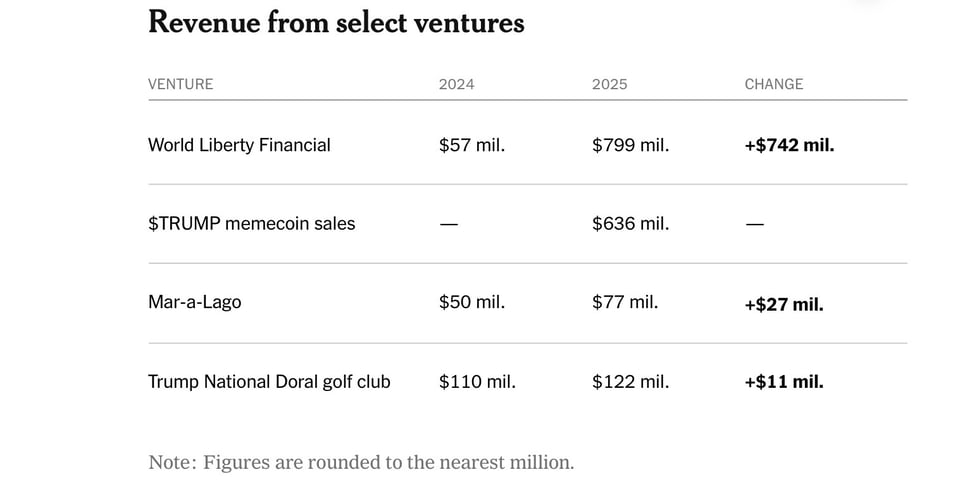
Last year, World Liberty marketed its coin to investors around the world, with 75 percent of each sale allocated to a Trump business entity, after the deduction of certain expenses, guaranteeing the president would make money even if the value of the token declined. The president received about $500 million from those sales last year, according to the filing, compared with $57 million in 2024.
World Liberty enriched the Trump family in other ways, as well.
In January 2025, days before Mr. Trump’s inauguration, an investment firm tied to the government of the U.A.E. bought a 49 percent stake in World Liberty, raising a slew of ethical concerns. Soon the Emiratis struck a deal with the Trump administration — over the objections of some national security officials — for the export of valuable computer chips that power artificial intelligence.
The filing released Tuesday did not explicitly refer to the deal, but it mentioned unnamed investments that generated more than $200 million for Mr. Trump.
The other major source of Mr. Trump’s crypto wealth was his memecoin, a novelty currency known as $TRUMP that he started selling days before his inauguration. He earned more than $600 million from sales of the coin, according to the filing.
The coin’s price shot up briefly, before plummeting, with its price recently hovering around $1.67, a roughly 80 percent drop from a year ago.
The Trump family also continued to pull in chunks of money from real estate branding deals, the new report showed, including some in the Middle East that generated a minimum of $35 million in revenue last year. Deals in Vietnam and Romania, as well as older ones in India, Turkey and Indonesia, combined to bring in at least another $20 million.
And the president’s major real estate holdings in the United States, like Trump National Golf Club near Miami, pulled in $122 million in revenue, while his Mar-a-Lago club generated a total of $77 million for him, the report said.
Now that Mr. Trump is flush with cash, and now that he has eliminated some of his long-running legal problems, he has reduced the liabilities on his balance sheet, including after an appeals court overturned a nearly half-billion-dollar legal judgment stemming from a civil fraud case in New York.
The disclosure report shows that Mr. Trump still owes more than $50 million to the writer E. Jean Carroll, who accused him of sexually abusing and defaming her. The Supreme Court on Monday declined the president’s request to review one of the judgments Ms. Carroll secured against him.
The financial disclosure captured several other legal wins for Mr. Trump, including payouts he collected from media and technology giants like ABC News, Paramount and Meta. ABC settled a defamation lawsuit, while Paramount agreed to pay him over the editing of an interview on the CBS News program “60 Minutes.” Meta settled a lawsuit he filed over the suspension of his Facebook and Instagram accounts after the Jan. 6, 2021, riot at the Capitol.
The disclosure also captured gains in Mr. Trump’s investments in the financial markets. While these numbers appear in wide ranges, making it difficult to decipher meaningful trends or specific amounts, they suggest that Mr. Trump continues to get richer as president.
At the end of last year, the disclosure shows, he held investment assets of at least $857 million, compared with a minimum reported value of $236 million the year prior. (New York Times)
A Woman of all trades who serves Democracy.
Hillary Clinton Makes a Surprise Appearance at Carnegie Hall
Clinton narrated “Lincoln Portrait,” a work by the American composer Aaron Copland, in her debut with a symphony orchestra.

Hillary Clinton — former first lady, former United States senator, former secretary of state, co-producer of a Broadway musical — added a new entry to her résumé last night: narrator with a symphony orchestra.
She appeared with Arcadia Symphony New York, which rented Carnegie Hall for a 250th-anniversary-themed program. Clinton read the narration for “Lincoln Portrait,” a 15-or-so-minute work by Aaron Copland that has become one of the go-to performance pieces as orchestras celebrate the nation’s big birthday. The actor F. Murray Abraham is to read the same text with the New York Philharmonic next week.
Clinton rehearsed with the orchestra and its conductor, Michael Fennelly, who cued her when to come in. The narrator’s job is to read brief excerpts from speeches by Abraham Lincoln, along with snippets of biographical material about him apparently written by Copland himself.
The piece ends with the last few lines of the Gettysburg Address that refer to “government of the people, by the people and for the people.” Clinton said after the rehearsal that she thought she would cry when she got to them.
“And, I mean, I’ve read that hundreds of times,” she said.
She joined the ranks of other famous people who have delivered Copland’s narration, including Judy Collins, Julius Erving, Henry Fonda, Danny Glover, Tom Hanks, James Earl Jones, Gregory Peck, the Lincoln biographer Carl Sandburg and Copland himself.
“And my husband,” she said. Former President Bill Clinton did “Lincoln Portrait” after he left office, with the Arkansas Symphony.
“You know, this has always been a moving, impactful piece combining this wonderful music with these words,” she said before touching a 250th anniversary pin she was wearing and adding, “We have to be as vigilant and careful as President Lincoln warned us of.”
Fennelly said he had been conducting opera in Bulgaria when a conversation he was having “moved away from music to current events and politics.” He did not want to talk about that, so — impulsively — he said he was going to conduct Beethoven’s Symphony No. 9 at Carnegie, even though he “totally made it up.”
Alice Kandell, a child psychologist, human rights advocate and art collector who is a longtime friend of Fennelly’s, said that the idea of making it a 250th anniversary concert came to mind later.
“I said, ‘What about Hillary Clinton?’” recalled Kandell, who had a walk-on part later in the concert. “He said, ‘We’ll do Lincoln Portrait.’” Then she called someone who knows Clinton, who called her.
Then Fennelly called Carnegie Hall, to book the date. “They said, ‘Do you have any stars who would draw or sell tickets?’ I said, ‘Hillary Clinton.’”
But he couldn’t say that publicly.
The orchestra said that Clinton’s staff had set one condition: There could no promotion of her appearance before the performance, out of concerns about security. The advertising focused on the Beethoven — the orchestra performed the “Ode to Joy”— and on “You Are My Rhapsody in Blue,” Fennelly’s arrangement of Gershwin’s famous piece. So for people attending last night’s concert, the first indication that a big-name narrator would appear in “Lincoln Portrait” came when they opened the programs the ushers had handed them as they walked in.(New York Times)

