Tuesday, May 12, 2026. Annette’s Roundup for Democracy.
You may have heard. AOC gave a marvelous interview. You can watch it.
How to win the Midterms.
Yes, it is doable. Two methods in the posts below.
Graham Platner points to Ohio GOP defying courts in response to Virginia redistricting ruling
Graham Platner, a Democratic candidate for U.S. Senate in Maine, pointed to past Republican defiance of court orders on redistricting as he reacted to the Virginia Supreme Court striking down the commonwealth’s new congressional map Friday.

“I’m old enough to remember when Republicans in Ohio just ignored court rulings repeatedly and did it anyway,” Platner wrote on the social platform X.
Platner was alluding to a legal battle that played out in Ohio ahead of the 2022 election in which the state Supreme Court repeatedly ruled that GOP-backed legislative maps were unconstitutional, but elections were ultimately held on them anyway.
The standoff began in September 2021 when Ohio lawmakers approved a new set of congressional lines that were quickly challenged as an unconstitutional gerrymander.
The Ohio Supreme Court struck down the map in January of the following year, and legislators adopted a second version that was also invalidated.
The court rejected several successive sets of maps, including in a March 2022 ruling that found the maps violated both the court’s orders and the state constitution. The Ohio Redistricting Commission was ordered to hire independent map drawers, according to the Brennan Center for Justice, which represented Ohio-based organizations and individual voters.
In July 2022, the Ohio Supreme Court again ordered state lawmakers to redraw congressional districts in a separate case. In a 4-3 decision, the court found the plan “unduly favors the Republican Party and unduly disfavors the Democratic Party” in violation of the state constitution’s ban on gerrymandering.
The map created two Democratic-leaning districts, gave Republicans an advantage in 11 others and left two highly competitive. But because the 2022 primary elections had already been held under those lines, the ruling could not take effect until the 2024 elections.
Ohio lawmakers approved a new congressional map last October that gives Republicans the edge in two districts, paving the way for a potential 12-3 GOP advantage in the state’s U.S. House delegation. It is expected to remain in place until 2030.
Platner’s message Friday could be seen as a hint to Virginia Democrats to take a similar course of action to Ohio Republicans after the recently passed referendum was invalidated.
The Virginia Supreme Court ruled that Democrats did not follow proper procedures when it pursued midcycle redistricting, striking down a new map that could have given the party a 10-1 edge in the upcoming midterms.
Virginia Attorney General Jay Jones (D) said in a statement Friday that his office was evaluating its legal options.
“This Court’s ruling follows a dangerous trend of tilting power away from the people,” Jones said. “My team is carefully reviewing this unprecedented order and we are evaluating every legal pathway forward to defend the will of the people and protect the integrity of Virginia’s elections.”(The Hill)
Callais is not the last word
What democracy defenders must do now and in the long term

In a span of less than two weeks, the U.S. Supreme Court (contravening the text and intent of the post-Civil War amendments and decades of court precedent) and the Virginia State Supreme Court (overturning the will of Virginia voters and inventing a new definition of “election”) have bulldozed through the electoral landscape to slant the 2026 midterm playing field in Republicans’ favor.
In Louisiana v. Callais, the U.S. Supreme Court demolished 60 years of progress in voting rights, robbed Black and Hispanic communities of the power to elect representatives of their own choosing, and aimed to decimate the ranks of non-white U.S. House members, state legislators, and local officials. This is nothing short of an attempt to reimpose white supremacy.
Voting rights legal guru Rick Hasen wrote:
This decision will bleach the halls of Congress, state legislatures, and local bodies like city councils, by ending the protections of Section 2 of the act, which had provided a pathway to assure that voters of color would have some rudimentary fair representation. It’s the culmination of the life’s work of Chief Justice John Roberts and Samuel Alito, who have shown persistent resistance to the idea of the United States as a multiracial democracy, and a brazen willingness to reject Congress’ judgment that fair representation for minority voters sometimes requires race-conscious legislation…. It protects Alito’s core constituency: aggrieved white Republican voters.
As infuriating, partisan, and legally unsound as these rulings are, they are not the final word on either the midterms or the future of our multi-racial democracy.
The Midterms
Even with the loss in Virginia, Democrats’ five-seat pick up in California should more than counteract the original Texas re-redistricting (where two of the five seats Republicans sought to steal may well go to Democrats). And despite the Virginia decision, Democrats may still pick up one to two more seats under Virginia’s old map. The net pickup for Republicans currently is less than ten before Democrats pursue their own redistricting in New York, Illinois, Colorado, and Maryland.
However, even with the advantage of, say, a dozen rigged seats, Republicans are unlikely to keep the House majority. Since 2024, Democrats have swung the electorate substantially in their direction, over-performing in comparison to Kamala Harris in 193 of 226 state legislative races, by 20 points in some cases.
On average, Democrats are doing more than 10 points better than they did in 2024. (Brookings’ William A. Galston wrote: “In the six special elections for the House conducted in 2025-2026, the swing toward Democratic candidates averaged about 15 points, while the swing toward Democratic gubernatorial candidates in New Jersey and Virginia averaged 14 points.”)
More than 20 Republican House seats were won by less than 10 points in 2024; 43 Republicans won by less than 15%. Given the electoral shift, Democrats’ list of targeted seats expands each week.
The New York Times reported that gerrymandering “tells only part of the story” about the midterms. While “Democrats could end up losing at least half a dozen safe seats, and possibly more,” depending on new maps drawn in Southern states, Republicans face gale-force “headwinds” thanks to Donald Trump’s atrocious approval numbers, his reviled Iran war, soaring gas and other consumer prices, snatching away healthcare coverage from millions, disaffection of Hispanic voters, and rampant corruption.
In short, gerrymandering, however outrageous, will not be enough to save Republicans if Democrats generate huge turnout, especially among those voters enraged that they have been stripped of voting power. (As Hungary demonstrated, a determined opposition can overcome a raft of unfair impediments imposed by a corrupt, unpopular regime.)
Democrats, independents, and disaffected Republicans know that the MAGA cult has no message — which is why MAGA lawmakers and courts must rig the election to cement white supremacy. That’s all they’ve got.
Democrats have their targets
The enormity of reversing 60 years of progress on voting rights necessitates a new era of intense organizing and public education — a new civil right movement to counter MAGA’s court-imposed Jim Crow. That effort kicks off with a grassroots National Day of Action on Saturday, May 16, in Alabama.
Organizers declared, “The dismantling of the Voting Rights Act is a reminder that we have unfinished business. The fight is ours and we are going to finish it.” Scores of democracy groups, faith-based organizations, and civil rights organizations will rally to oppose Jim Crow redistricting and to support multi-racial democracy.
The goal: Democrats must win, and win big, in 2026 and 2028. Senate seats, governorships, and other statewide offices cannot be gerrymandered.
A massive registration and turnout-the-vote operation must expand deep into Republican areas, appealing to disgruntled independents and Republicans while firing up the base. Democrats will need a broad, inclusive electoral coalition to pursue bold reform.
As former attorney general Eric Holder likes to say, progressives “need to be comfortable with acquiring power and using power.”
What then? If Democrats come out of the 2028 election with House and Senate majorities, and the presidency, they will have all the motivation and tools required to reverse the slide into Jim Crow, beginning with substantial reform of the discredited Supreme Court. The MAGA justices’ willful misreading of the Voting Rights Act and the Constitution to concoct a “color blind” interpretation of voting rights (coupled with their monstrous expansion of executive power and abuse of the emergency docket) should unify democracy defenders on the urgency of Supreme Court reform through court expansion, term limits, revised appellate jurisdiction, and ethics reform.
Election law guru Rick Hasen argued:
The Supreme Court itself has shown itself to be the enemy of democracy. If and when Democrats retake control of the political branches, it will be incumbent on them not only to write new voting legislation protecting minority voters and all voters in the ability to participate fairly in elections that reflect the will of all the people. They will also have to consider reform of the Supreme Court itself.
With the election of aggressive Senate Democrats running in 2026 and 2028, Democrats should have little trouble carving out a filibuster exception, especially if they win by large margins that affirm voters’ rejection of MAGA assault on pluralistic democracy.
In addition to reforming the MAGA Supreme Court, a myriad of solid proposals for undoing the damage wrought by Callais include: state voting rights’ protections, a federal statute that requires nonpartisan redistricting, proportional representation, and a constitutional amendment guaranteeing the right to vote. Democrats should pursue an “all of the above” approach, not merely to regain but to expand diverse voters’ participation and power.
Though the tools to sustain multi-racial democracy may be different from those employed in the 1960s,
Madeleine Greenberg of the Campaign Legal Center reminded us: “Every generation has faced attempts to restrict access to the ballot box, and every generation has pushed back.” If Democrats win elections decisively and fully exercise the power they obtain, they can fix what MAGA white supremacists have broken.
Only then can we fulfill the promise of pluralistic democracy. (Jennifer Rubin, The Contrarian, Substack.)
On the other hand.
Trump Wins Big as Virginia Dems Won’t Go Nuclear to Save 4 House Seats.
The state’s Democrats have decided against forcing resignations on the state Supreme Court to preserve their redistricting. Funny how Republicans always find a way, and Democrats don’t.
Top Virginia Democrats have decided against exercising a controversial procedural end run around last week’s state Supreme Court ruling that struck down their redistricting, which wiped away a gain of four House seats, the Democratic leader of the state Senate told The New Republic.
The decision—which nixes a complicated idea, discussed over the weekend by Democrats, to replace the state Supreme Court and get the case reheard—is likely to anger rank-and-file Democrats who had hoped the party would respond aggressively to the ruling, which has made it more likely that Republicans hold the House this fall.
The decision also contrasts sharply with moves undertaken by many GOP state legislatures in the South, who are aggressively gerrymandering their states with wild abandon to erase decades-old majority-majority seats from existence, after the U.S. Supreme Court struck down a key Voting Rights Act protection against racial gerrymanders.
“As a practical matter,” Virginia’s state Senate Majority Leader Scott Surovell said in an interview, the move “would not be capable of being implemented” given the “time frame.”
The decision effectively kills off hopes of getting back the four House seats that Democrats had moved into their column by pulling off a victory in last month’s referendum, which redrew the state’s House map. Last week, the state Supreme Court struck down the new map, wiping away that potential four-seat gain.
But over the weekend, many Democrats were heartened by an idea, floated by The Downballot, that could potentially save those four seats. The idea was that the Virginia legislature and governor could lower the retirement age of the state Supreme Court judges to remove them, replace them with new judges, and then get the court to rehear the case and decide it in their favor, restoring the lost map.
Yet Surovell insisted in an interview with The New Republic that the plan is unworkable. He cited a May 12 deadline set by the state Department of Elections for having congressional maps entered into the state’s election system. That’s necessary in order to be prepared for the congressional primaries set for August 1, for which early voting starts in mid-June.
That May 12 deadline would not leave enough time to execute the end run, Surovell said. The tactic would involve state legislative votes lowering the retirement age for judges followed by a new hearing of the case and other associated procedural arcana.
In a revelation that will dismay a lot of Democrats, the problem appears to be that the voting system has not been updated recently enough to make faster entry of the new maps possible (it’s currently being updated). If this ends up costing Democrats the House—which is unlikely but not impossible—the recriminations will be severe.
“Because the technology is so old, it takes a lot of time to input new districts into the computers, to ensure that people are assigned the correct ballots and that voting is not completely chaotic in November,” Surovell told me.
Democrats were taking the option of retiring judges seriously. Over the weekend, The New York Times reported that top Virginia Democrats had discussed the plan with House Democratic leader Hakeem Jeffries. Those discussions were inconclusive.
But Surovell told me he’s discussed the situation with Jeffries and with Virginia Governor Abigail Spanberger. And Survovell confirmed that in the conversation with Jeffries, he ran through all these obstacles.
The loss of those four Virginia seats will unquestionably make it harder for Democrats to win the House, though success is still probably likely. According to calculations by G. Elliott Morris, under the most likely scenario for GOP gerrymandering, Democrats now must win the national popular vote this fall by nearly three points to win the House. Under a doomsday scenario in which Republicans gerrymander to the fullest extent possible, Dems would have to win the popular vote by four points. The Times’ Nate Cohn similarly calculates it at four.
It’s plausible that Democrats could still win one or two of those four Virginia seats anyway, despite losing the new map, if things go well this fall. But at the very least, the failure to go nuclear to get those four House seats back means the Democrats’ margin for error in winning the House is substantially tighter.
In Florida, Republicans promptly rushed through a map that eliminated four Democratic districts, having zero qualms about it even though it faces substantial legal challenges. Republicans in other Southern states are expected to quickly follow suit, which could give Republicans a net gain of five seats—or possibly six or seven—in the redistricting wars.
When I asked Surovell about this takeaway—that Republicans keep finding ways around obstacles and Democrats don’t—he rejected the premise, noting that the successful referendum resulted in the expenditure of around $100 million. “I don’t think that was insignificant,” Surovell told me, adding that it’s still likely that Democrats will win two of the four lost seats.
Virginia Democrats still plan to appeal the ruling to the U.S. Supreme Court. But Surovell confirmed that even a good ruling would be unlikely to impact this cycle, due to that May 12 deadline. Of course, Virginia and many other Democratic states can redistrict next year in order to offset GOP gerrymanders, and do so in time for the 2028 elections. So, hey: There’s always next cycle, right? (New Republic)
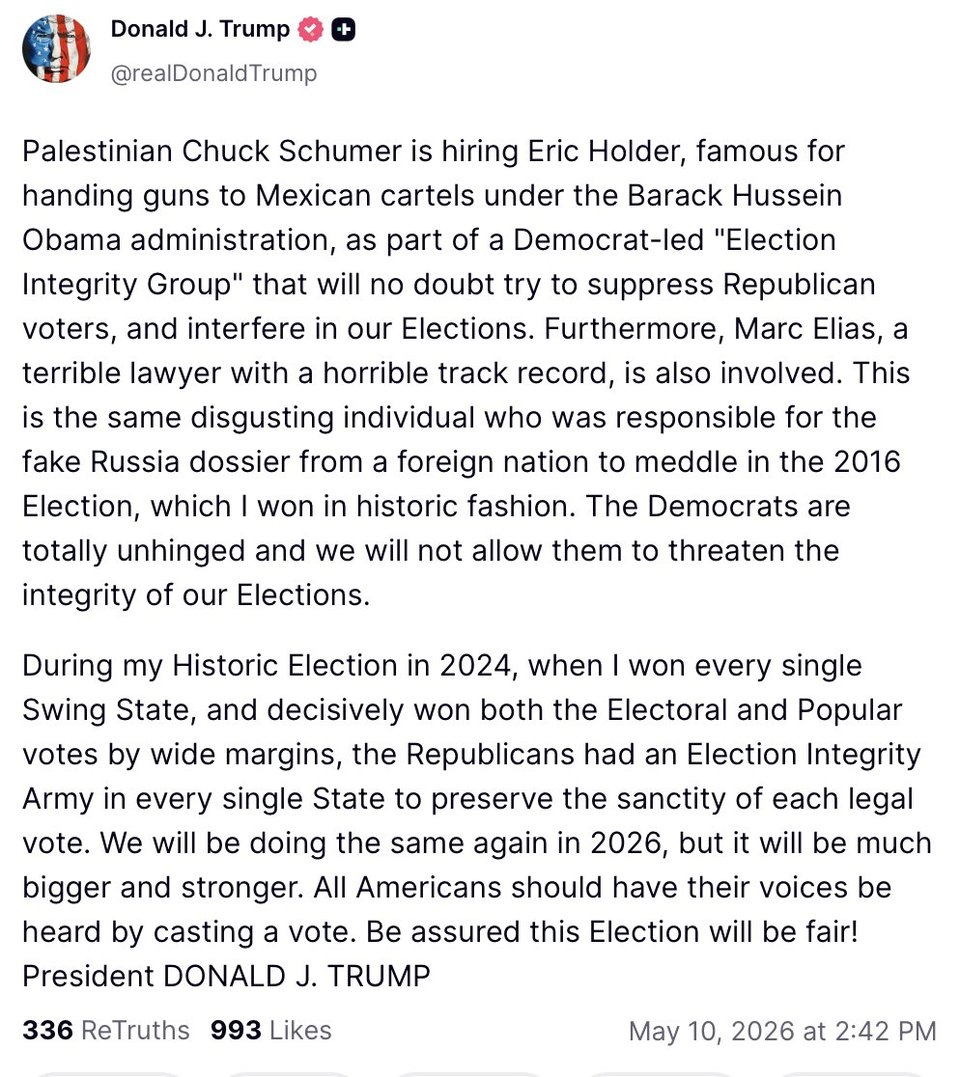
How’s Trump?
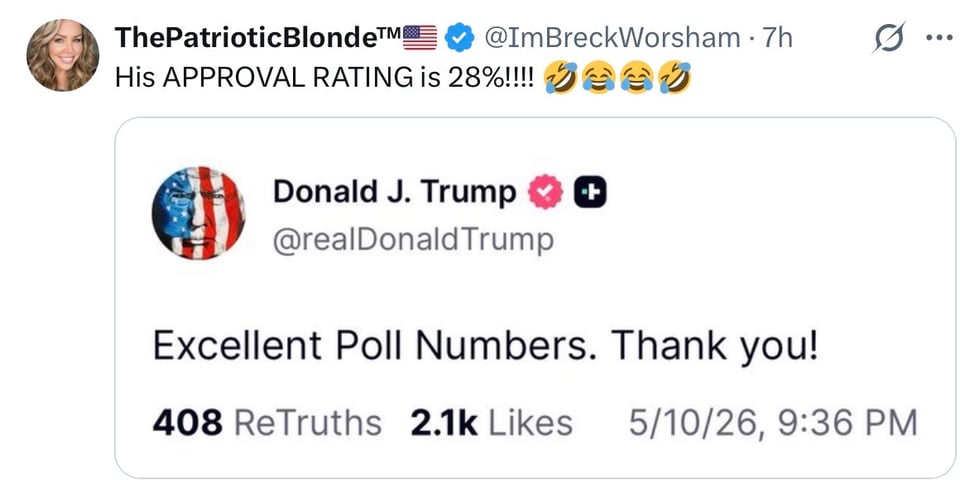
Trump's approval is underwarter in all the swing states
-24% in Wisconsin
-16% in North Carolina
-23% in Georgia
-20% in Michigan
-21% in Pennsylvania
-19% in Arizona
-20% in Nevada


The Hantavirus
Hope your Mother’s Day went smoothly.
A note to President Kennedy from his Secretary, Evelyn Lincoln.