Saturday, May 9, 2026. Annette’s Roundup for Democracy.
Virginia Redistricting - it’s all about the Midterms.
In Huge Blow to Democrats, Virginia Court Strikes Down House Map.
The decision is a major victory for Republicans, wiping away a measure approved by voters to allow Democrats to gain as many as four House seats in the midterms.
Virginia’s top court on Friday struck down a congressional map drawn by Democrats and recently approved by voters, dealing a major blow to the party as it struggles to keep pace with Republicans in the nation’s redistricting battle.
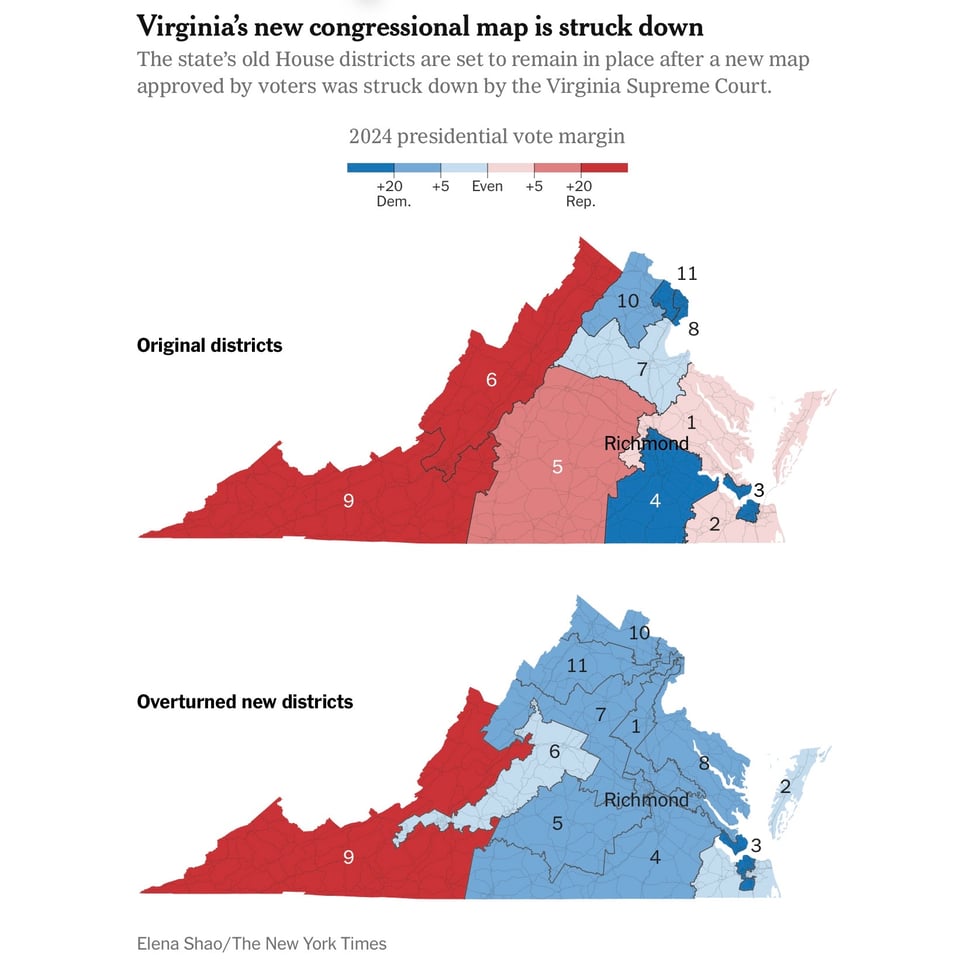
The ruling will wipe out four newly drawn Democratic-leaning U.S. House districts in Virginia, giving Republicans, who have carved out more red seats across the country, a structural advantage as they enter the midterm elections.
For generations, congressional maps have been drawn once a decade, after the census, to account for population shifts. But last year, President Trump started a rare, middecade gerrymandering war when he persuaded Texas officials to draw a new map to help Republicans as they face midterm headwinds. California countered with a map favoring Democrats. Other red and blue states followed.
After Virginia voters passed the map in a statewide referendum late last month, Democrats thought that they had battled Republicans to a draw, or that they had even eked out a small advantage. Then a ruling by the U.S. Supreme Court, which further weakened the Voting Rights Act, prompted several Southern states to work to pass new maps that would favor Republicans.
Now, the rejection of the new Virginia map means that, across the country, Democrats stand to lose half a dozen safe seats, and possibly more, from redistricting alone.
Still, Republicans face a challenging political environment in their bid to retain control of their slim House majority. Mr. Trump’s approval ratings have sagged as voters worry about the economy, the war with Iran and high gas prices.
In its 4-to-3 opinion, the Virginia Supreme Court wrote that Democratic legislators had violated the state’s constitution with their move to enact a new map meant to give their party 10 out of the state’s 11 U.S. House seats, up from the six it currently controls. Virginia voters had approved a constitutional amendment to allow for the map in a referendum.
The problem, the court’s majority suggested, was that the first vote on the amendment in the General Assembly, which would authorize Democrats to redraw the map, occurred days before last fall’s legislative elections — meaning that some Virginians who cast their ballots early did so without knowing how their state lawmakers would vote on the new map.
That, the justices wrote, violated the process laid out in the State Constitution.
“This constitutional violation incurably taints the resulting referendum vote and nullifies its legal efficacy,” the majority wrote.
Mr. Trump and Republicans celebrated the decision.
“Huge win for the Republican Party, and America, in Virginia,” the president posted on his social media site.
Democrats seemed despondent over the decision; they had invested eight months and nearly $70 million to pass the referendum.
Representative Hakeem Jeffries of New York, the House minority leader, said that “the decision to overturn an entire election is an unprecedented and undemocratic action that cannot stand.” Mr. Jeffries had lobbied Virginia legislators to advance their redistricting push and then campaigned for the referendum.
He added: “We are exploring all options to overturn this shocking decision.”
What those options were was not clear in the immediate aftermath of the decision.
Some legal experts believe that the Virginia Supreme Court’s ruling may be the final word on the state’s maps before the election. That is because the case involved a challenge to a state law about whether lawmakers had followed rules laid out in the Virginia Constitution, not a question of federal law or the U.S. Constitution.
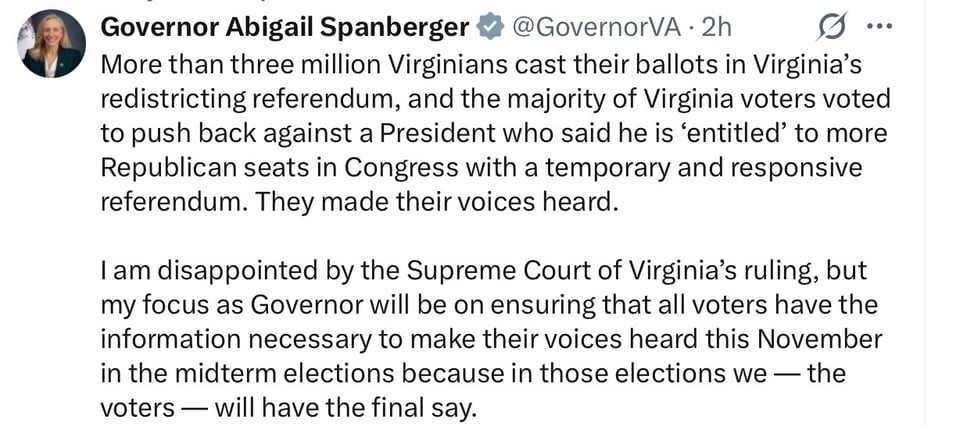
Gov. Abigail Spanberger, a Democrat, said in a statement that she was “disappointed by the Supreme Court of Virginia’s ruling, but my focus as governor will be on ensuring that all voters have the information necessary to make their voices heard this November.”
Since the U.S. Supreme Court’s ruling late last month, Republicans in Tennessee, Alabama and Louisiana have taken steps to draw new maps before the midterms. Those efforts could net Republicans a handful of additional safe seats before voters cast ballots in November. South Carolina is also exploring drawing a new map before November.
While Democrats have themselves grown more ruthless about gerrymandering, they are broadly struggling to keep up.
In part that is because, years ago, some Democratic-controlled states like Virginia installed independent commissions to oversee their map-drawing processes in an effort to insulate them from politics. But Republicans kept the cartographic power in state legislatures, allowing states like Texas, Florida, North Carolina and Missouri to enact partisan maps with few logistical hurdles.
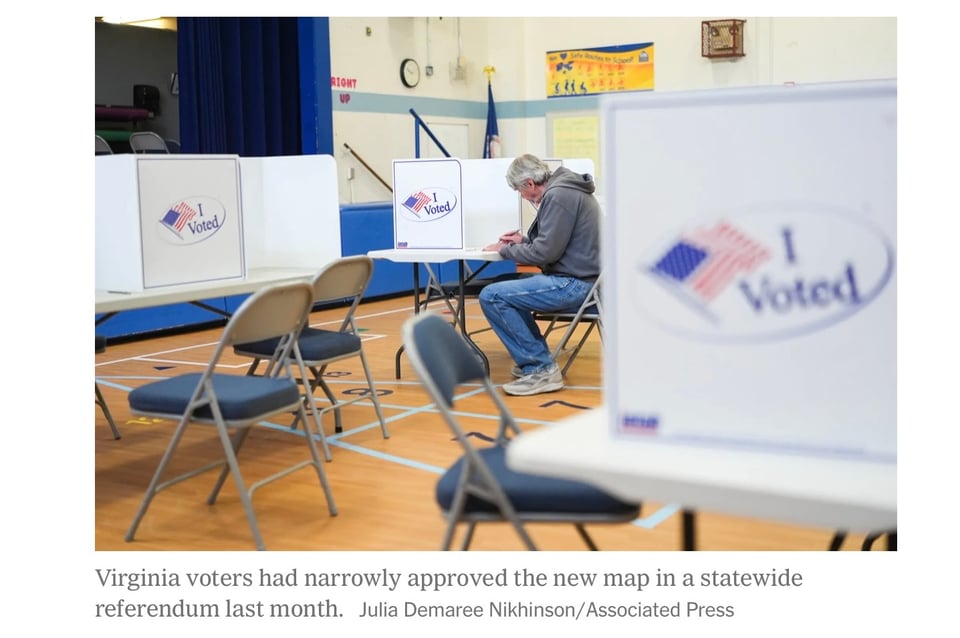
In Virginia, voters approved the amendment to override the independent commission by about three percentage points after the General Assembly had passed it twice. But Republicans challenged nearly every aspect of the process. Most of these lawsuits were filed in a county court in the rural southwestern corner of the state where a judge repeatedly ruled in the Republicans’ favor. These rulings were appealed to the State Supreme Court.
In the lawsuits, Republicans argued that the language in the amendment was misleading, that the new districts were not drawn compactly, that it was improper to vote on redistricting at a legislative session that had convened to discuss budget issues and that a state law would have required county clerks to post notices about the amendment months before it was actually voted on.
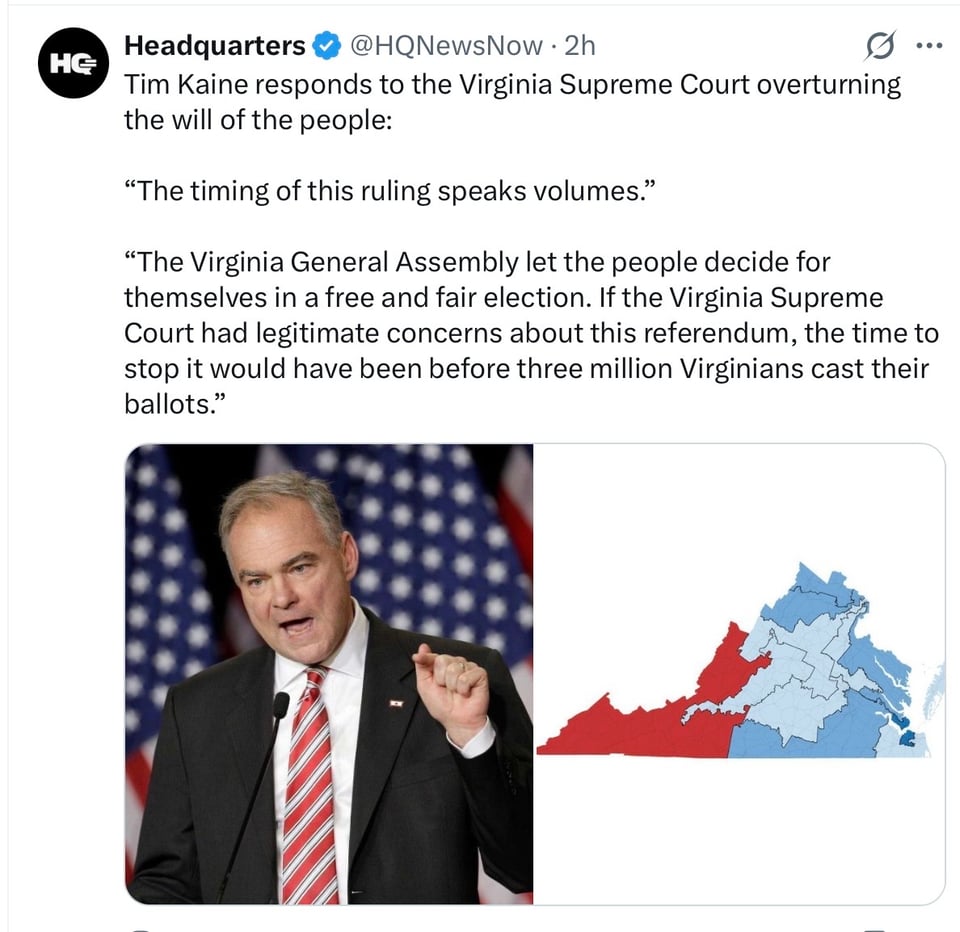
One of the most critical questions was about the sequence of events in Virginia’s complex amendment process. Before voters weigh in on an amendment to the State Constitution, the General Assembly must approve it twice, with an election for the state’s House of Delegates taking place between the two votes. The first vote for this amendment was on Oct. 31, just days before the state election. With hundreds of thousands of Virginians having already voted, Republicans argued that the legislative action had come too late.
The court sided with that argument.
“Early Virginia voters unknowingly forfeited their constitutionally protected opportunity to vote for or against delegates who favor or disfavor amending the Constitution by not anticipating a legislative vote on a constitutional amendment four days before the last day of voting,” the court’s majority wrote.
But Democrats’ loss in Virginia is likely to further stoke more redistricting battles. The party’s lawmakers in New York and Colorado have already signaled a desire to try and redraw their maps before the 2028 elections, and Virginia Democrats are likely to be in a similar position, since the court mainly took issue with the process, not with the resulting map. (New York Times)
One more thing.
Friday night final words on the midterms.
Republicans Are Building an Advantage in Redistricting. How Much?
Where things stands in the race for House control after recent court rulings.
The redistricting wars heading into the November midterm elections had been in a stalemate, with each party’s tit-for-tat gerrymanders roughly canceling each other out.
It’s not a stalemate anymore. Over just the last two weeks, new court rulings and new congressional maps have put Republicans on track to add more than a dozen districts that voted for President Trump. It would be enough for Republicans to obtain a significant structural advantage in the House of Representatives, giving them a much better chance to at least stay competitive even if they lost the combined national vote by a wide margin in the midterms.
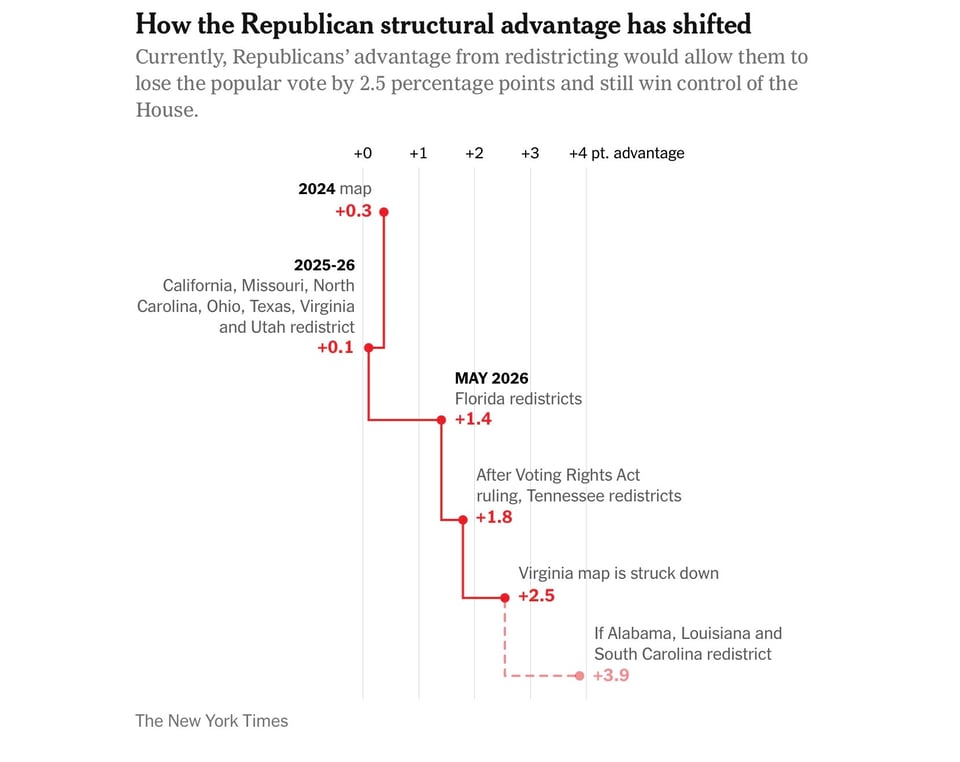
On procedural grounds, the Virginia Supreme Court on Friday struck down a Democratic-drawn congressional map that had been approved by voters. The map had been the centerpiece of the party’s effort to counter Mr. Trump’s mid-cycle redistricting campaign. The decision was entirely unrelated to the Supreme Court’s decision allowing states to dismantle majority-minority districts, which has triggered a rush of new Republican redistricting efforts across the South. For good measure, Florida Republicans redrew their state’s map, potentially adding up to four new Republican districts.
With Mr. Trump’s approval rating stuck below 40 percent and Democrats building a growing polling lead in the race for Congress, even a dozen new Trump districts might not be enough for Republicans to retain the House. But while Democrats remain favored, retaking the House is no longer a foregone conclusion. The new maps make it much easier to imagine how the midterms could be a seat-by-seat battle for House control — one which Democrats could well be favored to win, but which would not feel like the sweeping “wave” election it might have been otherwise.
It’s important to emphasize that this cycle’s redistricting fight has been surprising from the start, and the details remain in flux. Florida’s new congressional map, which was enacted on the grounds that the Supreme Court’s recent decision invalidates the state constitution’s prohibition on gerrymandering, faces serious legal challenges. Litigation is ongoing in other states, including Virginia. And so far, only Tennessee has enacted a new map in response to the Supreme Court’s decision on the Voting Rights Act. Louisiana, South Carolina and Alabama are expected to follow, but maybe one or two will not — or maybe additional states, red or blue, will join the fight.
But if everything stays as is — and with Alabama, South Carolina and Louisiana enacting new maps — Republicans will obtain a significant structural advantage. To win the House, Democrats could need to win the House combined national popular vote by around four percentage points, according to our estimates.
A four-point structural advantage wouldn’t be enough to make the Republicans favorites to win the House, but it gives them a real shot at it. In polling averages, Democrats lead by six points on the so-called generic congressional ballot, which asks voters which party they’ll support for Congress. But if Republicans make gains between now and November or pull off enough victories in key races, they could have a chance to retain control of the House even while losing the national vote by a significant margin.
A different way to consider the Republican advantage is to look at the kinds of seats they would need to win. Here, the most popular measure is the median congressional district — the district that would serve as a tipping point for House control. By this measure — after the Southern states redraw their maps — the median district will have voted for Mr. Trump by 5.5 points in 2024, or about four points more Republican than his 1.5-point margin in the 2024 national popular vote.
By each measure, Democrats need to win districts that voted Republican by a comfortable margin, though it may not be quite as challenging as it sounds. For one, there are nearly 50 districts where Mr. Trump won by five to 15 points. Democrats do not need many to break their way, and historically breakthroughs like these tend to happen when the national environment swings decisively in one direction.
For another, many districts that backed Mr. Trump by a wide margin have a recent record of voting for Democrats, including many with large Hispanic populations and many of the newly Republican districts created in this cycle’s redistricting wars. As a result, many Republican gains from redistricting might fail to materialize in this national environment: Democrats might hold districts like Florida’s 25th or 14th; Texas’ 28th, 34th or 35th; or North Carolina’s First.
And Democrats might flip some of the seats they targeted in their ill-fated Virginia gerrymander the old-fashioned way, like Virginia’s Second or even Virginia’s First.
On the other hand, these seats are so Republican that it’s easy to see how Democrats could fail to break through. If the Supreme Court’s Voting Rights Act decision and Mr. Trump’s mid-cycle redistricting campaign allowed Republicans to win the House while badly losing the national vote, it would be yet another blow to the credibility of American institutions during a time of bitter division. (Nate Cohn, New York Times)
Get ready to fight for our Democracy!
ABC in the news.
One more thing.
ABC is not the only one fighting back. Senator Mark Kelly is about to win.
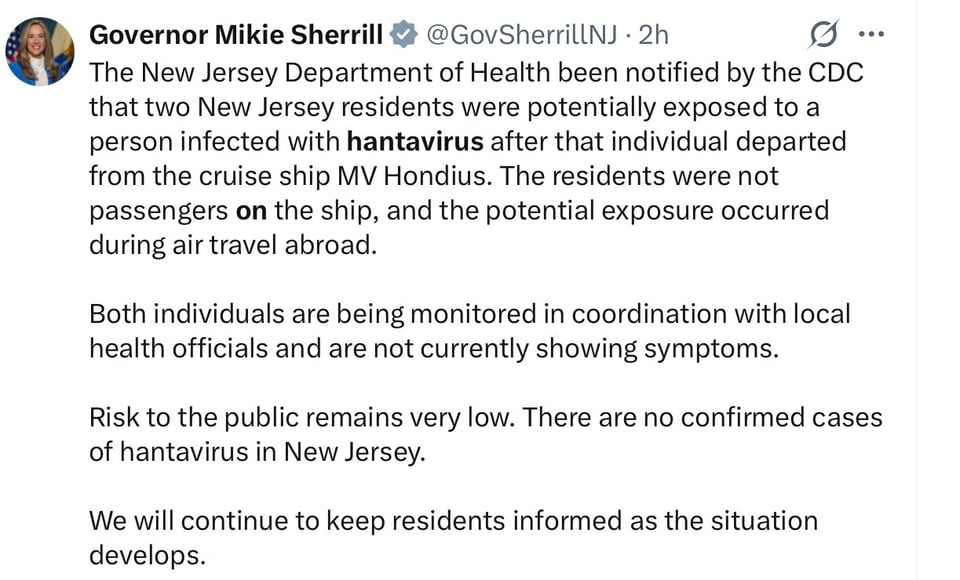
An update from New Jersey’s Governor on hantavirus monitoring in her state.
And from New York City.

Especially for New Yorkers who live on the Upper Westside like Eve and me.
Hope you enjoyed Suffs. We did.
Have a good weekend.
See you on Tuesday.

