(by zoë)
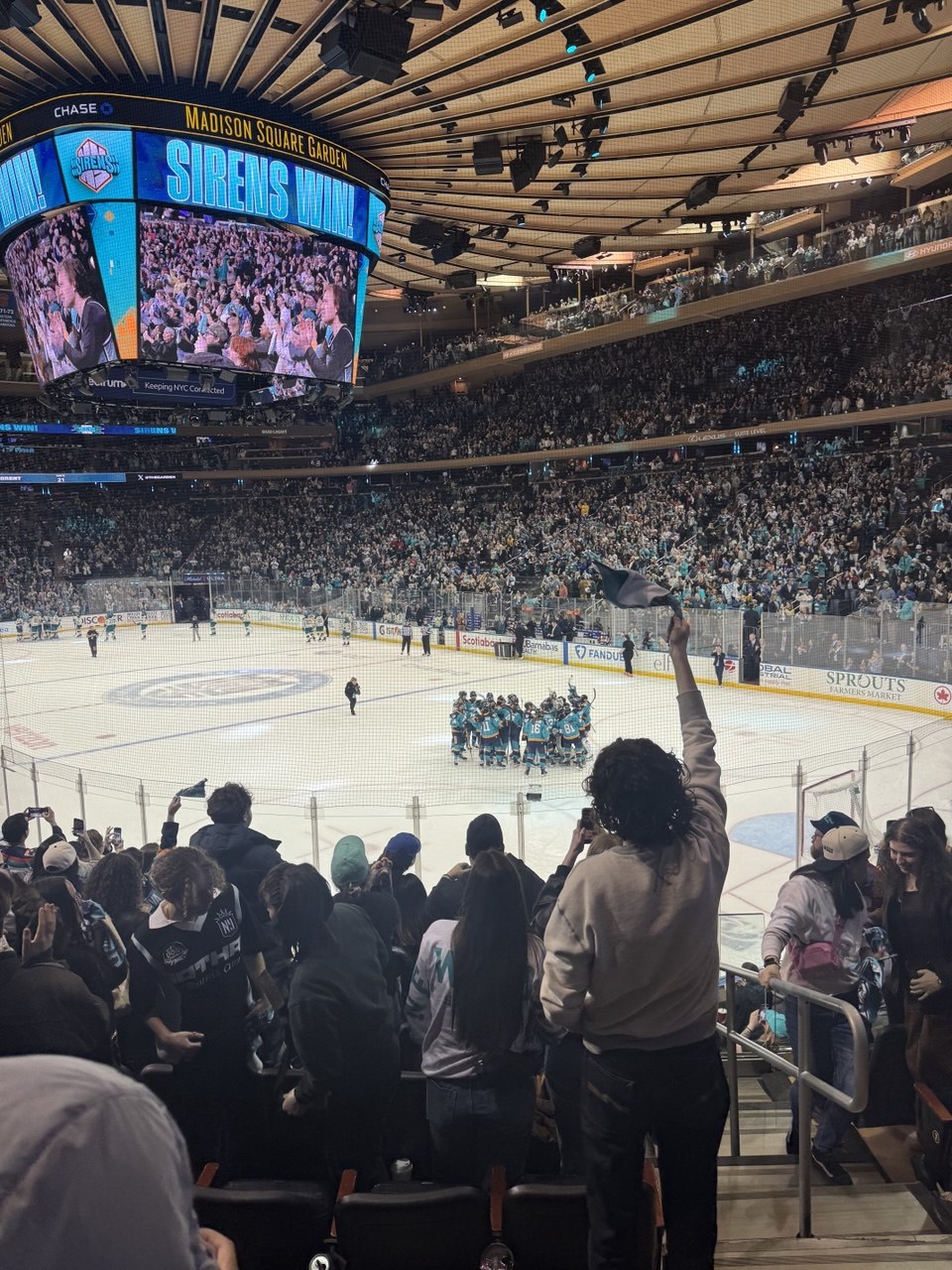
I got to go to the New York Sirens game at Madison Square Garden on Saturday night. It was around the time that Corinne Schroeder was nearing the 20-save mark in the second period – in what was very nearly a game-stealing shutout – that I started to feel like I was dreaming. Surely this wasn't real, and I could not be feeling this way. It's not like I haven't had cause to be cynical, casually nihilistic, and enraged over the last decade or so, and my relationship with hockey felt somehow consequential as a barometer for that. I was shocked at how much I was enjoying myself. Two days later, I'm still shocked.
To explain: I've never really done well with group settings or community spaces. I have a sort of paralyzing social anxiety that I've had to work very, very hard to understand and cope with – or at least that is what I tell myself to give myself grace. I can be an asshole and I treat everything I do like an exercise in analysis or philosophy and ethics. I'm sure it's exhausting; I've been told as much. It is for me, too. I've been trying to chill the fuck out. Being alive is a community that we all are in and it's messy and complicated, but you don't have to be. Approach others with openness and honesty about what your values are and be willing to stand by those values. It is a challenge to be honest with others and yourself when we are confronted so constantly with hatred, violence, and war. It's disorienting. Responding with love is a radical act, even in its most depoliticized and co-opted forms. The idea that a room of over 18,000 people can feel like love goes against my instincts for anything I've ever experienced in a crowd. I've been watching hockey for about 20 years – but I've never felt at home in it.
I'm kind of a veteran of sports flights of fancy, you see. I present a mostly rational exterior, I think, and then people get me talking about sports. I've been called out about this in a variety of settings. Sports fans really are freaks. None of us know why we do any of this. For me, a huge part of it has to be that I get off on the analysis. I didn't even get like this in college studying literature, but it certainly didn't help. I came this way, like an instructor of an elective that nobody I'm talking to knows they signed up for – I'm always analyzing everything. Growing up, I didn't even know I liked sports – maybe because the only sports fan culture I really had access to was around the Pittsburgh Steelers, which is, you can imagine, naturally horrific. Once, I got dragged to a Steelers game and spent the entire time dissociating and trying to listen to my CD player. It was immediately post-9/11 and I'd tried to bring a purse into Heinz Field, which hadn't gone well. I didn't know what was going on, and I didn't care. There were men everywhere and I knew from growing up in rural southwestern Pennsylvania that men who were drinking beer and watching football didn't want to hear about my mix CDs and I was absolutely not allowed to change the channel to watch Animal Planet. My dad and his friend had brought me and his buddy's kid as well – we were and remain friends and we both turned out to be queer. Sports were not "for" us.
My mom always said I should "join a club" when I complained about not having friends, and this annoyed the shit out of me. I think my actual complaint was that I'm a nerd about stupid shit and this is basically the only way I know how to make friends, so I gravitated towards the Internet as a place to socialize because that's where I could find other people interested in stupid shit, and it was tougher doing this in the real world when you lived in a small town. Getting interested in hockey was a profound social moment for me. Somehow, I came to the Penguins when I was in high school. I don't know why I got involved, but I have to think that the idea of going and hanging out with some people in real life was part of it. I'd basically grown up online and I never met a lot of the people I considered my best friends face-to-face. The idea that I might spend time with people who were interested in the thing I was interested in was significant, even if I'd originally met them on a forum or on Twitter.
Of course, you live and you learn: you find out that the communities you want to be a part of may not necessarily be a place where you fit in or where your values are shared. I'm thinking of a time I got photographed at a Penguins fan meetup with a huge group of people, most of whom I'd only exchanged pleasantries with when we walked into the bar. The picture was posted online and I noticed that someone in the group was holding up transphobic sign. I was absolutely mortified. I wasn't really ready to talk about my own gender and sexuality at that point in my life, but I knew that mocking trans people was wrong. I untagged myself in the photo on Facebook, but I didn't say anything, because what good would that do? It was already clear that even in a space where there were people who weren't straight white guys, those of us who weren't were more "allowed" to be there than an actual part of the community worth significant consideration.
We socialized around a sport that almost exclusively concerned men; it was celebrated as a win of some kind when a team hired a (white, cisgender, heterosexual) woman as a communications executive or physical therapist or skills coach. We were always supposed to celebrate it and not suggest the need for change in hockey culture was more radical than that. If we did, it needed to be more hopeful than actionable. As I progressed away from Penguins fandom and into being a (self-appointed, self-funded, crowd-funded) women's hockey journalist with varying degress of success, I pushed everything to its natural conclusion in my pursuit to understand it, which stressed me out so much that I had to quit. I did it completely to myself and perhaps for absolutely no reason, because I was never truly part of it. Not really. I made myself an observer from the outside, someone who left men's sports behind seeking a place where I was more welcome, only to immediately alienate myself as a journalist. And journalism required a tack that was (in my estimation, at least) necessarily adversarial. I felt the need to separate myself from something I'd only just begun to know.
And I did come to know it, intimately, but the potential joy that came along with this interest was abstracted and almost theoretical. I'd experienced it, not just with caveats that I still have, but a feeling of almost molecular discomfiture, a sense that I did not belong. Yet I was devoting so much time, energy, and money to carving out space in it. There was this feeling of always looking over my shoulder due to some catastrophic falling-out (whether personal or "professional", or "professional" inasmuch that your largely unpaid writing and editing can be professional). I lost close friends and made close friends. I was offered writing opportunities and made my own writing opportunities. Well-known hockey writers crashed out in my email and DMs because they didn't like something I'd said about their work. People I respected challenged me to learn and grow. A lot of people told me I was full of shit. Others lost my respect, made fun of me, made fun of my friends, and engaged openly racist and anti-LGBTQ trolling, which maybe shouldn't have been so surprising to see from adults. There was also typical online drama, which at least I was familiar with from my LiveJournal days – think: actually she's a bad person and she's friends with this person, who is also a bad person, did you denounce her posts?
There's a whole strata to sports freak community that is difficult to understand. It pulls in people from across political spectrums, in various states of emotional stability and wellness, with varying identities and motivations. Naturally, this is a space that blends fans, hobbyists, and people with professional aspirations, and I've always felt that most people in hockey, whether they're a linear news reporter or a season ticket holder, are kind of all three. If you care enough about sports, you're always like one decision tree away from starting a charity project or a blog. Sports are ideal conditions for social reproduction. It makes complete sense that it was alarmingly easy to start a moral panic about trans women in sports. People identify with sports communities very closely – they're piquant and arcane subcultures, often historically divided along a gender binary. Women's sports are inextricably woven into feminist discourse and history because they touch everything – agency, aesthetics, bodily autonomy, financial disparities, race, gender norms, identity, sexuality. It's a messy place to be if you're a sports freak.
When it came to throwing myself into women's hockey, I wasn't prepared for the soul-crushing loss of the sense of wonder I'd had the first time I saw women's hockey up close – an exhibition game between the Boston Blades of the CWHL and the Boston University Terriers at Walter Brown, the tiny, ancient secondary ice rink at the school's main Allston campus. I'd been watching NHL hockey, which was supposed to be the best in the world, for years. This was better – I could see that immediately. And no one was even at the game, and Hilary Knight had a hole in her jersey. A student in the media room provided me with a shot chart and stats at the end of each period – something that I wouldn't see again at a CWHL game, only available because this was an NCAA exhibition. This wasn't right. I had to do something about it.
I'm still not sure if I was the right person for the job or if all the time I spent on it was worth it, which is exactly how it always goes when I get "involved" in something. I liked being a Penguins fan until it became impossible to ignore that nothing about the Penguins organization or the fan community really reflected my values. The same thing happened when I was an online personal growth community mod (me @ my past self: the fuck?), and, of course, when I did Victory Press. It threatens to happen at my day job when I assert myself "too much." I'm in my mid-30s and I'm still learning to pick my battles.
All of this is to say that when I walked into Madison Square Garden on Saturday night, I was carrying nearly 20 years of baggage related to being involved in hockey and sports, and a lifetime of baggage from being in social space and not feeling like I belonged. That baggage is still there, and will always be there, probably. But I got the sense that fans who came to MSG to see the New York Sirens host the Seattle Torrent got to leave that baggage at the door for a few hours. Coming to women's hockey as a fan, for what is essentially the first time, I certainly did.
But like I said: I realized how special this was about midway through the second period. I can say this with confidence because we were in the lower bowl with a good view of what was then Corinne Schroeder's net, and I bruised the back of my thighs from being on the edge of my seat and half-standing, watching the puck die in the blue paint or bounce ever-so-slightly wide while the Sirens looked for a tying goal after falling behind 1-0.
The arena was full – a sellout crowd in Midtown Manhattan – and the overwhelming majority of folks in the stands were in Sirens gear or audibly rooting for the home team. US Olympians for the visitors, Hilary Knight and Alex Carpenter, got a huge cheer during the announcement of starting lineups, but it was nowhere near as loud as the boos when a penalty was called on New York, or the gasps of disbelief when Anna Wilgren or Emily Brown cleared the puck out of Schroeder's crease. I've been to Sirens games before, but they've never played a home game in front of a massive, sellout crowd. And I'd never been a sports fan in a massive, sellout crowd where I wasn't also constantly, on some level, afraid for my safety. I've had food and beer thrown at me and been chased into North Station at TD Garden by drunk townies for wearing the visiting team's jersey; I've listened to guys making loud, misogynistic comments while doublefisting Bud Lights, wondering if they were going to say something to me or to somebody else, sitting up straight and alert in case I had to rush out quickly. I'm older now, slightly better at picking my battles, and more accustomed to moving through crowds, but I think every LGBTQ person knows the calculus of determining whether or not a space is going to be welcoming. You keep your eyes and ears open. Even in familiar space, you don't always relax.
During the second intermission, with the Sirens still needing the tying goal in the third, the Madison Square Garden Jumbotron did a lyrics video singalong to "All The Things She Said" as performed by the music producer Harrison and included in Heated Rivalry. Thousands of people were singing this song, the iconic 2002 hit about two young girls falling in forbidden love, repurposed by Jacob Tierney's now-ubiquitous "gay hockey show" which also deals with "forbidden love." Shortly thereafter, I think during a TV timeout, the arena cameras found people dancing in the stands and projected them on the big screen. Five times in a row, when that person realized they were on the Jumbotron, they kissed their queer partner. Each time this happened, the crowd erupted in cheers. Then they switched to showing little kids and people who seemed more definitively to not be there with a significant other. They showed some hetero couples, who also kissed. It was expressly not a kiss cam, but an ad-hoc celebration of queer joy, which was juxtaposed seamlessly with the joy of everything else – hockey, being a little kid, dancing to music, and having a good time. Maybe the MSG camera operators wanted to stop with all the queer kisses. It didn't matter – everyone was doing it anyway. I saw people of all ages, gender expressions, ethnicities, and fan alignments enjoying this space together. Queer people kissed in front of god and everyone's children, and nothing bad happened. Trans and gender nonconforming people used the bathrooms, and nothing bad happened. Over 18,000 of us were in space together, many of us openly LGBTQ, and all I saw was joy. I laughed and cheered along with everyone else. I wasn't afraid.
Saturday's game was a perfect storm. The Sirens are getting attention from New Yorkers – they're being well-advertised, and the queer community especially knows about them. Fans have had to struggle with long public transit rides to get to their games, first at Total Mortgage Arena in Connecticut, then at UBS Arena on Long Island, and then in Newark. Attendance is better at Prudential Center, but it still doesn't come close to filling the lower bowl. The demand was there to see the Sirens at Madison Square Garden, especially with the long-discussed "Olympic bump" that women's hockey has been trying to capitalize on, with varying degress of success, since the late 1990s. Tickets were nearly sold out before Milano-Cortina, and a USA Hockey gold medal made a packed house inevitable.
It helped that the Sirens got to deliver an instant classic for their sellout crowd. New York had gotten a lot of shots on former Sirens goalie Corinne Schroeder, now in net for the Seattle Torrent, but she's very, very good. It took a backdoor tip by Sarah Fillier to beat her late in the third period. Overtime was fruitless, and the five-round shootout started inauspiciously for the home team, with Anna Wilgren's one-hander beating Kayle Osborne, but it missed fully crossing the goal line by millimeters. Fillier scored on Schroeder on New York's opening shootout attempt, but Alex Carpenter evened the tally for Seattle with her trademark filthy release. Defender Maja Nylén Persson gave New York the lead in the shootout, and Osborne stopped Carpenter on a second attempt to give New York the W. Frank Sinatra's "New York, New York" filled the arena, as it does after every Sirens home win. Thanks to two points at MSG, they're still in the playoff hunt.
I'm not a New Yorker and I need a pretty big incentive to spend time in Midtown. I'd never been to MSG before, and thought that it must surely be overrated, though perhaps my opinion is colored by the fact that I have never liked the New York Rangers. But it felt like magic. For a few hours, for a lot of us, I think it felt like home. Speaking for my wife and myself: neither of us has had that much fun at a hockey game in a long, long time. If ever.
The baggage I left at the door is still there and the future is uncertain. We do not live in a good country. I don't think it's controversial to say that anymore. This place fucking sucks because our federal government is trying to kill us. Everyone who contorts themselves into increasingly complex shapes to appease the powerful bigots and exterminationist creeps and warmongers in charge deserves to be called out about it. The PWHL does not have an inclusion policy for transgender athletes despite promising this on day one, and they've punted on it, most likely to continue to fly under the radar of our increasingly violent government and preserve the gains they have made. They still market to us – to queer and trans people – and endeavor to create an inclusive environment at their games and events. Like every other women's sports organization, they are willing to extract value from the trans community as fans, but less willing to make them stakeholders. I have written about this extensively and I will continue to talk about it. It's not perfect and nothing is.
The PWHL made Saturday night happen, but the magic at the Garden when we broke the US attendance record for women's hockey belonged to New York Sirens fans and women's hockey community. We showed up for ourselves and for each other to have a good time and enjoy hockey and love each other. We gave ourselves a night off from despair. And responding with love is a radical act.
You just read issue #8 of compatibility issues. You can also browse the full archives of this newsletter.