(by zoë)
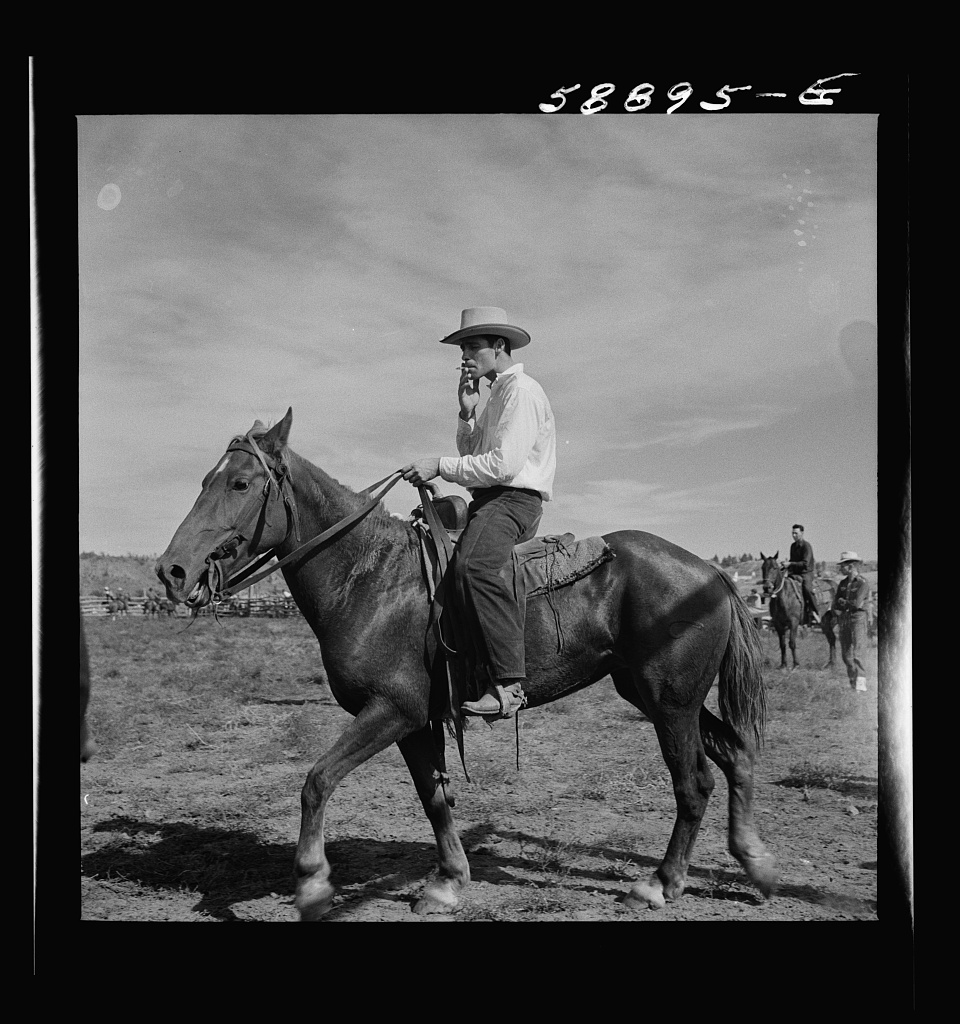
[I wanted to insert a public domain historical image of a hot cowboy at the top of this post but was unable to for some obscure technical reason. Read on to find out why the hot cowboy is relevant.]
[UPDATE: the cowboy is now below]
9-1-1 has maybe had more ups than downs for me in its 9th season. The ups are surprising, especially considering how low my expectations had been set by Season 8. But take "Mother's Boy" (season 9, episode 13) as the thesis statement for what constitutes American liberalism in 2026, for both Disney's ABC and the country at large. The offering is surprisingly bleak, even considering the circumstances. Tim Minear has the sole writing credit on this episode, which, for those who are familiar with Minear's body of television work, should make a lot of sense.
I think to understand "Mother's Boy" we have to go back to midcentury America and the height of pulp queer erotica. These stories – often rife with racist caricatures and dehumanizing sexual situations – are, much like the bodice-ripper rape fantasies of early romance novels, an exercise in removing agency in order to engage in forbidden pleasures. Gay sex was only decriminalized in much of the United States by 2003's Lawrence v. Texas decision; in New Mexico, where "Mother's Boy" is set, it was decriminalized in 1975, becoming one of the first states to do so. Decriminalization, of course, does not mean an end to discrimination, homophobia, or violence – which "Mother's Boy" makes incredibly clear when Buck and Eddie have a public argument in a small town diner and a group of other patrons mistake them for a gay couple. This misconception is later repeated by a local sheriff who steals Eddie's hospital apple sauce (an unfortunate role for veteran television actor Chris Bauer).
In following Buck & Eddie's road trip buddy comedy gone awry, Eddie has to save Buck from an unrelated kidnapping by an older couple who want to obtain a strapping young man to replace their son, who is braindead from a motorcycle accident. The couple run Buck and Eddie's rental Toyota off the road, and Eddie wakes up in the hospital, with Buck nowhere to be found. The attitudes of the rural desert hospital staff are appropriately soap-opera-crazy (surely that young man is confused, he was alone when we pulled him from the wreckage!) and, combined with homophobic apple sauce thief Chris Bauer, it's all up to Eddie to rescue Buck, since the inhabitants of this anonymous New Mexico town think that he and Buck are boyfriends and therefore not to be taken seriously. Not only is the homophobia a red herring and plot device used unapologetically as bait for Buddie shippers, it trades in all the appropriate aesthetics of, say, Gay on the Range. Eddie literally jumps out of the hospital window to rescue his man, clad in a tight, dirty white t-shirt and a flannel, and clutching his broken ribs, and later, I seem to recall, rides to the rescue on a horse.
I don't have a problem with any of this per se. The 9-1-1 writers know where their bread is buttered and the task of inserting Buddie into the narrative without actually doing Buddie is a fascinating task, made only slightly less fascinating by its lack of subtlety. But its blatant use of small-town homophobic violence and institutional discrimination to achieve its aims hits a bit close to home. I'm thirty-five years old, about the same age as the actors who play Buck and Eddie, and I grew up in a small town. When I was in high school, the kids at my school who were out were constantly getting beaten up and the only trans adult I knew of was an older woman we would see at the thrift store who was the subject of local urban legends and mockery. Now as a queer, nonbinary adult – out, married, publicly myself – there's something sour to me about this type of bigotry being used to tease a romance. Midcentury gay pulp erotica was by and large aimed at gay men and created these kinds of situations to portray lust while still categorically demonstrating that the narrative did not reward this behavior, that the lovers in the text would die at the end, that they would be punished for their indiscretions. It was the price we had to pay in past generations for being ourselves. Punishing Buck and Eddie for sins that they will only commit in the AO3 missing scene fics, and heavily romanticizing that punishment, isn't quite tastelessly breaking the fourth wall, but it does feel like mocking generations of small-town American queers in the fifth dimension. I don't quite know how else to describe it except that it felt like making fun of trauma that is very real and in contemporary living memory, seemingly specifically to cater to an audience who has not experienced that trauma.
It is "the end of history" not as a triumphant final form, but as a relentless flattening of the human experience into something from which there is no escape. I do not mean to discount the fact that the writers can play with characters' relationships and put them into situations that drive fandom engagement. But "Mother's Boy" did not feel like play, in the sense that it provided a road trip buddy comedy context for one of the most popular M/M ships on the Internet – it went out of its way to insert homophobic violence into the narrative. There are so many other ways, as a writer, that you can create a serious conflict in the diner, that you can get Buck into a crazy woman's house with severe internal injuries. You can misdirect and waylay Eddie for an appropriately dramatic amount of time without homophobic violence. You can heighten the stakes in myriad ways without going there. The deliberate choice to go there gives some indication about how far society has degraded just in the last two years or so.
I did once say that maybe 9-1-1 won't be with us in the next phase of the American experiment, and perhaps I was wrong, because they're still finding ways to innovate on narrative tropes the same way you might "innovate" with a chainsaw to address a hangnail, or how the United States military is "innovating" in the Strait of Hormuz. So far, 9-1-1 Nashville has been an absolute and unexpected delight, from its premiere which demonstrated an illegal lap dance for a wheelchair user as a moral imperative to correct the issue of her being bullied by bachelorettes, all the way to its episode last week which featured a 17-year-old putting a potato inside her vagina and leaving it there. (The potato grew roots, which caused medical distress. Its stated use case was as an abortifacient.) In Nashville, people still do the right thing, even if the plot is goofy and nonsensical – which is what this franchise is supposed to be all about. At some point since season 7, 9-1-1 original recipe has become a show about people who don't do the right thing for no reason whatsoever, or are only put in the position to do the right thing for an incredibly stupid reason. Eddie can rescue Buck in his cowboy drag as much as ya'll want, but I just really didn't see the need to flirt with the end of Brokeback Mountain as part of it. It's 2026 and "if you have feelings in public someone might think you're gay" is still being treated as a legitimate source of conflict. "But we're not gay!" is the only defense presented. It's 2026, and we're still being punished.
You just read issue #7 of compatibility issues. You can also browse the full archives of this newsletter.