On Habits and Procrastination
Hey all! Happy Sunday!
Thanks for subscribing! This is a side project I started to motivate myself to write more and put words to a lot of the stray thoughts in my head. The first week's thoughts are on habit building, graciously inspired by by this essay from James Clear and this podcast episode with BJ Fogg from The Knowledge Project.
Habits
In his book, Atomic Habits, James Clear defines the habit stages as follows:
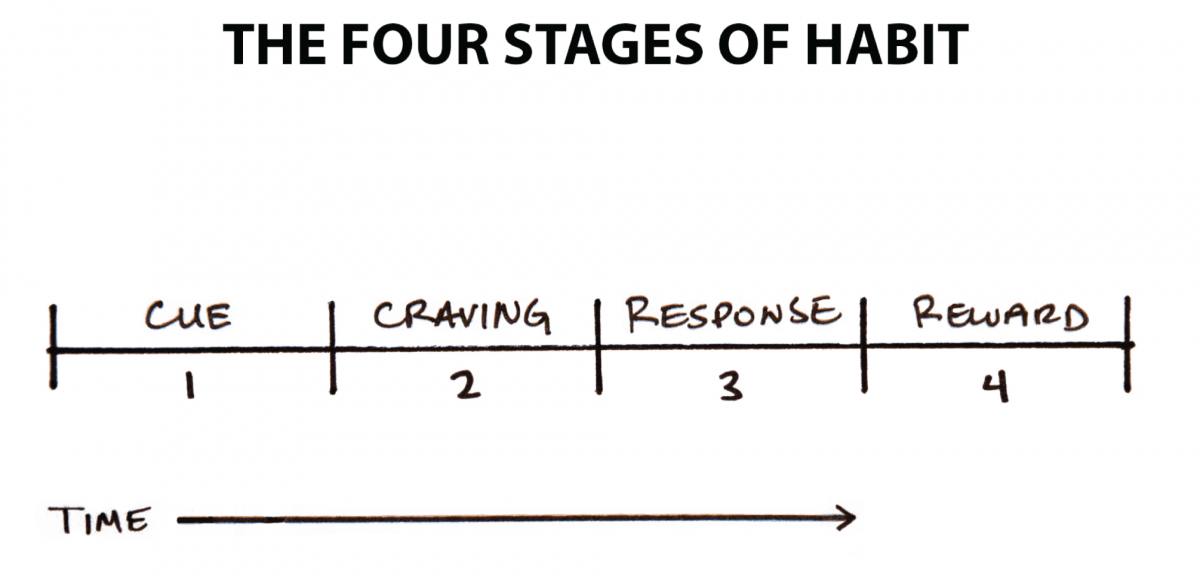
What we know as a habit is actually a progression from some sort of stimulus, thought process and neural pathway, actual action, and the corresponding reward. Recognizing that habits are comprised of multiple parts means that we can actively break them down to figure out ways to build better habits and how to stop bad ones.
To understand this framework, let's take a quintessential example of something we've probably experienced during the pandemic, entering the kitchen. Let's say you just took a break from a day of grinding, you're feeling a bit bored, and you're just going to refill your water bottle. Babam, you see the fridge and suddenly you think, wow, the ice cream I bought the other day seems really good right now. You go over to the freezer, pop open the drawer, and start devouring the delicious, frozen goodness. (On a side note, I've recently been exposed to the world of Jeni's and Nick's and they're both fantastic, highly recomend checking them out). Afterwards, you're nourished, satisfied, and, if you're anything like me, probably tossing the pint out because you finished it.
Needless to say, this probably happens multiple times a week (or even multiple times a day). And it follows the exact same framework that James Clear has established:
- Cue: You enter the kitchen
- Craving: You want a snack (or in this case, ice cream)
- Response: You go over to the freezer and eat the ice cream
- Reward: Your brain gets that good good dopamine
And so if you're doing this every day, for at least a year, you can see how fast it becomes instinct, that you're not even thinking through the steps and do them immediately.
So what?
Let's say you're on a goal to try to eat less ice cream (or at least eat something else). We can put interceptors at each step to inhibit it, making it more difficult to complete. At each step, asking yourself the questions
- How can I make it unobvious?
- How can I make it unattractive?
- How can I make it difficult?
- How can I make it unsatisfying?
Purposefully designing your life to increase (or decrease) friction means that it'll be easier (or harder) to do tasks. For example, maybe one way of decreasing your access to the ice cream is shoving it in the back of the freezer. Or not even buying it in the first place. That way, if you decide that you want ice cream, the amount of friction (driving to the store, paying for the food, coming back) is noticeably larger, making it much more difficult to happen.
Things I am up to
- Finished reading Abolish Silicon Valley (which you can peep my review here
- Still chugging through Prism work. It's super tiring but also extremely motivating.
Parting Thoughts
If you got here and you're thinking, god I hope this isn't another newsletter telling me how I should be better, you're absolutely right. It's not a newsletter telling you how to be better. Because you're already amazing! But in all seriousness, thinking around how we can decrease/increase fiction in our lives, whether its through software or things we do in real life, can fundamentally change how we work on a day basis.