
hymn is an acronym
This week I published my very first theoretical physics preprint...
Pleasant readers,
This week I posted my very first theoretical physics preprint, written with my American Math Society colleague Amanda Francis, Berkeley graduate student Digvijay Roy Varier, and Maryland physicist S. Jim Gates, who is one of the world's experts on supersymmetry, and won my esteem many years ago by a 100% genuine commitment to writing academic emails in the Comic Sans font, because comic-book improbabilities had set him on the path to theoretical physics. I've been working at the boundary of math and physics for my entire career, but my formal publications have always fallen on the math side of the line. It's astonishing how much work goes into establishing a common language, even between people working very close to the border.
Most of the paper is too technical to describe in a friendly email (with or without the aid of Comic Sans), but I can show you some of the math side of the puzzle. Here's part of our Figure 8:
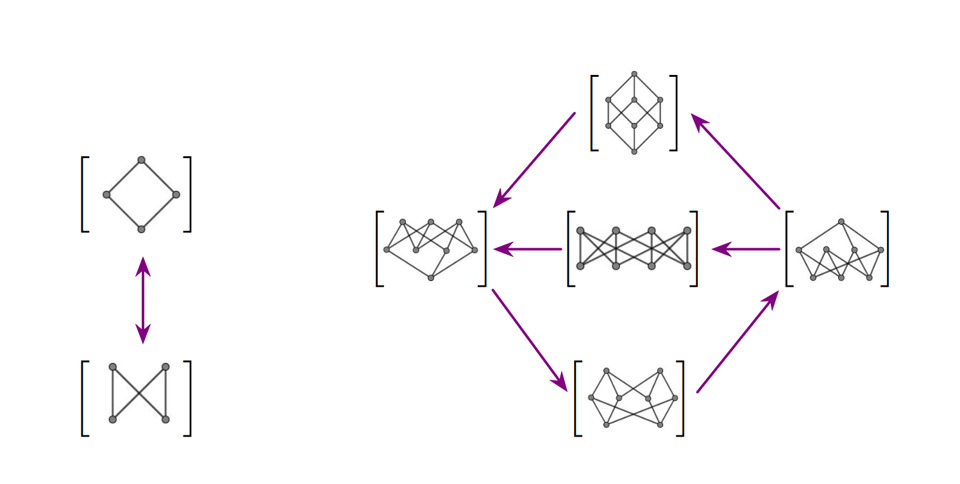
The left side has a wireframe drawing of a square, and the right side has a wireframe drawing of a cube. The rules of the game are that half the corners must lie on an odd level and half the corners must lie on an even level. You can move vertices up and down, as described by the purple arrows.
Much of our work in the paper centers on the wireframe of a four-dimensional hypercube, which has sixteen corners. How many ways are there to slide vertices up and down? How do you measure when the resulting configurations are the same or different? This puzzle is related, in a complicated way, to the physics of four-dimensional space-time.
Because I'm still on sabbatical, I can't offer you a cat, but here, with a more familiar kind of symmetry, is a swan:

Yours,
Ursula.

