
Comment in support of American science
Today, July 13, is the deadline to submit a public comment on proposed rule changes that would destroy American science funding.
Friends, family, and dearest colleagues,
Today, July 13, is the deadline to submit a public comment on proposed changes to US federal government research spending. The language is bureaucratic, but the intent is clear: under these new rules, American science would grind to a halt. I've written previously about this proposal from the Office of Management and Budget (for short, the OMB) and the threats it poses (scroll past the first cat picture!) Courtney Gibbons has put together a choose-your-own-adventure tool if you want some scaffolding for composing a comment.
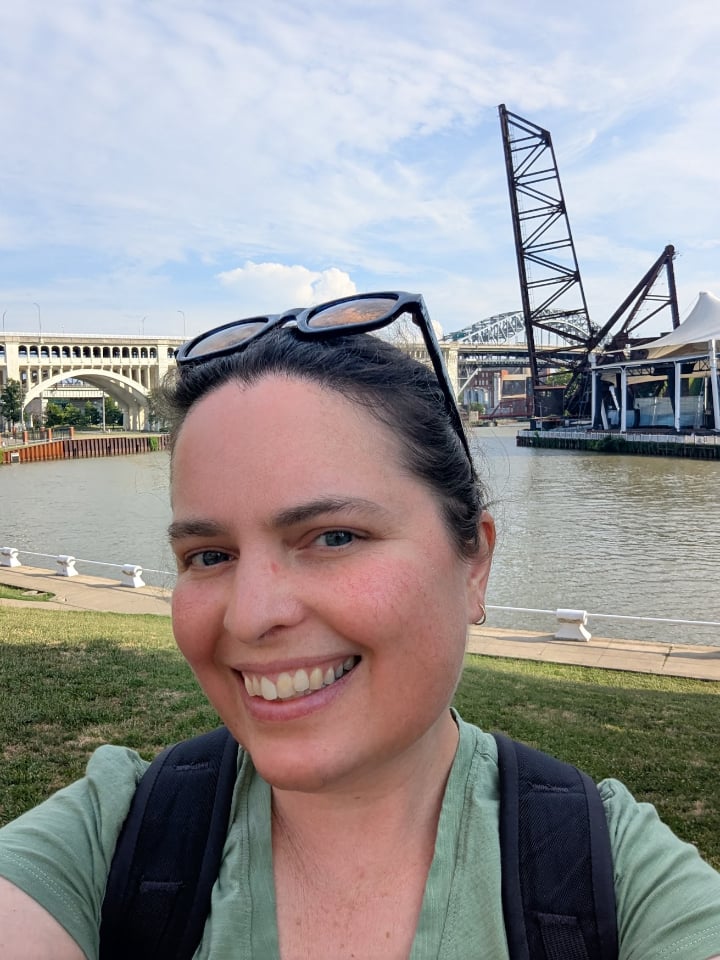
I want to share my own comment with you. (I also posted a PDF version, if it's easier for you to read or share that way.) I'm afraid I don't have a cat picture to soften the tidings, but here's a self-portrait in mathematician mode, from the Society of Industrial and Applied Math conference in Cleveland last week:
Here's the text of my public comment:
I am a research mathematician employed by Mathematical Reviews, a branch of the American Mathematical Society based in Ann Arbor, Michigan. I also hold an appointment as a Visiting Scholar at the University of Michigan. My research in algebraic geometry explores the mathematical implications of cutting-edge work in high-energy physics.
National Science Foundation investments were key to my development as a mathematician. In particular, a National Science Foundation grant funded my 2009-2011 position as a Teaching and Research Postdoctoral Fellow at Harvey Mudd College; without this workforce investment at a critical time, I would have left the United States STEM workforce to pursue a postdoctoral fellowship in Edmonton, Alberta (Canada). A small research collaboration SQuaRE grant from the NSF-funded American Institute of Mathematics (AIM) was deeply important to my development as an early-career researcher, and the insight gained from that collaboration powers my research program to this day.
I am driven to support and sustain the research community that fostered my own development as a mathematician. I do so by organizing both long-term focused research programs and intensive short-term research experiences for undergraduates and early career mathematicians. For example, I was recently Co-PI on the NSF grant "Collaborative Workshop in Algebraic Geometry", which funded a weeklong collaborative research program for graduate students at postdocs at the Institute for Advanced Study in Princeton, New Jersey. I have previously organized undergraduate summer schools in supersymmetry and homological algebra. These are advanced topics that fall outside the typical undergraduate curriculum. Exposing students to these exciting ideas early in their careers allows them to see themselves as creators of scientific and mathematical knowledge. Alumni of the programs I organized have gone on to lead extremely successful careers in both mathematics and physics.
I am deeply concerned about the proposed OMB changes and their impact on the National Science Foundation. Rather than streamlining procedures, these changes will introduce new barriers, hamper US leadership in mathematics and physics, and push young people out of STEM careers.
Though I will focus my comments on a specific section of the proposed rule for the sake of brevity, I believe the entirety of the proposed rules will hamper US leadership in STEM. The OMB should not pursue this rule change.
[200.340] Expanded termination authority.
I am particularly concerned about the proposed expansion of termination authority, which would allow the NSF to cancel any grant at any time without consulting scientific experts. Short-term research visits can be hugely powerful for mathematics research. I have already noted the impact on my own career of a grant that funded three one-week visits to the American Institute of Mathematics. There is no substitute for in-person conversations and equations sketched on the same piece of paper or chalkboard.
Typically, participants in mathematics research workshop or conference travel purchase their own tickets and then apply for reimbursement following the conference. Existing guidelines require the purchase of economy tickets from a US-based carrier. Such tickets are generally not refundable, and changes may incur substantial fees. For a full-time student, whose income is typically limited to some combination of scholarships, loans, and part-time teaching or research stipends and who has not had time to establish significant credit, fronting the money for a cross-country conference ticket represents a major investment. Before taking on my current role at the American Mathematical Society, I was a professor at a state university where I worked with many first-generation college students and other students from rural communities; for these students, a mathematics conference trip was often their first time riding on an airplane.
The possibility that research conferences will be terminated due to changing political priorities creates a chilling effect. It's harder for individual students, particularly first-generation college students, to justify such a purchase. As a frequent conference and workshop organizer, I hesitate to ask students to participate in a conference when there's a chance that the federal government will not pay them back. I often ask myself whether, in a worst-case scenario, I could afford to reimburse conference participants from my own pocket. The result is fewer research workshops, and particularly fewer workshops aimed at students and early-career researchers, even though this is the stage where a small investment in mathematical careers can have the greatest impact.
My concern is heightened because mathematicians frequently use technical language in a way that can be confusing to non-experts. For example, in my research area "left identity" refers to the order of multiplication, not to a position along a political spectrum. If research conference funding can be canceled at any time without input from mathematical experts, there is a real risk that conferences will be canceled by mistake or based on misleading extrapolations made by large language models.
I urge the Office of Management and Budget not to adopt the proposed changes to US science funding. In particular, the OMB should not adopt the proposed changes to [200.340].
Yours,
Ursula.

