Carol of the Banjos - Beta Radio (mp3)
A short but sweet banjo-led cover of Carol of the Bells. I don’t have much commentary to add to the arrangement (do you like banjos and/or chimes? you will like this) so I’ve decided to share a bit of history with you instead.
i. of the Bells
The tune of this carol is Mykola Leontovych’s 1916 choral arrangement of Shchedryk, a traditional Ukrainian new year’s song. It was one of the arrangements that Leontovych worked on for the Ukrainian national choir that toured around Europe and North America from 1919 to 1926 with the aim of creating awareness of Ukraine’s historical and cultural traditions and thus sympathy for Ukrainian independence. According to this article: “[the] strategy of musical diplomacy won the country some hard-earned recognition; in many venues, concertgoers led chants of ‘long live Ukraine!’”
I wonder if people shouted Slava Ukraini in Carnegie Hall when the choir performed there in October 1922 (we actually have a scratchy recording of the choir singing this song pressed on that same visit to New York City). One of those concertgoers was an American composer, Peter Wilhousky, who penned English lyrics for the arrangement in the 1930s. The melody of Carol of the Bells is the same as Schedryk, but the lyrics bear essentially no relation. Leontovych, the Ukrainian composer, did not live to see his composition become a Christmas standard. In January 1921, Leontovych, staying in the home of his parents over (Orthodox) Christmas, was shot dead by a Soviet agent.
ii. of the Banjos
Beta Radio are a band from North Carolina that describe themselves as having an “Americana-folk” sound. The banjo is an American instrument, and specifically an African-American one, created by slaves based on stringed gourd instruments like the akonting, ngoni, and xalam. A recognizable banjo can be seen in The Old Plantation, a 1785 watercolor of slaves dancing together, around fifty years before it became a staple of minstrel shows. I’d heard of minstrel shows ― music and comedy skits performed in blackface ― but I didn’t know they were among the most popular forms of live entertainment in the USA in the 1840s and 50. Their popularity helped drive interest in banjos, which led to mass-manufacturing of the banjos, leading to them being an inexpensive parlour instrument, such that by the 1920s people associated them with white Appalachians more than Black Southerners.
I’ve been trying to learn more about American history, given that I live there. I feel like my education about African-American history was a collection of fairly disorganised facts, including “slavery led to the US civil war”, “the underground railroad existed, yay Canada”, “Malcolm X and MLK didn’t agree about movement strategy”, and “there was segregation in Canada, too, but not as bad as in the US”. I’ve been startled hearing stories about segregation; this Moth story from a freedom rider who had been taught rules for staying alive, including never being in a car with a Black man in the driver’s seat and a white woman in the passenger seat. Around a year ago, on the edge of a warehouse concert, I stumbled upon a lecture / slide show by Stephen Somerstein, who, as a 24-year-old student newspaper editor, boarded a bus from New York to Selma to document the march. He showed this photograph, which he said was hard to take, because the man on the left, in the cap and vest, just kept losing it laughing. He asked the audience why we thought the man was laughing.
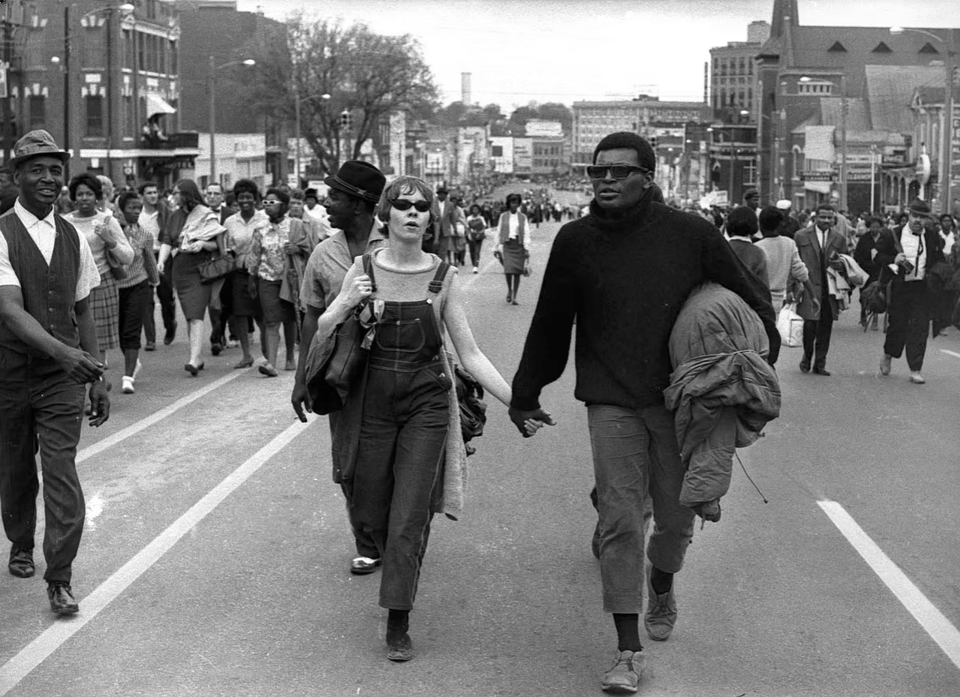
I didn’t know. Somerstein explained that it was because the sight of a black man and a white woman holding hands, walking down the streets of Montgomery, was so absurd. That’s the sort of thing that would normally get the man beaten or killed. The man in the cap just couldn’t believe it. Every time he looked over, he’d start laughing. I felt sort of grateful that I didn’t know what was funny about the photograph; there’s an innocence to that ignorance. But I don’t want to shield my eyes to such recent history, especially as the American Overton window seems to be shifting to admit more blatant racism. Civil rights aren’t a ratchet; an interracial couple in Alabama had more rights in 1875 than 1916 or 1965, and that frightens me.
O'er hill and dale, telling their tale,
Tessa
You just read issue #138 of xmas countdown. You can also browse the full archives of this newsletter.