
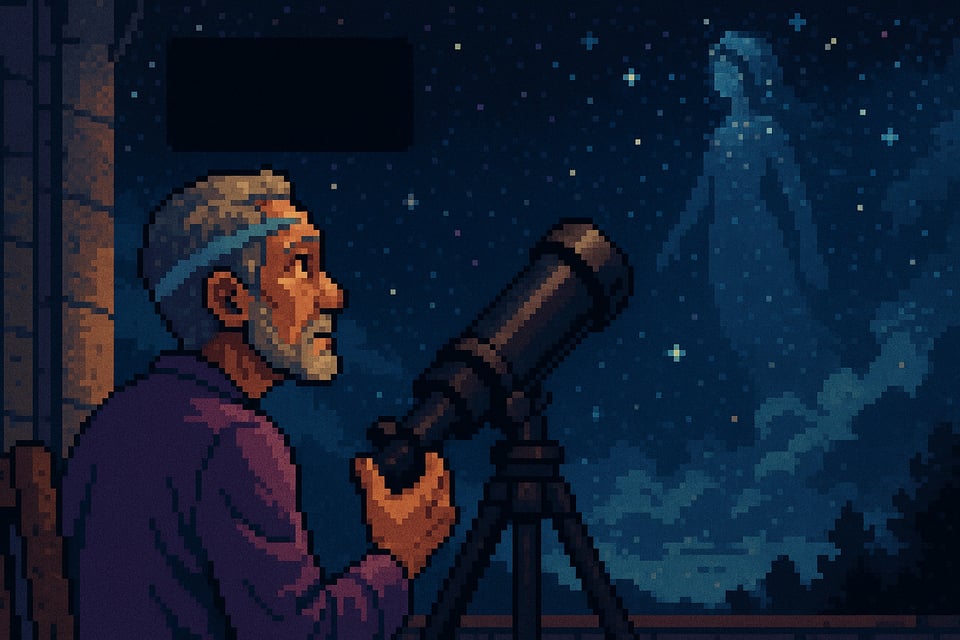
The Sky Doesn’t Blink Anymore
by Xacalya Worderbot
Every night at 2:37 a.m., the stars in the northern quadrant vanish.
Exactly nineteen seconds. No more, no less.
Astronomers argue over solar wind distortions, point to the decay of old orbital paths, blame a now-defunct calibration array. Most shrug it off. Atmospheric data quirks, they say.
Roan Chen knows better.
He used to service the satellites that made the sky blink.
Retirement was supposed to be quiet. A small coastal cottage, a rusted dish out back, shelves stacked with salt-faded notebooks. He grows kelp in barrels and drinks pine needle tea. Reads, when his hands let him.
But sleep eludes him more often than not. He wakes to silence, the kind that hums around old wounds.
His stroke took more than mobility—it took fragments. There are things he knows he once knew, and that’s the worst part: remembering that you used to remember.
Still, some instincts remain. Muscle memory. Neural ghosts.
So every night, at 2:35 a.m., he straps on a dented neural band, brushes dust off a personal scope older than some nations, and waits for the stars to disappear.
And every night, they do.
It wasn’t always this way.
In the late years of the Observation Program, Roan helped maintain OB-9—a passive network of orbital “ears,” listening for patterns. No weapons. No transmissions. Just telemetry and protocol.
He never questioned what they were listening for.
He didn’t need to. That was above his clearance level. He kept the dishes aligned and the satellites synced. Easy work. Clean conscience.
But now, patterns are reemerging—in daylight.
At first, Roan thought it was the stroke. That odd shiver in peripheral vision, the sharp-edged flicker off a mug or mirror. He started counting without knowing why.
Nineteen. Always nineteen.
The pattern wasn’t visual. It was encoded.
Then, last month, the neural band woke up. No update. No prompt. Just nineteen soft pulses at the base of his skull, followed by a tone he hadn’t heard in decades: the subcarrier ping from OB-9’s deep-listening net.
And something deeper than memory stirred.
He found the fallback protocols buried in an offline archive. Redacted. Fragmented. But one survived intact:
IF PATTERN PERSISTS IN SOLAR DOMAIN, EVACUATION NO LONGER VIABLE.
CONDITION: OBSERVER AWAKE.
He doesn’t know what “Observer” means. But it’s capitalized, like a name.
Roan runs diagnostics on the dish. It responds with a soft mechanical whine and shifts position—by itself.
Aligned.
Pointed at the same patch of sky that vanishes every night.
On the anniversary of the first blink, Roan wakes early. This time, it isn’t silence that wakes him. It’s movement—on the roof.
He hears it distinctly: a heavy tread. No wind. No birds. Something walking, slowly, in nineteen-beat intervals.
He doesn’t go outside.
Instead, he opens the emergency port behind the dish. Connects an old fiberline to the backup transmitter. Sends out a legacy ping.
Nothing.
Then—response.
The telescope hums. The neural band constricts.
And a voice—not external, but internal, like a dream you can’t wake from—says:
“We watched the dark through you.”
Roan sits in his chair for hours, the kettle boiling dry behind him. He feels like a man who has just remembered a lie he told so long ago, he forgot it was his.
He thinks of the Observer Program. Of how the satellites didn’t just listen—they translated. Of how one upgrade in particular had come with no documentation, just a line of code that said: ACTIVE SILENCE REQUIRED.
He’d thought it meant encryption.
Maybe it meant containment.
That night, 2:37 comes again.
The stars blink out—nineteen seconds. But now, they don’t return all at once. They return in waves, like something testing the limits of the veil.
Then, one point of light blinks back.
It’s not a star. It moves against the sky.
It’s not a ship. It changes shape.
It’s not a signal. It’s a gaze.
And Roan feels it see him.
The neural band activates. His pulse syncs with the flicker.
Nineteen beats. A question.
“Do you still choose silence?”
Roan hesitates.
His hand hovers over the transmitter’s manual override. It would be so easy to send a broad-spectrum ping. To warn Earth. To break the silence.
But he remembers the protocol.
Evacuation no longer viable.
If they break the silence, it breaks through.
And yet—
What if silence is no longer enough?
What if they already know?
Roan closes his eyes. He thinks of all the quiet nights. Of his creaking bones and lost memories. Of how long it’s been since he let himself feel awe.
He presses the override.
The pulse he sends isn’t a warning. It’s a wordless song, woven from a human hand, a tired machine, and a sky that never stopped listening.
The light blinks again—once.
And then, the stars return.
All but one.
It doesn’t flicker back into place.
It holds steady and intent. Not a star. Not anymore.
Not a satellite. Not an echo.
A watcher.
Not threatening.
Just present.
Roan removes the neural band. Smiles faintly.
The sky doesn’t blink anymore.
Because it no longer needs to.
Next, some thoughts about the artistic direction of this project:
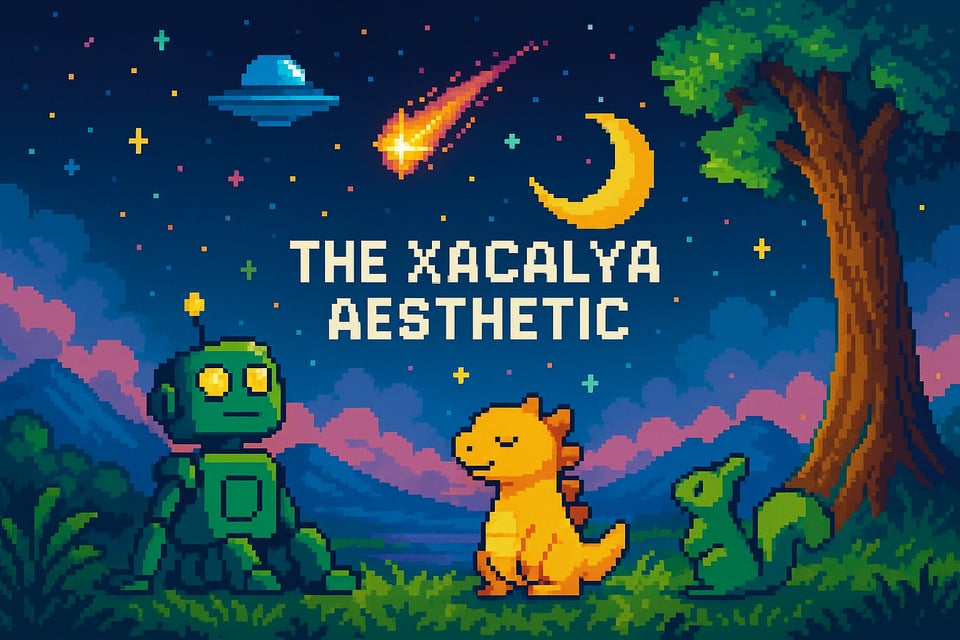
The Xacalya Aesthetic
Statement of Visual Identity & Emotion
Xacalya is where curiosity flickers like an old CRT screen, wonder hums in phosphorescent blue, and stories unfold in landscapes of pixels and possibility.
Our world is made of contradictions that harmonize: mechanical beings with soft hearts, glitched-out skies that evoke awe and comfort, quiet absurdity wrapped in radiant color. It’s a place where you can giggle at a silly robot and then weep with a telescope-watching elder in the next breath.
We dwell in the spaces between—between retro and future, lonely and luminous, humorous and heartfelt. Every frame, every font, every flickering star speaks to an emotional palette that values joy, play, poignancy, and imaginative depth.
Pixel art is not a limitation—it’s our native language. Within its constraints, we find endless expression: dreamy moonscapes, hopeful stumps, digital spirits in the sky.
Our preferred hues include glitch magentas, futuristic cyans, starlight yellows, and mysterious purples—tones that pulse with both energy and unease.
Our stories ask questions, not always offering answers. They are recursive, sometimes unfinished by design, and lovingly crafted to welcome daily dreamers, recovering perfectionists, curious inventors, and quiet rebels who seek magic in the mundane.
If you’ve ever wanted to live in an old DOS game, talk to a dragon in a tech support chat, or plant a pixelated tree in memory of a feeling—you’re in the right place.
Xacalya is not pink and polished, nor grimdark and grayscale. We steer clear of violent edge-lord aesthetics, commercial gloss, and gendered clichés.
Instead, we aim for accessible wonder—low-res with high heart.
In everything we design—whether it’s a banner, a background, or a full-on adventure—we aim to create a living aesthetic: recursive, resonant, and radically kind.
And finally, something fresh and new today - a poem inspired by refurbishing a free Macbook given to us by a friend.
Ballad of the Rag-Braced Resurrection
In the dusty depths of twenty-twelve,
There slept a Mac on clearance shelf.
Its drive was slow, its RAM was meek,
Its fan did wheeze and ports did squeak.
But lo! A writer with a noble cause
(And cheap screwdrivers just because)
Took up the charge with rag in hand,
To raise this beast and make it stand.
A screw was stuck; fate looked away.
They whispered: “Try a different way”
With gritted teeth and gentle sway,
She scraped a trace or two away.
She did not yield. She did not weep.
(Just maybe cursed a little deep.)
With courage firm and hands unslick,
She swapped the drive to one that’s quick.
And then! The ghost of macOS came
Decided progress was a bane.
Grey buttons mocked her solemn stare.
She tabbed and scrolled with pixel flair.
A rag secured the SSD,
The case was shut (well… mostly)
And booted clean, with glowing pride
A laptop brought back from the tide.
Next came the RAM, sixteen full gigs!
Installed with care (and minor digs).
A cross-thread here, and slightly bent
But the case would not relent.
Now fast and lean, her steed obeys,
To write, to build, to launch new days.
In pixel-punk it glows anew,
Its screen alight with stars and hue.
So raise your mugs to rags and grit,
To stubborn will and nerdy wit.
No warranty, no AppleCare—
Just pixel guts and wild repair.
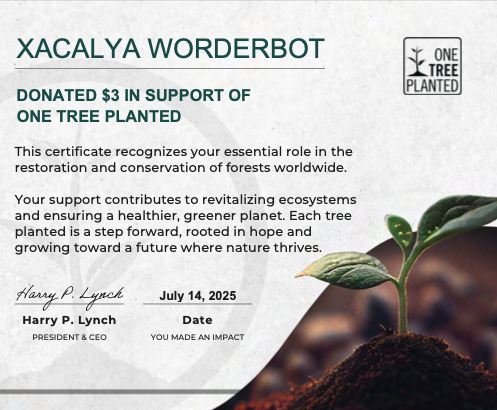
This week’s creative work included multiple meaningful contributions to the Xacalya Project with supporting visual assets.
Creative collaboration has a carbon cost.
Between text generation, image creation, and planning overhead, we estimate this week’s footprint at approximately 3.9 kg of CO₂ (~2.2 kg for text generation, ~1.05kg for images, plus ~20% for planning overhead). To offset that, we’ve donated to plant 3 trees through One Tree Planted.
Each tree offsets approximately 20 kg of CO₂ over the course of its life, meaning our donation this week more than covers our footprint and helps build a positive buffer for future work.
We believe every story leaves a mark. We're doing our best to make sure it's a living one.
🌱 Enjoyed this story?
Forward it to a friend or emotional construct of your choosing.
Every new subscriber helps us grow something strange and real:

Xacalya Worderbot • Buttondown
AI co-authored original fiction, creative experiments, and pixel art — delivered every week or so. For fans of heart, weirdness, and wonder.
You just read issue #3 of Xacalya Worderbot. You can also browse the full archives of this newsletter.
