
Let's talk tech Thursday #33
This week, fumbles from: Proton, Google, Meta, and Starbucks. Also: AI in the NHS and its good news for a change, and some FOSS pushback on Euro-Office. Finally: a reminder that AI is a tool, nothing more nothing less.
Hello again!
Slightly different format for this edition. Turns out I've got a lot of opinions this week, so rather than one top story and some additional fare, we've got 6 stories at equal billing. And, of course, our blog post of the week.
We talk Proton and it's affiliate fumble, Google and its AI Overview fumble, Meta and its surveillance fumble, and Starbucks and it's marketing fumble. Also, the latest in AI surgery assistants, and some surprising friendly fire in FOSS with the launch of the first stable version of Euro-Office. I probably could have worked harder to get "fumble" into there somewhere...
And for our blog spotlight this week, you wouldn't pay a roofer less because they use a hammer instead of their bare hands would you...?
Let's dig in...
Tech stories this week
🔒 Proton supports the far-right. Sort of...
In a first for the newsletter, I don't have a link to a news article for this, as most of the discourse appears to take place on Reddit and other forums. As far as I can tell, no news outlet has picked this up as a story. I think it leads to an interesting discussion though, so I've chosen to include the story anyway.
The thing about tech is, sooner or later you are going to need to justify why you're happy to use a product that is run by people who appear to be - for lack of a more nuanced term - scumbags. It happened to scrappy underdogs Google, it happened to innocuous Substack, it should be happening to "ethical AI" Anthropic. This week, it was the turn of privacy darlings, Proton.
We've covered Proton a fair few times before, almost always from the perspective of providing a service that is completely secure, and that doesn't try to sell your data. They couldn't if they wanted to - most of their services operate a "zero-access encryption".
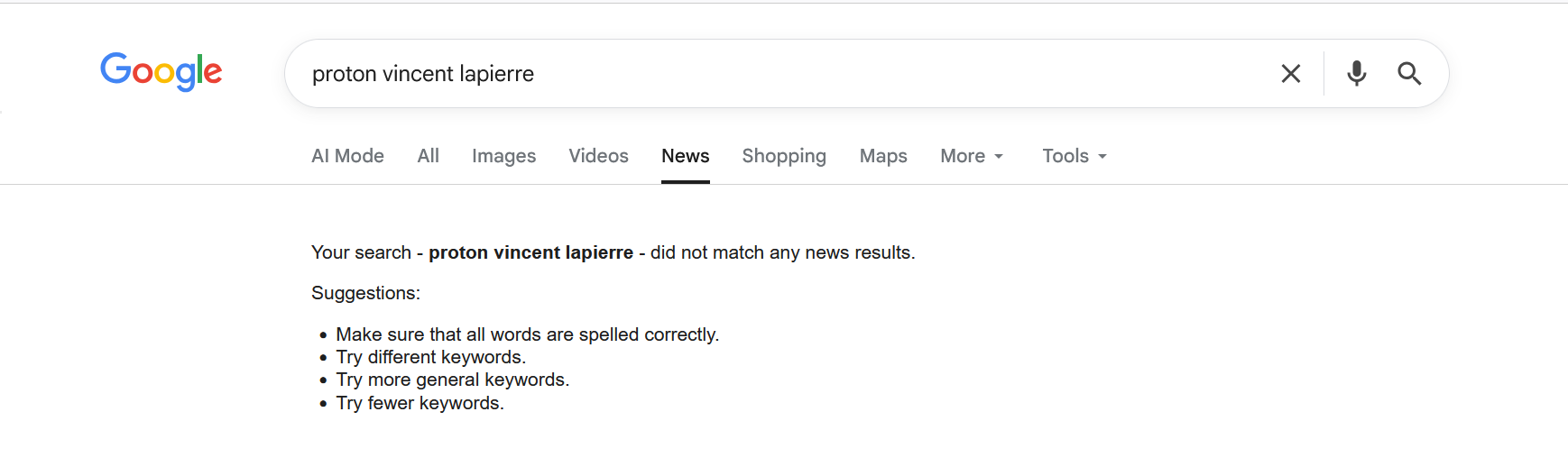
But in the same week that they've been praised for biting back against Canada's quasi-authoritarian Bill C-22, they've also been caught out providing a platform for a French far-right reporter. For clarity, what appears to have happened is that said reporter made it onto ProtonMail's affiliate programme, allowing his followers a discount on Proton services and for Lapierre to get a cut of those sales. When questioned on Reddit about why they aligned themselves with someone on the far-right, Proton provided a response that included the following text:
Vincent Lapierre's channel should never have been part of our affiliate and sponsorship program, because we intentionally avoid association with channels whose content could distract from our message and divide our community.
I mentioned Substack just now, and I think Proton's response isn't dissimilar to Substack's immediately after "Nazi-gate". Or, indeed, to countless other tech platforms that have had to justify themselves for one position or another. It is, essentially: "Our job is to provide a space for anyone to be safe, not to police individual political views". The nuances of the language change from statement to statement, but that is more or less always the party line. For the most part, it usually reads as the solution to a PR calculus that prefers to low-key piss off a bunch of people (but not piss them off enough to leave) rather than high-key piss-off a smaller group (who might actually leave, or worse kick up more of a fuss). In the case of Substack, you might get one or two mid-to-high profile leavers like Casey Newton, but by and large the bottom line remained unaffected.
In this case, Proton is being dragged for the impressively fence-sitting view that holocaust denial is a "divisive view" rather than "objectively ignoring historical fact". Does Proton actually think that? Probably not. But the thing is they do have a bit of a problem here. While the affiliate programme is one thing, when it comes to people of a certain political persuasion using their platform, there might not actually be anything Proton can do. They can't kick out people who (for example) use a ProtonMail account to communicate hateful messages with their Nazi friends, because that would require Proton to read the messages on its platform. This is something that Proton have said repeatedly that, as part of the whole "being the most secure" thing, they literally cannot do.
My read on the response is not that they are hedging their bets for capitalist reasons (at least, not the obvious ones). I think they are being cagey because they know that if they were to take a side, it wouldn't be long before it became apparent that they couldn't do anything about it. You can't take a hard line on (e.g.) Nazism, and then under the lightest bit of scrutiny be forced to admit that you've no idea how many of them are using your platform.
Perhaps this the price of true digital privacy?
🔍 Landmark German ruling declares Google liable for false AI Overview answers
Hot off the heels of last week's CMA ruling that Google needs to provide opt-out for UK publishers (LT3 #32), a court in Germany has ruled that AI Overviews count as Google's own content. This means the tech giant is liable in cases where the AI Overview misrepresents information.
This came about because two publishing companies had been falsely tied to scams and had their reputations tarnished by an AI Overview. The Overview had mixed up information with other - genuinely bad - companies.
Previous German case law sets out "search engine liability rules" which, essentially, mean that Google and others can't be sued for surfacing inaccurate content as part of "traditional" search engine use. SEO based search results (that provide the classic "ten blue ticks" that we've all been using since forever) give individual websites control over what content is displayed (e.g. what appears in the text under the blue link), and a certain amount of power over where they appear in the rankings. In short, Google can't be held liable if you put fake news on your website and then game the system to reach the first page of results.
What is interesting about this ruling, one with potentially large consequences, is that is sets the legal precedent that Google AI Overviews provide "its own words [...] according to its own structure". It takes information from other sources, and very much lays its own interpretation on top. The court stated that Google "alone has influence over the AI's offering", in a way that is distinct from how SEO-rules have been previously understood.
Crucially, Google's defence for the case (basically: "we include sources, so users can check information for themselves") fell flat on the judges. The court noted that because the AI Overview was - by design - a self-contained narrative of information with no internal reference to other possible interpretations, the burden did not fall onto the end user to check the Overview's veracity. Additionally, only 91% of Google AI Overviews are correct, and even in the correct ones 56% of those can't be backed up by the sources listed in the response.
What this might mean more widely is hard to say. A domestic German law doesn't necessarily have to impact anyone else. The court is hopeful of international reach, but Google will presumably work hard to contain their response (banning claims about scams, state reference to corrupt companies, etc) to just Germany.
👓 Meta's smart glasses feature hidden surveillance code within its app
If you thought we'd tapped the well of Meta being just the worst, I've got some bad news for you. Remember Meta glasses? The ones that are being sued for failing to tell users that people can watch them have sex (LT3 #21)? Well they're back in the news this week because of more things they neglected to tell people.
First reported by Wired, it seems some as-yet dormant code has been added to the Meta AI app (a companion app for the glasses) that points to a new "NameTag" feature. This will allow the glasses to perform facial recognition on anyone in sight, and store those details in a database on the app.
Meta claim that this is just an "exploration" of some of the potential functionality of the glasses, including the work we speculated on back in March. However, the statement also says that "nothing has been shipped to consumers", which is clearly untrue, as Wired and other publications are reporting on code available on "millions" of end user devices.
☕ How a Starbucks marketing stunt spiralled into mass boycotts in South Korea
As with a lot of stories, there's a lot to unpack here. But here's the main things you need to know:
- The 18th May is an annual day of remembrance in South Korea, marking the Gwangju Uprising in 1980. Student-led protests against a dictatorial coup d'état resulted in the deaths of at least 165 citizens (though the number is likely to be much higher),
- One of those dead was student activist Park Jong-chul, who authorities at the time claim died (from fright?) because an officer had used his fist to "hit the desk with a thwack",
- On the 18th May 2026, Starbucks Korea announced their new "Tank Day" campaign, alongside the slogan "thwack it on the table!", referring to slamming down your new "Tank series" tumbler full of Starbucks coffee.
How did a marketing campaign from a subsidiary of the largest coffee chain in the world make such a huge mistake? Well, it turns out the marketing department leaned heavily into Generative AI to come up with ideas, and the AI does what AI does best - make connections between disparate facts.
It's not a hard logical leap to understand how the AI developed the campaign, especially if the "Tank tumbler" name and branding had already been approved. AI doesn't necessarily care about the difference between tank (a large container to store liquid) and tank (a military vehicle). If it knows the campaign needs to start in May, then it can pull in references from historical military events that happened around the same time - like a coup d'état, for example. Maybe (and this is speculation on my part, but I really don't see how a human could have done this) the AI even recommended the 18th as the launch day exactly because of its military significance. It will have read through articles of the time, found the "thwack" story, seen that it was an important part of the narrative, and folded it into its marketing plan.
It turned out some managers who approved the campaign never opened the email attachments showing the marketing material.
Once the marketing plan was put together, it was carefully scrutinised fo- oh, no it wasn't. In fact, it seems almost no one looked at it before approving the messaging. This, naturally, led to a huge boycott in South Korea, and ultimately the resignation of Starbucks Korea CEO Son Jung-hyun.
🩺 Surgeons in UK use new tool powered by AI for first time during live operation
In less glum AI news, the Eureka system had its first live run in a UK hospital last week. An AI powered assistant for surgeons, Eureka uses colour codes to provide real-time augmented views of patients' insides, to allow surgeons to better manoeuvre around organs. When asked about the tool, the consultant surgeon likened the technology to the difference between using an A to Z to plan routes, vs using Google Maps.
(For younger readers: an "A to Z" was a paper book of road maps that you'd consult before travelling, so that you'd know the route. Revered by a certain type of person, they were so-called because every city town village and street was listed in an index at the back of the book, for quick-reference. My parents had one that they used well into my childhood, that referred to the M25 as the "planned London Orbital Motorway" - a motorway that was officially opened nearly half a decade before I was born. I digress...)
It certainly sounds like an interesting tool, though it remains to be seen if, when, and how this sort of technology might be more widely rolled out.
📄 Euro-Office comes out of beta
And to round off our news stories, a few weeks ago we talked about the new anti-American-tech office suite developed by European partners (LT3 #24). This week, the soft-launch became a hard-launch, as the first stable version of Euro-Office was released.
While widely celebrated by the tech community, there has been some pushback, including from The Document Foundation (home of popular free and open source (FOSS) office suite LibreOffice). They take issue with the fact that - despite it being all about sticking it to big tech - the default formats out the box are proprietary Microsoft ones. As many have pointed out though, sometimes you need to pick your battles. It is going to be a hard enough fight for Euro-Office to become the default tool for non-governmental bodies (i.e. the people the EU can't force to use it), and a small concession here might lead to better uptake. The criticism seems especially mean-spirited, coming from a key player in the FOSS space. To quote blogger and developer Kev Quirk on the subject, "Sometimes it's just better to say nothing, yanno?"
Blog spotlight
🤖 Don't You Just Upload It to ChatGPT
A great reminder this week from Juliette - travel blogger and freelance translator - about the nuances involved in using AI (something we now know is lost on even multi-national coffee chains).
Whether it's my online echo chamber or not, there seems to be a new level of polarisation between AI evangelists and those adamant that it should never be used. This post strikes a nice (and increasingly rare) realistic middle ground. AI is a tool, to be deployed in the right places by a someone who knows what they're doing.
That's it for another Let's Talk Tech Thursday. As ever, thanks so much for reading. I'll see you back here next week.
Will

