Pop Rocks and Professionals
Oralism as urban legend.
A Book is to Buy
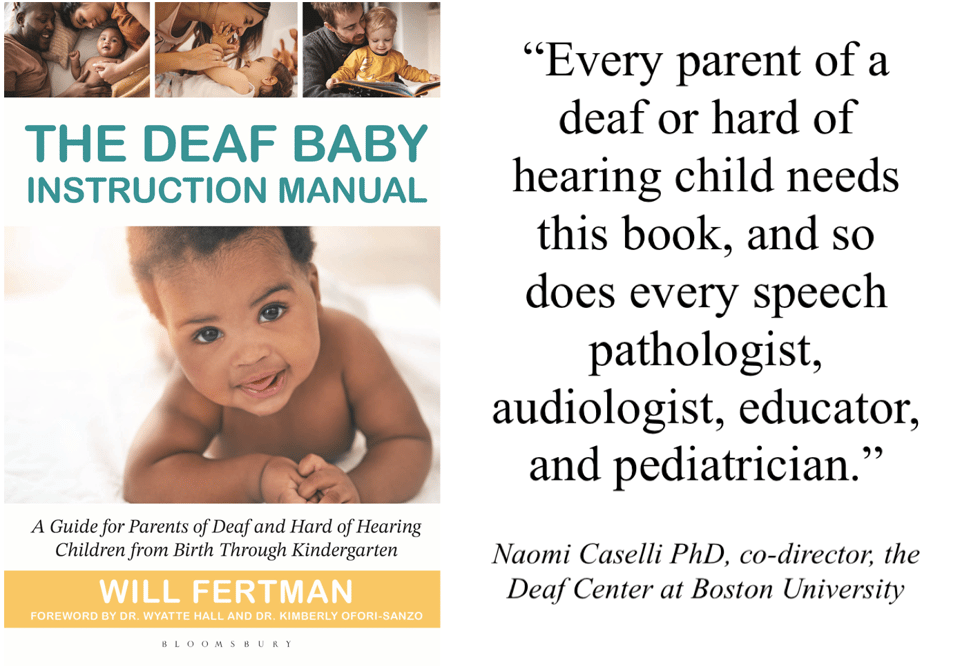
Astonishingly, The Deaf Baby Instruction Manual will be available in print and digital form on April 16 in the US, Canada, the UK, Australia and India. If you’re interested, pre-ordering the book is the best way to get your hands on it, so don’t wait.
New England Readings, April 24th & 26th
I’ll be promoting the book in Boston MA on April 24 at BU’s Deaf Space event, and Manchester CT on April 26 at Language First’s Early Language Center, where I’ll also be talking children’s books for deaf kids. Both events are family-friendly.
If you want me to come to your town and talk about the Deaf Baby Instruction Manual, or about reading children’s books to deaf kids, drop me a line.
Oralism as Urban Legend
A parent recently popped up on one of the Facebook groups with a very familiar set of questions. She had a child with CIs, and wanted take bilingual route with them. Unfortunately, she was having trouble with her child’s SLP, who was discouraging sign language and relentlessly pushing LSL and AVT. What were her options? Where could she find sign-friendly SLPs? And was Auditory Verbal Training really necessary for her kid to learn spoken English?
I jumped into the comments with my usual spiel: how sign supports global language skills and literacy, how AVT isn’t more effective than vanilla SLP work, how to identify good practitioners, etc. It was a quick couple paragraphs, ones I’ve written a hundred times before. But then Kim Ofori-Sanzo showed up in the thread and posted something that stopped me in my tracks.
“But also, AVT is not evidence-based.”
I was a little taken aback, because although we don’t much talk about it, that’s the underlying truth: AVT and LSL are not practices rooted in, or supported by, scientific research.
Honestly, “not rooted in” isn’t actually that bad. Most of the methods we use in education and child-rearing, aren’t cooked up in a lab. They’re basically traditions that evolved out of decades of trial, error, and common practice. It’s “not supported by” that’s more troubling. Science has the unique power to sort out which of our traditions actually work, and to build on what we learn, turning hunches and lived experience into testable hypotheses, and then into new and better practices.
Using triple antibiotic ointment on a cut once seemed like a fine idea. It was definitely better than nothing, and doctors did it for a long time. But when scientists started studying the issue rigorously, they found that ordinary petroleum jelly was just as effective, and without the potential complications of putting antibiotics on your skin, or the possibility of breeding resistant bacteria. So now when the dermatologist slices a mole off your back, instead of Neosporin, you get a little squirt of plain Vaseline instead.
In the past couple decades, rigorous studies of signed languages and bilingual education have begun to accumulate evidence that they work to support deaf children’s language development. Oralism, not so much. These days, it’s looking a lot like triple antibiotic ointment, an approach with no clear advantages and some dangerous potential side-effects.
Wyatte Hall and Corinna Hill’s recent paper in the Oxford Review of Education gets into the history of oralist rebranding, and the ways terms like Listening and Spoken Language sugarcoat the same old placebo. They argue that this cycle of promoting old ideas in new clothes (and sidelining Deaf expertise) has kept deaf education stuck on a destructive hamster wheel for more than a century.
But that begs a question: if AVT and LSL aren’t science, what are they?
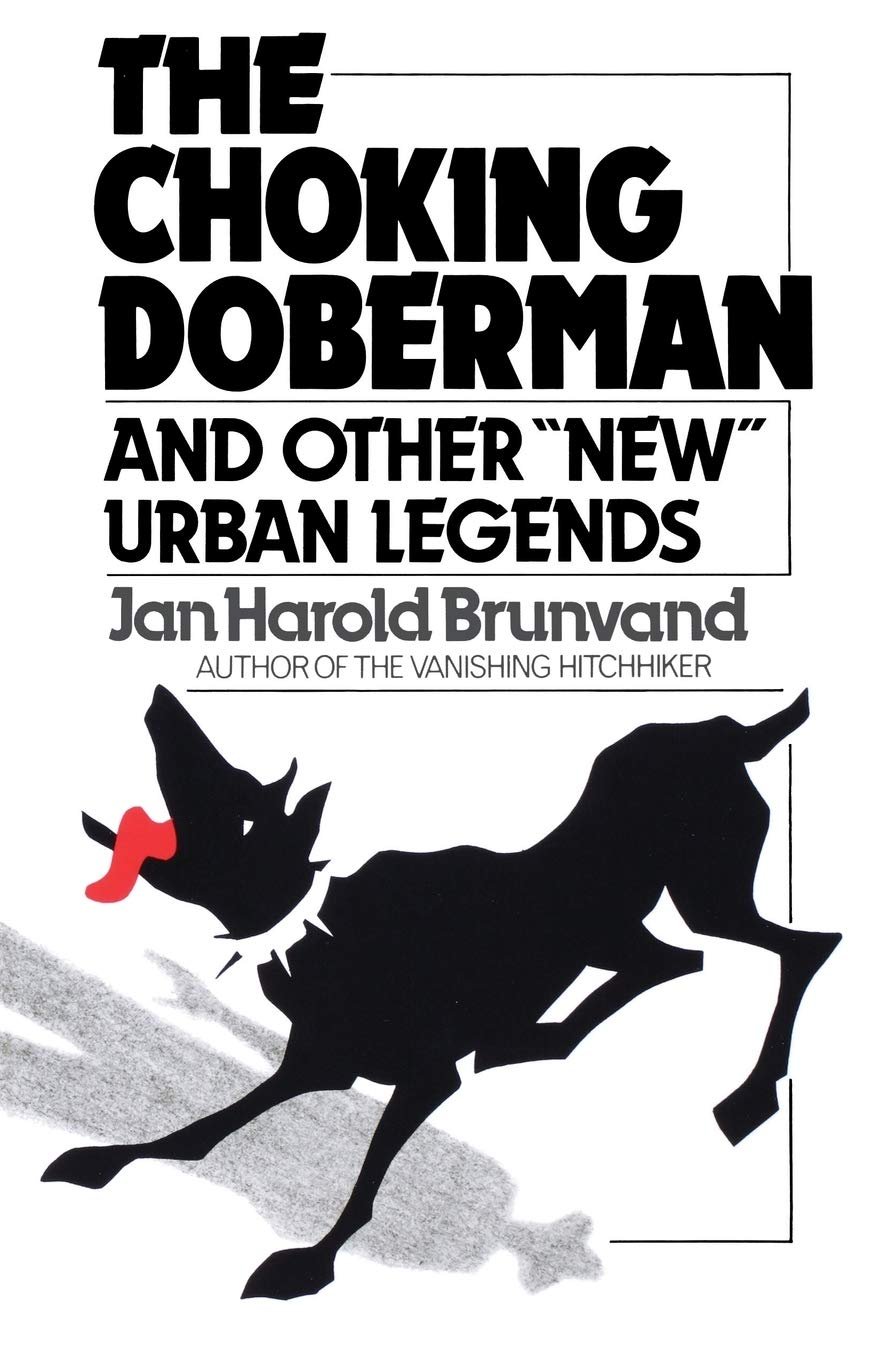
The term urban legend was coined by folklorist Richard Dorson, and popularized by Jan Van Brunvand’s series that started with The Vanishing Hitchhiker in 1983. In that first book, he outlines how urban legends arise:
When we follow the ancient practice of informally transmitting “lore”—wisdom, knowledge, or accepted modes of behavior—by word of mouth and customary example from person to person, we do not concentrate on the form or content of our folklore; instead, we simply listen to information that others tell us and then pass it on—more or less accurately—to other listeners…
It works about the same way whether the legendary plot concerns a dragon in a cave or a mouse in a Coke bottle.
Brunvand writes that while stories about hook-handed killers and deep-fried rats aren’t strictly true, the urban legends he documents all have certain qualities, “…a strong basic story-appeal, a foundation in actual belief, and a meaningful message or ‘moral’” that propel them from speaker to listener down through the generations and across the socials.
When we look at oralism as folklore, you can find that it fits each of these criteria:
It has a simple and “uplifting” story at its core: “Oh, I knew a child who was born who couldn’t hear anything. But they got a CI and learned to talk, and now you just couldn’t tell that they were deaf at all!”
It leans on the unspoken audist and ableist beliefs that pervade our culture: that English is somehow a special language, that speaking is the natural way everyone should communicate, and that to be happy, people need to fit in and appear as “normal” as possible. It also leverages American’s forward-looking faith in technology, with CIs and hearing aids as “miracle cures.”
It has a moral: parents who understand their responsibilities can mold their deaf children into socially and academically assimilated adults through hard work, focus, and the guidance of the professionals who know best.
When this Facebook mom asked if she really needs AVT/LSL for her deaf child, it’s because her kid’s SLP told her a version of that story. Even if she didn’t believe it, there was still a part of her that was afraid of violating its rules.
I know this because I’ve been told the same story about a thousand times—sometimes by professionals, or by fellow parents, but often by strangers who had absolutely no first-hand experience with deaf kids or deaf education at all. “I know a kid who got a CI and had speech therapy and they’re totally fine,” is the educational equivalent of “I know a kid who drank Pepsi and ate Pop Rocks at the same time and like, died.”
Sometimes, the storyteller is drawing on primary sources like NYT Op-Eds, and sometimes it’s just vibes. If the teller knows the real deaf person at all, it’s often a superficial impression from a distance. But because the story has those qualities—narrative simplicity, appeal to preexisting bias, and strong moral viewpoint—breaking the chain of transmission is difficult. So far, the efforts of the Deaf community over 100 years haven’t been enough.
Of course, LSL isn’t a perfect fit as an urban legend. For one thing, urban legends have never actually happened, while there are unquestionably some kids who’ve done ok with purely oral interventions—just fewer than folks assume. For another, while the word-of-mouth (ha!) aspects of oralism are strong with parents and the general public, oralism is not a purely oral tradition—it has a big body of literature, many professional advocates, and it’s taught as a practice in schools. Butler University is opening a new department of deaf ed based on LSL this year, with the support of Linda McMahon’s Department of Education. Which, as educator Victoria Monroe notes, is a choice.
So while “oralism as folklore” is one possible concept, maybe a closer fit is something like fakelore, an invented tradition that’s so thoroughly penetrated deaf-adjacent professions that it’s taken for granted. Or maybe its a set of potent memes, self-reproducing ideas that breed in culture like microbes in a petri dish. Or what philosopher Harry Frankfurt defined as bullshit; rhetoric that’s indifferent to the truth so long as it achieves its underlying goals. Or maybe it’s pentimento, as Hill and Hall put it in their paper—a eugenic idea painted over many times by layers of science-tinted propaganda. But whatever it is, don’t call it “evidence-based.”
Drop Me a Line
If you’ve got thoughts on the book, on oralism as an urban legend, or the works of Esphyr Slobodkina (I wanted to do Caps for Sale for this issue but it’s late enough already!) you can reach me via email, Facebook, or Bluesky.
