Queeribel: The Big Gay Exposé, Part 3
Hey again, y’all. To probably nobody’s surprise, life has once again been bounteous in its chaos harvest over here. Suffice it to say that (1) I did not end up having time to fully investigate a lead I mentioned in my last installment, but (2) I think the evidence I do have is pretty darn good as is, and (3) I decided to send this email today for a specific reason, which you’ll understand shortly.
Anyway: we’re getting to some of the juicy stuff, folks. In case you need to catch up on part 1 and/or part 2 of my massive timeline chronicling Claribel’s love life and possible sapphism, well, there are the links.
1866
January 8: Charlotte writes this poem at Tiddington, while visiting her cousin Janie.
Dream Life
Listen, friend, and I will tell you
Why I sometimes seem so glad.
Then without a reason changing
Soon become so grave and sad.Half my life I live a beggar
Ragged, helpless and alone
But the other [... this part is missing]
[as is this line]Half my life is full of sorrow
Half of joy still fresh and new
One of these lives is a fancy
But the other one is true.While I live and feast on gladness
Still I feel the thought remain
This must soon end, nearer, nearer
Comes the life of grief and pain.While I live a wretched beggar
One bright hope my lot can cheer
Soon, soon thou shalt have thy kingdom,
Brighter hours are drawing near.So you see my life is twofold
Half a pleasure, half a grief,
Thus all joy is somewhat tempered,
And all sorrow finds relief.Why you ask me is the dream-life?
Why the dream, the joy or woe?
Hush, friend, it is little matter,
And indeed I never know.
Charlotte could have been thinking of her superhero-like composer alter ego when writing this poem, certainly. It also, however, fits well into the long tradition of necessarily-closeted queer folks living double lives in order to be their true selves but also keep up appearances.
July: Oh my god.
Y’all, this is where it gets GOOD.
July 28, 1866 is the date written on a little paper packet, containing a lock of Charlotte's hair. It also has the caption “Only a lock of hair” — which is actually in quotes as written, because it's the title of a song that she likely had in the publishing queue with Boosey at the time. The song, with music by C herself and words by Mary Gifford (who also wrote the lyrics for “Take Back the Heart”), would be published in September 1866.
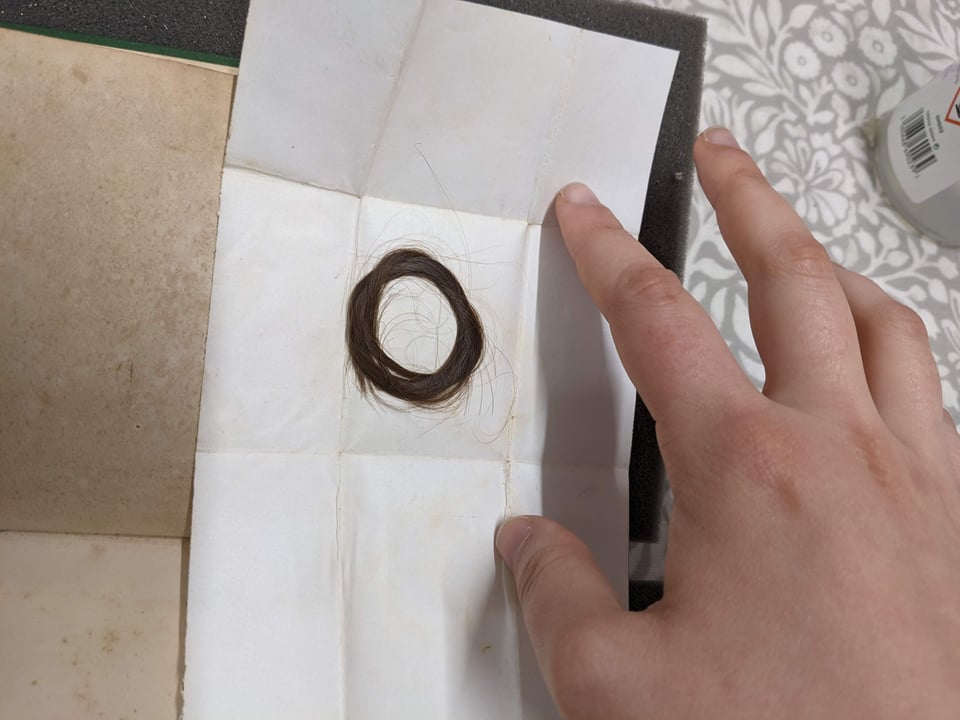
There’s no recipient listed on the packet, because of course that’d be way too convenient. But: this packet was tucked into a copy of one of Charlotte’s two posthumous poetry books — Verses and Songs, published 1870 — and together, they form an item in the collection of… drum roll…
Gunby Hall. Yes, the same Gunby Hall where the Hollways, including her ex-fiancé John George and her longtime friend Barbara, lived for a while.
And I'm going to emphasize this because it's important: the lock of hair and the copy of Verses and Songs almost certainly could not have been presented to their recipient at the same time. I can think of one scenario in which they might have been presented simultaneously, and it’s also not impossible that they had different original recipients. Regardless, the odds are high that someone made the decision to put the lock of hair in the front of the book. Someone decided they belonged together.
“But WHO?!” you might be yelling at your screen by this point. “Who is that someone, Whitney?!”
I may have an answer for you. May, mind ya.
At one point this past summer, I was attempting to organize some Google Books links that I’d gathered in a fit of late-night restlessness while in Lincoln, back in 2023. I’m still kicking myself that I didn’t look closer at this particular search result at the time, because here is the text of the footnote that made me lose my mind when I actually read it back in July:
[Anne Hodgson] is not the 'Miss Hollway' of i.286, whom Charles Tennyson Turner met in July 1866: 'very fine night on our return from the Charles Barnards. Miss Hollway there; she knew Alfred when she was a little girl' (Memorandum Book for 1866, TRC; transcribed by Roger Evans).
- from The Letters of Alfred Lord Tennyson, Volume 2: 1851-1870, pp. 208-209. Emphases mine.
For one thing, if the Charles Barnards referenced here aren’t our Charles Barnards, then I will deep-fry and eat my hat. But more importantly, y’all, that other guest is Barbara Hollway. The footnote’s reference to “i.286” is a letter from Alfred Tennyson in early 1850, thanking “Miss Hollway” for sending him a copy of Jean Ingelow’s first poetry book. Phyllis confirms it was Barbara who sent him that book.
Sadly, I don’t have the specific date of this visit — that’s the info I was going to try to track down before sending this newsletter, and the reason I’m kicking myself for not noticing this back in 2023 is that “TRC” in the citation stands for the Tennyson Research Centre… which is part of the Lincolnshire Archives. I could have requested the memorandum book while I was there already. Sigh. But even so, this is the closest thing to a smoking gun I’ve found in this whole big gay research process.
I have concrete historical evidence that places Barbara Hollway at the Barnards’ house in July 1866.
I think Barbara received the lock of Charlotte’s hair.
(thank you, Patricia, for also doing a recording of this song!)
August: Oh boy. Ohhhhhh boy.
I'll be real, I don’t know what exactly was happening, but something was for sure happening. I’ll be damned if it isn’t related to the lock of hair and its recipient, too, because the timing is so close. I don’t have precise dates for any of these August poems, so I’ve ordered them by increasing angst.
First up is “However We Try,” eventually published in song form as “Hidden Voices (However We Try).”
However We Try
However we try to forget the past,
Its shadow comes back again;
The scent of a sweet geranium leaf
May sting with sudden pain.
The sound of a voice, or the song of a bird,
Or the murmuring waves of the sea,
May melt into tears all the courage of years,
And bring back my sorrow to me!However we try to believe and hope
That whatever is, must be best,
There are times when visions come back again
And give us no peace nor rest.
The first glad song of the bird in spring,
Or the primrose that gladdens the lea,
May speak to the heart with a passionate tone,
And bring back my sorrow to me!
Now for another poem that eventually became a song. This one was published in Boosey’s Musical Cabinet #158 in January 1873.
Yes, We Must Part
Yes, we must part, love, tears do not flow;
Yet from thy heart, love, pity me now;
If my sad eyes their sad secrets should tell,
Lady, forgive me! Lady, farewell!Rose-light has died, love, faded away,
Firelight will bide, love, shadows are grey;
Never again may I yield to the spell;
Lady, forgive me! Lady, farewell!But one bright day, love, stars will arise,
Chasing away, love, clouds from the skies,
Then I shall tell thee what thou knowest well;
Lady, forgive me! Lady, farewell!
Yeah. Next…
“I trust Thee.”*
I trust thee, I trust thee, or what could I do?
Though others betray me, yet thou wilt be true.
Remember, remember thy promise to me,
Wherever thou goest, where’er thou may’st be!I know thee, I know thee, whate’er thou may’st say;
I too have a secret to treasure away.
Remember, remember our compact to-day,
Though others be faithless, we will not betray.
*Curiously, it’s capitalized like this in Thoughts, Verses, and Songs – as if the “thee” in question was God – but Charlotte was usually pretty good about capitalizing God’s pronouns as applicable, and the second stanza reads like it’s directed to another person rather than up high.
And finally, the poem that is perhaps her single biggest cry of pain.
Come back!
My heart cries out, Come back to me!
I think you love me yet;
Though parted we must ever be,
I dare you to forget!
All beauty felt in sight or soul
Speaks to my heart of thee,
And even in my dreams I call,
Come back, come back to me!Come back to me, come back to me!
Why is your pride so great,
While both must suffer misery?
Come back ere 'tis too late!
I did not reason on my love,
When first I felt its powers;
It fell upon my thirsty heart
As rain falls on the flowers.
September 19: Charlotte writes the lyrics to what would become her song "My Star." Note the high/low motif; it's popped up before, notably in “Imperatrice,” which is why I’m including it here.
My Star
Shine o'er me bright Angel, my guardian, my stay
Thou art to me as the morning star at the breaking of the day,
I see thee above me, I worship afar,
Shine on in thy splendour, my beacon, my star.When light veils me from thee, or clouds come between,
I feel thy soft shining though thou art unseen,
Thou urgest me upward where bright angels are,
Still call me, still draw me, my beacon, my star.When earth and earth's visions are fading away,
Then fades life's slow sunset from crimson to grey;
Shine brighter above me from heaven afar,
Still steadfastly guiding, my beacon, my star.
October 13: Per the Book of Everyday Thoughts, this is when Charlotte writes the lyrics to “Out on the Rocks,” while in Scarborough.
Do you remember it, darling, I wonder?
Do you remember it so long ago?
All that we said as we strolled there together,
Out on the rocks when the tide was low?What did I say as we strolled on together?
What did you answer me, timid and low?
What did you promise me? Do you remember it,
Out on the rocks when the tide was low?Never remember it, never remember it,
I have forgiven it, long, long ago —
I have forgiven it — only I think of it
Out on the rocks when the tide is low.
The titular rocks are probably Filey Rocks on the coast of Yorkshire, because that’s the name of another poem dated to October 1866:
Filey Rocks
There is light upon the orange rocks at sunset,
There is light upon the silver of the sea;
The whole wide earth seems bathed in heaven’s gladness,
And yet I think the darkness clings to me.Why can I not arise and fling it from me?
Why can I not be fearless and be free?
For, in my heart I know that, past the shadows,
A silver day-star might arise for me.
(This poem is also one of the reasons I suspect Charlotte had clinical depression.)
But I can end this month’s recap on a slightly happier note, thankfully, with another poem written at Scarborough and dated to October 15.
The Tide
The tide went down, the tide of fond affection
And left my heart a-thirsting and alone
The tide went down and only recollection
Was mine alone — the happy days were goneThe tide came up and filled my heart with gladness
All fresh and sparkling was its happy spray
The tide came up — forgotten pain and sadness
The happy present wills the past awayAnd now, my heart, be hopeful to remember
That if the tide must ebb, it flows again
As happy May must follow dark December
As summer sunbeams glitter after rain
November 27: Now we get to the reason why I wanted to send this email today.
On this day, 159 years ago, Charlotte gets a visit from Barbara Hollway. While we don’t know everything that happened at this visit, we do know that Barbara added a third verse to a poem Charlotte had been writing. It goes like this…
Farewell to thee
Farewell to thee,
I breathe it not.
Tho' widely severed be our lot,
I hold thee in my heart.Fond parting prayers,
O! let me not in words unspoken be.
'Farewell' and ah! forget-me-not
Shall still unlettered be.- CAB
I will not say forget-me-not,
For thou wilt not forget.
I will not say regret-me-not,
I know thou wilt regret.- Miss Hollway
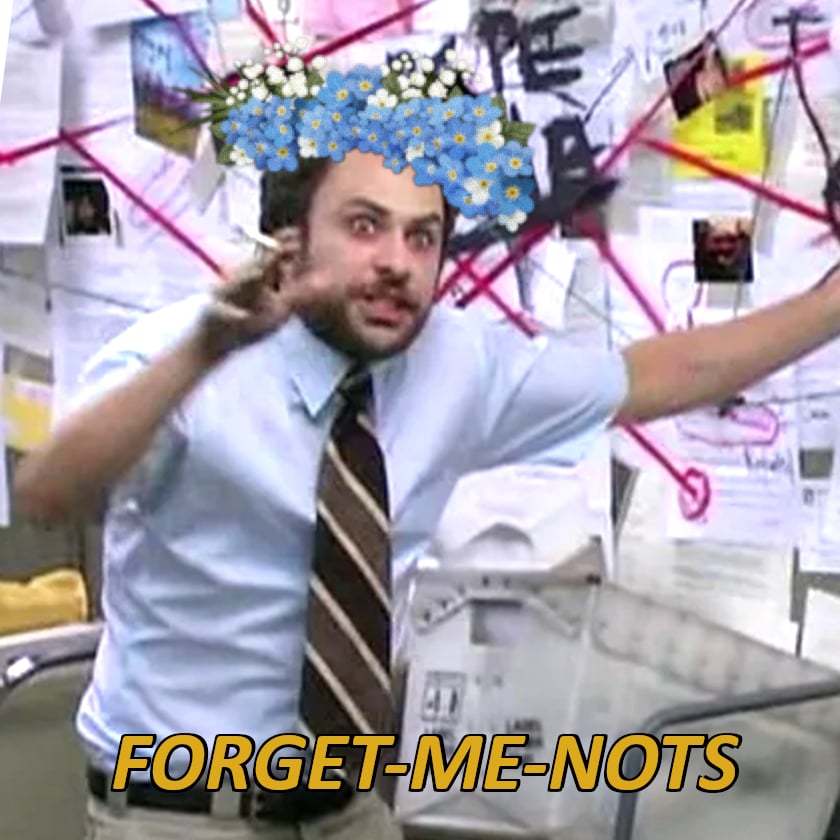
So you remember the forget-me-nots in “Down the Stream,” right? That’s a flower motif that pops up A LOT in Charlotte’s poetry, and especially the gay stuff. When I first noticed the motif in both this and “Down the Stream,” this is about what I looked like:
Phyllis also surmised the below poem was written on the same day. I’d agree it’s likely, since the song appears in Claribel’s manuscript book right after the Barbara collab.
[Hast thou no faith in me?]
Hast thou no faith in me?
How can I prove
All that I felt for thee
How deep my love.Some day when sorrow comes
Clouding life anew
I will be true to thee,
I will be true.Now the world seeks for thee
Welcome its wiles
While it has charms for thee
Bask in its smilesWhen the world frowns on thee
And thy friends be few,
I will be true to thee,
I will be true.
1867
January: Two poems of note here — both actually first dated to December, or Christmas, of the previous year, and then apparently Phyllis revised her estimate forward. Anyway, first we’ve got another poem in the genre of “girl, what is going on with you.”
The Secret
Deep as the diamond in the mine,
The pearl beneath the sea
Shall my excelling heart retain
Each look, each word from thee.As in the deepest shades her nest
The dove delights to hide
So will I bury in my heart
My joy, my hope, my pride.
And then…
Tell me the truth tonight
Tell me the truth tonight,
I fain would hear it now.
Tell me the truth tonight,
Art wearying of thy vow.Why is thy cheek so pale?
I fain would hear it now.
Why is thy cheek so pale?
Art wearying of thy vow?Why is thy eye so dim?
I fain would hear it now.
Why is thy eye so dim?
Art wearying of thy vow?Tell me the truth tonight,
‘Twere best to tell me now.
Tho’ my sad heart should break,
I’ll release thee from thy vow.
(Both of these are also set to music in Claribel’s manuscript book.)
I have a theory about the latter poem: I think she wrote this one for Charles. For the life of me, I can’t find all the notes/letters/whatever in Phyllis’s papers whereby I first concocted this theory. The picture I’ve gotten, though, is that the Barnards’ marriage had a rough patch in 1867/1868, in significant part because Charlotte and Charles had such different opinions on Charles’s clergy career. Skipping forward in time for a sec, a letter Charlotte sent to her aunt Anne Cooper on April 11, 1868 provides more context:
Charlie intends giving up Brocklesby next Easter. I think that has fidgetted and unsettled me wretchedly, but I see it's no use combatting the point. I shall never try any more to guide him. I persuaded him to take the living and now I see I was wrong. He is never likely to hold preferment again. He likes duty [U? &?] nothing else. Parish work he won't do.
I imagine Charlotte could have written “Tell Me the Truth Tonight” wondering if Charles was wearying of his marriage vow. As it happens, Charles was wearying of his clerical vow.
October: Another poem that Charlotte Sainton-Dolby would later set to music, called “Unspoken Love.”
This poem is one of three, out of Claribel's entire body of work, that's in “tercet form” — stanzas of 3 lines. Tercet form is rare as hell to begin with, and a lot of the examples you'll find if you Google it have an alternating rhyme scheme, e.g. ABA CDC […] or ABA BCB […]. All three of Claribel's tercet poems, however, have an AAA rhyme scheme. Furthermore, “Unspoken Love” is the only one written originally in English; the other two, “My Star” (no relation to the above poem of the same title) and “The Wild Bird,” are purportedly translations of Swedish poems. I haven’t managed to track down those original Swedish poems, sadly, but tercet form is uncommon enough that I suspect she got the inspiration for it from those poems.
Unspoken Love
Long years have passed since last we met,
Long years that I would fain forget,
But they enchain and bind me yet!I was too proud the truth to show,
And you too blind the truth to know, —
And so we parted long ago.You spoke of life as but a dream,
My visions were your constant theme, —
How empty they would one day seem!I was too proud the truth to show,
And you too blind the truth to know, —
And so we parted long ago!
Mid-December: Charlotte writes a letter to her cousin Amy Robinson, in which she includes the following postscript about her apparent BFF Victoria, Lady Yarborough.
P.S. Her small Ladyship is here so often I think her guests must be so cross. I hear Lady S. MacNamara took to abusing me frightfully only because she ‘hated Lady Y. making such a fuss of Mrs. Barnard.’
[chants] Tea! Tea! Tea!
1868
March: While on an extended visit to the Isle of Wight, Charlotte writes a less angsty but still sad poem titled (also) "Come Back."
The primrose comes with infant face,
The daffodil with stately grace,
The thrush’s song is loud and clear,
And joy returns, for April’s here; —
While I alone seem waiting yet
Some hidden sorrow to forget.
The swallow has re-crossed the sea:
Then come back thou, fair Hope, to me!The lilac buds are fresh and green,
The red tips on the larch are seen;
The snowdrops faded long ago,
When first a sunbeam kissed the snow.
Oh that my sorrow thus would fade!
Beneath its wings I live in shade.
The swallow has re-crossed the sea:
Then come back thou, fair Hope, to me!
June 14: Charlotte writes a poem in German while visiting one of Jean Ingelow's married sisters at Frensham.
Vergiss Mein Nicht
Donner kommen, Felsen trennen,
Aber [unsre] Freundschaft nicht
Ewig, ewig, soll sie brennen
Wie ein helles Sonnenlicht.Nim Sie hier die blonde Locke.
Ewig, Ewig, lieb ich dich.
Schlagt die [Dumpfe] Abscheids Glocke
Lebe wohl vergiss mein nicht.Herzen die einander Kennen
Ob auch alles wiederspricht
Werden sich doch einmals trennen
[Selbst] die Ferne scheidet nicht.Lebe wohl in seligen Stunden
Denk an deinen Freund zuruck
Bis des Abscheids schwere Wunden
Heilt des Wiederschens Gluck.[June 14th, 1868. Pierrepont.]
English translation provided by Phyllis or someone in her circle commencing below.
Thunder comes, rocks separate
But our friendship not
Ever, ever, shall it burn
Like a bright sunlightTake it, this blonde curl
Ever, ever shall I love you
Strikes the muffled parting bell
Farewell, do not forget me.Hearts which know each other
Even if everything contradicts
Shall never depart (separate)
Even the distance does not separate
In case you haven’t already cottoned on, you want to guess what “vergiss mein nicht” means in English?
“Forget me not.”
July 1, ish: issue 2, I think, of Odds and Ends comes out. This is a literary journal printed for private circulation in which Charlotte had some editorial role; I know she edited the third issue, but I need to actually look at it to find out more. Anyway, this July installment featured "Down the Stream" in print.
July 24: News first breaks that Charlotte’s father, Henry Alington Pye – who had been a longtime figure in Louth/Lincolnshire politics and civic life, and was then the county treasurer – is in debt to literally everybody, from his maids to probably the mayor. What’s more, he’s embezzled some money from the county treasury to try to pay off some of his debts. Yikes.
The family – Henry, his second wife Albinia, their youngish daughter Mary, and then Charlotte and Charles as well – promptly flees to Belgium so Henry can avoid debtor's prison (which, in fairness, would have sucked). Cue several months of Charlotte trying desperately to keep the family’s crap together, despite being devastated herself.
December: Charlotte writes the poem I've seen titled as "A Dream" or "I Saw in My Dream."
I saw in my dream a young girl fair
And her spirit had taken flight
And the sun fell over her yellow hair
To dazzle my wondering sight.As I gazed again with trembling awe
I saw her spirit rise
Like herself in form with the long gold hair
And the sadly beautiful eyes.Her body lay still but the fair trim form
Stood wrapt and strangely calm
While from the blue of the distant skies
Came the sound of an angel's song.And the angel of death came clothed in light
Through the dark clouds floating down
With a sword in one of his folded hands
In the other a golden crown.And a silver speaking thrilled through my dreams
As the young girl's spirit bent
In fear and awe and with veiled eyes
In self-astonishment."This had been thine," the Angel said,
"But for one lived life-long sin,
One earthly love that bars the door
Thy spirit should enter in.”And lower in shame the spirit bent
With a sad and sorrowful wail
And the light died out of the yellow hair
And the cheek grew pale.But all at once a glorious light
Came over the wondrous scene
And another presence was strongly felt
While the spirit looked up sereneA new light came in the pardoned eyes
And a trust and hope grew strong
And again the echoes fell soft and clear
From the sound of the angels' song."O merciful saviour crown me yet."
I woke — and my pillow with tears was wet.
“One lived life-long sin”? “One earthly love”? I genuinely cannot think of a non-gay explanation for this.
1869
Charlotte contracts typhoid fever in Brussels in early January, while en route back to England with Charles for what was likely a business trip. She's ill for two or three weeks, and she finally passes away on January 30, 1869 at the age of 38.
1870
Charlotte’s first posthumous poetry volume, Verses and Songs, is printed for private circulation, compiled and edited by Charles. A copy of the book ends up at Gunby Hall, where it now sits in their collection along with that lock of hair.
Well, that sure was a ride, huh? There’s one more part to this, but we’re finished with the concrete parts of the timeline. I’ll get part 4 out to y’all soon, promise. Till then, be well ❤️