Queeribel: The Big Gay Exposé, Part 2
Welcome back! Claribel was quite possibly queer, and I’m telling you all about it! Was planning to get this out last week, but of course Events™ intervened as usual. Frankly, though, the fact that I’m only about a week off schedule is a win I will gladly take.
If you missed part 1 of this massive timeline, here ya go. Otherwise, let’s just jump right into it.
1862
Not much of gay note this year, but we do get the most beautiful cover illustration that any of Claribel's songs ever get. It isn't even a contest. I don't know what possessed Boosey to hire near-legendary lithographer John Brandard to create an illustration for the cover to "The Old Pink Thorn," but this is what Brandard bestowed upon the world:
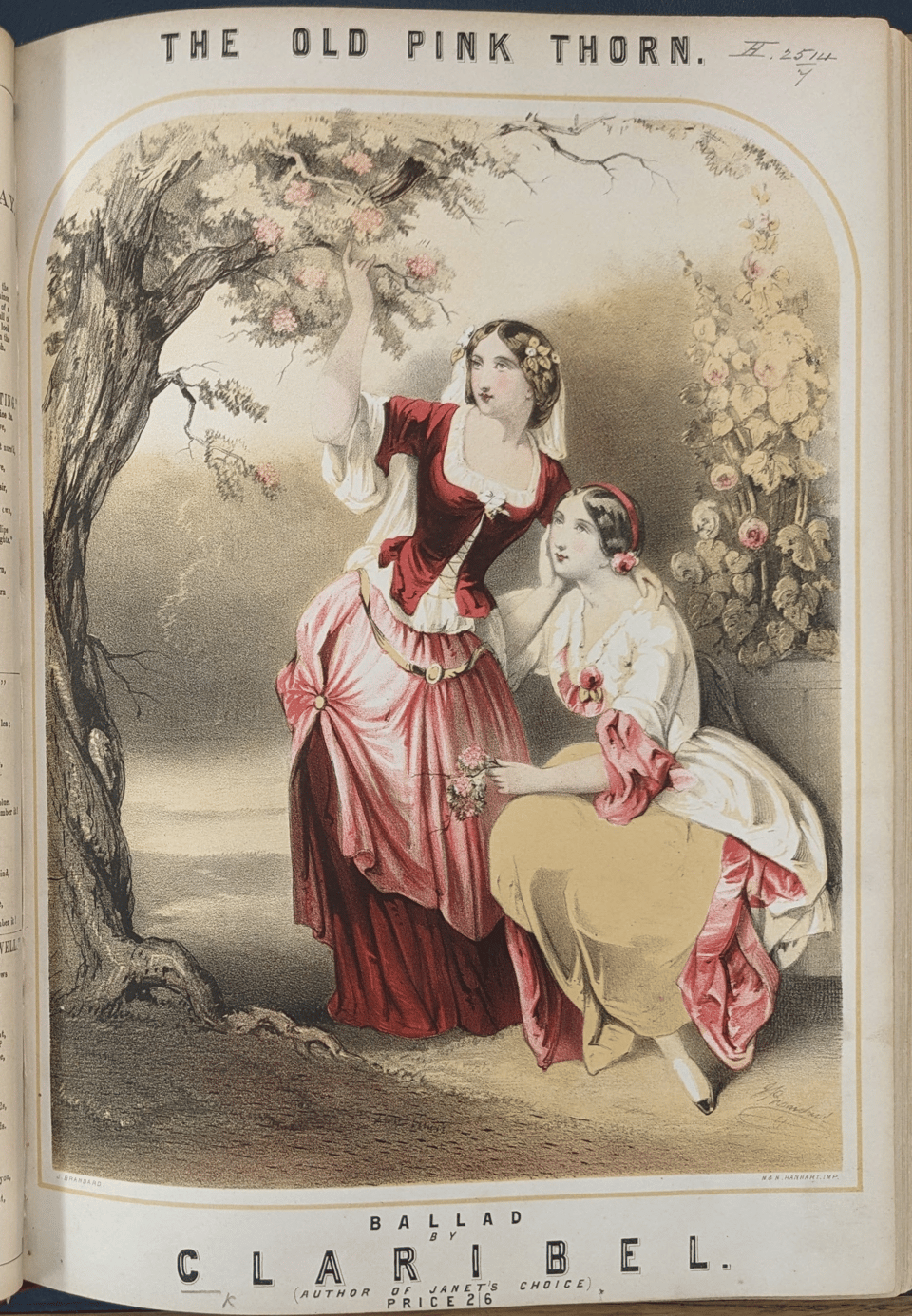
You can actually listen to this song for yourself, unlike with most Claribel tunes! My dear friend Patricia Hammond and her badass musical collaborator Matt Redman made the literal first-ever recording of this song as part of their Living Room Requests series, because I asked my partner to get me a Living Room Request of a Claribel song as a birthday present this year. Go forth!
1863
Sometime this year, on his wife’s strong advice and against his own inclinations, Charlie decides to take up the combined rectory of Brocklesby and Kirmington, a position offered to him by a friend (and I guess relation, however distantly? Phyllis says “cousin”), the Earl of Yarborough. The Barnards subsequently move back to Lincolnshire, to the rectory house in Kirmington.
Charlotte was, I think, already pretty good friends with Victoria Alexandrina, the Countess of Yarborough at the time; it was Lady Yarborough who’d presented Charlotte to Queen Victoria at court in 1856. This move, however, essentially made them neighbors, and they became a good bit closer after this point.
There are a couple poems of interest in this year, one with a specific date. For this first one, dated to January 5, Phyllis doesn't seem sure Charlotte wrote it, but I have a feeling she did.
Smiles [or, "Have you no more to say"]
Have you no more to say, love,
Have you no more to say?
With a smile so light, love,
You bid me go my way.Ah, woe betide the day, love,
I laid me at your feet,
And drank your deadly smiles, love,
Your smiles so deadly sweet.They stole away my life, love,
My strength and joy they stole.
Your smiles so deadly sweet, love,
They stole away my soul.And now you bid me go, love,
And with a mocking word
No looks but yours I saw, love,
No voice but yours I heard.Oh, would your eyes were dim, love,
Your red lips pale as clay,
Your white brows sere and wan, love
Your golden love-locks grey.Have you no more to say, love?
Ah! woe betide the day
Heaven turned to tears your smiles, love
They cast my soul away.
There are also two different versions of a poem I'll call "A Home." The second one is as it appears in Charlotte's second posthumous poetry book, Thoughts, Verses, and Songs from 1877.
A Home
Version 1, in the notebook:Where the lime trees throw their shadows
On the waving summer grass
Where the clover scents the meadow
By the streamlet as you pass:
There my love first came to meet me
On a sweet sad summer's day,
When the apples were in blossom
And the hedges white with May.Version 2, as published in TVS:
Where the lime trees throw their shadow[s?]
On the daisy-loving grass,
Where the cowslips in the meadow
Scent the footpath as you pass;Where the hyacinths are blooming
In a cloud of brilliant blue,
Where the nightingales are warbling
All the balmy evening through:There tonight my thoughts are roaming,
And I let them go and come
In the purple twilight dreaming,
Of that quiet, happy home.
So like, just keep this one in mind for the moment.
1864
We’re going to switch focus for a second and talk about probably the most (in)famous divorce of 1864, at least in England: the Codrington divorce case.
So: a messy-ass divorce is happening in the British court system, between this military bro Captain Henry Middlename Middlename Whatever Codrington and his wife Helen. The grounds are essentially Helen’s repeated infidelity, but one of the allegations that comes out in the course of this thing is that she was involved with another woman. Specifically, Emily Faithfull.
Now, Emily Faithfull is honestly fantastic and I love her. She’d already been involved for several years with the Langham Place Group of early suffragists/feminists (including Bessie Parkes Rayner, Barbara Leigh Smith Bodichon, and Frances Power Cobbe). In 1860, she’d also founded the Victoria Press, which employed female compositors/typesetters — a really stinkin’ new thing for this era. Badass.
Unfortunately, this court case ended up dragging Emily Faithfull’s name through the mud. It was alleged that she’d been a “companion” to Helen Codrington while her husband was away doing military stuff – basically living with them, so far as I can understand. And Helen increasingly just did not want to go to bed with her husband, instead expressly preferring to sleep in the same bed as Emily. A lot of stuff went down behind the scenes of the trial, much of which probably never saw the light of day. But even what did get said – imputations of lesbianism, that sort of thing – was enough to wreak havoc on Emily’s reputation. She recovered socially, after a while, but it was rough.
At this point, I’m sure you’re wondering how this relates to our gal Charlotte Alington Barnard. I’d already known about the case and wondered what/how much she might have heard about it at the time, whether that would have been an “oh, sapphics exist” moment for her. However, as it turns out, during the time period of this peak lesbianism (about 1854 to 1863, ish), the Codringtons lived at “82 Eccleston Square.”
From 1857 to 1863, you might remember from part 1 of this series, Charlotte and Charles lived at 6 Eccleston Square.
Mind you, I haven’t 100% figured out where #82 was, because the house numbering on the square is weird. But I highly suspect that Charlotte was very much a neighbor to all this sapphic stuff. It seems more plausible now that she would have known Emily Faithfull personally, and also that she would have had some sort of concept of sapphism, possibly as a direct result of that. And just maybe, if all that is true, Charlotte would have seen how Emily and Helen’s names and reputations were dashed to bits in the court of public opinion. I feel like that’d make anybody scared to be more open about queerness.
Anyway, end historical digression! Sometime around September 20, while at Mablethorpe (her favorite spot of seaside), Charlotte writes this poem. It’s quite harsh, by her standards.
"Oh, look not back!"
Oh, look not back! for, how should soft forgetting
Creep on the wayward soul, lamenting still?
What, in lost hours, was worth thy keen regretting? --
False, blinding hopes?-- a love that time could chill?Time teaches well; our worthless treasures stealing, --
Loosening the gilded chain of bygone years;
Hearts sorely grieved have felt its gentle healing;
Slowly, alas! it seals the fount of tears.
1865
Two related poems, likely written in the earlier part of 1865. One’s tentatively dated January, and I’d guess the other was written soon after; it feels like a refinement or re-framing of the same thoughts.
First, the one from January 1865.
[Oh, no, it never crossed my heart]
Oh no, it never crossed my heart
To think of thee with love
For we are severed far apart
As earth and sky above.And tho' in many a midnight dream
You prompted fancy's dreams to me
I always knew what thou wouldst be
No more than midnight dream to me.As something beautiful and bright
To worship as a star of light
A beam to gild with purest ray
My ever dark and lonely way.I dare not, do not, love thee, yet
My heart refuses to forget
And oh, I grieve that I shall be
No more than midnight dream to thee.
And then there’s this one, which was published in Charlotte’s first book of poetry from late 1865, Fireside Thoughts.
Imperatrice
When first we met, long years ago,
I deemed thee kind and calm,
But soon that sympathy of thine
Fell o’er my life like balm.
I guarded well this heart of mine,
Thou wert so high above me;
With all those winning ways of thine,
I did not, dared not love thee.And yet each day without thy smile
Was blank to me and drear;
I counted but the hours, and said,
'To-morrow brings her here.'
Yet, when thou cam’st, no word of thine
Was ever meant to move me;
Thou wert above this dream of mine,
I did not dare to love thee.I did not know the subtle charm
That held me like a spell,
But yet I knew I only loved
Thy presence much too well.
The happy hours slid swiftly by,
Bright as the skies above me,
And yet so safe and sure was I,
I did not dare to love thee!
If you didn’t catch the specific line that these two poems share, it’s the “did not, dared not” one. To me, that’s as good a proof as any that these poems are about the same person – a person for whom, in the latter, Charlotte dropped a female pronoun.
August 23-25, somewhere in there: this poem.
[Oh! I have loved thee]
Oh! I have loved thee with a boundless love,
Through all the wayward changes of my fate.
Thou wert the star whose rays could dissipate
My gathered gloom, and bid all clouds remove.Our passion grew from childhood
With its days it strengthened
And it prospered and became
Within our souls an aetna of pure flame.Oh! I have loved thee with a boundless, boundless love.
(Mildly kills me that the first stanza is in iambic pentameter and then she just kinda ditches that. It’s whatever, though, it’s fine.)
And on October 29: this poem.
Discipline
Trust not those stars again
Tho' bright and fair,
Trust not those skies again,
Tempest is there.
Trust not those flowers again
Fragrant and fair,
Trust not that rose again
Blighting is there.
Trust not those hopes again
Sunny and fair
Trust not that smile again
Peril is there.Trust not this world again
Smiling and fair,
Trust not its sweets again
Worm-wood is there.
Trust not its love again,
Sparkling and fair
Trust not its joy again,
Sorrow is there.
In addition, sometime this year, Charlotte decided to return to 1863’s “A Home” and write a follow-up, or second set of stanzas, or whatever. Let’s just say it only makes sense as a follow-up for one version of the poem.
Still the shadow[s?] of these Lime trees
Sweeps across the waving grass;
Still the clover scents the meadow
By the streamlet as I pass.
But my love sleeps neath the daisies
And the May buds bloom in vain;
She will never never see them
Or return to me again.Hush! regretful heart be silent!
Would I crave her from the skies;
Oft she gazed so strangely upwards
With her blue unclouded eyes.
Now she knows beyond all doubting
What was hidden from her view.
I will wait in patience darling,
Till I know the secret too.
Also, Phyllis scrawled a note on her typescript copy of this one that says “suggests death of Mrs. Pye” – Charlotte’s mother.
Girl…
Look, I’ll just say, if this poem is genuinely about Mrs. Pye then I will eat my hat. I will eat every single hat I own.
December 24: So maybe, amidst all this tantalizingly sapphic poetry, you’ve had a stray thought — what’s going on with Charles Cary Barnard during all this? With his and Charlotte’s marriage? Or, hell, maybe you’ve forgotten about him entirely at this point. Whatever. Regardless, Mr. Claribel absolutely has stuff going on too. Case in point, this snippet from a letter Charlotte wrote on this day to (I believe) her cousin Amy Robinson.
Yesterday was a calm birthday, happy in many ways. Poor C. was nervous all night and had a shivering fit. He had to bury a child in the dark almost. It died in the morning of a dreadful fever.
Here’s the thing about Charles Cary Barnard. Phyllis claims, God only knows why, that Charles was placid and even-tempered. Specifically, she claims that these traits are the reason Henry Alington Pye wanted him to marry Charlotte, as opposed to John George Hollway — thinking that Charles’s temperament would be a better counterbalance to Charlotte’s deep-rooted emotionality. Maureen Peters, who relied heavily on Phyllis’s research to write her biography of Charlotte’s contemporary and good friend Jean Ingelow, takes that notion and gets even more disparaging with it into the bargain:
Charlotte Barnard, later famous as 'Claribel,' proceeded to use her mild talents in the composition of sentimental songs, for there is little doubt that she quickly realised the gulf in taste and temperament which lay between her husband and herself.
(Jean Ingelow: Victorian Poetess, page 51)
I’m not going to mince words here: Phyllis and Maureen are full of shit. Charles, who didn’t like being a clergyman even at the best of times, had to bury a small child in the dark — had to bear witness to the parents’ grief — and he had what sounds like a massive anxiety attack about it. He was clearly affected by this on a profound level. I don’t know how anyone can read about this and not think that Charles had his own significant emotional depths, that he was entirely capable of feeling things as strongly as Charlotte could.
(It’s also some horrible foreshadowing, given that Charles later had to bury two of his own children with his second wife Alice — his eldest Leila, who died at age 3, and his youngest Lucille, who died at age 11.)
Anyway: sorry to end this installment on a sad note. There’s still a fair amount of heartbreak to go around in the latter half of this series too, unfortunately, so bring your tissues as needed — but there’s also some of the most compelling Gay Evidence I’ve got, because oh boy 1866 was quite a year. I hope it won’t be too long till I can send the next one, though I’m still waiting for one last nugget of information, so we’ll see. Till then, darlings, bye ❤️