What Is The National Book Rating Index?: Another "New" Review Tool Attempting to Legitimize Bias in Book Evaluation
The National Book Rating Index is a convenient answer to public institutions asking how to subscribe to right-wing review guides.
It was never a question whether the end of Moms for Liberty’s BookLooks in March would be the end of parental rights groups taking up the mantle on reviewing, rating, and targeting books on library shelves. There were already several working parallel to and in conjunction with the Moms for Liberty joint. Among them were RatedBooks.org and Take Back the Classroom.
What all of these projects have in common is that they’re created by people with an agenda to push. These parental rights activists believe they know better than actual experts, such as librarians, educators, and child development professionals, about what constitutes age-appropriate literature for young people, even though those same activists have never not had the right to guide the reading choices of their children. They’ve wanted the government to do the parenting for them.^
That these review resources are being taken seriously in some schools and libraries, rather than as projects by fringe groups furthering an agenda, is evidence of how expertise, knowledge, and education continue to be undermined. Politics, and specifically far-right politics, matter more than the actual development of a generation of young people.* Yet, backlash against the far-right overseeing school boards in the last election was swift, and it was real. Voters, taxpayers, parents, and those at the intersection of all three want people who care about education at the helm of their schools, not people who cannot stop talking about the genitals of minors.
Following in the footsteps of a successful scheme to fundraise off book bans by Take Back the Classroom, RatedBooks.org is now developing its own “new” resource of reviews, The National Book Rating Index.+ This time, they’re not only incorporating their reviews and the reviews that they subsumed from BookLooks. They’re also going to include links to other reviews, both those by experts and those working off a pro-hate agenda, so that parents “can decide” which ones to believe. It’ll also include a searchable database of successful book removals of titles they deem inappropriate, modeled after Take Back the Classroom.
The National Book Rating Index will be available here “at the end of the year,” per RatedBooks.
According to their own lore, the National Book Rating Index was created in response to a librarian seeking a way to provide her students with access to a database of book reviews, allowing them to choose what to read next without being exposed to “explicit content.” That’s the “explicit content” of the reviews themselves, not the books.++ Not only is the premise that students are clamoring for such a review database wild–most students don’t read professional reviews before picking up a book but instead rely on word-of-mouth recommendation or social media recommendations or the genre/description/author blurbs on the book’s cover, not to mention they’re not too stupid to pull out their phone and Google or ChatGPT the title for reviews if they want them–it’s also a deep tell on the librarian themselves.
That librarian could have used their own skills as an information professional to figure this out. They could have also simply admitted they wanted it for themselves, whether it’s to guide student reading and/or engage in silent censorship for any number of reasons. Instead, the librarian allegedly went to a far-right “parental rights” group to do it. RatedBooks thought this was the opportunity to create a new index where minors can access just their book ratings–no context nor cherry-picked passages–freely.
For a mere $5 a month or $50 for a lifetime membership, though, those over 18 can subscribe to full access to the database. That access provides the group’s book reports, including the tally of the number of swear words these books have, the cherry-picked passages deemed “obscene” by these parents, and more. But because the National Book Rating Index works in parallel to RatedBooks–that won’t be going away–they had to add some perks to justify a subscription. Anyone can still use or access RatedBooks freely, including the minors they’re so worried about. That they don’t trust their kids to borrow appropriate books from the library but do trust that these same kids won’t lie when a pop-up box asks them on a website if they’re over 18 is wild.
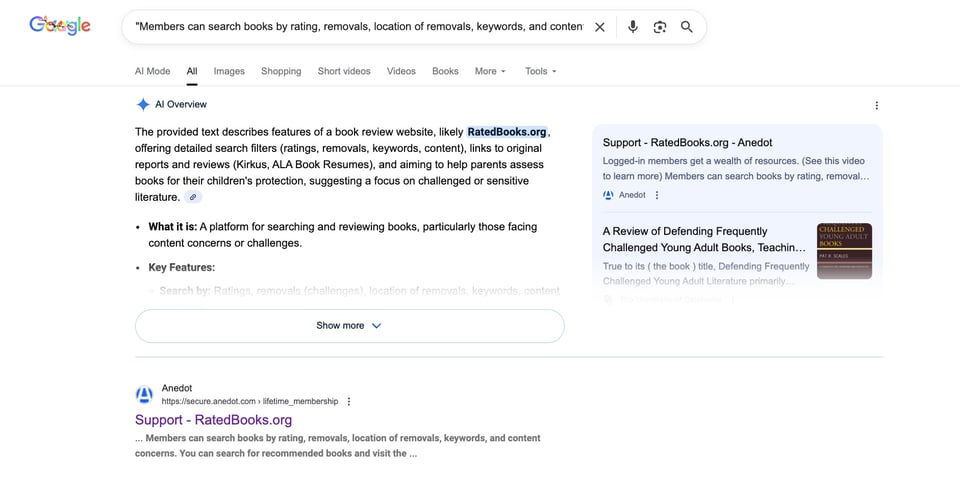
Here’s what those National Book Rating Index subscription perks are, per the announcement and solicitation that ramped up on Giving Tuesday:+++
Members can search books by rating, removals, location of removals, keywords, and content concerns. You can search for recommended books and visit the originating website to read the full report. Books will have multiple reports linked in; we are even linking in reviews from Kirkus and the ALA's recommended "Book Resumes" so you can gauge how much you trust these organizations' reviews to protect your child's innocence.
RatedBooks updated their email ask campaign shortly after the first blast went out, which is why the link to the cited perks above is no longer accurate. Now the promise of the database includes:
One Index, Two Ways to Use It:
Our database contains over 17,000 titles that have been reviewed, challenged, or removed from schools. We designed a unique system that allows children to find good books while giving parents the data to vet the bad ones.
For Kids (The Public Interface):
Completely Safe: Located on the homepage, anyone can search a title to check its rating without a login.
Sanitized Results: We use a manually assigned formula to generate a generic safety rating (all ages, juvenile advisory, youth advisory, youth restricted, adults only & deviant content).
Locked Down: No explicit descriptions, no "steam" levels, and no outbound links will work. Kids cannot click through to mature content.
For Parents (The Member Interface):
Full Transparency: Log in to see detailed reports with profanity count, and explicit content warnings.
Removal Tracking: See if a book has been removed from districts like Davis, UT or Brenham, TX, and access PDF reports to use for challenges.
Source Comparison: View ratings from Plugged In, The Good and the Beautiful, Kirkus, BookLooks and RatedBooks side-by-side.
It's interesting to see that “ALA’s Book Resumes” are no longer a central selling point. Book Resumes aren’t an ALA product to begin with, as they’re a collaborative, multi-organizational project hosted through Unite Against Book Bans.
But here’s the real sell of the National Book Rating Index: it’s pretty clever to put the reviews done by actual experts in the field beside those done by parents with an agenda. It attempts to elevate those biased reviews to the same level of professionalism and authority as those done by actual experts in the field. We know RatedBooks sows panic over book content by simply lying. Now, by providing “options,” they give themselves further belief in an expertise that doesn’t actually exist. The onus of deciding the “right” reviews now falls on parents and, as will be discussed shortly, professionals who work in institutions that will find such a Rating Index a boon. That onus of decision-making is no different from what has already existed.
Creation of such a tool isn’t a surprise. That it took this long is.
School districts overtaken by extremism have been asking for a subscription to such a thing for the better part of the 2020s. It is easier for a school board to justify implementing book banning when they can point to a database they have to pay for, rather than something freely available on the internet. Volusia Schools (FL) wanted to do this in early 2023; St. Francis Schools (MN) went ahead and tried to use BookLooks reviews last year, but were barred from doing so due to being sued over such a blatant political move. This is a solution they’d have no doubt turned to.
It also makes sense that RatedBooks, a collaborative effort among groups such as Utah Parents United, No Left Turn in Education, the Pavement Education Project, and the standalone Facebook groups of LaVerna in the Library and her state-level sister pages, Mary in the Library, would be the leader in developing such a database. Utah is an active book banning state, with a “Bright Line” rule used in determining so-called “sensitive material”–AKA, the stuff that needs to be removed from schools. It’s a rule that undermines the federally standard Miller Test for obscenity. Utah law also requires statewide removal of any book banned in three or more public school districts. So far, the state has banned 19 titles from all of its public schools, and just two of the state’s 42 school districts are responsible for 80% of the books prohibited in all districts.
That doesn’t address how some Utah politicians are also cozy with Utah’s parental rights advocates. Ken Ivory, a Utah State Representative, has been quite active in the RatedBooks/LaVerna In The Library Facebook pages. He doesn’t hide the direct connection from that "parental rights" book rating site to state-level audits of books in libraries. This little passage on .pdf page 14 from A Review of School Library Books: Questionable Content Shows the Need for More Robust Oversight, put out by the Utah Office of the Legislative Auditor General in mid-October 2025, is easily traceable right to Ivory's participation in LaVerna:
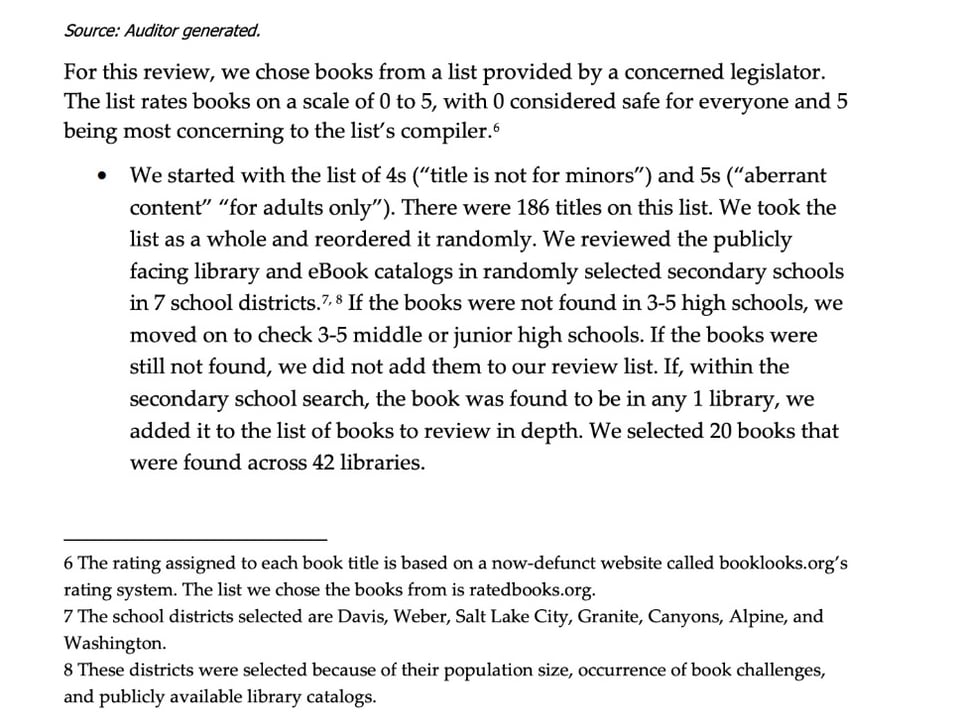
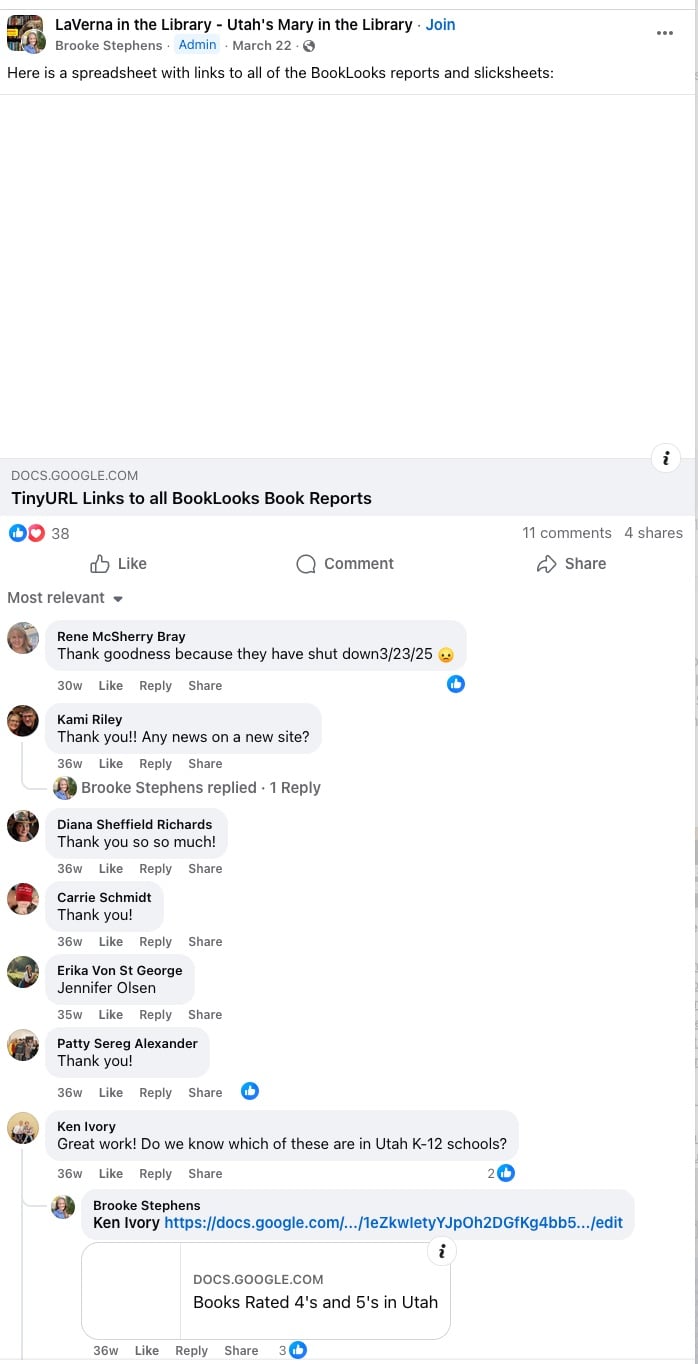
Ivory asked specifically for those books in a March 14, 2025, comment on a public post on the LaVerna in the Library Facebook page:
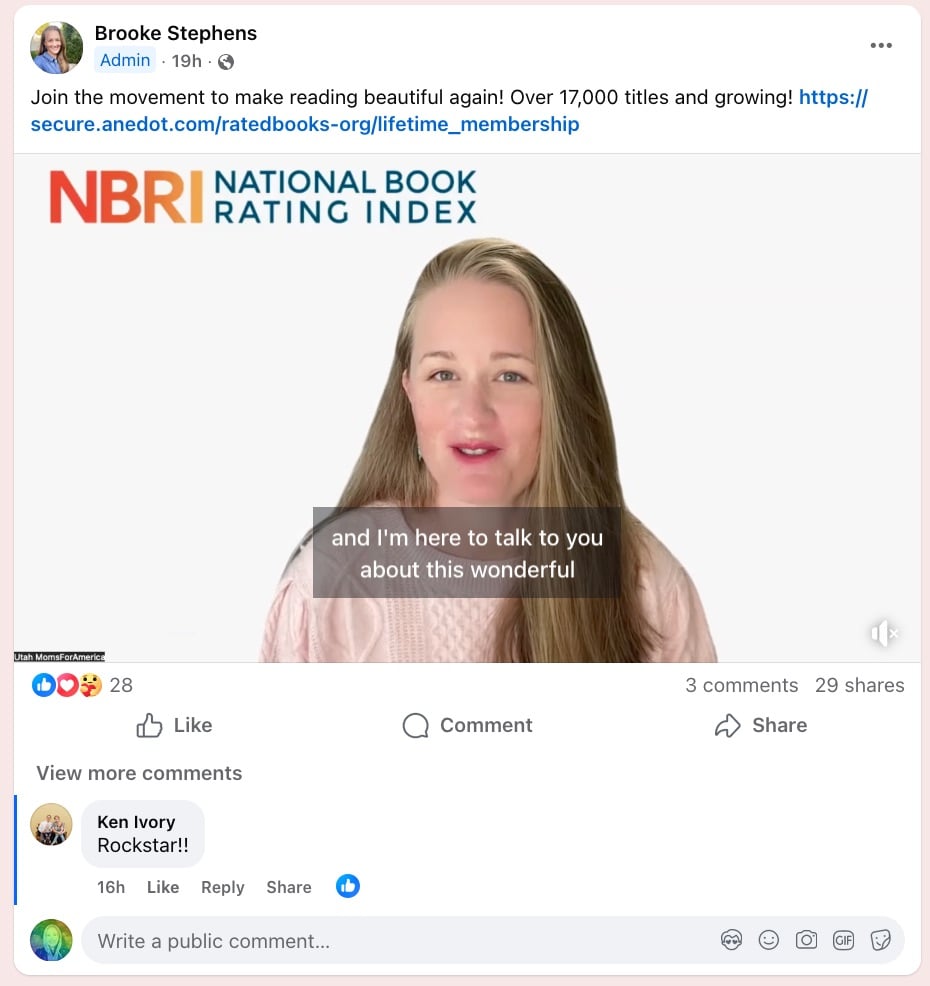
Of course, and not surprisingly, Ken is excited about the new National Book Rating Index.
Keep an eye out in 2026 as this new Index rolls out, and it begins to be pointed to as a solution to the ongoing manufactured panic over “porn” in schools. It appears that politicians and school boards will have a new tool to address a problem that doesn’t exist, at the expense of students and the vast majority of parents who don’t believe in censorship.
How soon will we see the first state-level legislation created by politicians–not librarians or educators–that outlines exactly how materials in their collection are selected? The answer is likely to be as early as the upcoming legislative session.
How soon will the National Book Rating Index be provided as a simple solution, with politicians telling librarians or educators they’re overreacting? The book reviews from Kirkus and “the ALA” are in there, too, after all (right alongside those from Focus on the Family and numerous “parental rights” groups). If librarians or educators were concerned about being told how to do their jobs by these bills, they would know then which reviews in the provided Index are the appropriate ones to follow.
It’s the perfect setup for even more book censorship, and it’s the ideal setup for further encouraging quiet/silent censorship. These “parental rights” groups are eager to shut down expertise and be the authority.
We know whose parental rights are the ones that count here. It’s not yours, mine, or those of most American parents. Most parents not only trust librarians to do their job, but they also don’t opt their kids out of books or library access.
Notes:
^If there’s a policy or law, then mom and dad don’t have to explain to their children why they dislike gay people or Black people or provide any education around sex that might dissuade them from a pro-birth agenda. They can point to rules and policies to explain that that’s “just the way it is.”
*This isn’t new in America, to be clear. See: the United Daughters of the Confederacy, for one. It’s also worth reading Ann Bausum’s White Lies: How the South Lost the Civil War, Then Rewrote the History.
+Both RatedBooks.org and Take Back the Classroom–via its parent Capitol Resource Institute–are 501c3 nonprofits; RatedBooks only secured that status in May 2025. It’s unclear how the $5/ 5/month or $50 lifetime membership fees collected by RatedBooks for the National Book Rating Index will be used, given that the web development, platform, and hosting are being provided by a company owned by Brooke Stephens, founder of RatedBooks and Utah Parents United, and her husband.
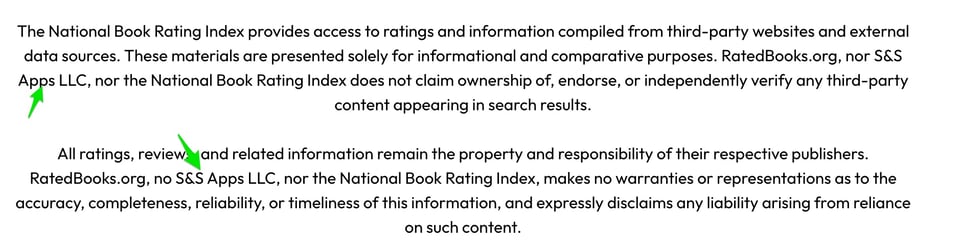
++Taken as a whole, those cherry-picked passages propagating the bulk of RatedBooks reviews do look a little more like they fit the definition of “obscene” per the Miller Test than the actual books themselves do.
+++Since newsletter blasts don’t archive as webpages do, I’ve done a Google search of the language used in the initial email. You can see the language in that first (& only) link to the newsletter. Here’s the screenshot: