
Navigating the Brain Poisoning of Book Censorship
On parenting and reading picture books in an era of relentless censorship and intellectual control.
My daughter is five, and she’s been a voracious reader since she was born. There are never enough story times at home, and she’s figured out that asking for a book is something that I rarely say no to. Her bookshelves are stuffed, her library basket is bursting, and picture books are slipped into spaces and crevices throughout the house.
One of her favorite books is one she discovered at our local indie bookstore: Itty-Bitty Kitty-Corn by Shannon Hale and illustrated by LeUyen Pham. The cover is pink and sparkly, with a bright-eyed kitten at the center.
Published in 2021, it’s kid catnip (pun intended). The story follows the aforementioned pink kitty who loves a unicorn poster so much that she decides to fashion a horn for herself. She’s excited to become the unicorn, but her “friends,” Parakeet and Gecko, tell her over and over that she’s no unicorn. This upsets Kitty. As she tries to hide who she knows herself to be, those friends continue to bully her.
But then Kitty meets a real unicorn. While she sees just how different she is from the unicorn, she also sees how many similarities they have. The unicorn then tells Kitty how much she admires Kitty’s pink furry ears. It’s something that the unicorn has made a headband of and dons proudly.
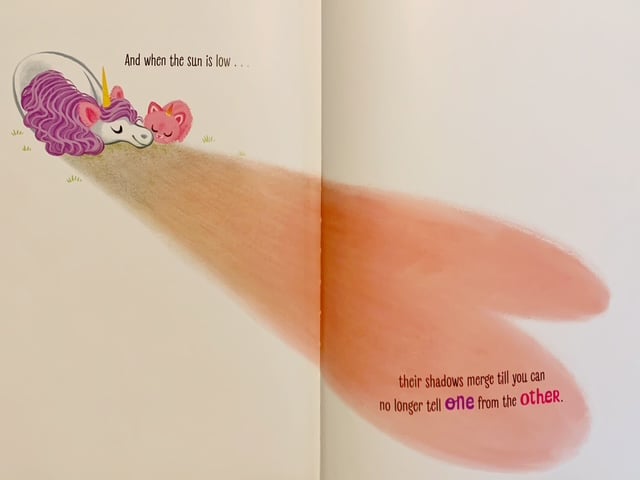
The story ends with Kitty and the unicorn sharing mutual admiration and understanding that they are both “kittycorns.” The final spread is particularly moving, featuring the pair lying side by side, their shadows forming a long heart. Every time we get to it, my daughter–a particularly interactive reader–says “awww,” pressing her hand to her heart.
I’ve read the book five billion times. But every time I read it, I find myself feeling the opposite of “aww” at the end.
I’m angry.
There’s nothing particularly earth-shattering about the book, and that’s not a belittling statement or assessment. It’s very cute, and the message–be yourself–is a bedrock of children’s picture books. The story does a good job of introducing the idea of friends who aren’t really friends–Parakeet and Gecko are jerks to Kitty the entire time–and Kitty learns what friendship looks like when she meets the unicorn. Within the single volume, we don’t know where or if Kitty ditches the mean people in her life; what we do know is that she learns what it means to be kind to others–and herself.
For years, book banners have been calling Itty-Bitty Kitty-Corn a book that indoctrinates children. Those who read and share it in classrooms and libraries, as well as the book’s creators, have been labeled “groomers.” The book, censors cry, encourages children to question and change their gender.
Neither unicorn horns nor kitty ears, nor pink sparkles nor purple manes of hair define gender. Gender is a human construct, completely made up, fluid, flexible, performative. It is not something animals concern themselves with, even and especially if sex is something we know is and can be mutable and flexible in the animal world, too. To assert with one’s full chest that Itty-Bitty Kitty-Corn is a story meant to groom children into changing their gender and not a story about being yourself, no matter what other people say, is to express just how much space thinking about gender takes up in these people’s everyday lives. It’s to show off just how much time they spend thinking about what’s happening in the pants of other human beings.
That’s the actual sickness here. It’s not a horn-wearing kitty nor a kitty-ear wearing unicorn.
But years of swimming in these sick mindsets have absolutely affected how I read this book. Much as I love seeing my daughter’s face light up when she asks to read the kitty-corn book, I have to take several beats before agreeing.
I’ve found myself looking for the places where the book is “sexually suggestive,” and where the book “promotes” anything related to gender ideology. It isn’t there. It’s never been there. But much like when you can see the patterns of where and how book banners behave because you’ve been studying their actions so long, it’s getting harder and harder not to read books like these with the innocence and charm they deserve. With the curiosity and enthusiasm of a five-year-old discovering the magic of books. While my brain hasn’t been cooked, it sits on the counter beside the stove, watching the pots of bubbling noodles.
But the last time I read the book, something else clicked.
This is a story censors want to ban, not because of its supposed gender messaging. It’s a book censors want to ban because it’s actually a story about identifying people like them and how powerful it is to ignore their cruelty and carry on with your own truth.
Book banners aren’t Kitty, of course. They’re Parakeet and Gecko, constant negative vibes and belittling of the things that bring other people joy. Nowhere does Kitty say that other people need to be unicorns, nor does she say they need to look at the joy other creatures have and adapt it. Kitty simply tells her “friends” who she is, and those “friends” feel the need to cut her down, rather than lift her up. They’ve decided their narrative of Kitty. If she refuses to conform to their small worldview, then she’s the one who is the problem. Not them.
To be yourself in a world that wants you to be anyone else is the most powerful thing you can do.* Reading and promoting the books that other people don’t want you to read is to form your own thoughts and opinions, independent of what other people tell you that you need to think or see.
To do both in tandem–watch the delight of a 5-year-old as she turns to the page where Kitty and the unicorn show the world what it is to love yourself and other people while also knowing where and how images like that are fuel for hate and bigotry–is to understand what’s at stake here.
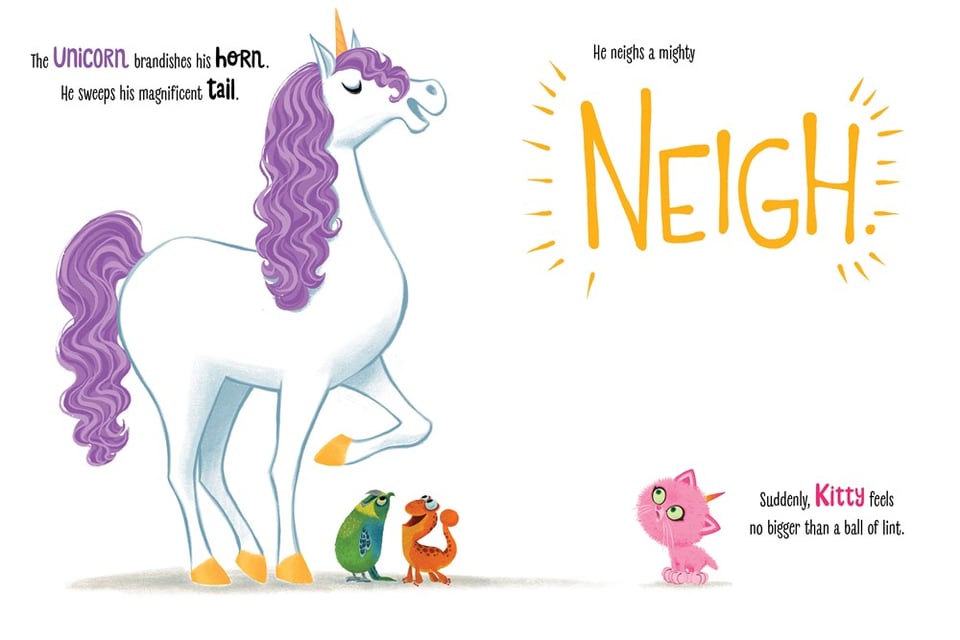
You can see this very thing in Itty-Bitty Kitty-Corn. When the unicorn arrives, Parakeet and Gecko aren’t looking at one another nor affirming one another’s stance that this isn’t okay. Gecko’s expression suggests that maybe, just maybe, his world is expanding a little bit more than he’s been permitted. Parakeet, on the other hand? You can see how she’s trying to explain away contradictory information, as she’s grown so accustomed to parroting. It’s cognitive dissonance.
Kitty doesn’t feel small in this moment because of her small thinking. She feels small because her wildest dreams and beliefs have manifested before her.
She allows herself to marvel at possibility. It’s mind-blowing when you permit yourself to believe in the world and its magic, even and especially when others tell you not to.
I don’t want my kid to like every book she reads. She deserves opportunities to engage with and wrestle with ideas and concepts; I want her to disagree with ideas and people through smart, factually supported arguments developed through education and exposure. Indeed, at five, she’s got a bevy of opinions that I’m often surprised to hear because I haven’t imparted any particular idea into her head about the things at hand. That surprise is something I cherish. It’s proof she’s coming into her own and navigating the things before her with her own brain and through her own experiences.
What I don’t want is for my kid to tell anyone else that they don’t have the right to do those very things. That’s precisely what the people claiming a cute book about kitty-corns–something that’s not even REAL–want for the world.
What a sad and small space to occupy.
*Thanks, e.e. cummings.