
Iowa Lawmakers Hate Reading Books Almost As Much As They Hate Queer Kids
There's no requirement for a whole book to be read before it's banned in Iowa under SF 496. A new proposal to the bill could speed up bans even more.
In May 2023, Iowa legislators passed Senate File 496. The bill, dubbed Iowa’s “Don’t Say Gay” law, was cheered on by Moms For Liberty and other far-right extremists. It came on the heels of similar discriminatory bills passing in other states, including Florida and Texas.
SF 496 is an education bill about denying queer kids the right to exist in public and denying straight kids the right to learn about their queer peers and queer people, period. It’s a massive, messy law, but three provisions have been identified as especially problematic:
It forces students out of the closet by requiring that parents be notified if students request to use a different name at school than the one on their birth certificate.
It bans any curricular instruction or references to gender identity or sexual orientation for kindergarten through sixth grade.
It allows for widespread, state-sanctioned, school-implemented book banning. There are two provisions here. First, school libraries cannot have books that “depict or give instruction to gender identity and sexual orientation” at the K-6 level (that is, no gay books). Second, K-12 schools must remove any books in public schools that include “sex acts.” “Sex acts” is defined by an Iowa statute, and in the case of SF 496, this provision of the law isn’t applicable to the Bible or other religious texts.*
Schools began removing books almost immediately. You may recall that some became pioneers in deploying AI to do the work, including Mason City School District. AI offloading or not, districts went far broader in their bans than necessary, pulling books that do not in any imaginable world include “sex acts” per the state statute. They removed books without reviewing them in full, the exact goal that legislators had in the bill, since it allowed for widespread censorship without having to apply the pesky Miller Test.
By November 2023, the ACLU of Iowa and Lambda Legal filed a lawsuit over the above-mentioned provisions of the law. That was soon followed by a second lawsuit from Penguin Random House, the Iowa State Education Association, an Iowa high school student, two middle school teachers, a K–12 district librarian, and authors Laurie Halse Anderson, John Green, Malinda Lo, and Jodi Picoult. A month after filing these suits, a lower federal court blocked these portions of SF 496, and several schools across the state that had banned books put them back on shelves. Let’s go ahead and assume that those books–most of which had been on those very school shelves for years, if not decades–did no harm to the students in the years before their removal nor in the time after they were returned.
It would take dozens more paragraphs to lay out the timeline of these cases in the court system, and it has been a long, tumultuous road. Rather than do that, it’s worth reading through ACLU of Iowa’s timeline. We’ll skip ahead instead to April 2026, when the Eighth Circuit overturned the temporary block of the law, and SF 496 was once again rule in the state.
Since April, schools have gone on a book banning bender. Annie’s Foundation, a grassroots organization outside of Des Moines that has been fighting book censorship and advocating for diverse literature in the state, has been tracking the titles being removed statewide under SF 496. It is not surprising that the bans are wide-ranging and wide-reaching, with plenty of questions from people who are familiar with these books wondering what, exactly, the “sex acts” were in them. At least nine districts included 1984 among their newly banned books, and districts are absolutely decimating their library collections, with some removing more than 100 books and including books that have been banned nowhere else.+ Johnston Public Schools, a Des Moines suburb, removed over 210 titles. What Annie’s Foundation has found through its documentation of removed titles is that there’s no consistency from district to district. What’s deemed illegal in one school is perfectly fine in another, once again driving home the point that this is about compliance and erasure, not about any actual danger.
Context of a passage doesn’t matter with SF 496. It’s about words and phrases that could align with the state’s definition of “sex acts,” undermining the Miller Test–the federal standard for defining obscenity. That’s why using AI was effective in 2023 and is likely a tool being used again in 2026. You can plug Iowa’s definition of “sex act” into a machine, load up your catalog, and ask for matches. Never mind how many of the hits that come back pull from unprofessional, politically-motivated “review sources” that also cherry-pick phrases and passages to point to as damaging to children.
Why read a book when you can simply ban it?
Library workers and educators are in a tough spot with the law, being turned into the very banners they’re being targeted by. That is the exact goal, and it’s especially delicious to republicans in Iowa who failed to pass any of their slate of anti-library laws last legislative session.
It’s important to emphasize that SF 496 is an anti-LGBTQ+ law. But the consequences of the law, as in any anti-LGBTQ+ law, impact the entire populace. That’s clear in the wide-ranging erasure of literature under the guise of it including “sex acts.”++ That’s also clear when taken in conjunction with states like Florida and Texas, which have also attempted to redefine the Miller Test through vague language around what constitutes depicting or describing sexual content. Legislators don’t care about the books, nor do the extremist groups driving their agendas. They care about compliance and control. The books are but a convenient and symbolic tool.
But things have just taken a more urgent turn in Iowa with the start of the new school year and the court’s stamp of approval on the law’s implementation. With the power to enforce SF 496 and knowledge of how poorly their campaign of anti-library bills fared last legislative session, conservative legislators are looking to push their censorship agenda in a new way.
The State Department of Education is considering new rules related to the law, and one of these rules appears to be unfavorable to students, educators, literacy, and broader regulations when it comes to defining obscenity. In the Department’s Notice of Intended Action published on September 2, there’s this:
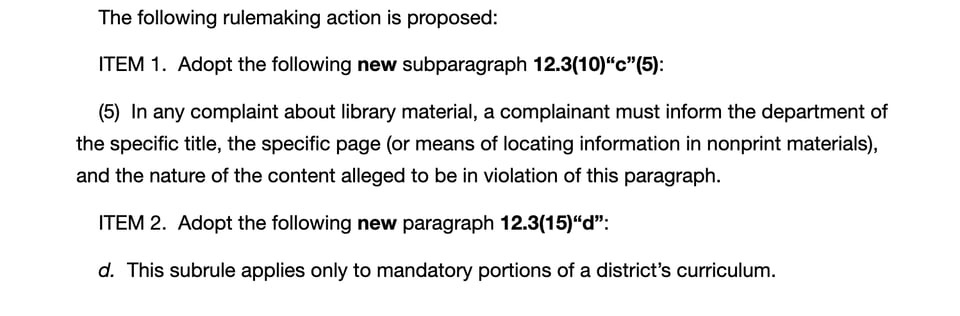
Like all the laws being passed nationwide related to banning books, Iowa’s is vague and unclear. We know the definition of “sex act” under state code; however, SF 496 places the onus on schools to review their collections and remove materials believed to be in violation. There are consequences for violations, which can be found in the state administrative code. What this new proposal seems to be saying, though, is that people outside the school can now complain about materials in the library and doing so requires very little effort.
While “complainant” is not defined here, as engrossed, SF 496 doesn’t grant anyone a free pass to complain about materials in school libraries that violate the law. The responsibility is on the schools. This new proposal, however, opens the door to submitting complaints about materials. All that’s needed is a handy print out from Rated Books or Take Back the Classroom.
Complaints don’t need context, and there’s no need to read the book to complain. They just need to point to the offending passage, and, thanks to the structure of SF 496, the school has to take some action. We know that means removal more than anything else–and it’s a removal made easier by providing an exact identifier for the offending word or passage. If the school doesn’t comply with the complaint, it’s unclear what would happen next. Does the complainant go to the state and put the state on the school? That is precisely what the South Carolina law says, and it’s why there are over 20 books banned from every public school in that state.
This new provision appears to be a means of developing a state-sanctioned, mandatory book ban list. It doesn’t even require anyone to bother with a whole book.
The Miller Test uses the phrase “as a whole” twice in the mere 70ish words of the test. In Iowa, that federal standard doesn’t matter. There’s no need to review books as a whole to complain about them, and there’s no need to review a book as a whole to remove it from shelves; the law provides the avenue both for the complaint and the review to be done as swiftly and as broadly as possible. Indeed, the very same people who complain about how the kids don’t read, that test scores are dropping, and that literacy rates are dangerously low are the same ones saying a few words are enough to earn a book’s banning.
Isn’t it something that the language in Iowa’s definition for “sex acts” is itself enough of a violation of the law to be illegal to have anywhere in the school?
The state’s Department of Education is currently accepting citizen comments about the proposed rule. If you’re an Iowa resident, take the time to submit some questions about this change. What does it even mean? What’s the definition of complaintant–conveniently, it isn’t in the code with the proposed change. If schools are to self-police SF 496, why bring up complainants at all?^
Most importantly, ask the state’s Department of Education why it is they don’t believe it’s necessary to read a book in full to determine whether or not it’s appropriate for minors? Why is this not a requirement of the law nor one of the new proposed changes in the law?
To submit a comment, the information is available here. You can click the passage where you’d like to leave a comment right there, and you can also click the “leave a comment” button on the right-hand side of the page. All comments must be received before September 22, 2026.
For those who can attend, the Iowa Department of Education is holding a public hearing on the same day at 8 a.m. in the Grimes State Office Building in Des Moines.
Annie’s Foundation wants to amplify the message that it’s important to read the whole book before deciding it needs to be removed from schools. They’ve developed their own additional call to action on the matter and invite anyone who can to take part:
Annie’s Foundation is launching The Whole Book Matters, a new campaign built around a simple idea: a book is not a passage, and a book cannot be reduced to a sex act.
Right now, we have an urgent ask.
Iowa is in the middle of rulemaking concerning implementation of SF 496, which has resulted in the removal of more than 1,500 different titles that Annie’s Foundation has tracked in Iowa schools. The public-comment period closes September 22, and we want as many people as possible who have actually read these books to have the opportunity to speak before it does.
We’ve created a simple action page where readers can search the 1,500+ titles, choose a book they actually know, find prompts and examples, and learn how to submit their own public comment.
The question we're asking readers to answer is straightforward: What did reading the whole book mean to you, and what does a teenager lose when access to that book is taken away?
Speak. The Handmaid’s Tale. Beloved. The Bluest Eye. The Hate U Give. Nineteen Minutes. Stephen King. John Green. Fourth Wing. A Court of Thorns and Roses. A Game of Thrones. And more than a thousand others.
Five honest sentences about one book are enough.
THE WHOLE BOOK MATTERS: anniesfoundation.com/wholebook
The September 22 deadline makes this urgent, but The Whole Book Matters won't end on September 22. After the public-comment period closes, Annie’s Foundation will continue collecting and sharing stories about what these books offer young readers and what is lost when an entire book is reduced to a passage depicting sex.
Redefining the Miller Test, despite what republicans claim, isn’t about giving parents rights. It’s also not about the power of “local control,” no matter how many times that shows up in talking points. The Miller Test builds local control within it, emphasizing today’s community standards as key to identifying so-called “obscene” material. All of these attempts to change the Test are new ways for one group to steal that local power away from the citizens. You should care that legislators spend more time defining a “sex act” and demanding books with passages that might fit the description be removed from the public schools you pay for with your tax money than they are crafting legislation that protects your life, liberty, and happiness. They care more about thinking about what’s in the underpants of minors than they do about prosecuting the people of their party who have sexually abused, assaulted, and trafficked children.
It is not the two paragraphs about a couple of queer kids realizing they have genitals in a YA book that’s causing damage to anyone. It’s the actual pedophiles and groomers who not only keep falling upward into positions of power but who also are protected by sycophants and loyalists who spend time and countless dollars blaming everyone but themselves.
Like so many other bills passed under the guise of “local control,” SF 496 is about giving over all control to whatever the weird republican fixation of the season is. It’s also as Iowa’s Democratic House Majority Leader Jennifer Konfrst said in 2023 when the bill passed–this is about capturing political headlines, not for students’ best interests and the time being spent to interpret the thing could be spent on preparing for the new school year instead.
Now, as ever, WE are the ones who have to stop this. No one is coming to save us–they never were.
Notes:
*The LGBTQ+ community–which includes myself–should consider where or how this identity can be recast as a religious affiliation. It sounds like a joke, but the way these and other cruel laws are written makes this a real solution to the manufactured problem. Queer books would then be religious texts.
+Just some context here: Waverly-Shell Rock School District serves about 2,300 students; New Hampton-Turkey Valley serves fewer than 400 students; and Ballard School District serves fewer than 2,000 students.
++ This is worth underlining because in July, Penguin Random House and their fellow plaintiffs (of which Lo is no longer a party) filed an amended complaint in their lawsuit. The scope was narrowed, with plaintiffs asking the courts to protect nine specific books from being included under the law. None of the nine books is LGBTQ+ or includes LGBTQ+ themes. There’s no denying the importance of fighting for the nine named books from being swept up with SF 496, but the lack of LGBTQ+ representation overlooks the law’s purpose: queer erasure. The queer books–as with queer people–get thrown under the bus.
^ The lack of context and clarity in this new proposed rule leads to considering that it could also be a way to end the mass book bannings. If schools have to wait to pull books until someone complains about them, rather than self-policing through finding just the “sex acts” in the books on library shelves, that could cut down on mass and slapdash censorship. This is likely an overly optimistic reading, given everything, but that’s just how little information there is about this addition.
—
There’s so much further reading available on just how cruel, out-of-touch, vindictive, and abnormal these Iowa politicians are. When I went to college in Iowa decades ago, we heard constantly about the brain drain–that’s the idea that people come into the state for their higher education, then leave, unable to find jobs that fit their talent. The brain drain is now something entirely different: politicians simply lie and deceive their constituents, while removing any opportunities for people in the state to get an education or a good job.
Iowa Senator Tells Schools Use Moms For Liberty’s BookLooks, Book of Books to Remove Books
Here’s How Moms For Liberty Is Lying About Books–this was key to getting SF 496 written and over the finish line in 2023.