
The Blueprint of Censorship In 2026 Is Florida, Right Now
This week, we learned 21 states are eager to dismantle your First Amendment Rights. It should be bigger news.
Although it was my intention not to send out another newsletter this year, a story came up this week that’s worth sharing in advance of the new year. Florida, which has been a blueprint for the nation when it comes to book bans, is showing just how much it’s garnering support from other states nationwide this week.
In August, Judge Carlos Mendoza of the U.S. Middle District Court of Florida ruled in favor of the plaintiffs in a lawsuit brought by Penguin Random House against the state of Florida. He stated that none of the books being banned via the state’s House Bill 1069 rose to the definition of “obscene.” Anyone who has paid attention to book censorship, and especially the moves being made in Florida, expected this ruling to be the end of the story. The state would be appealing the decision.
This week, Florida appealed the decision to the U.S. Court of Appeals for the 11th Circuit. The initial brief can be read here, and there are several things of note within it:
The appeal hinges significantly on the ruling rendered in Little v. Llano County by the Fifth Circuit, which was issued in May 2025. Though the lawsuit itself originated before the ruling from the Fifth, the state found it so valuable for their argument that much of their appeal is based on a very recent decision.
The state didn’t attempt to disprove Judge Mendoza’s declaration that none of the 23 titles named were obscene. Instead, they used examples from books that were not a subject of the lower court’s review.
The state also misquotes its own law on page 22 of the brief, claiming that HB 1069 prohibits "sexually depictive content," which it does not.
In other words, Florida’s brief relies significantly on misinformation and disinformation to argue its case.
The school board appellants submitted their brief in the case this week as well. Of note? Precisely the opposite of what everyone who claims book banning is about local control says. The school boards abdicate all local control and authority when it comes to materials, deferring to the state's say. “Local control” has been a lie for years. This has been about the state deciding what you and your family can or cannot read.
Many people continue to write off Florida and its censorship as lost causes, especially five years into this fight. But those people are failing to recognize several factors that make what’s happening in Florida crucial for everyone across the US to understand.
First: Florida is comprised of so many disenfranchised and gerrymandered voters. This intentional manipulation of the electorate is precisely how the GOP retains power. It’s not that people are voting for them in high enough numbers to declare victory. It’s that they’ve redesigned the game so the only outcomes are in their favor.
Second: Florida is the blueprint for book censorship elsewhere. This is what’s become quite clear this week as the state attempts to appeal this ruling. Why? Twenty other states filed an Amicus Brief this week with the 11th Circuit in support of Florida’s appeal. That is nearly half of the states siding with Florida about the importance of being able to ban any and every book that the government wants to from public institutions of democracy, simply because they want to. That is 20 more states, 21 with Florida, that wish to revoke your First Amendment Rights when it comes to public and public school libraries.
Half of the states in this country want to dismantle your rights.
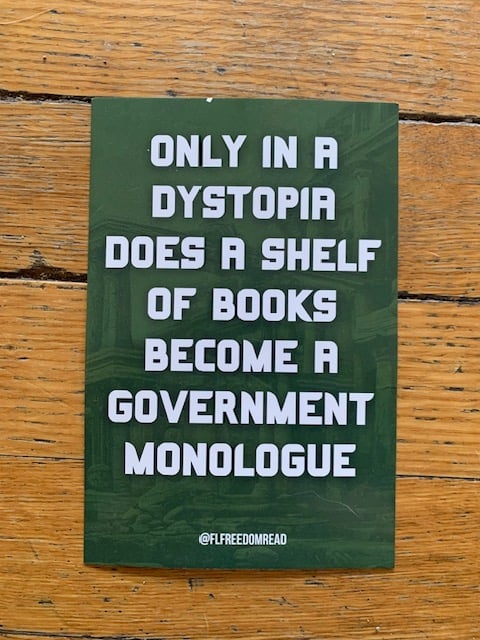
It’s not a “Florida” thing. It’s not a “Texas” thing. It’s a 21 states out of 50 thing. The government wants to dictate to half of this country's states what they can read and what they can think. They want public institutions of democracy and civic engagement to be mouthpieces of government beliefs.
What’s especially worrying about this case is that, whatever outcome may prevail in the 11th Circuit, there is the opportunity for this case to then be appealed to the Supreme Court. The Supreme Court denied a hearing to Little vs. Llano County earlier this month, but a case on book censorship out of Florida–and one that tackles the ever-changing definitions of “sexual content”–would likely be more appealing to that bench. It’s more partisan and more attractive to the conservatives who make up more than half the court.
Hope is not entirely lost here, and there are things you can do right now that will help move the needle. First, if your state is one of the 20 who’ve filed the Amicus Brief–Arkansas, Alabama, Alaska, Georgia, Idaho, Indiana, Iowa, Kansas, Louisiana, Missouri, Montana, Nebraska, North Dakota, Ohio, Oklahoma, South Carolina, South Dakota, Tennessee, Texas, Utah, and West Virginia–write your attorneys general and tell them what you think. Make sure they know if they're elected, their jobs are on the line. If they're appointed, emphasize that they don't represent your beliefs.
The second thing to do applies to anyone in the country. Write your Congressional representatives in both the House and the Senate and tell them to support the recently reintroduced Right to Read bill. While it is a long shot that this bill will pass under the current administration, given that it could not pass under the prior one, it offers a glimmer of hope that’s desperately needed. That is especially true for those living in states like Florida or the other 20 states named above, where passing a state-level anti-book ban bill is unlikely to happen.
No one is coming to save us. We are the ones responsible for saving ourselves and saving our rights.
Now is the time to act. Free speech absolutists are doing all they can to chip away at your First Amendment Rights. The timing of this news, which falls at the end of the year during the holidays, is intentional. They want you to be too busy to notice so that they can say no one cares.
Now is the time to commit to turning the tide so that the right to read and the right to access facts and information in libraries continue to belong to us, the people. Libraries are not government mouthpieces. They belong to all of us, and we need to show up even louder and more complex than before.