
Bad Library Bills, 2026 Edition: State-Level Legislation of Concern
Alabama, Ohio, New Hampshire, and several other states already have bills targeting libraries and books on deck for 2026.
With the new year here, so, too, are the latest legislative sessions in many U.S. states. Not every state holds an annual session — Texas, for example, holds them every other year — and the rules for where and how legislators can propose new bills differ in each state. This means we don’t yet have a clear sense of what the legislation impacting libraries and the materials available in them will look like for 2026. Proposals may not be presented until sessions begin; others may not be presented until deep into those sessions. What we do know is that the cult behavior of extremist legislators means they’re eager to copycat others as opportunities arise.
There are pre-filed bills in eight different states so far that directly impact libraries and/or the materials made available in them. This is not a comprehensive list. As part of one’s due diligence in the coming year, I encourage anyone who wants to stay abreast of 2026 state-level legislation to do two things. The first is to bookmark EveryLibrary’s bill tracking page. It will update to the 2026 bills soon, if it hasn’t by the time you read this.
The second is to learn where and how your own state’s lawmaking system works and spend some time this year monitoring what’s happening. As a citizen in a democracy, it is your duty to keep an eye on bills within your own state. Be aware of when your state legislature is in session and have the contact information of your representatives handy. If you’re feeling particularly ambitious, have a few email templates ready that offer facts and statistics from research about the value and necessity of libraries, which you can include in your correspondence related to upcoming bills in your state.
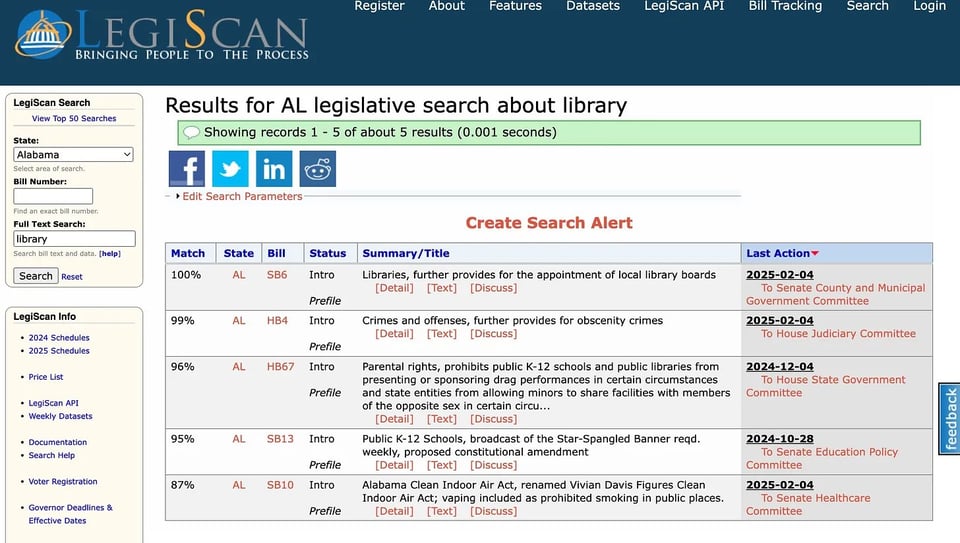
You can stay informed about state-level legislation by regularly searching LegiScan by state and keyword (I use “library” and “librarian,” but you may want to add others as well). You may need to click through the links the search serves up to ensure those bills are for the current legislative session and/or actually related to the topic of interest.
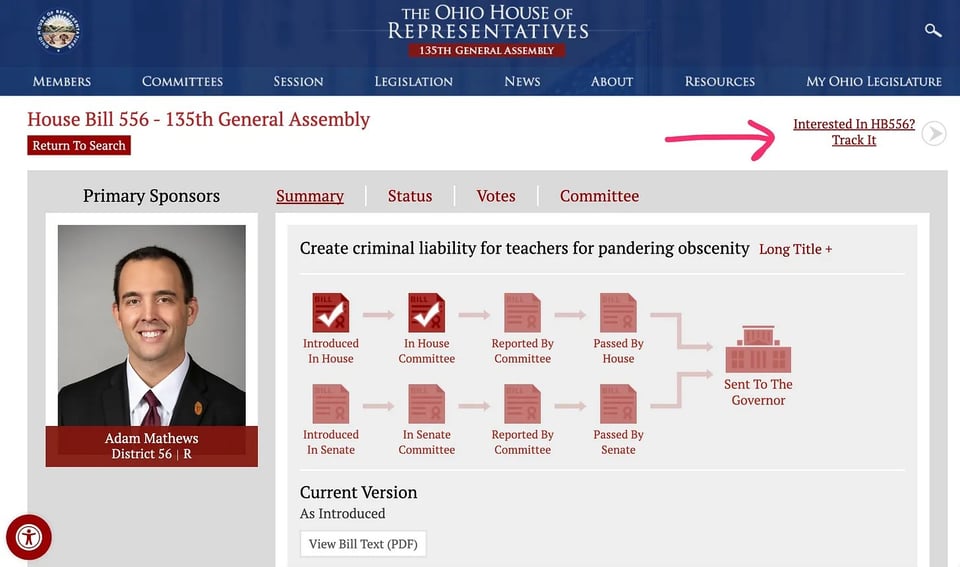
Many states offer the option to set up an RSS feed for bills of interest. Here’s what it looks like on the Ohio House of Representatives website:
Other states share the tools available for use on their websites. Here’s an example from the Iowa legislature with tons of options.
Depending on your job or your access to public or academic libraries, you may be able to find additional proprietary tracking software and apps.
What is happening so far on the state level in terms of bills that threaten the right to read and our public institutions of democracy? The “good” news is that there are fewer pre-filed this year so far when compared to last year. This is also worthy of concern, though, because it makes it harder to predict what the trendy new tactics might be in the coming year.
There are two significant factors to consider regarding why we may not be seeing many pre-filed anti-library/literary bills yet, and why it is likely that we’ll see more bills filed through the first six months of the year. First, the Fifth Circuit’s ruling in Little v. Llano County issued in May 2025 gives government officials in Louisiana, Mississippi, and Texas the authority to decide what books are available in public libraries. The ruling currently applies only to these three states. Still, as noted recently, this case is the primary basis for the state of Florida's argument in the Eleventh Circuit regarding why it can ban any books it wishes. Little v. Llano County will likely serve as justification for state lawmakers in far-right-friendly legislations both within and beyond those jurisdictions to create laws that turn libraries into government mouthpieces.
The second is that while the Institute of Museum and Library Services (IMLS) was victorious in the federal court system following the administration’s targeted dismantling of the agency, it’s still not funded for Fiscal Year 2026. Trump’s FY 2026 budget sunsetted the agency. While Congress’s markup overrode that and added funding back to the agency (at a slightly lesser amount than in 2025), the budget hasn’t actually passed yet. We’ll likely see another government shutdown when the temporary budget expires at the end of January. That would again close down the IMLS (and every federal agency) until a budget is approved. We also have to account for the fact that the budget allocated to the IMLS in 2025 was inappropriately spent on the administration’s pet propaganda projects. Where and how the IMLS stands will impact state legislation, both because it will allow legislators to try to shutter state libraries again and because it’ll be cited as justification for libraries not being essential.
Early Anti-Library, Anti-Literature Bill Proposals for 2026
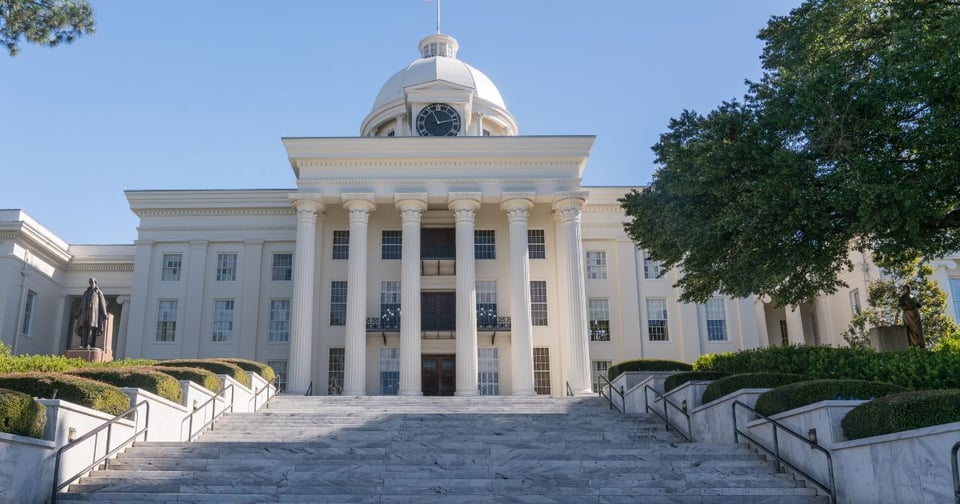
Alabama — Senate Bill 26
Introduced by Christopher Elliott, SB 26 would alter the way library boards operate in the state. As it is, public library boards are appointed by a governing body in the library’s respective city or county. SB 26 would continue this common practice, but it would give those appointing government bodies the power to instruct the library board on what to do. That is, the library board would serve at the “pleasure” of the body that appoints them, rather than serving at the will of the taxpayers or in the best interests of the library.
If the county board that appointed the library board doesn’t like gay people, guess what the library board has to do in response?
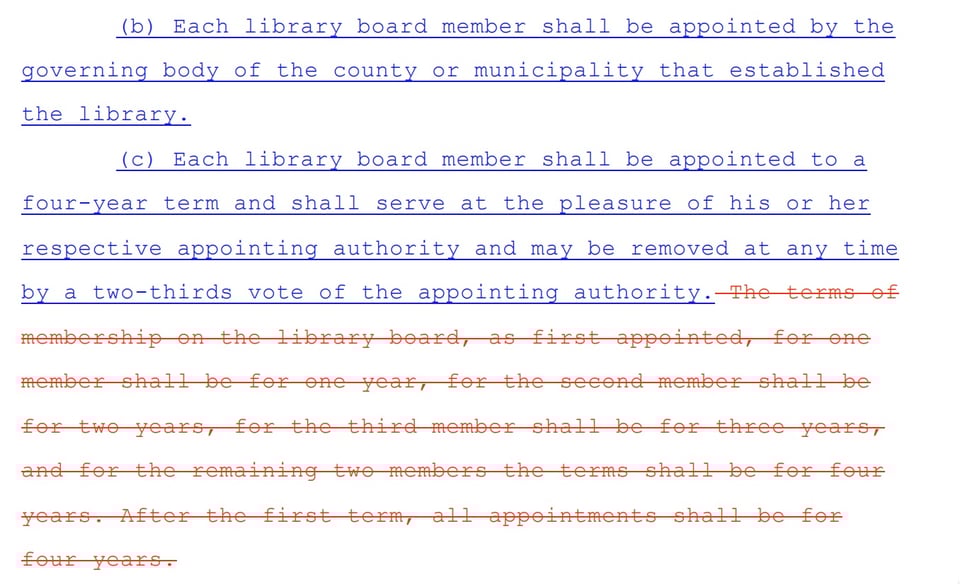
There’s a penalty here, too, for library board members who don’t follow the marching orders. They can be removed from the library board by a 2/3 vote from the same authoritarians telling them how to run the library.
Additionally, this bill would require library boards to submit an annual report to the state, detailing where and how they have reviewed and/or removed books from their collections. Recall that the Alabama Public Library Services (APLS), which oversees libraries in the state, has yanked state funds from libraries for not complying with their demands to ban LGBTQ+ books–see Fairhope Public Library. APLS passed new regulations late last year that prohibit books exploring “trans” descriptions or depictions in books for those under 18. SB 26 is a surefire way to enforce partisan mandates on local libraries.
Libraries are not the will of the current political party in charge. They belong to the people. Unfortunately, this bill would fundamentally restructure libraries to the viewpoints of whoever has the power to appoint library boards. So much for “local control.”
The first hearing for this bill is scheduled for January 13. If you’re in Alabama, you’ve got time to get the word spread about this before it’s even read.
Florida – House Bill 1119 (companion bill Senate Bill 1692)
The Florida Freedom to Read Project has done a great job summarizing this bill; rather than replicate their efforts, here’s what they’ve said.
In short, this bill is a resurrection of one that died in last year’s legislative session. School districts would no longer need to read materials in full to decide they’re against the law and need to be banned. HB 1119 is a continuation of the Florida government’s insistence that it doesn’t need to follow the federal standard for defining obscenity through the Miller Test. The 60-some words of the Miller Test repeat only one phrase, and it’s the one Florida lawmakers keep trying to destroy: “as a whole.”
As before, it serves as another reminder that the so-called claims of seeking “local control” over library materials are a lie. The state wants to decide what you and your children have access to, and with HB 1119, it aims to do so as quickly as possible.
Missouri — Senate Bill 1123
Back in 2022, Missouri passed a bill that criminalized school employees who provided students with “sexually explicit materials.” That vagueness was the point. It could apply to any book deemed “inappropriate” by a person of authority, whenever and wherever. This law was intentionally designed to create a chilling effect and slowly see books by and about queer people disappear from shelves.
The Missouri Association of School Librarians and the Missouri Library Association, with the help of the state’s ACLU, filed a lawsuit over the law. In November 2025, the bill was ruled unconstitutional.
SB 1123 is a bit of a head-scratcher, given that decision, but ultimately, it just moves the goal posts. The changes target state funding of libraries or schools that employ individuals who’ve been found guilty of providing students with materials the state doesn’t like. Rather than explicitly targeting teachers or librarians, this goes above them, threatening the institutions themselves with defunding. This seeks to accomplish two things simultaneously: create a chilling effect and harm the institutions. The second’s been the higher-level goal all along, of course. There’s money to be made in privatizing libraries and certainly in school voucher schemes.
These provisions are also a covert attempt at employment discrimination. The right has made library workers and educators who believe in diversity, equity, and inclusion into caricatures. If schools and libraries are fearful of losing state funding because of this bill, what do they do when they ask a candidate if they believe all young people deserve representation, and that candidate is an emphatic yes?
This bill has been introduced twice previously. We’ll see if it gets legs this year. If anything, it sounds like there’s an assumption that the state will be appealing the court’s ruling from November, so it’s worth pursuing again.
Missouri — Senate Bill 1280
Perhaps the updates being proposed for SB 26 make more sense in context with this bill. After all, it would permit school employees, school board members, and librarians to be sued for not properly censoring content accessible to minors via digital catalogs (in schools) and public access computers (in public libraries).
This is a deeply concerning bill, and, were there a theme emerging from the landscape of bad bills at this point, it’s this: states want to censor digital catalogs and materials provided by schools and libraries.
Missouri’s bill would require parents have full access to “electronic database[s], application[s], or website[s] that [list] or [provide] resources or materials, including, but not limited to, books, electronic books, periodicals, and multimedia content, including, but not limited to, images, audio, and videos.” Every public and character school district would be required to have someone in charge of “excluding from the digital library catalog any resource or material that is "explicit sexual material" or "pornographic for minors.” This person wouldn’t be allowed anonymity, either — their identity and place of work would be made available upon request.
Like the bill in Idaho, where parents are allowed to sue librarians for making available materials they deem inappropriate to minors, SB 1280 would allow any parent in a district to sue “for intentionally or negligently violating the act.”
As it applies to public libraries, SB 1280 would require that any computer in a public library have software installed that restricts materials for minors deemed "pornographic for minors or explicit sexual material". We don’t need to imagine what this looks like. Anything the right considers “inappropriate,” including puberty books and books on so-called “gender ideology,” would be lumped under these categories.
It is KOSA on the local level.
New Hampshire — House Bill 1214
Republicans in New Hampshire racked up a lot of Ls last year. They didn’t manage to close their state library, which is the oldest in the nation. They also didn’t pass a bill that would ban books and criminalize library workers, thanks to the governor’s veto–and despite trying to revive the bill at the end of 2025, they failed again.
On deck for 2026 is a bill that’s little more than a partisan conspiracy theory intended to harm librarianship as a profession further. HB 1214 would ban the state librarian from providing scholarships to students who wish to attend library school accredited by the American Library Association (ALA). That’s the whole bill. It’s a single sentence long.
The ALA has been a constant target of the conspiratorial right, and this bill plays right into it. Library science/study programs are Master’s level programs that equip individuals with the skills, knowledge, philosophy, and background necessary to succeed in the information industry. While there are programs not accredited by the ALA, it is those accredited programs that are taken seriously enough and rigorous enough to prepare students for the field. ALA accreditation is a lengthy process.
This bill not only plays into the conspiracies about a legitimate professional association. It also strips a small power away from New Hampshire’s highest-level librarian. Recall that at the end of 2024, it was New Hampshire conservatives who forced then-Governor Sununu to withdraw his appointment for state librarian because she was involved in the state library association … and the ALA.
Imagine if this time and energy were being spent on solving actual problems.
Of note: the New Hampshire House has passed Senate Bill 33. It’s a wide-ranging censorship bill targeting not only books, but also webpages, videos, artwork, performances, and more. It’s not a guarantee this will go further than the House passage, especially given the history of other censorship bills in the state over the last couple of years. But this is a call to action for anyone in New Hampshire to get loud and stay loud.
Oklahoma – House Bill 2978
This one’s a pretty straightforward book ban bill. School libraries would be prohibited from purchasing “obscene” materials for the collection. Not only are there no such thing as obscene materials in school libraries, this bill is one that purposefully erases the part of the current law where school library materials “be reflective of the community standards for the population the library media center serves.”
Library materials now must reflect whatever the party in charge believes is not “obscene” now.
Ohio — House Bill 583
Where Missouri’s digital materials censorship bill forces schools to become censors, Ohio’s bill would put the onus on vendors to censor any materials deemed “obscene” or “harmful to minors” before they could be used. Database providers who fail to comply will risk losing their contracts and may be required to reimburse school districts.
Again: vague definitions are the point. This is an on-ramp to removing access to any books by or about LGBTQ+ people under the banner of “obscene” or “harmful to minors.” The state could also easily file content on gender under “depicting child sexual exploitation,” a third category of content that database vendors must remove. Such labeling would not only play into partisan politics on the right, but it would also give those same people additional opportunities to justify further discrimination of queer people from public life.
This bill will reduce the number of options available to public school students for finding reputable information. Databases provide research that is often vetted and peer-reviewed; it is the kind of information that those who “do their own research” eschew in favor of conspiracy theories discoverable via Google or what’s trending via social media algorithms. It’s only fitting that this bill would suggest it’s databases peddling pornography to children in schools. That could not be further from the reality of what students are using school databases for.
Targeting digital content provided by educational institutions is an attack on facts and information. It’s an attack on student learning, and it’s an attack on educators whose job depends on teaching students how to navigate a continually evolving information landscape.
Laws like this make shoving Artificial Intelligence into schools and libraries uncritically and unthoughtfully so much easier, and it makes those who are forced to use AI swallow it down while tech billionaires, via their far-right loyalists, take over public institutions of democracy.
Database providers will need to decide whether they comply with these requirements. If they do, they’ll roll out censored content to all of the states because that’s the only fiscally responsible way to do it. Database providers who don’t comply will lose untold amounts of money from states like Ohio in lost contracts.
But, as always, it’ll be students who lose the most. This breeds educational inequity, further allowing voucher schemes to step in and dismantle public schools. It’ll also lead to more stories like this one from Oklahoma, where whatever a student says must be accepted as appropriate and laudable, or the educator loses their career.
This law is perhaps one that can be compared to the vendor ratings system demanded via the Texas READER Act. In October 2025, a federal judge ruled this provision of the state law unconstitutional.
Utah – House Bill 197
At least one member of Utah’s legislature is cozy with the folks behind Rated Books, so it was only a matter of time before such a system would be seen as worthy of being incorporated into a bill related to school library books. It’s now here.
HB 197 would require that every Local Education Agency in the state:
[C]ontract with one established book reviewer to provide a service to an LEA that:
(i)identifies relevant page numbers and excerpts that potentially contain sensitivematerial; and
(ii)uses technology, including artificial intelligence assisted analysis, to screen the instructional materials described in Subsection (8)(e)(i) for violations of this section.
There’s a reason Rated Books wanted to create the National Book Review Index and make it a subscription-based service. It’s because they want to be able to sell their product to become a preferred vendor for the state when it comes to book reviews that cherry-pick passages deemed inappropriate by partisan interests. Similar to the Florida bill above, Utah’s bill completely disregards the Miller Test in favor of its own definitions of what is or is not appropriate.
HB 197 also includes additional regulations. Among them:
[U]se the list described in Subsection (8)(d) as a reference tool when reviewing library materials or instructional materials the LEA maintains;
(c)provide training to each school on how to utilize the artificial intelligence tool thestate board procures under Subsection (8)(e);
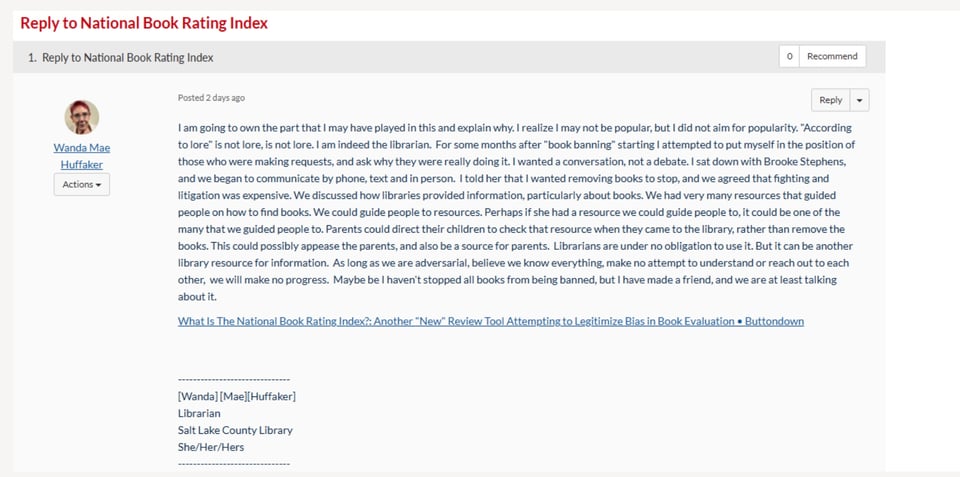
Professional library workers would have to use the “tool” developed by non-professionals to perform their job, and they would also need to know how to utilize any AI developed for this purpose. This further deprofessionalizes librarianship and opens up the opportunity to eliminate those jobs altogether via AI. In other words, school library workers become tools of the “parental rights” groups in the state. I hope that’s what the librarian who advocated for the National Book Review Index had in mind when she asked the group for such a tool.^
From a practical perspective, this one’s a head scratcher because, as much as Rated Books has done a lot of naughty books reports, it’s but a fraction of a fraction of the books available for purchase, and it’s not forward-looking. They are reviewing older books. They do not review books that will be hitting shelves in the future. So not only would library workers be stuck choosing materials that Rated Books selects to review–and recall that for several months, they reviewed primarily romance books published for adults!–they wouldn’t have current or updated collections because who knows when they would get around to reviewing books published in 2026.
There’s a reason professional review resources exist for library workers. It’s because they understand how libraries operate and how the publishing industry works.
HB 197 also has a digital materials component (see bills for Missouri and Ohio), and then there’s this part:
(1)As used in this section, "academically rigorous" means content that meaningfully advances core academic standards by requiring sustained comprehension, analysis, andsubject-matter learning beyond materials intended primarily for entertainment.
(2)An LEA shall require a school within the LEA to:
(a)prioritize the acquisition and accessibility of academically rigorous books including primary sources and scholarly works focused on:
(i)United States history; and
(ii)Utah history;
(b)maintain a collection of biographies on the founders and other historically influential figures who have shaped the course of United States and Utah history;
(c)when choosing textbooks and curriculum, prioritize alignment with state standards;and
(d)adopt a policy on the procurement of school library materials and resources that is designed to acquire academically rigorous school materials including the materials described in Subsections (2)(a) and (2)(b).
There will be no “fun” books in school libraries, and there will be a wide range of books on “the founders” and “other historically influential figures,” easily accessible from right-leaning outlets like Heroes of Liberty. How easily it will be for “parents” to complain about the history and/or the foundational figures included in library collections now, based on their political views. Indeed, we know there wouldn’t be history as told from the voices of those marginalized or harmed by the actions of white settlers and white supremacy. Not only is that DEI/critical race theory. It’s also likely not in whatever the ratings database is; if it is, it's probably labeled as “indoctrination.”
Children in Utah public schools will be subject to the whims of “parental rights” groups. They will not receive a broad education, nor will they have access to librarians in their schools who can cater to their interests. Those librarians will be working to meet the letter of the law instead.
We’ve also seen how well the use of AI has gone for book banning. The right is obsessed with this technology and using it to ban books because that means they don’t have to actually do any work.
Wyoming — House Bill 10
Though the bill seemed like it might not make forward progress last summer, guess what’s back?
You can read about this dangerous, censorious bill in full here. In short, HB 10 would require that public and public school libraries certify that their collections accessible to those under the age of 18 have no “sexually explicit” materials. Libraries and schools would be liable if such materials were in their collections, with a significant fine for each violation.+ Anyone would be allowed to claim there are “sexually explicit” materials in the collection and thus begin the process of suing those institutions.
The bill’s language, paired with the stiff financial penalties, would effectively remove the young adult section from every public library and public school library in the state. It would put tremendous pressure on library workers to figure out what is meant by “sexually explicit,” even with what are themselves explicit descriptions in the bill. If even one or two books were deemed illegal, it would also bankrupt just about every library or school in the state.
Laws like these are not only about gratifying the genital obsessed party’s weird fixation on sex as it relates to minors. They’re also about financial ruin for public institutions of democracy and civic engagement. These politicians and party sycophants seek the opportunity to create a deeper divide between the haves and the have-nots, and they aim to establish similar institutions that are privatized, allowing them to profit.
I’ve already covered what this means in states like Wyoming, where the gulf between the working-class Wyoming resident and those who own pricey vacation homes on a chunk of land is growing. Wyoming is gutting its tax-supported public goods by eliminating taxes altogether.
Another concerning bill on the docket? Indiana’s House Bill 1086. This would require that the 10 Commandments be displayed not only in each public school classroom. It would also require that they be displayed in every public school library. A Texas law requiring public school classrooms to display the 10 Commandments was blocked in November 2025, as was a similar law in Arkansas in August 2025.

A Note of Hope
There haven’t been many positive library bills pre-filed at the state level. The reasons for this are essentially the same as those for destructive bills.
In good news, though, the year begins with three states proposing anti-book-ban/freedom-to-read bills. Those states, Massachusetts, New Hampshire, and Pennsylvania, would join 13 other states in preserving the right to read in state law.*
Anti-book ban laws vary in their power, and they’re only as good as they’re enforced. The good news is that states like Maryland, which passed its bill in May 2024, have become leaders in using the bill to curtail book bans. Other states, including California and Minnesota, have continued to see bans in the years following the implementation of their laws, and they should follow suit.
If you live in Massachusetts, New Hampshire, or Pennsylvania, here’s how you can get involved in passing those bills. If you live in a state without a right-to-read bill and/or you’re interested in learning how to get the ball rolling on something similar in your own state, hopefully this can be helpful for you, too.
And for anyone, regardless of where you live in the U.S., don’t forget that we have the possibility for preserving the right to read at the federal level right now, too. Write your Congressional representatives in both the House and the Senate and tell them to support the recently reintroduced Right to Read bill. While it is a long shot that this bill will pass under the current administration, given that it could not pass under the prior one, it offers a glimmer of hope that’s desperately needed. That is especially true for those living in states like Florida or the 20 states that’ve publicly submitted their support of library censorship, where passing a state-level anti-book ban bill is unlikely to happen.
Notes:
+The original bill set this fine at $50,000 per violation. This has since been downgraded to $500, which is still an absurd amount of money.
^She is real, and worse, she’s involved in the American Library Association’s Intellectual Freedom Round Table. This is why “libraries are neutral” is inappropriate. It undermines what libraries are–pro-library in every respect–and it throws the work of people who’ve been actually fighting book censorship under the bus.
*This would be 14 states, but New Yorkers should know that Governor Kathy Hochul, who had a freedom to read bill sitting on her desk for months, vetoed the bill over the holidays. Quite good timing, as those who’ve been fighting for this one were likely too busy with the rest of their lives to notice.