the university of hope and the video game fixation of despair
Apparently I haven’t send an email in five months! A lot has happened in that time, so obviously I’m going to ignore all of it and talk about an old video game.
First, some context: In about 2013, beloved friend Kassie said something to the effect of “Hey, you should read this let’s play translation of this weird Japanese murder mystery game.” I duly did, and then I started reading the as-yet-incomplete let’s play translation of the sequel, at which point I became acutely insane about it. I remained insane about it for approximately one year, and then moved on, as is my wont. Sometime after the frenzy had died down, the game got an official English translation. But I was over it, right? So I never actually played it.
Fast forward more than a decade: It is 2026 and we have just bought a condo while the world continues to fall apart at speed. I am exhausted and deranged in a way that I haven’t been since – guess when! And what was I doing around that time? Why, I was reading a game translation that made me feel literally anything other than weariness and dread. And now that game is old, cheap, and playable on a console that I have. And so is its sequel. A perfect storm!
This all sounds totally fine until you realise I’m talking about Danganronpa.
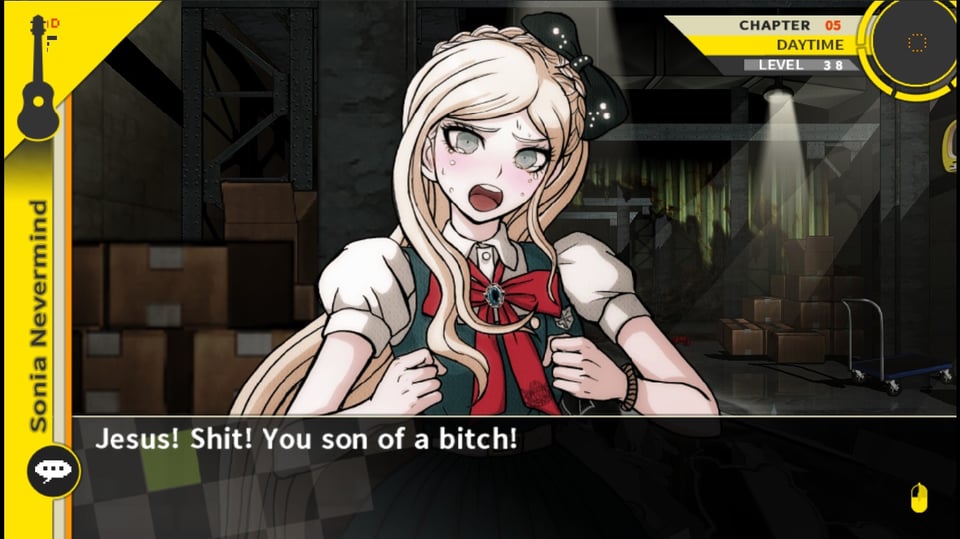
If you were on the internet in the 2010s, you probably remember Danganronpa – or, as I knew it then, “Dangan Ronpa”. This is because its fandom was one of the more insufferable pockets of vintage Tumblr. Maybe I’m overstating its importance; there’s an equation in there somewhere, something to do with time passed multiplied by latent shame. But it was heinous, and for a little while it was pretty omnipresent. I have never looked back on my fondness for the let’s play proudly.
Unfortunately, the games still fuck. Let me explain.
In Danganronpa (the first one, which has bafflingly acquired the English subtitle “Trigger Happy Havoc” in translation), you are an ordinary high school student who won a lottery to attend a school for ultra-talented geniuses. Talent, in Danganronpa, is intrinsic and quantifiable. It is possible to be the best at anything, from swimming to gang leadership to obnoxious hall monitor behaviour. Your talent, having been selected by lottery to attend a school that functionally guarantees its graduates an illustrious future, is good luck.
The second you step into your new school life, things get weird. Before you know it, you’re locked in the school under the custody of a weird robot bear (with Doraemon’s voice!) who pits you and your classmates against each other in a sort of slow-motion, extremely psychological battle royale. If you kill another student and get away with it, you get to leave! But if you get caught – and your classmates will always have the chance to try to identify the killer after the fact – you die. And if your classmates fail to catch you, they die. Needless to say, nobody but the robot bear is having a good time.
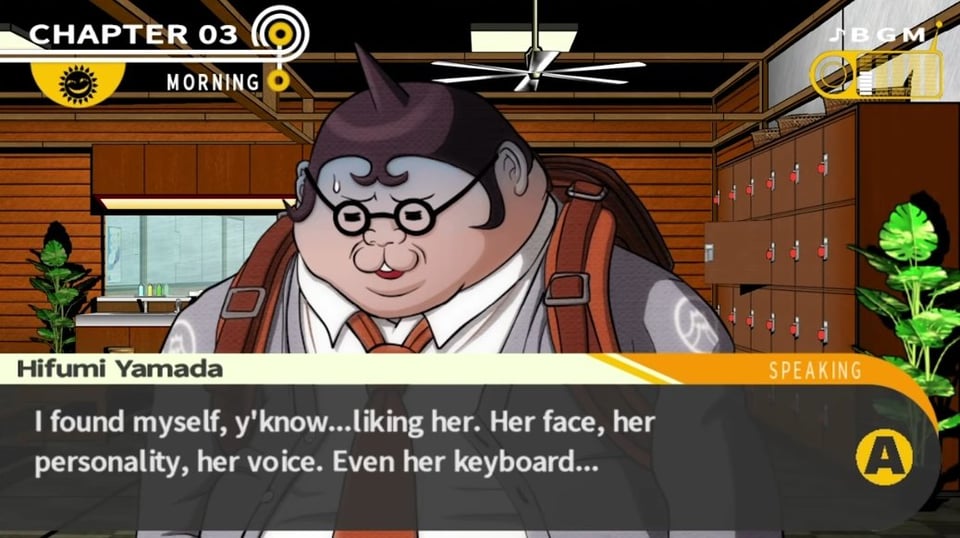
Danganronpa 1 is both a hideous gonzo spectacle of teen-on-teen ultraviolence and a smart, satisfying mystery game. The ugliness is part of the point: It forces you to confront what you’re participating in at every step. Of course, as your classmates start dying and the stakes of your situation mount, you start to learn that all is not what it seems! But ultimately, you and your classmates come together and bring your unique skills to bear against the person masterminding your torment. It’s not quite a happy ending, but it is a victory you feel you have earned.
Danganronpa 2 takes every premise the first game establishes, then smashes it all on the ground while holding your gaze and smiling.
You thought your fancy school for talented kids was a good place worth protecting? Surprise – they weren’t just exploiting you, they were trading on their reputation to sucker regular kids into handing over huge sums of money. You thought talent was what made a character worthy of inclusion in the story? Surprise (and spoiler alert) – not only has your new player character been a normie the whole time, his misery about it has led him to make some really bad choices. And that’s just the start! Digging more deeply into what the sequel does to the original would bring me into game-breaking spoiler territory. But this was what set my brain on fire in 2013. The original is a great game. The sequel is a thesis statement on systemic exploitation in elite education, and unfortunately, I am still not over it.
Long-time Waverly enthusiasts will know that I got my undergraduate degree at a very fancy school.
When I was about seven years old, a teacher said cheerfully to me: “I want Oxford or Cambridge for you, please!” (Even as a child, I was a regrettably goal-oriented set of processes.) At about eleven, I read Pullman’s His Dark Materials and fell in love with his vision of Oxford – its waterways and rooftops, its streets filled with scholars and spies. By fourteen, I was researching colleges and comparing English courses across the two universities. At sixteen, I visited Cambridge for the first time. I pictured myself, older and wiser, studying tragedy in a college garden dappled with flowers. My parents drove me through freezing rain to my interviews. I remember poring over a poem in a tower room I never found again; I remember the smell of dust and lignin, the roof beams and the warped window glass.
I cried when I got the news that I’d secured my place. Later that day, we drove up to my high school to collect my exam results. My English teacher hugged me; the local newspaper took a photo of the Oxbridge cohort, smiles on our faces, envelopes in our hands. It was a whirlwind of congratulations. When it finally set me down on our driveway again, quiet at last after all the frenzy of the morning, I looked down at my envelope and thought: What do you mean, I don’t get to stop here?
Somewhere along the way, I had crossed some wires. I had exhausted myself just getting to the starting line; I had confused achievement with finality, reward with respite. I forgot that being chosen meant having to stay chosen, and to prove every day that the right choice had been made.
My first week in my student bedroom, I slept more than ten hours a day – never at the right time. By the midpoint of my first term I had dropped two dress sizes. I saw a doctor, got on the pill for some reason, and did not improve. My essays hovered around a 2.1 (that’s British for “good but not great”) all year; I tore myself to shreds about it, horrified that I wasn’t living up to the potential they had seen in me. My Director of Studies seemed less and less interested at every progress meeting. I finished out my first year desolate and crushed with disappointment – in myself, in the way it had all turned out. What did I have to show for the person I had been when I still had it in me to try?
It got worse. In my second year I briefly saw a therapist who handed me some CBT workbooks and told me to monitor my mood. I barely went to a single lecture. There was a glimmer of hope toward the end of the year, when we started work on middle English literature and my new supervisor told me my ideas were great; it was summarily crushed when I worked with her to develop those ideas and she decided that, actually, I wasn’t trying hard enough. In my third year we worked together again, this time on a full dissertation, and – look, you get the idea. It was bad. I wrote a text adventure game about how bad it was. My classicist friend ended up making sure my dissertation was fit for purpose, because I couldn’t be in the same room as my supervisor by the halfway point of the project. I am skimming the surface in part out of self-defence. I don’t think my dignity can stand any more strictly autobiographical Cambridge deep-dives, twelve years on from graduation.
Here’s what haunts me, though. I was briefly on the college’s student governing body, and during a fit of righteous misery I pitched to my colleagues the idea of working toward better student mental healthcare. The proposal unlocked something awful in the room, and in everyone in it. The meeting turned into a sort of Academics Anonymous session, in which everyone had a horror story to share. Someone’s director of studies had been blowing off their meetings for weeks. Someone else had been drinking alone in her room most evenings since term began. Someone else had an uncomfortable number of friends who simply weren’t eating.
It was endemic. We all knew. And because of the strength of the brand – the insurmountable idea that we ought to be fine, because everyone else was fine, because we were the chosen few who made it this far – we all believed that our little circles were the only ones suffering.
The antagonist of Danganronpa is depression.
Not literally, but honestly, close enough. In both games, your enemy is the personification of despair. And despair doesn’t necessarily need to lie to you. It just needs to tell you the awful truth of where you are, what’s happening to you, and what you’re going to become.
Which is to say, in a sense, that the antagonist of Danganronpa is you. It’s the choices you’ve made to get here and the way they’ve locked you in; it’s the weakness and fear and learned helplessness that makes it impossible to see a way out. You beat Danganronpa 2 by gaining the ability to see your situation for what it is – a series of broken systems, a game you didn’t realise you were playing – and opt out of it altogether. You can’t make it go away, necessarily, but you can get yourself out in one piece. You can at least believe in yourself enough to try.
I saw a way out, I think, when I realised I wasn’t alone. There wasn’t really a point at which the experience got better. There was, however, a point at which I decided that it didn’t matter. I might never meet the standard I’d learned to hold myself to. I might never win my supervisor’s approval, and I might never be happy with how those three years went. But I would get through it, and I would live.
Which I suppose I did! I have lived long enough to play the games through for Isaac, because the best way to deal with derangement is to share it.
I am still not proud of the way I feel about this game, but I am glad to have rediscovered it. Thank you for indulging me in this departure from my usual subject matter, not that I’m even sure what that is anymore. I promise I will write about the condo at some point, I guess?
xoxo
W
Add a comment: