
Forever on Our Mind: Tell Me It's Going to Be Okay
Coming to terms with the wreckage of the Eagle Creek Fire—and finding a little hope in the ashes
196. Tell Me It's Going to Be Okay
July 2018:
Nearly 10 months ago, almost to the day, a teenager tossed illegal fireworks into the canyon surrounding Eagle Creek—one of which sparked the Eagle Creek Fire. The conflagration would go on to burn 50,000 acres—an area larger than Washington, D.C.—and forever alter the landscape, ecology, and soul of Oregon’s Columbia River Gorge.
One week later, with the fire still raging, I spent a drizzly Saturday night seeing Michael Franti & Spearhead at McMenamins Edgefield, an outdoor concert venue at the doorstep to the Gorge and about 30 miles west of where the blaze began. When rain began to fall midway through Franti’s spirited set, I wasn’t sure whether it was accompanied by falling ash—clouds of which had reached Portland and blanketed cars soon after the fire broke out.
At one point between songs, Franti paused to thank the first responders working to save Cascade Locks—a community of about 1,500 that was evacuated soon after the fire broke out—and protect the natural spaces that had brought enormous joy to millions from around the world.
Half listening, I reflected on my own relationship with the Gorge.
I learned to love hiking on Angel’s Rest and eventually notched hundreds of miles on the region’s trails. For years, friends and I patronized brewpub patios in the likes of Hood River and Cascade Locks. I adored driving the Historic Columbia River Highway and Interstate 84 every autumn, admiring the technicolor foliage that was bright enough to nearly render headlights unnecessary on drives after dusk.
All those memories and more came flooding back in the midst of Franti’s soliloquy—rousting my first tears since the Eagle Creek Fire began.
They wouldn’t be my last, and I reset the mental “Days Since Matt Cried About the Eagle Creek Fire” counter soon after stepping out of my car and onto the trail to Dry Creek Falls on this sunny July Sunday.
Officially, I’m here—just two miles from where the blaze began—to research an Oregon hiking guidebook that I’m in the midst of writing. I signed the contract a little more than three months ago, back when it seemed like “No Trespassing” signs might replace trailhead maps across the Gorge for years to come. Miraculously, however, volunteers worked tirelessly to reopen a few trails since then—including this slice of the Pacific Crest Trail and a short offshoot to Dry Creek Falls, which tumbles about 75 feet and is ringed by an amphitheater of columnar basalt.
I’m torn about whether I should even be here. On one hand, the Gorge is historically one of the most beautiful places on Earth—a playground of trees that stretch to the sky, meadows covered in dazzling wildflowers, waterfalls thundering over rocky shelves, and viewpoints that seem to reach the ends of the Earth.
On the other hand, portions of the Eagle Creek Fire were found still smoldering not five weeks ago; should I really send people into this? And what am I sending them into, anyway?
I guess that’s why I’m here.
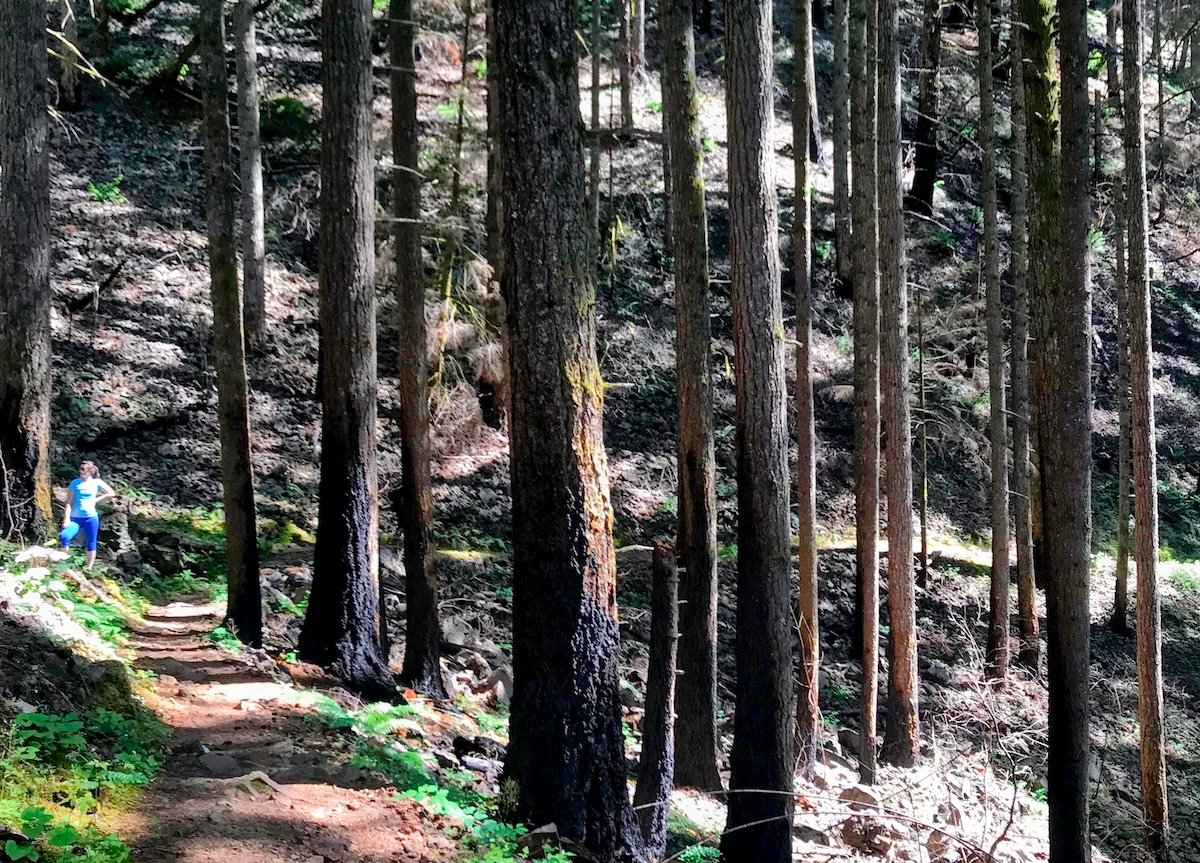
Almost immediately after stepping onto the trail, I walk into a dystopian hellscape. Charred trees line the path. Fallen trunks splay out around me like a jumble of Pick Up Sticks. Stubborn, rust-colored clumps of fir needles never got the message that they should have fallen by now. It’s every bit the graveyard I envisioned when my editor and I debated whether to include the hike.
Just as remarkable is what it feels like. It’s like the fire took more than plants and trees; it sucked the color and life out of this once-vibrant forest. It took the character, the resolve, the will to regrow. Even on this sunny day, everything’s cloaked in shadow. Everything seems so dead.
Well, almost everything.
Until the Eagle Creek Fire started spreading last September, I’d always believed that wildfires were bad, full stop, case closed, end of story. But as firefighters made progress and the fall’s first rains arrived, I became obsessed with learning about wildfires as a natural phenomenon. I pitched editors on stories about the fire and what it meant for our environment, and I interviewed experts and scientists to figure out what the future of the Gorge looked like in the most literal sense.
Officially, I was writing about a topic of interest to outdoor enthusiasts. But deep down, I needed to believe that something beautiful could rise from the ashes of something so heartbreaking.
For months, I’ve seen the videos on Instagram and photos on news sites—and they’re nothing short of apocalyptic. I saw my favorite outdoor spaces going up in smoke, and I got dizzy thinking about how one small firework could ruin all that forever. Working on those stories, all I wanted was for someone smarter to tell me that it’s going to be okay. I needed someone to remind me that this, too, shall pass. That this hurt won’t last forever.
The experts reassured me—but not in a way I expected.
To a person, they insisted that wildfire is an essential part of a forest’s natural lifecycle. (Ideally, it wouldn’t be caused by a careless teenager—but still.) What I enjoyed wasn’t the Gorge as it always had been, a canyon encased in amber, but the Gorge at a blinking moment in time. Before the fire, I had about 10 good years with the Gorge—almost no time at all in a life cycle that began thousands of years ago and will continue long after I’m gone, with or without the Eagle Creek Fire. The fire-scarred forest is not good or bad, they reminded me, just different.
They talked about mosaic-like burn patterns and how wildfires didn’t eviscerate whole forests in one fell swoop. Fallen snags provide shelter for mice, rats, and squirrels. Those critters attract eagles, falcons, and other birds of prey whose droppings spread seeds—creating brand-new forest floors covered in vibrant wildflower blooms. In time, songbirds will build nests in the snags and drown out the nearby Interstate 84 with their melodic chatter.
Hiking further into the forest, if I squint hard enough, I start to see what they mean.
Verdant ferns still reach my thighs, just as they always have. The season’s first raspberries are coming in, and their thorns are as sharp as ever. (My scraped-up calves will attest to that.) A few clumps of untouched vine maple wait patiently to turn yellow and orange this autumn. A woodpecker, with its machine gun-like cadence, bores into a trunk off in the distance. And the trees, however burned their trunks may be, still gleam a bright green if I stop, look up, and take a moment to notice the canopy.
I’ve spent 10 months grieving the forests that will only ever live on as smoldering embers in my soul, unable to accept that the Gorge I knew is gone—or that a new forest is growing in its place. More times than I can count, I’ve wished for just one more hike that begins in wildflower blooms or ends at the base of its waterfalls. I’ve pined for one more summertime wade through Oneonta Gorge. I’ve wished for another PB&J on the summit of Angel’s Rest and a cotton-candy sunset following the triumphant drive home.
I don't know how much of that I’ll ever get back—or how life will look when the paintbrush and tiger lilies make their triumphant returns. A few tears fall alongside the sweat that’s building on my brow. I’m stricken by all the devastation, heartened by what’s still here, and curious about how much different this may look next July—or the July after that. I remind myself to accept what happened and appreciate what survived—because if these Douglas firs can handle a wildfire that torched 50,000 acres, why can’t I harbor a little hope for the future?
I’m not sure what next July may hold or how I’ll feel when it arrives. But, here and now, I know this: The Gorge is alive.
Thanks for reading! If you’re not already a subscriber, learn more about “Forever on Our Mind: 1,859 Love Letters to Oregon” and click the button below to subscribe to this weekly email:
Subscribe now