
Forever on Our Mind: Mingling With Ghosts at Kam Wah Chung
Reckoning with Oregon's past—and celebrating its resilient communities
106. Mingling With Ghosts at Kam Wah Chung
May 2022:
In the late 1800s, the two largest Chinatowns in the United States were in San Francisco and Portland. But what about the country’s third-largest Chinatown?
It was in, of all places, John Day, Oregon.
Today, John Day sits surrounded by fossil beds and its namesake national monument, wheat fields, cattle ranches, and countless outdoor opportunities. In the mid- to late 1800s, though, some 2,000 Chinese immigrants arrived in John Day and nearby Canyon City to get in on its feverish gold rush and flourishing mining industry. The beating heart of that community was the Kam Wah Chung & Co. building, run by Ing “Doc” Hay and Lung On.
My then-girlfriend and I arrive on an overcast Saturday to learn about this slice of Oregon history while touring the Kam Wah Chung State Heritage Site in John Day—and to grapple with the ghosts of Oregon’s past.
Kam Wah Chung (translated as “golden flower of prosperity”) was built in 1865, not long after the ink had dried on Oregon’s state constitution. With its founding in 1859, Oregon wrestled with racism in some pretty grim ways. Slavery was prohibited, but Black citizens could not live, work, or own property within the state. In 1862, the Oregon Legislature passed a law taxing Black, Chinese, and Hawaiian Oregonians $5 per year for being Black, Chinese, or Hawaiian in the state. And despite a sizable Chinese population in the John Day area, an arsonist purportedly burned down an immigrant settlement in nearby Canyon City in 1885.
Given that fraught and shameful history, I’m curious how a close-knit Chinese community survived and thrived in the remote Oregon outpost.
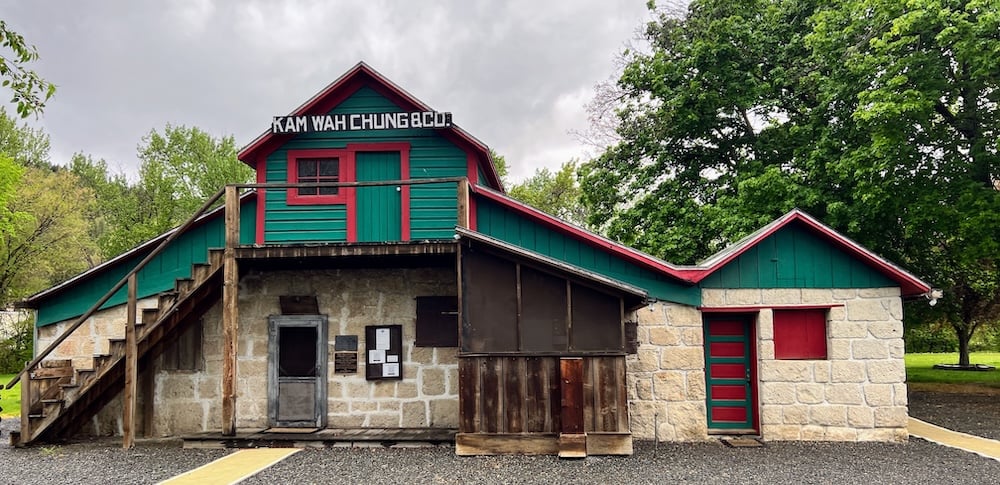
Even before our tour group steps inside Kam Wah Chung & Co., I realize that “thrive” might be a stretch. The outside of the two-story building looks like two structures stacked atop each other, which it essentially is: The bottom floor was built from stone, and the haphazard top-floor addition was erected to host weary travelers (but ultimately never used). As we survey the building, the tour guide directs our attention to an iron sheet covering one of the windows. As she explains, Hay and On covered the building’s windows and doors every night to prevent drunk cowboys and miners from shooting out the windows.
A whiff of cheap-motel stuffiness fills the air as we walk into the barely-touched building, which served as a general store, bunkhouse, doctor’s office, gambling den, post office, house of worship, and sleeping quarters for the co-owners—apparently all at once. How they managed to squeeze so much into a building no larger than my first apartment, I cannot fathom. Airplane cabins are less cramped.
That stuffiness feels intentional, given the Kam Wah Chung building’s forgotten past. Hay’s declining health led him to board up the building in 1948; he expected a quick recovery but never returned and passed away in 1952. After having served John Day for roughly 60 years at the time of its closure, the Kam Wah Chung building sat mostly untouched for more than two decades. When officials first inspected the site in the 1970s, it looked almost exactly as it had when Hay left for what would be the final time.
A faded, torn plush chair—the same chair in which Hay diagnosed weary patients—remains just inside the door. The ratty armchair, its washed-out maroon hues hiding under decades of dust and disrepair, wouldn’t look out of place in a small-town arthouse theater.
Beyond the chair, Hay’s pharmacy remains behind iron bars. Here the doctor chose from 500 herbs in determining treatment for all kinds of ailments. Dust-covered boxes, jars, cans, tins, and bottles line the shelves, each bearing a Chinese inscription. Upon discovering the site, researchers found one jar labeled “dragon bones”; tests revealed the contents were actually ground-up dinosaur bones from near present-day Beijing. A clear jar contains a rattlesnake immersed in rice wine. A bear paw sits on the counter, surrounded by a knife and a dozen or so containers the size of airplane liquor bottles.
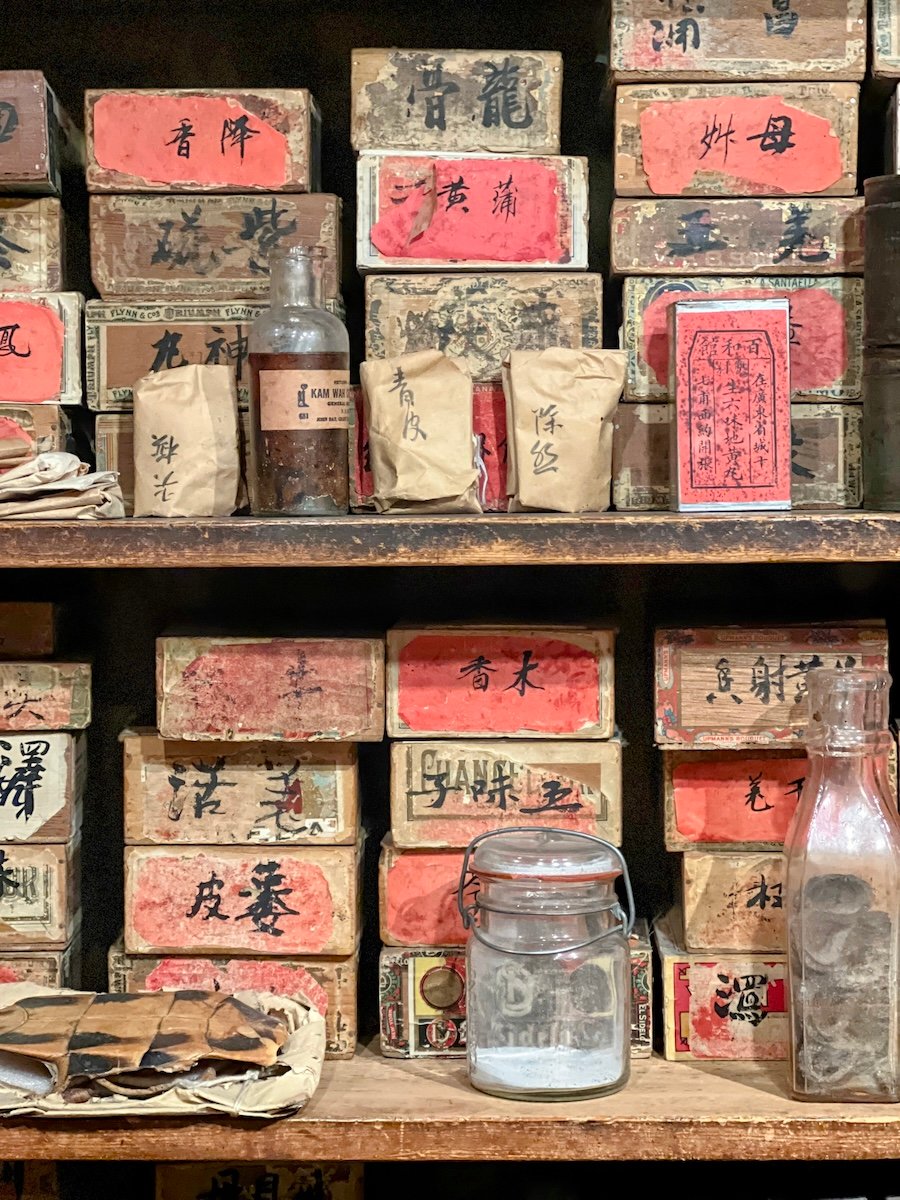
Every inch of the claustrophobic building is crammed with well-preserved artifacts of a bygone era. A phonograph, through which Chinese opera once played, sits on one chair. A harp-like string instrument is next to the general store window where On sold goods imported from China. Old calendars, dating back to the 1920s, hang on the wall above Hay’s plush chair.
Most museums require a leap of faith when trying to picture the era it documents; here in Kam Wah Chung, the artifacts leave nothing to the imagination. Every step or shift in weight elicits a groan from ghosts in the floorboards; every vial, box, and jar hints at healing an unhealthy community; and a few stray light bulbs dangle from the ceiling, shedding light on a history that could have remained forever in the dark.
I take a few photos of the building’s restored exterior once our tour ends. Even outside, I remain engaged in a staring contest with a slice of Oregon history. The iron sheet over the window takes on a dull sheen in the shade, and a few stray bullet holes remain obscured by the screen door. It’s difficult to reconcile the hostile reaction to Hay and On with all the good they did.
That’s because the Kam Wah Chung story, ultimately, has a happy ending. By the time the building was boarded up in 1948, Hay and On had been ingrained in the John Day community for decades. Hay joined the local Masons and eventually provided John Day’s European-American residents with medical care once Chinese laborers moved elsewhere for work. On, meanwhile, opened the first car dealership in eastern Oregon and employed several John Day residents. The pair also kept their money in local banks during the Great Depression, almost single-handedly keeping them in business and saving the town. No longer were Hay and On outcasts. They were healers—in more ways than one.
This newsletter is free—but if you enjoyed this essay and would like to support my work and travels around Oregon, you can make a one-time or monthly donation at Buy Me a Coffee or via the button below:

And if you’re not already a subscriber, you can learn more about “Forever on Our Mind: 1,859 Love Letters to Oregon” and click the button below to subscribe to this weekly email: