
Forever on Our Mind: I'll Ride the Wave
Reckoning with my estranged father's passing while seeing my all-time favorite band in concert
195. I’ll Ride the Wave
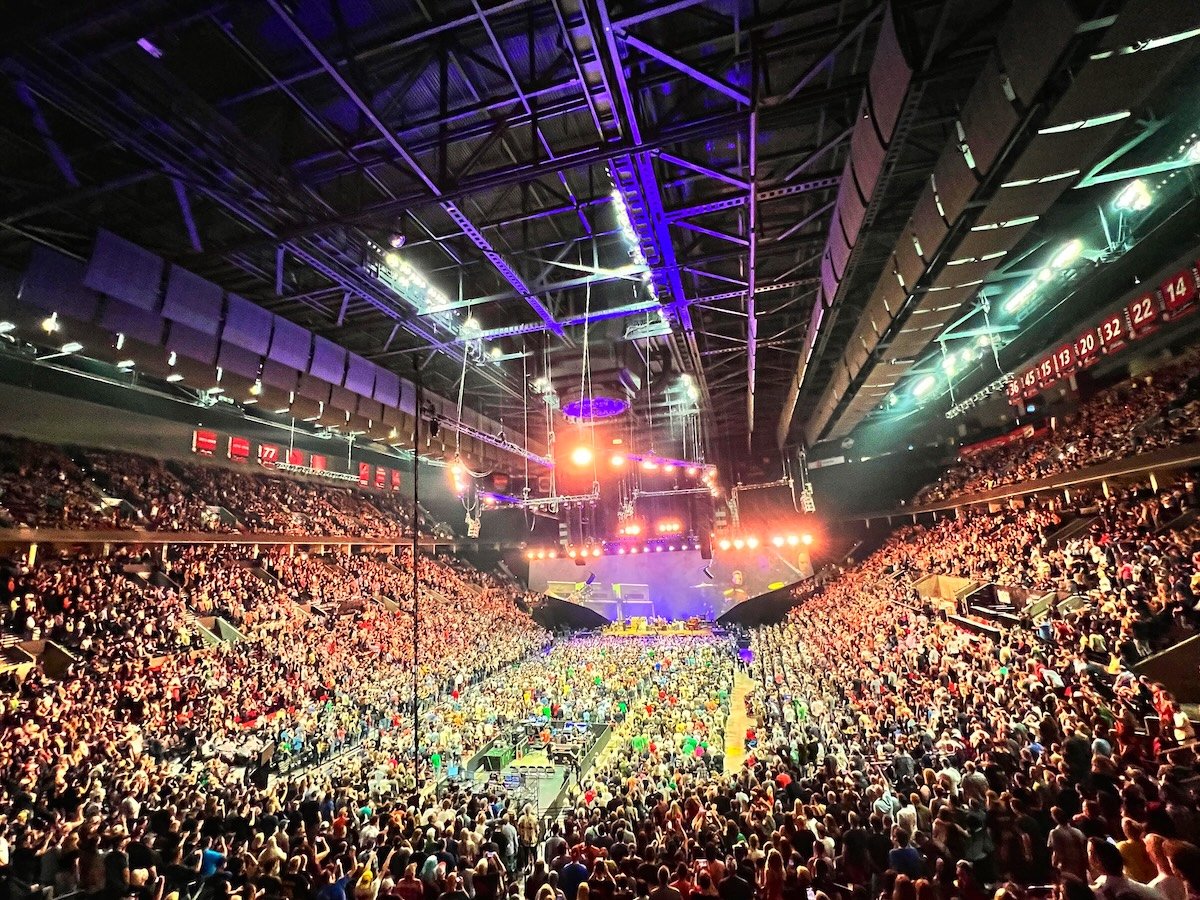
May 2024:
Time never moves slower than when waiting for your favorite band in concert—especially when you’ve waited 15 years for this moment.
I last saw Pearl Jam in 2009, and I’m no more than 15 minutes from the lights dimming in the Moda Center—but the wait feels like hours.
I pass the time by theorizing about the night’s setlist to my patient girlfriend who politely feigns interest next to me. (Because what woman doesn’t dream of being talked at by a bearded white boy about his favorite band from before she was born?)
For decades, Pearl Jam has drawn on a catalog of roughly 175 original songs and myriad covers to craft an entirely new setlist every single show. When lead singer Eddie Vedder creates the 20- to 30-song setlist each night, he is as likely to include a 30-year-old B-side or a track from the band’s latest album as he is one of Pearl Jam’s biggest hits or a Tom Petty cover. (Over the next few hours, he will do all of the above.) No two nights are ever alike, and every night has the potential for musical transcendence. That unpredictability and spontaneity is why some fans have seen the band dozens of times—and why I’ll fly cross-country to see them in New York City later this summer.
I may not know what to expect, but that doesn’t stop me from trying to figure it out. I’m not sure why, but I figure they’ll open with a punchy, up-tempo rocker that sets the tone for a high-energy show. Might they hit us with the breakneck “Do the Evolution” out of the gate? Maybe the frenetic “Johnny Guitar”? Will they throw us a curveball with the groovy “Dance of the Clairvoyants”?
After a few minutes, I decide that Pearl Jam will open with “Corduroy”—a fast-paced track from the band’s third album and a live staple that they’ve performed more than 600 times since the song’s release in 1994.
Eventually, mercifully, the lights go down. The members of Pearl Jam walk on stage, silhouetted by the flashes of 20,000 camera phones, and pick up their instruments. The first mournful notes from Stone Gossard’s guitar ripple through the arena, and they could not be any more different than what I expected. I’ve heard this song dozens, if not hundreds of times, and I can’t believe it. They’re going there.
Pearl Jam is opening tonight’s show with “Release”: a slow drone of a song from the band’s debut album, the first track they ever performed live, and a one-sided conversation with Vedder’s deceased father.
Adrenaline takes over. I jump out of my chair, yell “Let’s fucking go!” to no one in particular, and bang the wall behind me in exuberance.
And then, before Vedder sings the first lyric, I start crying.
My father officially passed away on February 19, 2023, but the father I grew up with actually died about 10 years earlier.
In the summer of 2013, I found myself at a crossroads. I’d left my home near Portland the year before to begin a new life in Seattle and wished desperately to move back. I made friends with coworkers and fellow ex-pats, started dating, volunteered at a youth homeless shelter, and enjoyed success in my new job—but it wasn’t Portland and, therefore, wasn’t home. I returned to the Rose City most weekends to visit breweries with friends, scream myself hoarse at Timbers matches and Blazers games, and sample as many of the city’s beloved food carts as my appetite would allow. When my apartment lease came up for renewal near the end of that first year, I did what any kid would do and asked my father’s advice: Should I see where another 12 months might take me in Seattle, or return to the safety and comfort of home?
One warm June evening, we sat around the backyard fire pit while I poured my heart out. I was unspeakably lonely. I missed this life I’d built on frequent visits to Portland. Every time I merged onto I-5 and returned to Seattle, I cried a little—and only got through it by thinking about how soon I’d return. I wasn’t sure what to do, where to go, or how to figure it out.
Eventually, I brought my meandering soliloquy to a close and awaited his insight. For what felt like minutes, only the crackling fire filled the silence. I took a long, slow sip from the Anderson Valley summer ale I’d bought for this exact moment.
When dad eventually spoke, he didn’t encourage me to follow my heart back to Portland or stick it out in Seattle. He didn’t ask any questions. He didn’t try relating this moment to a crucible in his own life. Rather, he said, “Yeah, things are pretty good around here.”
With that, the conversation moved on to how mom was doing, grandma’s health, and the work he’d done in the garden. If dad had any thoughts or opinions about my desire to move home, he never shared them. He never acknowledged my loneliness or promised he wouldn’t be disappointed if I returned.
Later that weekend, still smarting, I asked about his surprising reply—or lack thereof. He said simply and without apology, “I thought we were done talking about it.” If we weren’t done talking about it before, we certainly were then. That’s when I realized that I’d never again know the loving, caring, attentive, and engaged father that I’d grown up with.
I uncomfortably tolerated this new, distant version of my dad for a few more years. After moving back to Portland, I treated him to an ill-fated, four-day trip to the Wallowa Mountains in 2019, during which he didn’t ask a single question about how I was or what was new. He suffered from balance issues, falling easily and often, but insisted that seeing a doctor couldn’t possibly help. He’d fill commercial breaks on MSNBC and silences during backyard hang-outs with unsolicited advice—how I needed to settle down with a girlfriend, lose weight, or leave the freelance life for a real job.
He meant well, but I pleaded for him to be a better father and a more engaged presence, to pay a little more attention and be a little less dismissive. Every time I did so, he stopped talking, retreated inward, and said simply, “Okay” with all the petulance of a six-year-old who’d just been put in time-out. Wherever he went in those moments, I could not reach him. The conversations that started with me asking dad to be a little nicer, usually ended with me apologizing for bringing it up in the first place.
When he passed in 2023, I’d been estranged from my family for two years and wasn’t by his side at the end. I wrestled with the decision and agonized over my choice in those final few days, even as mom pleaded via text for me to visit the hospital. But some wounds take years to heal, and others never do—and I couldn’t bear to rip off the bandage that night.
Decades of memories, longing, hurt, and anguish don’t bubble to the surface as much as they boil over when Eddie Vedder approaches the microphone. He could have opened with “Inside Job”, “Better Man”, or dozens of other songs, but he chose the one where he tries to wrap his arms around a ghost. He chose the one where he tries to reach his deceased father and extend him some grace—something he could never do in life.
The first tear gives way to a second, a third, and a fourth. Feeling 40 years of big emotions welling inside of me, I try to steady myself with a long, slow exhale—and don’t know whether to sing along or sob uncontrollably.
I couldn’t be happier to see my all-time favorite band in concert—or more heartbroken that the emotions around my father’s death have encroached on this sacred moment. I so badly want to think of literally anything else for the next six minutes, but the only way out of this grief is to go through it.
Maybe that, more than anything, is actually what makes this moment sacred. I had memories worth grieving, and Pearl Jam is telling me it’s safe to peel back the bandage for a few minutes. Maybe the grief is a gift.
I see the world
Feel the chill
Which way to go
Windowsill
I take another deep breath and try to sing along. “Release” builds with every chord, every drumbeat, every lyric.
It sounds like Vedder is waking up. We know what he’s building toward and where he’s going, but we’re not there yet. The wave hasn’t crested. We’ve waited this long, and we’ll have to wait a few more seconds.
I see the words
On a rocking horse of time
I see the birds in the rain
I’ve been trying to make peace with his passing for more than a year, and I’m trying again tonight.
He coached my Little League team and was the first person waiting to celebrate at home plate when I hit my only home run—just like he’d promised a year earlier. After our Cub Scout troop marched in the Veteran’s Day Parade, he took me out for burgers and ice cream at Dairy Queen. He showed me how to fish, helped carve my pinewood derby cars, and inspired a lifelong love of reading by never saying “no” to buying another book.
Even when we got by on free school lunches and holiday deals at the outlet mall, he and mom found a way to show us the world. We went whale-watching in the San Juan Islands and camped in the shadow of Mount St. Helens. He let me skip school to see the Seattle Mariners. Took me to my first Blazers game in 1989, a loss to the Seattle SuperSonics, and encouraged me while I worked up the courage to solicit autographs from Kevin Duckworth, Terry Porter, and Clyde Drexler afterward.
The unbridgeable distance between the doting father of my childhood and the man I sat with around the fire in 2013 only grew in the years that followed. When I cut off contact nearly a decade later, I no longer recognized the man on the other side of the divide; I would always be his son, but he was no longer my father.
Even so, more than a year after his death, glimmers of light continue to piece the darkness and hint that we might not have been as far apart as I’d thought. The further I get from those happy childhood memories, the more perspective I have on who he became after I graduated from college and left home—and the more of him I see in myself. For better and worse.
He’d occasionally lose his train of thought, mid-sentence, a habit I chalked up to old age and poor health; today, I occasionally lose my train of thought, mid-sentence, a habit I chalk up to my brain getting pickled by always-on screens and a brain that never turns off.
He took the slightest criticisms deeply personally, stopping hard conversations before they could start and, in essence, making his emotions the responsibility of the family members who dared to speak up. It’s a trait I always bristled at—and a trait my girlfriend pointed out in me not more than a few months ago.
We’ve always been quick to apologize, even before we know what we’re apologizing for and whether we’re really sorry. He and I have always been eager to crack wise and tell a joke. We’ve always felt things, good and bad, with an unshakeable intensity. We both loved Safeway doughnuts more than our doctors would like. (One of us still does!)
None of it lets him off the hook, but it makes him more human. So while Eddie Vedder empties his heart on stage, I try to make space for the hurt and the happiness, to understand that it’s all wrapped up together. It’s okay, if not essential, to harbor these wildly disparate feelings. Some days, I see more bad than good; other days, I see almost nothing but good. I think about what I wish I could have said—and how little it would have mattered. I tell him—and myself—that it’s okay. He did his best. I don’t always believe it, but in this moment, I do.
Oh dear dad
Can you see me now
I am myself
Like you somehow
No matter the questions I’ve posed in life, I’ve always found the answers in Pearl Jam’s lyrics. Eleven years ago, for instance, I would have been better off bypassing that fireside chat and listening instead to “I Am Mine” while deciding between Seattle and Portland: “I know I was born and I know that I'll die / The in between is mine.”
In the aftermath of my father’s passing, I wasn’t looking for answers in “Release”. I found them, anyway—and tonight, I’ll join 20,000 Pearl Jam fans in singing those answers loud enough for dad to hear in the afterlife.
I know what’s coming and take a deep breath. My tears fall like rain. The crescendo approaches, and we scream in unison:
I'll ride the wave
Where it takes me!
I'll hold the pain
Release me!
This newsletter is free—but if you enjoyed this essay and would like to support my work and travels around Oregon, you can make a one-time or monthly donation at Buy Me a Coffee or via the button below:

And if you’re not already a subscriber, you can learn more about “Forever on Our Mind: 1,859 Love Letters to Oregon” and click the button below to subscribe to this weekly email: