
Forever on Our Mind: Beautiful Benches of Oregon, Part III
The latest in a series of tributes to Oregon's beautiful benches takes me into the heart of the state's youngest lava flow
173. Beautiful Benches of Oregon, Part III
Note: One of my favorite things about hiking is taking a break from hiking—whether to drink some water, admire the view, or rest my “barking dogs” (as my grandmother liked to say). With years of occasionally not hiking under my belt, I’ve developed a deep appreciation for a well-placed bench along the trail. This is the latest in a series of pieces that pay tribute to the most beautiful benches in Oregon.
***
July 2016:
When I started my Oregon odyssey about two years ago, I had no idea how much I had to learn about the state—like how much of its natural beauty was shaped by volcanic activity.
In the past week alone, I hiked atop Crater Lake’s Wizard Island (a volcano within a much larger volcano) and walked through the volcanic fissure known as Crack-in-the-Ground. After departing the Oregon Outback, my trip continued with a visit to the Newberry National Volcanic Monument—where I’m hiking the Big Obsidian Flow Trail on a bluebird July afternoon.
The trail sits at about 6,800 feet above sea level and deep within the Newberry Caldera—the heart of the largest volcano, by volume, in the Cascade Range. In all, Newberry Volcano stretches 75 miles north to south and 27 miles east to west—covering an area roughly the size of Rhode Island.
The shield volcano has erupted, on and off, for about 400,000 years. It was about 75,000 years ago that a major eruption caused the volcano’s walls to collapse, leaving behind a bowl-shaped caldera that is today home to a pair of lakes, two lakeside lodges, a handful of campgrounds, miles and miles of hiking and mountain biking trails, and—as I learn at the national monument’s visitor center—a relatively young lava flow that dates back “just” 1,300 years.
When a helpful ranger suggested a short hike through the Big Obsidian Flow on my way up to Newberry Caldera, I bombarded her with questions: We have lava flows? The stuff that spills out of volcanoes? And you can hike through them? And you can do that just two miles from here?
I don’t think I let her finish that last answer before speeding away and onto an unexpected adventure.
Soon after lacing up my boots at the trailhead a few minutes later, I step onto a sprawling lava flow covered in sponge-like pumice; black, glassy obsidian; and other volcanic rocks that cover every inch before me.

The rocky trail ascends from the parking lot and into the chaotic rock piles that cascade in every direction. Early on, I can’t help but touch a piece of shiny obsidian on the side of the trail; it’s warm, but not hot, in the summer sun—and is impossibly smooth. I may be surrounded by jagged edges and sharp corners, but there’s something comforting about that softness.
The further I hike into the lava flow, the more the surrounding forests of the caldera retreat into the background; after a few twists and turns, I leave Earth behind for another planet entirely.
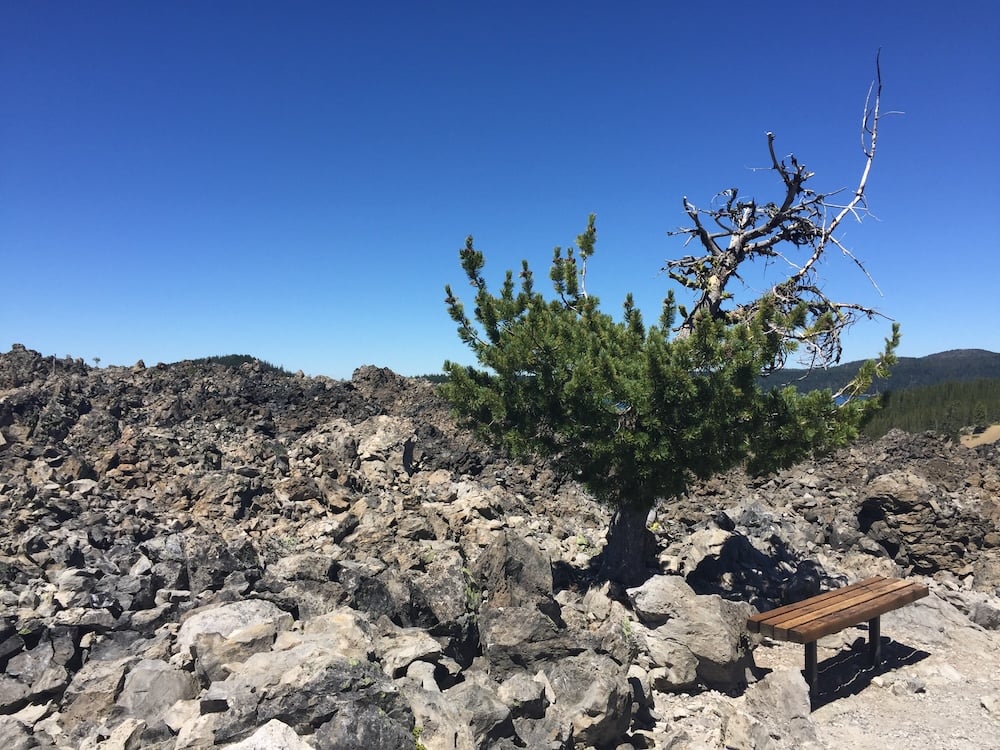
Along the way, a few stray pines fight to grow between and above the jumble of rocks. Signs of life are few and far between out here, and I admire the trees’ moxie.
A handful of interpretive panels explain how to spot the difference between pumice and obsidian, detail the many ways humans have used these rocks for millennia, and describe how various flora and fauna make it work in this inhospitable environment—including lacy lichen, the aforementioned pine trees, and thousands of frogs that will migrate through the lava flow later this summer.
Eventually, I arrive at a wooden bench in the shadow of a pine whose crown appears to have been ravaged and ripped apart. This bench probably enjoyed its fair share of shade back in the day—but is fully exposed without the cover of the damaged tree.
No matter. I plop down, take a few swigs of water, and try to make sense of my surroundings.
The occasional piece of obsidian shimmers under the summer sun. A gentle breeze dances through the treetop behind me. Only the deep blue hue of Paulina Lake, off in the distance, breaks up the monochromatic feast for the eyes.
Growing up, I knew of volcanoes as far-off hazards and icons of my imagination. Lava raced down their slopes in Hawaii. Mount Vesuvius famously leveled Pompeii some 2,000 years ago. The angsty Mount Doom erupted only after the One Ring had been destroyed near the end of the Third Age.
But this? This is something else entirely. I never put “hiking through a lava flow” on my bucket list, simply because I never thought it possible—especially in my home state.
I try to take it all in and bottle this sense of surprise, but nothing about the craggy blanket around me seems possible. The waterfalls of the Columbia River Gorge, snow-capped summit of Mount Hood, and the Willamette Valley’s vineyards? Those seem possible. Those at least seem real.
But the hard-edged, glassy expanse of the Big Obsidian Flow is expanding my definition of what Oregon looks like—and what the “outdoors” has to mean. It’s showing how much more I have to learn about this beautiful state. Above all else: It’s not just possible, it’s real.
This newsletter is free—but if you enjoyed this essay and would like to support my work and travels around Oregon, you can make a one-time or monthly donation at Buy Me a Coffee or via the button below:

And if you’re not already a subscriber, you can learn more about “Forever on Our Mind: 1,859 Love Letters to Oregon” and click the button below to subscribe to this weekly email: