Urbababble

Archives
Subscribe

Urbababble

Archive

The Butlerization of Cities

Hey everyone,

When I first moved to New York, I lived in Ridgewood, Queens. Hardly what people have in mind when they think "New York City." I remember the broker showing us the "roof deck" (heavy on 'roof,' light on 'deck') where, if one squinted, the faint outline of the Empire State Building could be made out in the distance. Bright Lights, Big City, baby.

Despite the outer borough-ness of this first apartment, it had everything I expected from an NYC apartment. A tiny bedroom, a neglectful landlord, a broken shower, and bizarre roommates. More importantly, it had a grocery store a five minute walk away, a bodega on the corner, and a perfectly serviceable greasy pizza joint two blocks down. Because my bedroom was nine feet by 12 feet and the "common area" was the kitchen, the idea of getting groceries delivered would have been a laughable concept, because any excuse to get out of the house was a good excuse.

I bring all this up because after my story about 15-minute-or-less grocery delivery services got published, a reporter named Matt Newberg from a publication that covers the tech/food industry called HNGRY emailed me with a few insights. Among other things, he pointed out that "JOKR (and pretty much everyone else) stole its idea from Getir, which has been around for 6+ years" and hyperlinked to a Financial Times article from last year. In that article, a Getir co-founder said, "We’re democratising laziness...It’s like having a butler for a dollar or two.”

#19
October 7, 2021
Read more

Scavenger hunt results and some other stuff

Hey everyone,

Thanks to those who participated in the scavenger hunt! I received eight submissions of legally parked delivery trucks. The winning submission belongs to...Bee Cambell, with this beauty from Greenpoint:

IMG_8466.jpg

Never thought I'd see the day. A future Urbababble will be on the subject of Bee's choice. Let me know when you've made up your mind, Bee!

#18
October 2, 2021
Read more

Let's Do An Urbanist Scavenger Hunt

Hi everyone,

I want to try a little experiment. Let's play an urbanist scavenger hunt. Send me a photo of a delivery truck (USPS, FedEx, Amazon, or UPS) that is legally street-parked while making a delivery. No parking lots or driveways. It has to be parked on the street.

#17
September 25, 2021
Read more

I changed my mind

I love changing my mind. It's fun to admit I'm wrong rather than digging in my heels. Not only is it fun, but it's also way easier. And I also find I feel good after doing so, whereas when I try and defend a position I am growing unsure about, I feel worse, like I have a foreign object in my stomach.

So I wrote an article about something I changed my mind about. Specifically, I no longer believe the U.S. needs to build 500,000 public electric vehicle chargers, or a million, or whatever huge number various politicians and industry experts say. Instead of helping spur EV adoption, I worry this narrative actively undermines it, because charging EVs at home—something that can easily be done by the majority of American car owners—is constantly cited as one of the key benefits of EV ownership.

Of course, we still need more chargers, especially fast chargers, in strategic locations to create a true fast-charging network nationwide. And as more EVs get on the road, the more chargers we'll need to keep up capacity. But the number experts cite to plug those gaps is more like 10,000 to 30,000. That's still a lot, but far more manageable.

If you think I'm missing something important here about why 500,000 chargers is necessary, I really would love to hear from you—see above about changing my mind—but please, please read the article before emailing me. I beg you. I've gotten so many emails this week from people who didn't read the damn article. I can't learn anything from you if you just tell me what I already wrote.

#16
September 16, 2021
Read more

A story to tell

For those of you who don't know, I used to be a sportswriter. One of the last sports stories I ever wrote was about a guy named Eric Thompson. He was an athletic prodigy, the best kid at every sport in his small Illinois town from the very first time he played it. He was particularly good at football; his coach told me he could have played in college if he wanted. But he didn't, because in eighth grade, Eric tried a new approach to the high jump and shattered the state record. From then on, he was a Track & Field prodigy.

Eric received full scholarship offers to virtually every college program in the country. His high school coaches told him that with just a year or two of training with a top jump coach, he could be repping Team USA at the Olympics. This wasn't pie-in-the-sky stuff. When it comes to comparing jumpers and their career prospects, high jump is pretty straightforward. And Eric only needed a couple more inches at most to join Team USA.

But things didn't go as planned. The story I wrote ran under the headline "." I cannot do Eric's story justice in a few sentences. But I first came across it while researching another anti-doping case and saw it mentioned in a footnote. He became caught in the dragnet of an anti-doping system meant to catch drug cheats, not kids experimenting with a tiny amount of street drugs two days before a meet at a house party. As a result of this one bad decision and the ensuing chain of events, he became a literal footnote in athletic history.

#15
September 7, 2021
Read more

They're nearly there, except for all the hard stuff

I would say, on average, I have 99 percent of driving figured out. But that one percent is proving pretty tricky. Small disturbances like construction crews, bicyclists, left turns, and pedestrians remain headaches, and I find driving in new cities particularly difficult. I also can't handle rain, sleet, or snow. Other than that, I'm a great driver!

Haha, just kidding, that's not me, that's "self-driving" cars. The above paragraph is essentially a direct quote from that Bloomberg story, but replacing "computers" with "me" or "I." Can you imagine a human saying "I can mostly drive just you know not when there are people around, left turns, or any place other than my home area?"

These companies are asking federal and state governments to change the legal framework so they can operate in more areas and there is a widespread consensus they are "the future." This would be funny if it isn't so scary. The problem with pre-ordaining a certain technology as "the future" is it can be a self-fulfilling prophecy. Cars did not play nicely with society at first; we paved hundreds of thousands of miles of roads and changed laws and street designs and the role of the police to make them work. It is not difficult for me to imagine the same happening for self-driving cars. Just two years ago, some doofus in the automotive industry, who for some reason the paper granted anonynimity so he or she make their dumbass remarks without consequences, told the New York Times we'd need "gates at each corner" to trap pedestrians on the sidewalk so self-driving cars wouldn't run them over.

It sounds ridiculous. But I could absolutely envision a scenario where, instead of self-driving cars learning how to deal with construction crews, pedestrians, cyclists, and left turns like every human driver, roads and laws are redesigned to eliminate the conflict altogether.

#14
August 20, 2021
Read more

We have to build useful stuff

Every six months or so it seems I write a column about how Andrew Cuomo has done yet another bad transportation thing. In January it was the Moynihan Train Hall. Last week, it was the LaGuardia AirTrain, which received final federal approval thanks to the environmental review process being rigged in its favor. What is the point of the environmental review process if it doesn't block a train to a parking lot to make it easier to drive to the airport?

Cuomo likes to defend these projects by saying he is good at building things. In a country where building infrastructure—from wind farms to fast electric vehicle chargers to bus shelters and virtually everything in between—is marred in red tape, it can feel like a victory to build anything at all, even if that thing is not very useful.

This perspective was crystalized for me when I went on the Brian Lehrer Show to talk about the AirTrain. Brian said once or twice something to the effect of, "Assuming you can't extend the N Train because of NIMBYs..." (Extending the N train is the obviously best transportation option to provide a one-seat ride from three boroughs and new stops in Queens to LaGuardia.) I pushed back. I'm not going to transcribe what I said because I don't want to listen to my own voice any more than I already have to, but it was something to the effect of: I don't accept that premise. We can't just concede every infrastructure fight in anticipation of NIMBY opposition. We need to build stuff.

I wish I had said that last part slightly differently. We need to build useful stuff.

#13
July 30, 2021
Read more

What are you willing to do to fight climate change?

Hey friends,

Thanks to everyone who responded to my challenge a few weeks ago. Here are a few things that may not stand the test of time, according to some of you, paraphrased by me for brevity.

#12
July 21, 2021
Read more

A Challenge

Hi everyone,

I have a question for you, perhaps something to think about over this long weekend. It is more of a challenge, really. But it’s a question I ask myself sometimes. I’m curious to hear what others say.

What is a widely held belief in your industry/field that is most likely to be generally regarded as wrong 50 years from now? And here’s the tricky part: it has to be something you currently believe, too.

#11
July 2, 2021
Read more

What Prospect Park's car ban taught me about better streets

In 2018, New York finally banned cars from Prospect Park. Before that, in the Dark Ages, private vehicles were allowed to drive north on the loop in the mornings and south in the evenings. As you'd suspect, the hour limits were not well observed and there were basically cars in the park all the time. Because when you say cars are allowed some of the time, drivers will assume they're allowed all the time.

When the full-time ban hit, a few signs were put up at the park entrances, but the physical barriers could and would be moved. For at least six months, private cars were still a fairly common sight along the Prospect Park loop.

Over time, such observations gradually became less and less frequent, even though the physical barriers are just as flimsy or non-existent as before. Sitting here now, I actually can't remember the last time I saw a private car driving on the Prospect Park loop.

The thing is, there are still vehicles in Prospect Park. Lots of them, in fact. Pretty much every time I go to the park, I see at least one vehicle in the park itself, whether it's a big maintenance truck, an NYC Parks pickup truck, a cop car (or three), a playground maintenance repair truck, private vans for the Smorgasburg events, etc. etc. Even some private cars still enter on the Licoln Road entrance and cross the loop to enter the parking lot. Nothing is stopping them from turning right and going up the loop just as they did before. But they don't.

#10
June 30, 2021
Read more

Abolish the driving test

Since many of you were kind enough to share your driving test stories, I'll share mine.

I don't remember a thing about it. I know it happened, because I carry a laminated piece of paper in my wallet to prove it, but I couldn't tell you a single detail. I do remember the driving school I attended. It was on the second floor of a bulding in a small shopping center in Newtown, CT, right above a cigar store. The place reeked of smoke. I'd come out after a three-hour classroom session and my clothes would smell of cheap cigars.

Like many teenagers, I was a smart enough driver to behave when someone was watching and dumb enough to drive like an idiot when I thought no one was. Also like many teenagers—especially males—it is but for the grace of God I am not dead by now for having driven like an absolute moron.

Now that I am older and value my life more, I drive differently. I don't own a car and therefore drive much anymore, but when I do I am about as cautious as one can be while still technically driving. Needless to say, I don't think that driving school or the license test had much impact on me, other than giving me a lifelong disdain for the smell of cigars. It was other stuff, like getting slammed with a speeding ticket in Virginia and gaining the perspective of a pedestrian and cyclist, that taught me to behave on the roads.

#9
June 15, 2021
Read more

I wrote a lot about cars for some reason

Hey everyone,

Thanks so much to all those who wrote in about your driving test experience. I read every email and even responded to some. It will help the article I’m working on a lot.

One of the greatest services journalistic outlets has done for the American public in recent memory was giving ample, in-depth coverage to the 100th anniversary of the Tulsa race riot. It felt like every major publication dedicated at least one feature article to the subject. (I did not; I was too busy writing about the Kerner Report like a fool.) The number of people who seemed to learn about the riot for the first time, and thus get that much closer to a more accurate understanding of our nation’s history, was great to see, especially in light of the ongoing right wing fearmongering over teaching such sensitive topics as "white people often do bad things" in school.

If the subject of late 19th/early 20th century race riots is something you’d like to learn more about, I recommend picking up a biography of Ida B. Wells. I read this one and learned a lot from it.

#8
June 9, 2021
Read more

The arc of a patriotic narrative is long, but it bends towards bullshit

Hey, hope you're doing well.

Before I tell you about my latest work, a quick question about my future work. I'm researching a story about drivers tests. Do you remember doing your drivers license on-road test? What do you remember about it? Do you think preparing for it made you a better driver? If you'd like to help me out with an article about this, reply to this email and tell me about your drivers license test. I might want to interview a few of you. Thank you!

*

A little more than a year ago, I wrote an article about why reading history is a form of therapy. Like most of the articles I've written that I am most fond of, few people read it. I choose to attribute this to the fact it was published on March 9, 2020 (Mayor de Blasio: "Do not put hand sanitizer in your mouth...Don't put it in your nose. God forbid, don't put it in your eyes.") and not that I wrote a quasi-academic essay with no news peg.

#7
May 25, 2021
Read more

Accidental Urbanism

Note: this email has images, but no trackers.

A few Saturday mornings ago I was biking to meet a friend when I saw a wonderful surprise. Atlantic Avenue, one of the most dreadful car-centric stretches in the entire borough, finally had a protected bike lane!

I rode it for three blocks both ways and it was a perfectly lovely and functional protected bike lane. Just like that, Atlantic had been transformed from a bike no-go zone to one of the best crosstown routes in the borough.

#6
May 1, 2021
Read more

On Being Less Sure

I have a confession. I have never ridden a high speed train. In 2014 I was on a train in Germany from Frankfurt to Amsterdam that seemed to be going pretty fast but I don’t know if it technically qualified as “high speed.” Even if it did, we were unexpectedly delayed for hours and everyone on the train looked very mad as if they expected better. The train could have gone 300 mph but the fact people expected to be on time was the real novelty of European rail travel. Deutsche Bahn refunded half of our ticket prices and even that seemed not good enough to most people.

My only other memorable non-Northeast Corridor intercity train experience was from Seattle to Los Angeles on Amtrak. My dad and I thought it would be fun. We were wrong. The train was 18 hours late. Everyone was estatic when we arrived as if we had just survived an interstellar journey. It was the only time before or since I was happy to be in Los Angeles.

It is, perhaps, with these experiences in mind I decided to explore if the U.S. is ready to build lots of high speed rail as part of a massive infrstructure plan, or if we should instead focus on making our regular passenger rail better than it was in the 19th Century, which it currently is not. I concluded . My editor told me lots of people seem mad at me online for this. A few of them may even have clicked on the article.

#5
April 19, 2021
Read more

I Am Infrastructure

Quick note: I am going to be changing email providers before the next edition. Future emails will be coming from a service called Buttondown. I am doing this so I can turn off all email tracking and other “features” Substack has that I don’t want or prefer to customize. Everything else should remain exactly the same.

#4
April 8, 2021
Read more

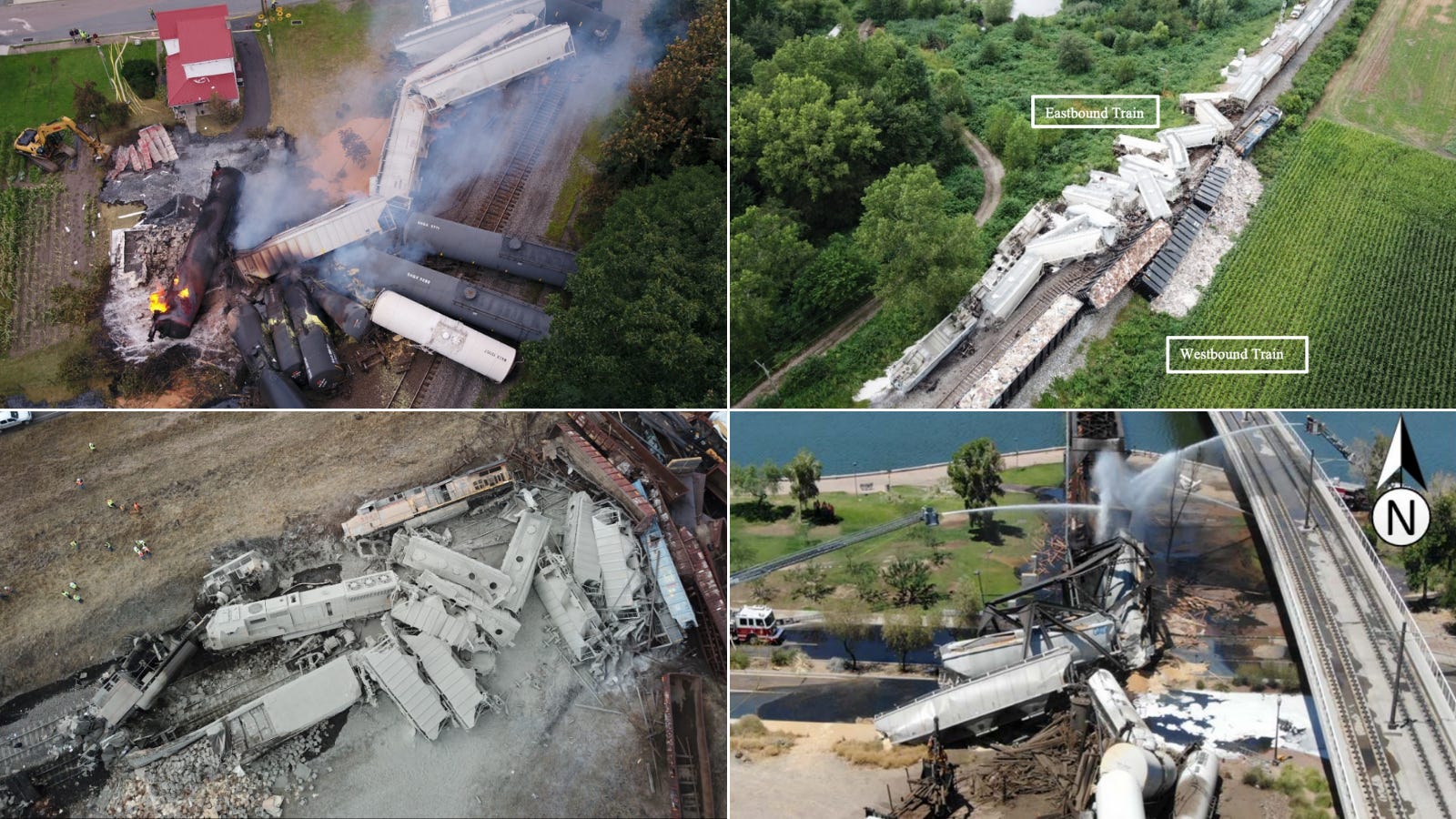
"I implore anyone who might be watching who has the authority to act to please act now."

Credit: NTSB

About a month and a half ago, I stumbled on a Youtube video that looked like a proof of life hostage video. It was some guy I’d never heard of standing in front of an off-white wall. I clicked on it thinking I was about to watch a video about how the freight rail industry has been impacted by COVID. Like most people, I thought very little about the freight rail industry. I figured, in all likelihood, this would be two and a half minutes of my life I’d never think about again.

That is not what happened.

"It's only a matter of time before fatigued workers, unrealistic inspection policies, and unqualified inspections result in a major incident in someone's neighborhood," said the man in the video, Jason Cox of the Brotherhood of Railway Carmen. With a kind of stoic intensity, he continued: "I implore anyone who might be watching who has the authority to act to please act now."

#3
March 22, 2021
Read more

We used to be better than this

Recently, I knew I wanted to do a deep dive into how the U.S. has fallen so badly behind on auto safety. I knew about the big cars and pedestrian safety issues and all that. But there seemed more to the story to me, specifically one of government failure, as the U.S. is unique among developed nations when it comes to road fatalities getting worse. I had come across various ways the National Highway Traffic Safety Administration (NHTSA) had dropped the ball in recent decades. But I needed to hone in on one as a way to tell the larger story. Then I learned about New Car Assessment Program.

To be sure, NCAP, the program that rates cars on safety, had been ably covered before, most prominently by David Zipper at Bloomberg. But I suspected there would be value in showing readers not just how the program had failed over time, but how it succeeded before it failed, and how sometimes the most effective forms of government are the simplest ones.

Researching these questions took me to a time when the U.S. government was much better. Still deeply flawed, of course, but better in many respects. It addressed real needs, often with bipartisan legislation. And NCAP encapsulates how so many of our problems these days is not because of an absence of laws or rules to address problems, but that those laws or rules have decayed to the point of being useless. Like everything else, good government needs to be maintained or it stops doing its job.

So I hope you’ll take the time to read about NCAP. As with most things, there are no easy answers, but there are very interesting questions.

#2
March 4, 2021
Read more
Powered by Buttondown, the easiest way to start and grow your newsletter.