The Ugly Laws, Institutionalization, and the Latest Executive Order
Just my initial thoughts, more to come later
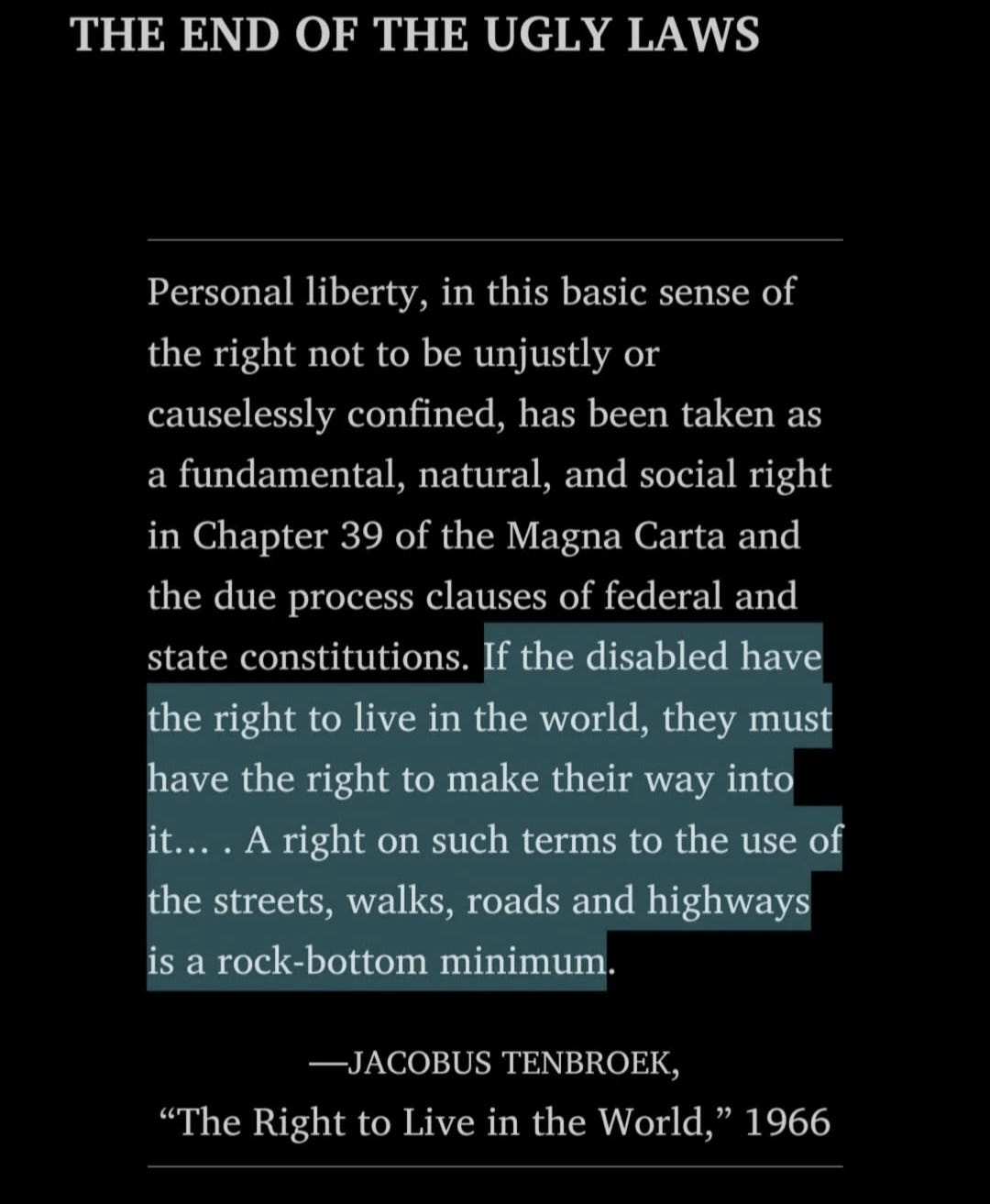
Image description for accessibility: dark background with text that reads: "THE END OF THE UGLY LAWS
Personal liberty, in this basic sense of the right not to be unjustly or causelessly confined, has been taken as a fundamental, natural, and social right in Chapter 39 of the Magna Carta and the due process clauses of federal and state constitutions. If the disabled have the right to live in the world, they must have the right to make their way into it.... A right on such terms to the use of the streets, walks, roads and highways is a rock-bottom minimum.
Disability, Chronic Illness, & Culture is a reader-supported publication. To receive new posts and support my work, consider becoming a free or paid subscriber.
-JACOBUS TENBROEK,
"The Right to Live in the World," 1966"
Last July, I posted this quote on Instagram after I finished reading The Ugly Laws: Disabled in Public by Susan M. Schweik (I highly recommend this book). In the caption, I wrote: "Extremely heartbreaking to read this quote while politicians & others in power are trying to deny immunocompromised, chronically ill, & other disabled people "the right to live in the world" through mask bans, lack of COVID precautions anywhere including hospitals, etc."
And now, as of yesterday, we have Trump's executive order to "end crime and disorder on America's streets." Much like the Ugly Laws, it explicitly targets homeless people, people struggling with addiction, and disabled people (in this case, mentally ill people). Three extremely vulnerable groups of people. If states follow this order, and many of them likely will, it's going to further criminalize homelessness and mental illness (because, to be clear, both were already criminalized) and defund life-saving harm reduction programs.
The stigma of mental illness, homelessness, and addiction all made this executive order possible. Every time people start talking about mentally ill people after a school shooting, they helped fuel the sanism (discrimination against mentally ill people) behind this order. Every time people talk badly about their homeless neighbors and complain about having homeless encampments or shelters nearby, they helped make this happen. Every time people paint people struggling with addiction as inherently bad people, every time they talk about addiction as a moral failing or an issue with "will power," they helped make this happen.
This executive order weighs on me as, on a personal note, my family is currently trying to help another family member get out of a state hospital. Throughout my life, I have watched this family member be placed in hospital after hospital. He has faced housing insecurity and violence as a result of his schizoaffective disorder, the stigma it carries, and the ways people with mental illness are treated in this country. We live in a very rural state with extremely few resources for crises related to mental health. We have had to deal with so much frustration trying to find resources for him. While I am lucky that I have never been institutionalized, I have had crises related to my own bipolar disorder where I could not access resources, or the support I received was not enough, even as someone with health insurance. It's of course so much worse for the many people in my state who don't have health insurance.
Please listen to the groups impacted by this executive order & the advocates who help them. Follow disability lawyers & pay attention to any lawsuits, protests, or other actions that come up. And educate yourselves about disability history, the ugly laws, and the extremely dark history of institutionalization in this country. If you're having a hard time after hearing about this executive order, just know you're not alone. I think that's all I have to say right now.