
Storytelling frameworks for people who aren't natural storytellers
Hi there, it’s Adam from Untools.
Most people aren't natural storytellers. When you need to pitch an idea, present a case study, or explain why something matters, it's easy to default to listing facts or walking through everything chronologically. When you do that, people will probably just nod politely but won't remember anything, or lose interest before you get to the point.
Research supports this: In a 1969 study, students who built stories around information remembered it 7 times better than those who simply memorised facts. Another experiment by Chip and Dan Heath (authors of found "Made to Stick") found that 63% of people remembered stories from presentations, but only 5% could recall individual statistics.
It’s clear that using stories to get your point across can greatly amplify its effect. And a clear framework will help your audience follow the story, remember key points and take action.
Let's look at two practical storytelling frameworks that will give you you a repeatable structure to communicate more effectively.
Before-After-Bridge (BAB)
A 3-step contrast structure to show the painful present, the desirable future and how to get there. Perfect for demos, pitches and presentations.
When to use it
Product demos and sales presentations
Landing pages and marketing copy
Internal pitch decks for new initiatives
Conference talks and keynotes
How to use it
The power of Before-After-Bridge lies in contrast. You're helping people see the gap between where they are and where they could be, then showing them the path between.
1. Before
Describe the current painful reality your audience experiences. Be specific about the frustration, because vague pain doesn't motivate action. What's annoying, slow, expensive, or broken right now?
2. After
Paint a vivid picture of life after the problem is solved. Make it tangible and desirable. What does success look like? How does it feel? What becomes possible?
3. Bridge
Explain how your solution gets them from Before to After. This is your product, service, or idea. Keep it simple and just show the path, don’t overwhelm with every feature.
Example
Let’s see how this could be used using an example with a product pitch:
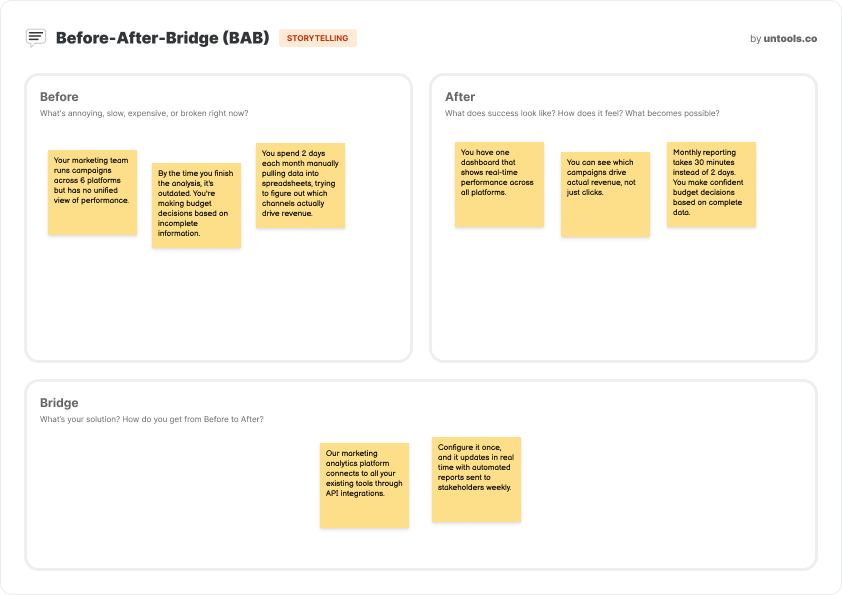
Before: Your marketing team runs campaigns across 6 platforms but has no unified view of performance. You spend 2 days each month manually pulling data into spreadsheets, trying to figure out which channels actually drive revenue. By the time you finish the analysis, it's outdated. You're making budget decisions based on incomplete information.
After: You have one dashboard that shows real-time performance across all platforms. You can see which campaigns drive actual revenue, not just clicks. Monthly reporting takes 30 minutes instead of 2 days. You make confident budget decisions based on complete data.
Bridge: Our marketing analytics platform connects to all your existing tools through API integrations. Configure it once, and it updates in real time with automated reports sent to stakeholders weekly.
Get these templates in PDF and Miro along with 3 more storytelling frameworks in Untools Vault.
Common mistake to avoid
Don't make the Before section too abstract or mild. "Things could be better" doesn't motivate anyone. Be specific about the pain: "You waste 6 hours weekly in meetings" will resonate more than "Communication isn't optimal." The more specific the Before, the more compelling the After becomes.
Pixar’s Story Spine
A fill-in-the-blank story structure made popular by Pixar that forces you to establish context, introduce conflict, show causality, and resolve with transformation.
When to use it
Brand storytelling and origin stories
Project case studies and portfolio pieces
Customer success stories and testimonials
How to use it
The Story Spine gives you connecting phrases that create a narrative arc. You fill in the blanks, and the structure ensures your story has all the necessary elements.
Once upon a time... (Set the scene. What was the initial context?)
Every day... (What was the routine or status quo?)
But one day... (What changed? What's happened to start the change?)
Because of that... (What happened as a result? This can repeat several times times)
Until finally... (What's the climax or turning point?)
And ever since then... (What's the new normal? What changed permanently?)
The power is in the connecting phrases. "Because of that" forces you to show causality instead of just listing what happened. "Until finally" creates a clear climax. "Ever since then" shows the result or the moral of the story.
Example
Let’s see how this framework can be used for a brand’s origin story:
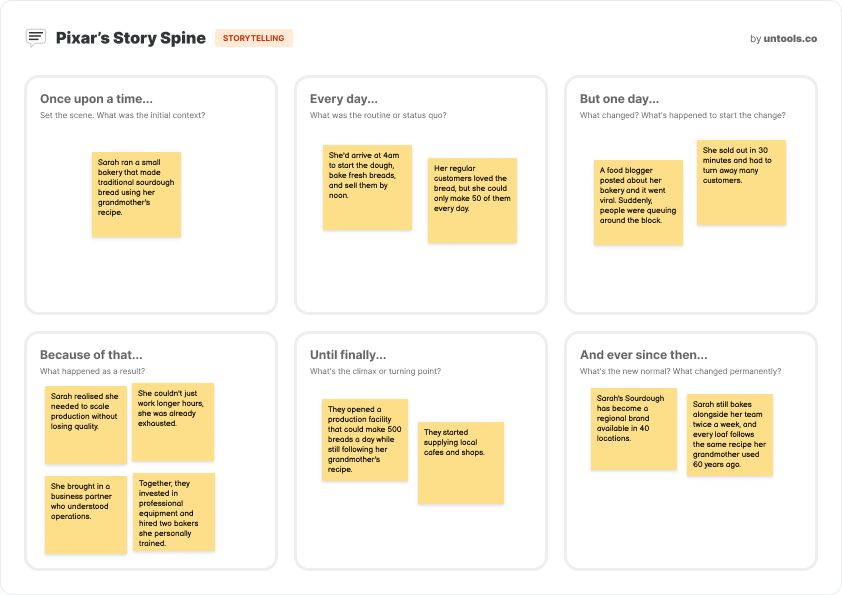
Once upon a time, Sarah ran a small bakery that made traditional sourdough bread using her grandmother's recipe.
Every day, she'd arrive at 4am to start the dough, bake fresh breads, and sell them by noon. Her regular customers loved the bread, but she could only make 50 of them every day.
But one day, a food blogger posted about her bakery and it went viral. Suddenly, people were queuing around the block. She sold out in 30 minutes and had to turn away many customers.
Because of that, Sarah realised she needed to scale production without losing quality. She couldn't just work longer hours, she was already exhausted.
Because of that, she brought in a business partner who understood operations. Together, they invested in professional equipment and hired two bakers she personally trained.
Until finally, they opened a production facility that could make 500 breads a day while still following her grandmother's recipe. They started supplying local cafes and shops.
And ever since then, Sarah's Sourdough has become a regional brand available in 40 locations. But Sarah still bakes alongside her team twice a week, and every loaf follows the same recipe her grandmother used 60 years ago.
Common mistake to avoid
Don't skip the "Because of that" steps. Many people jump from "But one day" straight to "Until finally". That's just a problem and solution with no story in between. The "Because of that" steps are where you show the journey, the struggle, and the causality. That's what makes it a proper story.
Untools Vault members will get access to a full version of this guide with 5 storytelling frameworks with templates in PDF and Miro. Learn to tell any kind of story in many different contexts.
You also get complete toolkits for decision-making, problem-solving, facilitation, systems thinking, and AI collaboration. Vault is $99 one-time for lifetime access.
The full guide will be published tomorrow, get your access now.
Get Untools Vault
These two frameworks (Before-After-Bridge and Pixar's Story Spine) give you structure when you need it. One helps you show transformation, the other helps you tell a complete story.
Pick one that matches something you need to communicate this week and try it. You'll find that having a clear structure makes storytelling much easier than trying to improvise.
Until next time,
Adam
-
Love this! As a non-profit communications professional, it’s nice to see tools and resources that can improve brand and storytelling
Add a comment: