Eisenhower matrix: How to avoid the busy-work trap
Hi there, it’s Adam from Untools,
One of the most popular productivity frameworks is the Eisenhower matrix – a 2×2 matrix for prioritising based on urgency vs. importance. A famous quote by Dwight Eisenhower goes:
“I have two kinds of problems, the urgent and the important. The urgent are not important, and the important are never urgent.”
The biggest challenge with using this framework efficiently is how to tell the truly important asks from merely urgent ones? And why do we seem to so often pick the seemingly urgent tasks over the important ones? We’ll explore answers to these questions in this newsletter.
The mere-urgency effect: Why do we postpone important tasks
When we’re faced with choosing which tasks to work on, we more often pick the urgent ones over the important ones as this research found. Why is that?
Urgent tasks are often perceived as less effort and they have bigger short-term rewards – we get a small dopamine hit from completing a task.
The problem is that this happens even when there is only an illusion of urgency. For example, someone marks an email 'URGENT' about a report they'd 'love to see by Friday'. But there's no actual consequence if you deliver it Monday instead.
This leads to important tasks being postponed (sometimes indefinitely). But it’s precisely this sort of work that’s critical for our long-term wellbeing (e.g. exercise), careers and personal development (e.g. reading professional books).
How can we then tell the really important tasks from the actually urgent ones?
Telling important and urgent apart
On paper, it’s simple: Urgent tasks typically have deadlines or require quick action. Important tasks matter for the long term and align with your goals.
In practice, this distinction gets more muddy: atask feels urgent when someone is merely waiting for it. Important tasks don’t feel important when the payoff or consequence is weeks or months away.
That Slack message marked "urgent" can feel like a true crisis you need to respond to now. Meanwhile, that strategic product document with no deadline keeps getting postponed because it never feels like the right time.
Urgent tasks often come from others. Important tasks, on the other hand, are usually a result of introspection, long-term goals and planning. They’re important to us, not others. Not doing important tasks may also have consequences but they will happen later in the future. This is part of the trap of chasing urgent tasks over important ones.
To truly tell the two apart, we need to stop for a moment, question urgency and confirm if something is really important. Next time you’re deciding what to work on, try going through these questions:
Is it truly urgent?
Does it have a real deadline? What’s the consequence of missing it?
Am I doing this just to feel productive?
Am I mistaking “someone is waiting” for “this needs to be done now?”
Is this truly important?
Will this matter in a month or a year?
Does this move me towards my long-term goals?
Would I regret not doing it if I look back in a year?
If you're not sure what's important to you, it helps to step back and clarify your goals first. If you know what's important but still can't prioritise it, the problem might be your environment or expectations, not your judgement.
Applying the Eisenhower matrix
Armed with this knowledge, we can come back to the Eisenhower matrix and use it to prioritise our tasks.
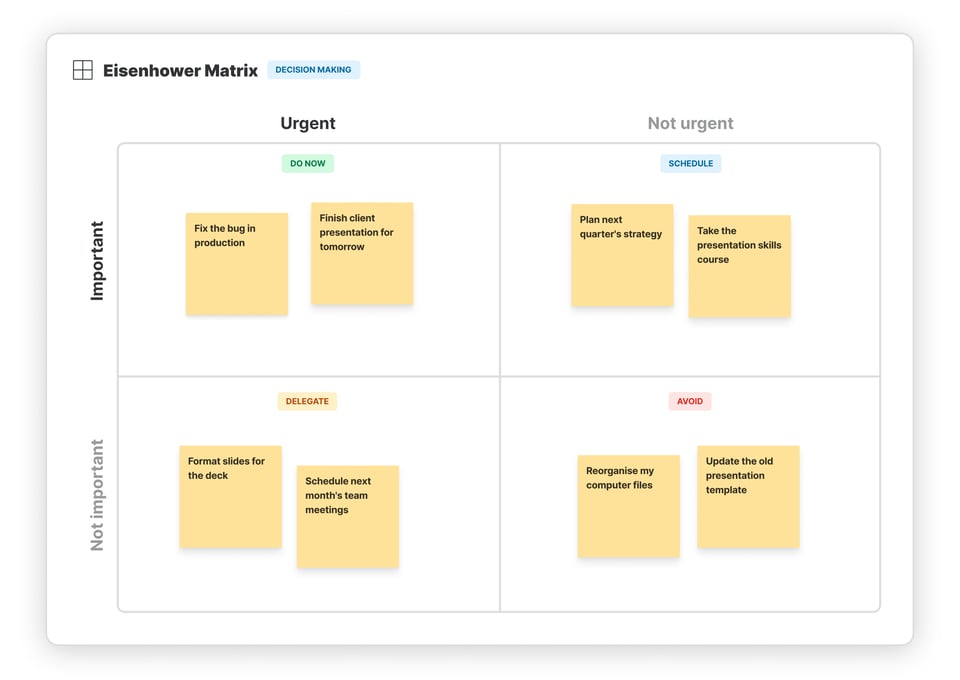
The matrix gives you four quadrants based on the urgency and importance.
Example of the Eisenhower matrix. Want this template in PDF, Miro and Notion along many others? Get it with Untools Vault.
1. Urgent and Important: Do now
Pressing deadlines and crises that need to be handled immediately. For example, a production bug affecting customers, a client presentation due tomorrow, or a responding to a job offer.
The challenge with this quadrant is that spending too much time on such tasks can lead to lots of stress. You can’t always eliminate these tasks but it’s good to try preventing them from dominating your to-do list.
2. Important but not urgent: Schedule
This quadrant is where the most valuable work happens. Tasks that contribute to your long-term goals like strategic thinking, learning new skills, working on large projects.
Schedule these tasks in your calendar and treat them like meetings you cannot cancel. Investing time into this quadrant can actually help you reduce tasks from quadrant 1.
3. Urgent but not important: Delegate or minimise
Tasks that feel pressing but don’t actually contribute to your goals. Many emails, meetings without clear agendas, administrative work.
This is where the mere-urgency effect can lead to doing busy-work that feels productive but without actually making any real progress.
Delegate what you can, try to automate some of these tasks or batch them together when you’re low on energy and can’t tackle the important tasks.
4. Not urgent and not important: Eliminate
Time-wasting activities that don't contribute anything meaningful. Social media scrolling, unnecessary meetings you attend out of habit, busywork that makes you feel productive without achieving anything.
Be honest with yourself about which activities belong here and cut them out. If you need downtime, choose activities that actually recharge you—that's different from mindless distraction.
Balance the quadrants
The key to using the Eisenhower matrix efficiently is to prevent quadrants 1 and 3 from dominating. Strive for more balance and especially spending more time in quadrant 2.
Common challenges
Here are a few common challenges you might face when applying this framework and how to deal with them.
Everything feels urgent and important
If this happens regularly, you're probably facing one of these issues: saying yes to too much, not planning ahead (many quadrant 1 tasks could be prevented with better quadrant 2 planning), or your workload is genuinely unsustainable and needs a conversation with your manager.
Treating everything with a deadline as quadrant 1
Not everything with a deadline is both urgent and important. Try asking questions like: "When does this actually need to be done?" and "What's the impact if this takes an extra day?"
Never delegating
If you find yourself with too many quadrant 3 tasks, something has to give. What could you hand off to someone else? What can be automated? What could you simply stop doing?
Avoid the trap of busy-work with the Eisenhower matrix
The Eisenhower matrix helps you make conscious choices about where your time goes. If you're always busy but not making progress on what matters, start using it to spot the difference between urgent busy-work and important deep work. That awareness is what makes the difference.


Add a comment: