
Stranded in England
In The Meeting Place: Māori and Pākehā Encounters, 1642-1840 (republished in a new edition by Bridget Wiliams Books last year) one of the topics I explored was the meeting of Māori and Europeans outside Aotearoa. It is a theme I have written about before. The remarkable extent of Māori travel to the outside world in the pre-1840 era is perhaps underappreciated still (though Eugene Bingham’s new book on Ngāpuhi rangatira Te Pahi’s journeys to New South Wales and elsewhere should help).
In this post drawn from The Meeting Place I focus on the story of two men from the Hauraki district whose ultimate fate is still far from clear. They had been exploited and abandoned far from home, then received remarkable assistance from the community they found themselves stranded in, but what became of them thereafter is unknown as is more information on their identities.
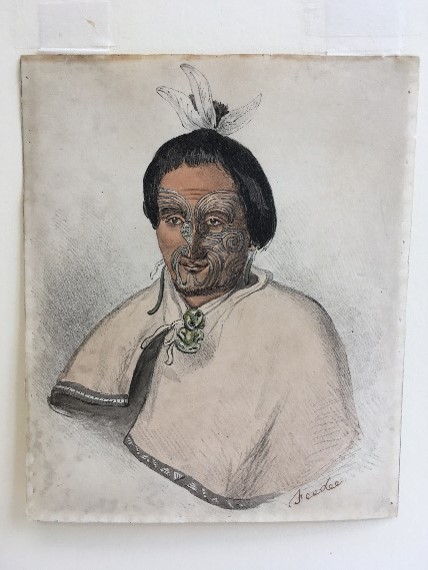
In 1829 portraits were commissioned of two Māori men then in England. ‘Feedee’ (probably Te Whiti) was described as aged about fifty and a chief of ‘Howdruckee’ (Hauraki). A further note indicated that he belonged to the ‘Nar-te-mar-lu Tribe’ (Ngāti Maru). ‘Adic Hator’ was aged about twenty-three and the nephew of Te Whiti. His name might have been either (E) Te Kato or (E) Te Hato. George Craik wrote that the pair had visited England ‘to observe the manners and condition of the people’ and that, having no other funds, they had been obliged to tour the various towns performing haka and displaying their weapons of war in ‘native dress’ in return for payment. But when they reached Derby both men succumbed to the measles. Abandoned in the town by their promoter, who had fleeced them of the profits, the pair were left reliant upon the charity of the people of England.
Other evidence indicates that the two men’s journey to England was not planned and points to the extraordinary lengths the people of Derby went to in order to care for the men and return them home. According to a report published in the Derby Mercury newspaper, Te Whiti was brother to the chief of his tribe, who had fallen in battle with Hongi Hika (possibly making him brother to Te Hīnaki). His tribe scattered and cut off, Te Whiti and his nephew had engaged with the captain of a ship whose crew had deserted to help sail her to Sydney in return for a musket each. But instead he sailed for South America, where he was obliged to leave the ship and a new captain had come on board to complete the voyage to England. Soon after arriving in London, Te Whiti and his relative had agreed to work their passage back to New Zealand on another ship. A man called Johnson, but whose real name was Joseph Riles, was on board and asked them to perform ‘the war whoop and other customs of their country’. He told them he was going to New Zealand in a fine new ship of his own and would give them a shilling if they came with him.
They agreed and went onshore with Johnson. About a week later he told the two that ‘they had better see a little more of England before they sailed, and that he would accompany them into the country’: ‘From London he took them to Bristol, and exhibited them, contrary to their inclination, as a show, at the September fair, in that city. From Bristol he proceeded with them through several parts of Wales, Gloucester, Worcester, Stroud, Walsall, and Burton-on-Trent, still exhibiting them at each place where they halted. This occupied a period of nearly three years.’
Quite how they had survived the best part of three winters in England is difficult to know given many Māori visitors struggled to make it through one. When the group reached Derby in November 1829 another exhibition opened under the now familiar pretence that the two New Zealanders were travelling for their own ‘improvement’, relying upon funds raised through such performances in order to finance their travels, and that Johnson had accompanied them from New Zealand.