
Robin Hyde and Ōrākei (Part II)
In December I brought you Robin Hyde’s July 1937 piece ‘Who Says the Orakei Maoris Must Go?’. For this second and final instalment I have copied and transcribed her article published a month later, ‘No More Dancing at Orakei’. In it, Hyde describes the efforts of many to stop the eviction of Ngāti Whātua from Ōrākei, including prominent poets A.R.D. Fairburn and R.A.K. Mason, members of the clergy and others. Tellingly, she also lists some of those who had failed to turn out in support, including doctors, and ‘the entire body of the Auckland University College professorial staff’.

Hyde also reminds readers of the evidence outlined in her previous article from the 1930 Acheson inquiry that Ngāti Whātua had been promised they would be permitted to retain their papakainga lands. By the time of Hyde’s latest article, Prime Minister Michael Joseph Savage had returned to New Zealand but it was still unclear what his final decision on Ōrākei would be. But Hyde was not simply standing on the sidelines as an observer. She had been elected secretary of the Friends of Ōrākei Association and was actively involved in the efforts to save the village. (In the piece below, she is, on my reading, both the ‘avowed Socialist’ and one of the two women who spend hours discussing the case after delivering their submission to the Prime Minister’s private secretary).
As noted in my previous post, although Savage did order a halt to the eviction of Ngāti Whātua from Ōrākei, the reprieve was merely a temporary one. By the early 1950s they would be removed entirely, their landholdings reduced to a quarter-acre urupā. It would take many decades more of struggle before that would be reversed.
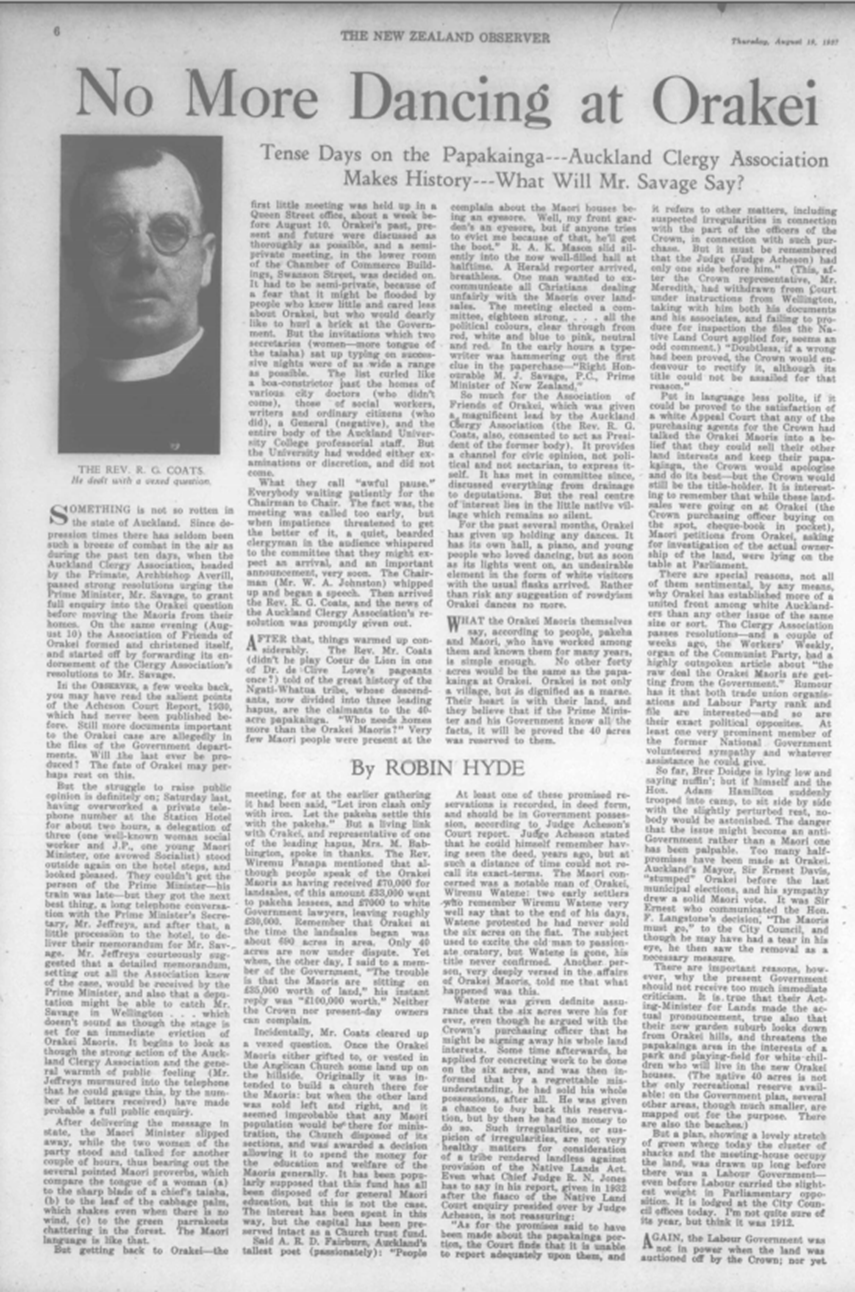
‘No More Dancing at Orakei’, New Zealand Observer, 19 August 1937
Something is not so rotten in the state of Auckland. Since depression times there has seldom been such a breeze of combat in the air as during the past ten days, when the Auckland Clergy Association, headed by the Primate, Archbishop Averill, passed strong resolutions urging the Prime Minister, Mr. Savage, to grant full enquiry into the Orakei question before moving the Maoris from their homes. On the same evening (August 10) the Association of Friends of Orakei formed and christened itself, and started off by forwarding its endorsement of the Clergy Association’s resolutions to Mr. Savage.
In the OBSERVER, a few weeks back, you may have read the salient points of the Acheson Court Report, 1930, which had never been published before. Still more documents important to the Orakei case are allegedly in the files of the Government departments. Will the last ever be produced ? The fate of Orakei may perhaps rest on this.
But the struggle to raise public opinion is definitely on ; Saturday last, having overworked a private telephone at the Station Hotel for about two hours, a delegation of three (one well-known woman social worker and J.P., one young Maori Minister, one avowed Socialist) stood outside again on the hotel steps, and looked pleased. They couldn’t get the person of the Prime Minister—his train was late—but they got the next best thing, a long telephone conversation with the Prime Minister’s Secretary, Mr. Jeffreys, and after that, a little procession to the hotel, to deliver their memorandum for Mr. Savage. Mr. Jeffreys courteously suggested that a detailed memorandum, setting out all the Association knew of the case, would be received by the Prime Minister, and also that a deputation might be able to catch Mr. Savage on Wellington . . . which doesn’t sound as though the stage is set for an immediate eviction of Orakei Maoris. It begins to look as though the strong action of the Auckland Clergy Association and the general warmth of public feeling (Mr. Jeffreys murmured that he could gauge this by the number of letters received) have made probable a full public enquiry.
After delivering the message in state, the Maori Minister slipped away, while the two women talked for another couple of hours, thus bearing out the several pointed Maori proverbs, which compare the tongue of a woman (a) to the sharp blade of a chief’s taiaha, (b) to the leaf of the cabbage palm, which shakes even when there is no wind, (c) to the green parakeets chattering in the forest. The Maori language is like that.
But getting back to Orakei—the first little meeting was help up in a Queen Street office, about a week before August 10. Orakei's past, present and future were discussed as thoroughly as possible, and a semi-private meeting, in the lower room of the Chamber of Commerce Buildings, Swanson Street, was decided on. It had to be semi-private, because of a fear that it might be flooded by people who knew little and cared less about Orakei, but who would dearly like to hurl a brick at the Government. But the invitations which two secretaries (women—more tongue of the taiaha) sat up typing on successive nights were of as wide a range as possible. The list curled like a boa-constrictor past the homes of various city doctors (who didn’t come), those of social workers, writers and ordinary citizens (who did), a General (negative), and the entire body of the Auckland University College professorial staff. But the University had wedded either examinations or discretion, and did not come.
What they call "awful pause.” Everybody waiting patiently for the Chairman to Chair. The fact was, the meeting was called too early, but when impatience threatened to get the better of it, a quiet, bearded clergyman in the audience whispered to the committee that they might expect an arrival, and an important announcement, very soon. The Chairman (Mr. W. A. Johnston) whipped up and began a speech. Then arrived the Rev. R. G. Coats, and the news of the Auckland Clergy Association's resolution was promptly given out.
After that, things warmed up considerably. The Rev. Mr. Coats (didn’t he play Coeur de Lion in one of Dr. de Clive Lowe’s pageants once ?) told of the great history of the Ngati-Whatua tribe, whose descendants, now divided into three leading hapus, are the claimants to the 40-acre papakainga. "Who needs homes more than the Orakei Maoris ?” Very few Maori people were present at the meeting, for at the earlier gathering it had been said, “Let iron clash with iron. Let the pakeha settle this with the pakeha.” But a living link with Orakei, and representative of one of the leading hapus, Mrs. Babbington, spoke in thanks. The Rev. Wiremu Panapa mentioned that although people speak of the Orakei Maoris as having received £70,000 for landsales, of this amount £33,000 went to pakeha lessees, and £7000 to white Government lawyers, leaving roughly £30,000. Remember that Orakei at the time the landsales began was about 690 acres in area. Only 40 acres are now under dispute. Yet when, the other day, I said to a member of the Government, “The trouble is that the Maoris are sitting on £35,000 worth of land,” his instant reply was “£100,000 worth.” Neither the Crown nor present-day owners can complain.
Incidentally, Mr. Coats cleared up a vexed question. Once the Orakei Maoris either gifted to, or vested in the Anglican Church some land up on the hillside. Originally it was intended to build a church there for the Maoris: but when the other land was sold left and right, and it seemed improbable that any Maori population would be there for ministration, the Church disposed of its sections, and was awarded a decision allowing it to spend the money for the education and welfare of Maoris generally. It has been popularly supposed that this fund has all been disposed of for general Maori education, but this is not the case. The interest has been spent in this way, but the capital has been preserved intact as a Church trust fund.
Said A. R. D. Fairburn, Auckland’s tallest poet (passionately): “People complain about the Maori houses being an eyesore. Well, my front garden’s an eyesore, but if anyone tries to evict me because of that, he’ll get the boot.” R. A. K. Mason slid silently into the now well-filled hall at halftime. A Herald reporter arrived, breathless. One man wanted to excommunicate all Christians dealing unfairly with the Maoris over landsales. The meeting elected a committee, eighteen strong, . . . all the political colours, clear through from red, white and blue to pink, neutral and red. In the early hours a typewriter was hammering out the first clue in the paperchase—"Right Honourable M. J. Savage, Prime Minister of New Zealand.”
So much for the Association of Friends of Orakei, which was given a magnificent lead by the Auckland Clergy Association (the Rev. R. G. Coats, also, consented to act as President of the former body). It provides a channel for civic opinion, not political and not sectarian, to express itself. It has met in committee since, discussed everything from drainage to deputations. But the real centre of interest lies in the little native village which remains so silent.
For the past several months, Orakei has given up holding any dances. It has its own hall, a piano and young people who loved dancing, but as soon as its lights went on, an undesirable element in the form of white visitors with the usual flasks arrived. Rather than risk any suggestion of rowdyism, Orakei dances no more.
What the Orakei Maoris themselves say, according to people, pakeha and Maori, who have worked among them and known them for many years, is simple enough. No other forty acres would be the same as the papakainga at Orakei. Orakei is not only a village, but is dignified as a marae. Their heart is with their land, and they believe that if the Prime Minister and his Government know all the facts, it will be proved the 40 acres was reserved for them.
At least one of these promised reservations is recorded, in deed form, and should be in Government possession, according to Judge Acheson’s Court report. Judge Acheson stated that he could himself remember having seen the deed, years ago, but at such a distance of time could not recall its exact terms. The Maori concerned was a notable man of Orakei, Wiremu Watene: two early settlers who remember Wiremu Watene very well say that to the end of his days, Watene protested he had never sold the six acres on the flat. The subject used to excite the old man to passionate oratory, but Watene is gone, his title never confirmed. Another person, very deeply versed in the affairs of Orakei Maoris, told me that what happened was this.
Watene was given definite assurance that the six acres were his for ever, even though he argued with the Crown’s purchasing officer that he might be signing away his whole land interests. Some time afterwards, he applied for concreting work to be done on the six acres, and was then informed that by a regrettable misunderstanding, he had sold his whole possessions, after all. He was given a chance to buy back this reservation, but by then he had no money to do so. Such irregularities, or suspicion of irregularities, are not very healthy matters for consideration of a tribe rendered landless against provision of the Native Lands Act. Even what Chief Judge R.N. Jones has to say in his report, given in 1932 after the fiasco of the Native Land Court enquiry presided over by Judge Acheson, is not reassuring:
“As for the promises said to have been made about the papakainga portion, the Court finds that it is unable to report adequately upon them, and it refers to other matters, including suspected irregularities in connection with the part of the officers of the Crown, in connection with such purchase, but it must be remembered that the Judge (Judge Acheson) had only one side before him.” (This, after the Crown representative, Mr. Meredith, had withdrawn from Court under instructions from Wellington, taking with him both his documents and his associates, and failing to produce for inspection the files the Native Land Court applied for, seems an odd comment.) “Doubtless, if a wrong had been proved, the Crown would endeavour to rectify it, although its title could not be assailed for that reason.”
Put in language less polite, if it could be proved to the satisfaction of a white Appeal Court that any of the purchasing agents for the Crown had talked the Orakei Maoris into a belief that they could sell their other land interests and keep their papakainga, the Crown would apologise and do its best—but the Crown would still be the title-holder. It is interesting to remember that while these land-sales were going on at Orakei (the Crown purchasing officer buying on the spot, cheque-book in pocket), Maori petitions from Orakei, asking for investigation of the actual ownership of the land, were lying on the table at Parliament.
There are special reasons, not all of them sentimental, by any means, why Orakei has established more of a united front among white Aucklanders than any other issue of the same size or sort. The Clergy Association passes resolutions—and a couple of weeks ago, the Workers’ Weekly, organ of the Communist Party, had a highly outspoken article about "the raw deal the Orakei Maoris are getting from the Government.” Rumour has it that both trade union organisations and Labour Party rank and file are interested
— and so are their exact political opposites. At least one very prominent member of the former National Government volunteered sympathy and whatever assistance he could give.